31st Session of the International Seabed Authority (part II)
The 31st Session of the International Seabed Authority

The International Seabed Authority (ISA; FrenchAutorité internationale des fonds marins) is a Kingston, Jamaica-based intergovernmental body of 171 Member States plus the European Union.

It was established under the 1982 UN Convention on the Law of the Sea (UNCLOS) and its 1994 Agreement on Implementation. The ISA’s dual mission is to authorize and control the development of mineral related operations in the international seabed, which is considered the “common heritage of all mankind“, and to protect the ecosystem of the seabed, ocean floor and subsoil in “The Area” beyond national jurisdiction. The ISA is responsible for safeguarding the international deep sea, defined as waters below 200 meters (656 feet), where photosynthesis is hampered by inadequate light. Governing approximately half of the total area of the world’s oceans, the ISA oversees activities that might threaten biological diversity and harm the marine environment. Since its inception in 1994, the ISA has approved over two dozen ocean floor mining exploration contracts in the Atlantic, Pacific and Indian Oceans. The majority of these contracts are for exploration in the Clarion–Clipperton zone between Hawaii and Mexico, where polymetallic nodules contain copper, cobalt and other minerals essential for powering electric batteries. To date, the Authority has not authorized any commercial mining contracts as it continues to deliberate over regulations amid global calls for a moratorium on deep sea mining. Scientists and environmentalists warn that such mining could wreak havoc on the ocean, a crucial carbon sink and home to rare and diverse species. Funded by UNCLOS members and mining contractors, the Authority operates as an autonomous international organization with its own Assembly, Council, and Secretariat. The current secretary-general of the agency is Leticia Carvalho, whose four-year term began on 1 January 2025.
Links:
31st Session of the International Seabed Authority

Part I

Brandbrief aangaande vergunningaanvraag diepzeemijnbouw buiten het kader van de Internationale Zeebodemautoriteit (ISA)

Treaty on the Prohibition of Nuclear Weapons – adopted (2017) 2026

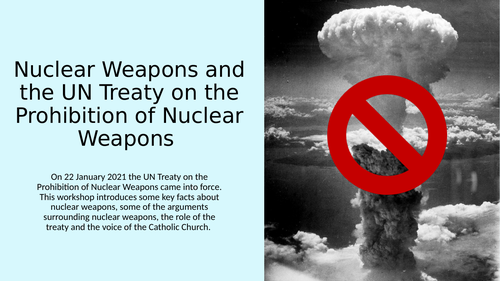
The Treaty on the Prohibition of Nuclear Weapons (TPNW), or the Nuclear Weapon Ban Treaty, is the first legally binding international agreement to prohibit nuclear weapons, with the ultimate goal being their total elimination.

It was adopted on 7 July 2017, opened for signature on 20 September 2017, and entered into force on 22 January 2021. For those states that are party to it, the treaty prohibits the development, testing, production, stockpiling, stationingtransfer, use and threat of use of nuclear weapons, as well as assistance and encouragement to the prohibited activities. For nuclear-armed states joining the treaty, it provides for a time-bound framework for negotiations leading to the verified and irreversible elimination of its nuclear weapons programme. A mandate adopted by the United Nations General Assembly on 23 December 2016 scheduled two sessions for negotiations: 27 to 31 March and 15 June to 7 July 2017. The treaty passed on schedule on 7 July with 122 in favour, 1 against (Netherlands), and 1 official abstention (Singapore). States that have joined the treaty are typically also members of nuclear-weapon-free zones. None of the states that possess nuclear weapons have joined the treaty, nor have any of the states that participate in nuclear sharing or extended nuclear deterrence relationships, including NATO membersAustraliaBelarusJapan, and South Korea.

Links:
United Nations Conference to Negotiate a Legally Binding Instrument to Prohibit Nuclear Weapons, Leading Towards their Total Elimination

Agenda 07-07-2023 – Treaty on the Prohibition of Nuclear Weapons | The ban treaty, two years after: A ray of hope for nuclear disarmament

48th session of the World Heritage Committee 2026

The World Heritage Committee meets once a year for an ordinary session to discuss the management of existing World Heritage Sites, and accept nominations by countries.

Extraordinary meetings can be convened at the request of two-thirds of the state members. Meetings are held within the territory of state members of the World Heritage Committee at their invitation. Rotation between regions and cultures is a consideration for selection and the location for the next session is chosen by the committee at the end of each session. The World Heritage Committee is a committee of the United Nations Educational, Scientific and Cultural Organization that selects the sites to be listed as UNESCO World Heritage Sites, including the World Heritage List and the List of World Heritage in Danger, defines the use of the World Heritage Fund and allocates financial assistance upon requests from States Parties. It comprises representatives from 21 state parties that are elected by the General Assembly of States Parties for a four-year term. These parties vote on decisions and proposals related to the World Heritage Convention and World Heritage List. According to the World Heritage Convention, a committee member’s term of office is six years. However many States Parties choose to voluntarily limit their term to four years, in order to give other States Parties an opportunity to serve. All members elected at the 15th General Assembly (2005) voluntarily chose to reduce their term of office from six to four years. Deliberations of the World Heritage Committee are aided by three advisory bodies, the IUCNICOMOS and ICCROM.

Links:
48th session of the World Heritage Committee

2026 BRICS Summit

BRICS 2026

The 18th BRICS Summit is an upcoming international summit of the BRICS nations, scheduled to be hosted by India in 2026 as part of its BRICS chairmanship.

BRICS is an intergovernmental organization comprising BrazilRussiaIndiaChinaSouth Africa, and additional member states admitted in recent years. The BRICS summit is held annually, with the chairmanship rotating among member countries. Between 14 and 15 May 2026, the foreign ministers of BRICS member states met in DelhiIndia, ahead of the leaders’ summit.

Links:
2026 BRICS Summit

#nzon2026 Noorderzon Festival of Performing Arts & Society 2026

Noorderzon

Noorderzon is een jaarlijkse elfdaagse internationale kunstenmanifestatie die plaatsvindt in het Noorderplantsoen en op diverse nabijgelegen locaties in en rondom het centrum van Groningen.

Noorderzon combineert hedendaagse podiumkunsten met een toegankelijk zomerfestival in het Noorderplantsoen. Bezoekers komen niet alleen voor de culturele voorstellingen, maar ook voor de foodtrucks en het samenzijn in het park. Een bijzonder kenmerk van Noorderzon zijn de containervoorstellingen, kleinschalige optredens in compacte ruimtes die populair zijn bij bezoekers vanwege hun intieme sfeer, deze voorstellingen zijn een vast onderdeel van het festivalprogramma.

Links:
Noorderzon

Studium Generale op Noorderzon

2026-07-06, Lief dagboek

Maandag; Wat eten we vandaag?; WK voetbal corrupt; Wespen; Day of Cooperatives; Wereld Zoönosen Dag; Global Dialogue on AI Governance; Luchtalarm.

Deze afbeelding heeft een leeg alt-attribuut; de bestandsnaam is dagboek.png

Wat eten we vandaag?:

Klik op afbeelding voor origineel

Knipselkrant:


Agenda:

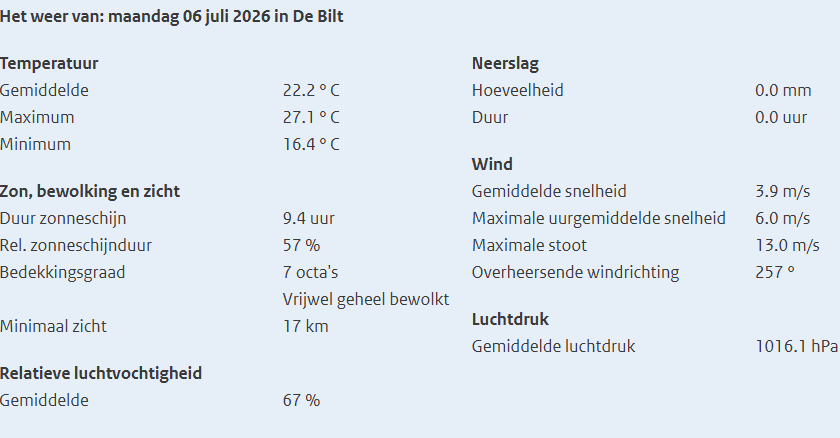
Weer:

Links:
In de geschiedenis

Waarschuwingsstelsel sirene en NL-alert test / #Luchtalarm – dit is een noodgeval! / #Ballenalarm

In heel Nederland klinkt op elke eerste maandag van de maand om 12:00 het luchtalarm van het waarschuwingsstelsel of waarschuwings- en alarmeringssysteem (WAS), behalve op feestdagen, Nationale Dodenherdenking of bij andere speciale gebeurtenissen.

De test duurt 1 minuut en 26 seconden. In juni en december wordt tevens een NL-Alert testbericht verstuurd naar mobiele (GSM) telefoons. Het WAS is een netwerk van 4278 sirenes in Nederland die draadloos en onafhankelijk van elkaar aangezet kunnen worden vanuit de alarmcentrale van de regionale brandweer. De sirenes worden gebruikt om te waarschuwen via een luchtalarm voor (dreigend) gevaar, met name indien er gevaarlijke stoffen in de lucht aanwezig (kunnen) zijn. Het systeem is ontwikkeld door Siemens, en gebruikt elektronische sirenes op basis van de Federal Signal Modulator 2008 en 1004. Het waarschuwingsstelsel is eigendom van het Ministerie van Justitie en Veiligheid, en is op 3 juni 1998 in gebruik genomen. De bevolking is van tevoren geïnstrueerd om in het geval dat de sirene afgaat naar binnen te gaan, ramen en deuren te sluiten en radio of televisie aan te zetten. Op de aangewezen calamiteitenzenders kan de overheid verdere aanwijzingen geven, bijvoorbeeld dat een gebied geëvacueerd zal worden.

Extinction Rebellion maakt er met de actie Luchtalarm – dit is een noodgeval! telkens met kleurrijke vlaggen en banners een mooi maar bloedserieus moment van. Met deze actie wil Extinction Rebellion NL aandacht vragen voor de klimaatcrisis en de biodiversiteitscrisis en duidelijk maken dat het al vijf over twaalf is. Sluit je voor een paar minuten aan bij deze actie en laat zien dat je ook vindt dat de overheid in actie moet komen om een leefbare toekomst voor ons en onze kinderen te waarborgen. Kom langs en doe mee! Iedereen is welkom. Neem borden mee, we delen tijdens de actie ook patches uit waarmee we onze boodschap kunnen uitdragen.

‘Het Ballenalarm‘ is een ludieke actie waarmee de Stichting Zaadbalkanker vraagt om extra aandacht voor zaadbalkanker, ook wel teelbalkanker genoemd. Het idee is dat mannen op de eerste maandag van de maand om 12:00 – als de maandelijkse alarmsirenes loeien – hun teelballen checken, en dit elke maand opnieuw. Dit moet leiden tot de vroegtijdige ontdekking van zaadbalkanker, de meest voorkomende kanker bij mannen tussen de 15 en 40 jaar.

Links:
crisis.nl

Wanneer wordt de sirene getest?

Veiligheidsregio’s: geen goed alternatief voor luchtalarm na 2027 is onacceptabel

Global Dialogue on AI Governance – first session

Global Dialogue on AI Governance

The first session of the Global Dialogue on AI Governance will be held on 6 and 7 July 2026 in Geneva.

The Global Digital Compact (A/RES/79/1), adopted at the 2024 Summit of the Future, set out a shared vision for an open, safe, and inclusive digital future. Among its commitments was the creation of Global Dialogue on AI Governance to serve as an inclusive space within the United Nations for governments and stakeholders to deliberate on today’s most pressing AI challenges. The United Nations General Assembly established the Global Dialogue on AI Governance in Resolution A/RES/79/325, following intergovernmental negotiations and broad consultations with diverse stakeholders.

Links:
Global Dialogue on AI Governance

Roadmap

From AI to ‘killer robots’: UN chief issues urgent governance call

Agenda – We Must Act Now – publication