Stop massale kwekerijen voor octopusvlees – petitie

Help de octopus

De strijd tegen het kweken van octopussen is nog niet voorbij.

De hyperintelligente octopus is een prachtig en fascinerend dier, maar zijn welzijn is in gevaar. Want nog altijd zijn er plannen om hem op te sluiten in massale kwekerijen voor octopusvlees. Na jaren van actievoeren is het gelukt om de bouw van de eerste octopuskwekerij ter wereld op Gran Canaria tegen te houden, maar het risico op een kwekerij is niet weg. In Spanje, Mexico en Japan zijn er nog altijd plannen om een octopuskwekerij te bouwen. Opsluiting in een kale bak in een massale kwekerij zou leiden tot ernstig dierenleed. Ook bestaat er geen slachtmethode met verdoving waarbij het dier zo min mogelijk pijn lijdt. Bovendien zou deze industrie leiden tot milieuvervuiling en een nog grotere druk leggen op de overbeviste zeeën. De dieren zouden namelijk gevoerd worden met miljoenen uit het wild gevangen vissen. Een vreselijke vorm van voedselverspilling. En voor gemeenschappen die voor hun voedsel van deze vissen afhankelijk zijn, bijvoorbeeld aan de westkust van Afrika, neemt het risico op honger toe. Deze problemen gelden niet alleen voor octopuskwekerijen, maar ook voor andere carnivore aquacultuur (industrie waarin vleesetende waterdieren worden gehouden), zoals tonijnen. Om een einde te maken aan het dierenleed en om de biodiversiteit te beschermen, roepen wij overheden op om octopuskweek te verbieden en de aquacultuur van andere vleesetende waterdieren te beperken. Laat ook je stem horen en teken de petitie.

Links:
Help de octopus

Een stad voor iedereen? – publicatie

Een stad voor iedereen?

O&S-onderzoeker Hester Booi lichtte tijdens het O&S-symposium ‘Wie komt, wie blijft, wie gaat?’ op 8 oktober 2026, met als hoofdthema demografie, de belangrijkste conclusies uit het rapport ‘Een stad voor iedereen?’ toe en de Amsterdamse wethouder Scholtes nam dit rapport in ontvangst.

Ook gingen we dieper in op de gevolgen van veranderingen in de bevolkingssamenstelling. Volgens de bevolkingsprognoses van Onderzoek & Statistiek (O&S) blijft Amsterdam de komende decennia groeien tot naar verwachting 1,08 miljoen inwoners in 2050. Maar de ontwikkelingen in het aantal geboortes en de binnenlandse en buitenlandse migratie zijn onzeker en worden beïnvloed door externe factoren en politieke keuzes. O&S heeft een aantal varianten gemaakt voor de Amsterdamse bevolkingsprognose waarin we hebben gevarieerd met de aannames over de toekomstige bevolkingsontwikkeling.

Links:
Een stad voor iedereen?

Van 28.000 naar 66.000 80-plussers: Amsterdam moet zich voorbereiden op vergrijzende stad

Groei van de stad naar 1,08 miljoen inwoners in 2050, minder gezinnen en veel vergrijzing

#NobelPrize Nobel Peace Prize – announcement 2026 (TV webcast)

The Nobel Peace Prize for 2026 goes to a person who with exceptional courage and integrity has led the way towards a more comprehensive global legal order. This year’s laureate has been instrumental in ensuring that war crimes, crimes against humanity and genocide are prosecuted.

The Norwegian Nobel Committee has decided to award the Nobel Peace Prize for 2026 to Navanethem “Navi” Pillay for her efforts to promote peace and international law. Navi Pillay’s commitment to universal legal principles and her firm moral compass are constants in a long career. Born into a family of Indian Tamil origin under apartheid in Durban, South Africa, Pillay became a lawyer and legal pioneer, confronting deep structural discrimination, segregation and exclusion. A common thread runs from her early work defending Nelson Mandela and others who stood up against apartheid to her service as a judge in some of the key international court cases of our time. This year’s laureate has significantly enlarged the scope and impact of international law. She has served as a judge on the High Court in South Africa, the International Criminal Tribunal for Rwanda and the International Criminal Court. She was the United Nations High Commissioner for Human Rights and, until recently, she chaired the UN Independent International Commission of Inquiry on the Occupied Palestinian Territory. Today Navi Pillay is a judge on the International Court of Justice in the case where Myanmar stands accused of genocide. In historic international court cases, she has shown that legal measures can help prevent acts of war and violence. Navi Pillay has also contributed to strengthen the institutions of international law. Her independence, expertise and steadfastness have made her one of the most respected international jurists of our time. The first Nobel Peace Prize was awarded 125 years ago. Already then, the Norwegian Nobel Committee underscored the importance of resolving conflicts through international law – a theme that has remained prominent throughout the history of the peace prize.

The reach of international law expanded after the Second World War, in particular with the creation of the UN institutions. The key insight was that lasting peace must be built on legal principles, not on the will of the strong or a fragile balance of power. Additional legal mechanisms were introduced in the post-war decades, and momentum picked up further after the end of the Cold War. However, the rules-based international order has never been perfect. The greatest powers have often evaded responsibility. In practice, cases brought under international law have produced different results depending on who is the perpetrator and who is the victim. Nonetheless, we have seen that more and more conflicts are being addressed through diplomacy, treaties and legal mechanisms, rather than threats, violence and warfare. Leaders and populations alike have come to the same conclusion: international law is a foundation for a more peaceful world. At a time of existential challenges – including more wars and conflicts than the world has seen in a long time – international law is no longer just a supplement to peace and security. It is an absolute necessity. And yet, the system of international law is under tremendous pressure, and its institutions are under attack. We see a shift towards power politics at the expense of legal frameworks and global respect for law and justice. Whenever might overtakes right, it undermines stability, trust and peaceful co-existence. In awarding this year’s Nobel Peace Prize, the Norwegian Nobel Committee wants to remind the world that the rule of law – national and international – underpins the system we have set up to ensure peace and resolve conflicts non-violently. Peace requires justice. History has shown that a world operating without the rule of law is unjust, unwise and inhumane.

The judges – those who guard the thin red line between order and chaos – are therefore highly deserving of our praise. But today, as these same judges are sanctioned, and their institutions are attacked, we need people of courage, vision and determination – qualities that Navi Pillay demonstrates in her work on the bench. Navi Pillay has held states and national leaders accountable and brought hope to victims of violence and conflict. In all the positions she has held, she has stressed the responsibility of individuals and states to comply with the rule of law. She has also helped define the relevant norms and legal principles. When the International Criminal Tribunal for Rwanda established that rape and sexual violence could constitute a crime against humanity – as well as genocide – her influence was a significant factor. In the same case, Ms Pillay was instrumental in a separate legal breakthrough: for the first time, a defendant faced charges of incitement to commit genocide purely on the basis of spreading propaganda. The Nobel Peace Prize for 2026 springs directly from Alfred Nobel’s will. Navi Pillay strengthens fraternity between nations and – by systematically advancing the use of tribunals for peace and justice – she provides substance, direction and motivation for peace conferences in their modern form. Navi Pillay is one of the great defenders of international legal principles in our time. Her distinguished career reminds us of the need to support, fortify and expand the global rule of law. Navi Pillay’s commitment to justice and human dignity is a source of hope and inspiration to all who seek to bring about a more peaceful world.

Links:
Nobel Peace Prize for 2026

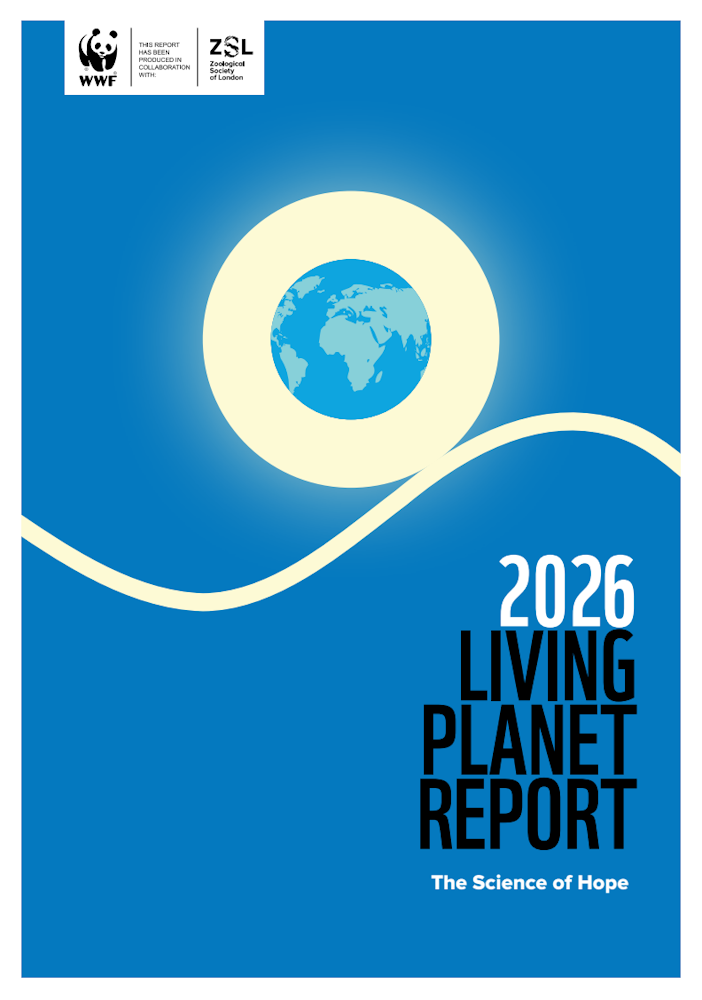
Living Planet Report 2026

Living Planet Report 2026

For three decades, WWF’s Living Planet Report has charted the shocking decline in the state of nature, the latest edition shows that wildlife continues to be lost at an alarming rate.

But it also finds signs of hope: when we act together, nature can recover. And change can happen quicker than we think. Like every other species on Earth, people depend on nature. Yet we are destroying the living systems that sustain us. Wildlife populations are plummeting. The size of populations of wild species fell by 73% on average between 1970 and 2022, according to the Living Planet Index. This is based on scientific monitoring data from 35,803 populations and 5,790 species of amphibians, birds, fishes, mammals, and reptiles. Freshwater species are faring worst, with average population sizes plunging -85%. At a regional level, the steepest declines since 1970 have been recorded in Latin America and the Caribbean (-95%), Africa (-80%), and Asia and the Pacific (-49%). Nature is in crisis – but there are signs of hope. While the headline statistics make grim reading, not all species are declining. In fact, around half the populations in the Living Planet Index are stable or even increasing. Halting and reversing the loss of nature is possible.

Links:
Living Planet Report

Hoe gaat het met de natuur wereldwijd?

Solomon Linda – sterfdag (1962) 2026

Solomon Popoli Linda (1909 – Soweto, Johannesburg, 8 oktober 1962) was een Zuid-Afrikaanse musicus, zanger en componist van Zoeloe-afkomst.

Als herdersjongetje schreef hij het lied “Mbube” (letterlijk vertaald: leeuw) om de leeuw(koning) te eren. Het nummer zou later bekend komen te staan onder de naam The Lion Sleeps Tonight en werd vele malen gecoverd. De originele versie werd oorspronkelijk a capella gezongen. Solomon Linda werd ondanks het succes van het nummer nooit rijk en is in armoede gestorven.

Links:
The Sad Truth Behind The Lion Sleeps Tonight

The Lion Sleeps Tonight – OVT VPRO

The Story of SOLOMON LINDA [English CC]

World Cephalopod Awareness Days / Wereld Inktvis dagen 2026

Every year from the 8th to the 12th of October, International Cephalopod Awareness Days come around to teach the world about cephalopods, this event is all about celebrating and sharing how fascinating and incredible they are!

Cephalopods are a class of marine invertebrates that are easy to recognize by all their arms and tentacles. They are part of the Phylum Mollusca, which means they’re related to other animals with soft bodies and shells, like snails and clams. Unlike the other mollusks, though, cephalopods have large brains and are known for their intelligence. Cephalopods are also interesting because they have three hearts and blue blood. They have highly developed eyes, and they have an amazing ability to camouflage because their skin can quickly change color and texture.

Links:
World Cephalopod Awareness Days

The Cephalopod Page

Stop massale kwekerijen voor octopusvlees – petitie

2026-10-07, Lief dagboek

Woensdag; Wat eten we vandaag?; Natuurlijk kan het slimmer; COA Ter Apel; Microsoft update; Wist Netanyahu van aanslagen 7 oktober of niet?; World Cotton Day; Werelddag voor Fatsoenlijk Werk; Kanker in 2045; The Linux Foudation Open Source Summit; Frankfurter Buchmesse; Nobel Prize in Chemistry; Buitenspeelalarm.

Deze afbeelding heeft een leeg alt-attribuut; de bestandsnaam is dagboek.png

Wat eten we vandaag?:

Klik op afbeelding voor origineel

Knipselkrant:


Agenda:

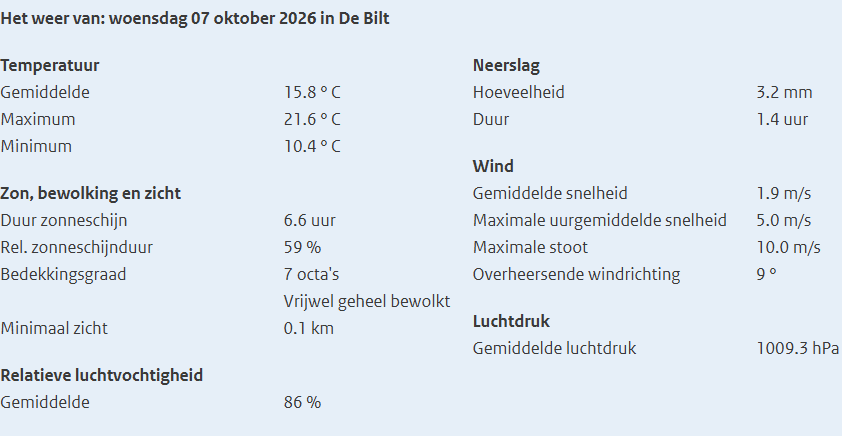
Weer:

Links:
In de geschiedenis

#NobelPrize in Chemistry – announcement 2026 (TV webcast)

They made chemistry choose a mirror image.

Some molecules, such as amino acids, exist as two variants that are each other’s mirror image. However, living organisms only contain one of these mirror images. How chemical asymmetry such as this could have emerged was long a mystery to chemists. Henri B. Kagan and Kenso Soai are awarded the Nobel Prize in Chemistry 2026 for discovering a solution to this puzzle. Life’s chemistry is what chemists call homochiral, after the Greek words for “same” and “hand”. Like hands, all amino acids exist as two mirrored variants, but only one of them is found in the proteins in your cells. The other is rarely found in nature. For a long time, chemists wondered how homochirality can emerge. When they began to experiment with chemical reactions that can form two mirrored molecules, they always obtained equal proportions of both in their test tubes. However, chemists strived to produce only one of these mirror images, because in the development of molecules that will interact with living beings – such as in pharmaceuticals – only one mirror image will have the desired effect. The Nobel Prize in Chemistry 2026 recognises discoveries that have enabled chemists to drive chemical reactions that lead to homochirality. “Henri Kagan and Kenso Soai have provided a solution to a chemical mystery that is over a century old: how homochirality can emerge spontaneously. The chemical reactions they have developed are spectacular,” says Heiner Linke, chair of the Nobel Committee for Chemistry. Henri Kagan took the first decisive step in 1986, when he discovered a new way of manipulating chemical reactions. This allowed him to create a greater excess of one of the mirror images than had previously been thought possible. Kenso Soai took the next step. In 1995, a key publica­tion describes how he designed the first ever chemical reaction that had the potential to be homochiral. In 2003, he finally succeeded. He presented a reaction in which only one of the two possible mirror images was formed. Other than life itself, no one had previously achieved this feat. Thanks to Henri Kagan and Kenso Soai, we now know how homochirality can emerge. Their discoveries have been decisive for chemists who design reactions for the manufacture of pharmaceuticals.

Links:
Nobel Prize in Chemistry 2026

Chemistry Nobel for solving mystery of how ‘handed’ organic molecules can emerge