Emissions Gap Report 2026

Emissions Gap Report 2026

United Nations Environment Programme (2026), Emissions Gap Report 2026: The point of return – Urgent emissions cuts needed to come back from overshoot of 1.5°C.

The 2026 Emissions Gap Report lays out the cuts to emissions needed (by 2030, 2035 and 2040) to get on a return pathway — finding that the cuts needed are far above what current Nationally Determined Contributions deliver. However, the report finds that it is possible to close this emissions gap — pointing to many successful climate policies that have already delivered real-world emissions cuts and could be scaled up globally to accelerate action.

Links:
Emissions Gap Report 2026
#ResiliencePays #DRRday Day for Disaster Risk Reduction / Dag voor Rampenrisicovermindering 2026

International Day for Disaster Risk Reduction

The International Day for Disaster Risk Reduction (IDDRR) was started in 1989, after a call by the United Nations General Assembly for a day to promote a global culture of risk-awareness and disaster reduction.

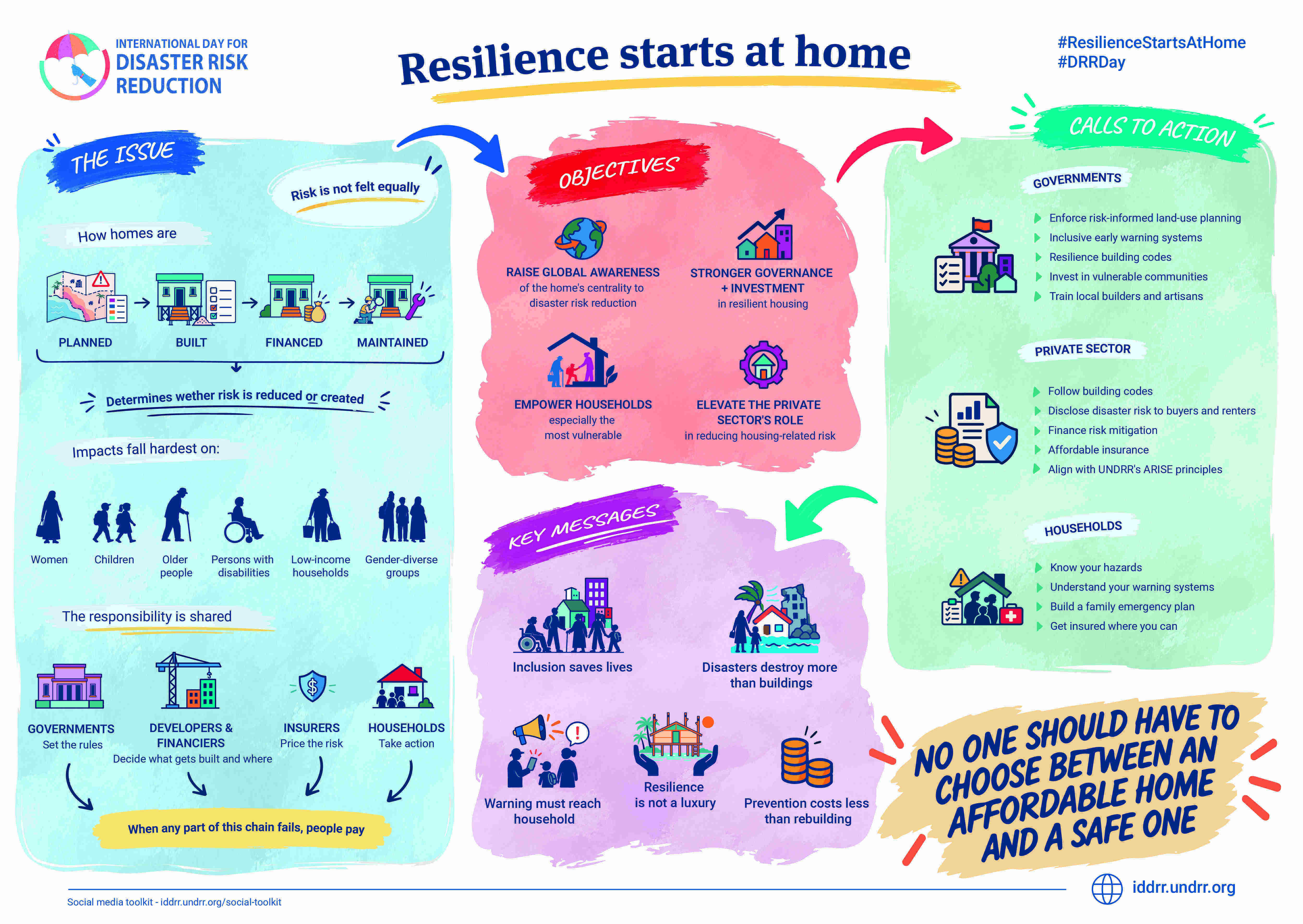
Held every 13 October, the day celebrates how people and communities around the world are reducing their exposure to disasters and raising awareness about the importance of reining in the risks that they face. To ensure homes remain safe for everyone, the United Nations Office for Disaster Risk Reduction has selected “Resilience Starts at Home” as the theme for the 2026 IDDRR. The 2026 IDDRR aims to raise global awareness of the centrality of the home in disaster risk reduction, advocate for stronger governance and investment in resilient housing, elevate the role of the private sector in reducing housing-related risk, and empower households, particularly those facing heightened vulnerability, to take risk-informed action to protect themselves and strengthen community resilience.

Resilience Starts at Home, click on picture to read

Links:
Day for Disaster Risk Reduction

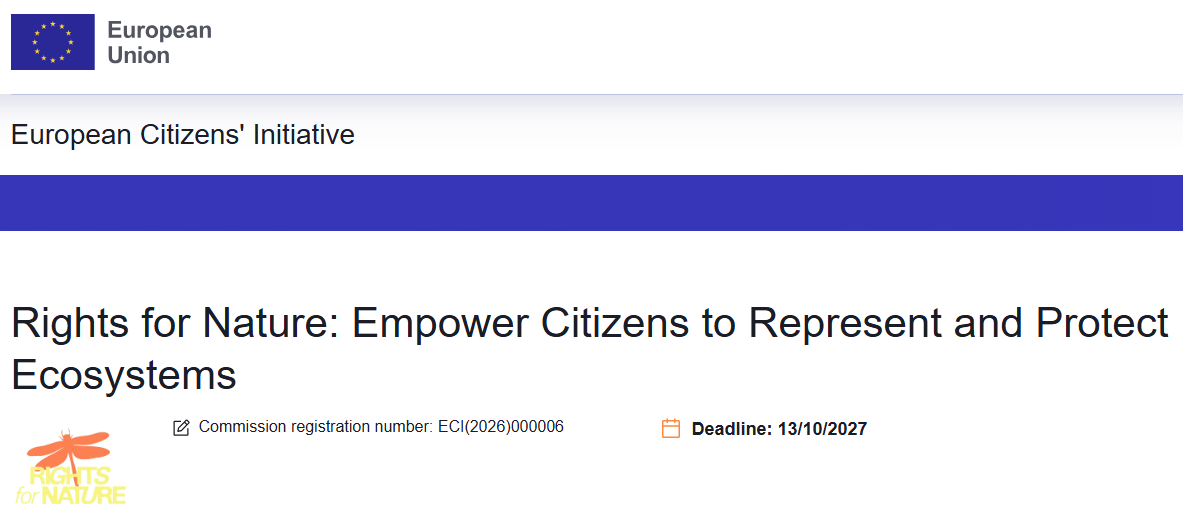
European Citizens’ Initiative : Rights for Nature: Empower Citizens to Represent and Protect Ecosystems

Rights for Nature: Empower Citizens to Represent and Protect Ecosystems

This European Citizens’ Initiative seeks to recognise Rights of Nature in European law via a legal act such as a directive or a regulation to strengthen the protection of ecosystems.

Ecosystems across Europe are in crisis despite existing environmental law, demonstrating the need for an integrated legal and governance framework that complements existing protections while addressing their structural fragmentation. We seek to move from treating nature as property to recognising ecosystems as living entities with intrinsic value and fundamental rights. These rights include the rights to exist, to regenerate their biocapacities and vital cycles, and to be restored. Ecosystems should also be granted legal personality, similar to companies. The aim is also to empower citizens and communities to act as stewards and representatives of ecosystems, both to prevent harm and to support protection, restoration and regeneration. Thus, these representatives should have legal standing and additional legal measures when defending ecosystems’ rights, building on Mar Menor’s example in Spain.

Links:
European Citizens’ Initiative : Rights for Nature: Empower Citizens to Represent and Protect Ecosystems

Rights for Nature

Zet de natuur in de Europese wet

Sixth-fifth Session of the IPCC

ipcc

The Intergovernmental Panel on Climate Change (IPCC) Panel meets in plenary session about twice a year. It may meet more often for the approval of reports.

The Panel controls the IPCC’s structure, procedures, work programme, and budget and accepts and approves IPCC reports. The Panel is the IPCC corporate entity. The IPCC is an intergovernmental body of the United Nations (UN). Its job is to “provide governments at all levels with scientific information that they can use to develop climate policies“. The World Meteorological Organization (WMO) and the United Nations Environment Programme (UNEP) set up the IPCC in 1988. The UN endorsed the creation of the IPCC later that year. It has a secretariat in Geneva, Switzerland, hosted by the WMO. It has 195 member states who govern the IPCC. The member states elect a bureau of scientists to serve through an assessment cycle. A cycle is usually six to seven years. The bureau selects experts in their fields to prepare IPCC reports. There is a formal nomination process by governments and observer organizations to find these experts. The IPCC has three working groups and a task force, which carry out its scientific work.

Links:
Opening of the Sixth-fifth Session of the IPCC

65th Plenary Session of IPCC suspended / Statement by the IPCC Chair Jim Skea on suspension of the 65th Plenary Session of the IPCC

2026-10-12, Lief dagboek

Maandag; Wat eten we vandaag?; Russian lab worker death; Wecycleweek; Schiphol; World Arthritis Day; Columbus Dag / Día de la Raza / Día de las Culturas / Discovery Day / Día de la Resistencia Indígena / Native American Day / Leif Eriksson Day; AI self-replicating; Warsaw Security Forum; Expositie De Overstap; Week tegen Armoede; Nobel Prize.

Deze afbeelding heeft een leeg alt-attribuut; de bestandsnaam is dagboek.png

Wat eten we vandaag?:

Klik op afbeelding voor origineel

Knipselkrant:


Agenda:

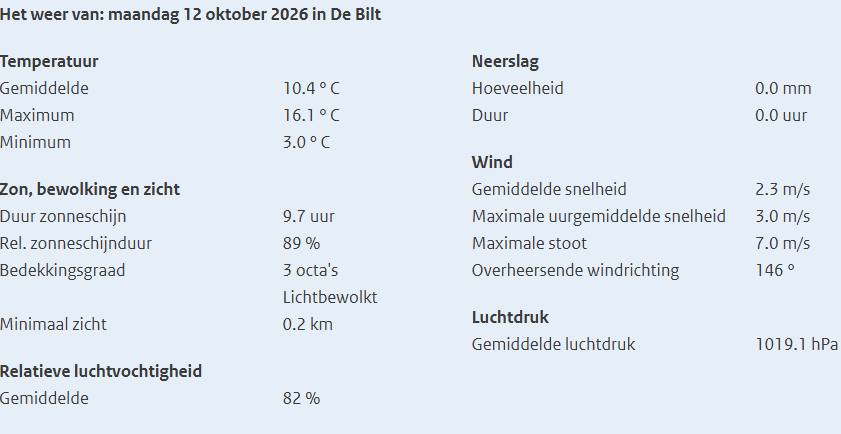
Weer:

Links:
In de geschiedenis

2026 Global Multidimensional Poverty Index – publicatie

2026 Global Multidimensional Poverty Index

The 2026 Global Multidimensional Poverty Index (MPI) report provides a statistical update of the global multidimensional poverty index, covering 108 countries.

The report highlights that, of the 6.3 billion people living in these countries, 1.2 billion people—or 18.9 per cent—are living in acute multidimensional poverty. The number of people living in multidimensional poverty has risen for the first time since the index was launched in 2010. The 2026  update of the global MPI database includes new surveys from 13 countries. The report also provides subnational estimates covering 1,360 regions across 100 countries. The report shows that more than half of all multidimensionally poor people are children and that more than 8 in 10 multidimensionally poor people live in rural areas. Sustainable Development Goal target 1.2 calls for countries to reduce by at least half, by 2030, the proportion of men, women and children living in poverty in all its forms and dimensions. The 2026 MPI update shows that, among the 89 countries with MPI trend data, 33 have halved their MPI value in fewer than 15 years, including six countries in Sub-Saharan Africa. This report highlights that reducing multidimensional poverty remains challenging, but achievable. The publication of the 2026 Multidimensional Poverty Index Report was supported by a financial contribution from the Republic of Korea.

Links:
2026 Global Multidimensional Poverty Index

The Sky at Night – Space for Different Perspectives (TV BBC Four / BBC iPlayer)

The Sky at Night

The Sky at Night is a monthly documentary television programme on astronomy produced by the BBC.

The show had the same permanent presenter, Patrick Moore, from its first broadcast on 24 April 1957 until 7 January 2013. The latter date was a posthumous broadcast, which followed Moore’s death on 9 December 2012. This made it the longest-running programme with the same presenter in television history. Many early episodes are missing, either because the tapes were wiped, thrown out, or because the episode was broadcast live and never recorded in the first place. Beginning with the 3 February 2013 edition, the show was co-presented by Lucie Green and Chris Lintott. Since December 2013 Maggie Aderin-Pocock has been a presenter. The programme’s opening and closing theme music is “At the Castle Gate”, from the incidental music to Pelléas et Mélisande, written in 1905 by Jean Sibelius, performed by the Royal Philharmonic Orchestra and conducted by Sir Thomas Beecham.

This episode:
When most people think of dyslexia, they think of difficulties in reading and writing. But while this is correct, it isn’t the full picture. In this episode, Maggie Aderin is on a journey of discovery. After an adult diagnosis of dyslexia, she is attempting to understand how her own life and work have been affected by the condition. And to do so, she seeks out scientists at the very top of their game, utilising a whole constellation of dyslexic traits in their own research.

Along the way, she heads to the Open University, where PhD candidate Jessica Hogan studies the vents of the icy moon Enceladus from a lab here on Earth. This involves an ingenious set-up, using a vacuum chamber to mimic the freezing, low-pressure environment of Enceladus in an attempt to understand its mysterious hidden oceans – and maybe, to aid in the search for alien life. But how has her enhanced problem-solving, a trait associated with dyslexia, aided in the engineering of her experiments?

Maggie also visits the University of Cambridge, where Dr Floor van Donkelaar works to understand the mass distribution in very young galaxies. These cosmic toddlers have been throwing out some big surprises – they are much ‘clumpier’ and more uneven than expected, and Floor’s research could be key to improving our understanding of how the universe evolved. Maggie discovers that visual thinking, another trait reported as a strength amongst many dyslexics, may be aiding Floor in her investigations.

Stepping away from space science for a moment, Maggie meets up with Dr Helen Taylor. Helen’s research crosses academic boundaries, taking in evolutionary anthropology, psychology and neuroscience, seeking to look at dyslexia differently. She has theorised that dyslexia is a consequence of human cognitive evolution, which has expanded our species’ capacity to gather information and evolve into the societies we live in today.

And finally, Maggie heads to one of the UK’s most secure and secretive facilities, Government Communications Headquarters (GCHQ). The centre of Britain’s signals and cyber intelligence efforts, part of GCHQ’s job is to protect us from threats from space. Here, she meets a real-life spy and fellow dyslexic, from whom she learns why GCHQ actively recruit from the neurodivergent population. His pattern recognition skills aren’t just keeping us safe but are also used in his personal joy in looking up at the skies.

From computational astrophysics and engineering to secret intelligence work, Maggie reveals how diverse ways of thinking are helping us to explore the universe and uncover its greatest mysteries.

Links:
Space for Different Perspectives

Expositie De Overstap over de kracht – en het falen – van klimaatbeelden – tentoonstelling

De Overstap

Van 12 tot en met 17 oktober 2026 exposeert het Nationaal Klimaat Platform (NKP) klimaatbeelden in de Pop-Up store op station Utrecht Centraal, bovenaan de roltrappen bij spoor 18/19 en gaat daar in gesprek met publiek en deskundigen over klimaat in taal en beeld. Heeft het klimaat een nieuw verhaal nodig? En welke beelden werken wel en welke juist niet?

De bevindingen uit het publieksonderzoek, maar ook uit de dagelijkse podcast, lunchlezingen, filmvertoningen en talkshow in de Pop-Up vormen mede de basis voor het advies dat het NKP aan het kabinet aanbiedt. Smeltende ijskappen, bosbranden, droogte, protesten, of juist zonnige foto’s van mensen met een ijsje: het zijn de beelden die dagelijks bij artikelen over klimaatverandering verschijnen. Maar werken ze nog? Herkennen mensen klimaat erin, voelen ze zich betrokken, en gaan deze beelden eigenlijk wel over de tijd waarin we nu leven? Uit eerder onderzoek van het NKP naar archetypebeelden in de media bleek dat veel bestaande beelden niet meer goed aansluiten. Afgelopen zomer was daar een treffend voorbeeld van: toen hittestress voor doden zorgde, ging dat nieuws vergezeld van foto’s met ijsjes en zwemmers. De beelden die doorgaans worden gebruikt, worden niet altijd met klimaat geassocieerd, of werken juist afschrikwekkend met desinteresse of klimaatstress als gevolg.

Links:
Klimaatbeelden

Schrikt deze klimaatfoto af? Expositie zoekt beste beeld voor klimaatnieuws

AI models may be capable of self-replicating without access to a datacenter – publication

AI models may be capable of self-replicating without access to a datacenter

Experiments suggest that small AI models may be months away from being capable enough to self-replicate on commercial internet-of-things (IoT) devices, like smart ovens and off-brand Android TV boxes.

A replicator like this would be challenging to shut down, since there’s no centralized point to shut off—though it may be slow (with a doubling time of days). Unlike non-AI malware, it could also figure out unfamiliar devices on its own. In our evaluations, a 9B model got inference running on 8 of the 9 hardware types we tested. Models of 30B parameters and under can already complete many of the individual steps for replication today, though they make mistakes when composing them end to end. In our simplified evaluations, GLM-5.2 and stronger models are capable of end to end replication. If small models improve at their historical rate, they’ll match this capability level by the end of this year. Small weight-based replicators may be possible soon after.

Links:
AI models may be capable of self-replicating without access to a datacenter