
Wereld Longkankerdag / World Lung Cancer Day 2025
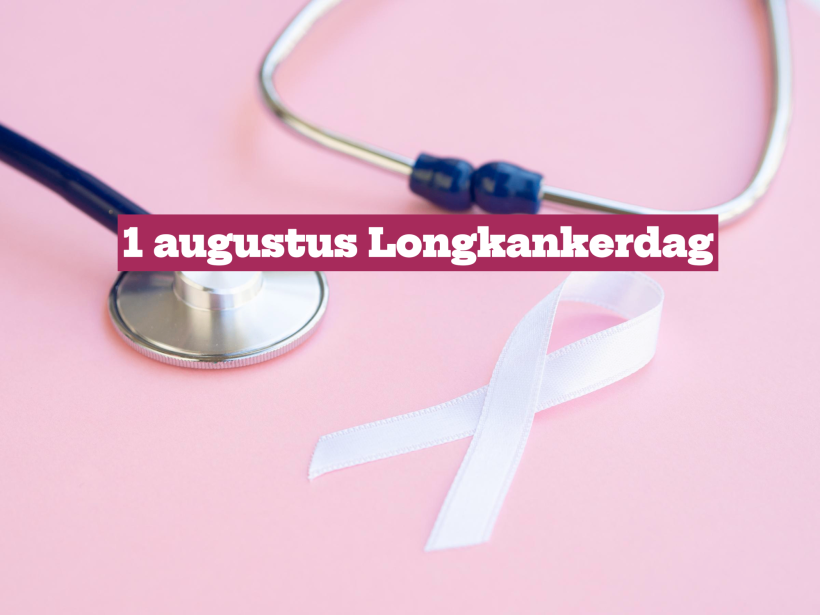
Op Wereld Longkankerdag wordt over de hele wereld stilgestaan bij alle mensen die longkanker hebben (gehad) én hun familie en naasten.
Longkan

Op Wereld Longkankerdag wordt over de hele wereld stilgestaan bij alle mensen die longkanker hebben (gehad) én hun familie en naasten.
Longkan

World Wide Web Day is celebrated on August 1st every year, it is a global celebration dedicated to web browsing.
Tim Berners-Lee developed the World Wide Web (“WWW” or the “Web”) in the year 1989 at the CERN centre located in Geneva, as a way for him to interact with co-workers via hyperlinks. A quarter of a century later, WWW has become the principal means of transaction, interaction and communication among the humans, opening the door of possibility for people in ways that would have been unthinkable to the previous generations. The World Wide Web is a global information medium which users can read and write via computers connected to the Internet. The term is often mistakenly used as a synonym for the Internet itself and often called “the Internet”, but the Web is a service that operates over the Internet, just as email (also e-mail) and Usenet also does. The history of the Internet dates back significantly further than that of the World Wide Web. Web is the global information system.
Links:
Wo
30th Anniversary of the World Wide Web

Finally, your chance to be heard: A global day to celebrate your freedom to object, using its most universal gesture: The Middle Finger.
World Middle Day is the global day to celebrate the freedom to object, using the most universal gesture of discontent: The Middle Finger. There is no better way to protest peacefully. We’ve all got something that annoys the hell out of us. Or outrages us. Whatever it is, big or small, on August 1: Give ‘em the finger! On August 1, post or tweet a middle finger and let us know what you wish to protest against.
No hate-policy:
Look around. The Middle Finger gesture has become a universal symbol of discontent, of protest. It’s sometimes useful and we encourage you to use it as such. But hate is neither useful nor welcome. We distance our efforts from any such behavior and will eliminate any comment or contribution which we deem to be hate-mongering.

International Childfree Day is celebrated annually on 1 August, it was created in 1973 in the United States by the National Alliance for Optional Parenthood, at the time the National Organisation for Non-Parents (N.O.N.), under the name of Non-Parents’ Day.
The day is aimed at celebrating people who voluntarily choose not to have children and to foster acceptance of the childfree choice. It has also been described as “a day of celebration worldwide for those couples who have faced criticism, ridicule, and rejection because they chose to be Childless by Choice.” The initiative, resurrected in 2013 by author Laura Carroll, also bestows annual Non Parent of the Year Award, which initially consisted of a male and a female. As of 2018, the ‘male’ and ‘female’ categories were replaced by Childfree Person of the Year (a person of any gender identification) and Childfree Group of the Year (a couple, duo, trio, or a group, whether childfree romantic partners, social media groups, forum leaders, or website founders). Winners include Belgian writer Théophile de Giraud and American author Jennifer Thorpe-Moscon in 2013. The 2020 winners were Elizabeth Hintz, an American doctoral candidate who “has dedicated her professional career to understanding and normalizing childfree experiences”, and the Russian internet community “Childfree”, which “has helped so many people to find a point of support in so pro-child, so patriarchal Russian society.”
Links:
Wikipedia

Roma Holocaust Memorial Day (known by various slightly different names) is a memorial day that commemorates the victims of the Sinti and Romani Holocaust, which resulted in the murder of an estimated 220,000–500,000 Sinti and Romani people by Nazi Germany and its collaborators during World War II.
The date of 2 August was chosen for the memorial because on the night of 2–3 August 1944, 2,897 Roma, mostly women, children and elderly people, were killed in the Gypsy family camp (Zigeunerfamilienlager) at Auschwitz concentration camp. Some countries have chosen to commemorate the genocide on different dates. The European Parliament on 15 April 2015, declared “that a European day should be dedicated to commemorating the victims of the genocide of the Roma during World War II and that this day should be called the European Roma Holocaust Memorial Day”. The Council of Europe also holds commemoration ceremonies.

Reactie op verzoek commissie Buitenlandse Zaken inzake afspraken met Israël over de verantwoording over de situatie in Gaza.
Te behandelen: 23432-569 Brief regering d.d. 28 juli 2025 – C.C.J. Veldkamp, minister van Buitenlandse Zaken. Reactie op verzoek commissie inzake afspraken met Israël over de verantwoording over de situatie in Gaza.
#DontForgetGaza Sit-ins op elk centraal station in Nederland
Nederland: Sluit de genocide geldkraan! – petitie
24-uurs wake Buitenlandse Zaken (TV webcast live)

Vroege Vogels is een live-radioprogramma, tv-programma en online community van BNNVARA over natuur en milieu.
In het radioprogramma wordt het gesproken woord omlijst door licht klassieke muziek en salonmuziek. Het radioprogramma werd in 1978 voor het eerst uitgezonden door de VARA en is een van de langst lopende en best beluisterde radioprogramma’s van de publieke omroep. Het wordt elke zondagmorgen uitgezonden tussen 07:00 en 10:00 op NPO Radio 1. De beginmuziek is een bewerking van Vivaldi’s “Piccolo Concerto in C major” (RV 443).
De kleine geveltuintjes midden in de stad zitten vol leven, wereldwijd onderzoek naar natuur en milieu met het Darwin200 zeilschip Oosterschelde en hoe klonk de tijd van de dino’s? En verder: het leven van natuurbeschermer Jaap Dirkmaat, boeren binnen gezonde grenzen en de bodemecologie door de jaren heen. De column is deze week van Dolf Jansen. Vroege Vogels Radio wordt gepresenteerd door Andrea van Pol vanuit het Groene Huis te Amersfoort.
Links:
Vroege Vogels (na afloop terugluisteren)
Boeren binnen gezonde grenzen, slankpootvlieg en bodemecologie
Donderdag; Wat eten we vandaag?; Tegenlicht – De verkuttificatie van het internet; gratis OV voor AOW’ers; Misleiding met eieren; Wereld Rangers Dag; Sit-in van Rijksambtenaren; Gaza Sit-ins op elk centraal station in Nederland.

Wat eten we vandaag?

Knipselkrant:
Agenda:
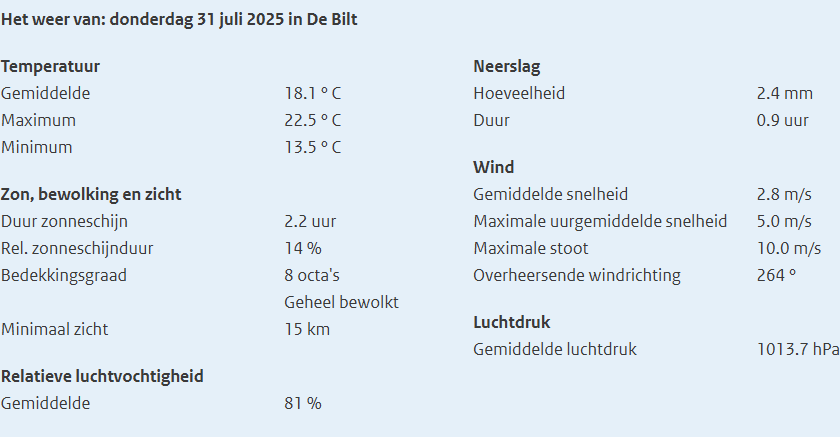
Weer:
Links:
In de geschiedenis
Sit-in door een groep Nederlandse ambtenaren die zich ernstige zorgen maakt over het aanhoudende Israëlische offensief in Gaza – dat volgens het Internationaal Gerechtshof bestempeld werd als plausibele genocide- en het Nederlandse beleid in reactie hierop.
Je kent ze misschien van de sit-ins die elke donderdag om 12:00 plaatsvinden voor het Ministerie van Buitenlandse Zaken. Als ambtenaren zijn zij doordrongen van het belang van internationaal recht. Ze legden een eed af op de Grondwet, inclusief artikel 90 waarin staat dat de regering de internationale rechtsorde bevordert. Het is aan de politiek om het beleid uiteen te zetten, dat klopt. Maar ook de politiek heeft zich te houden aan onze Grondwet en aan internationaal verdragsrechtelijke verplichtingen. Het is aan ambtenaren om de politiek erop te wijzen wanneer beleid het internationaal recht (mogelijk) schaadt. En die taak – die plicht – nemen zij zeer serieus. Zij verwachten van onze regering dat zij zich onvermoeibaar in gaat zetten voor consistente naleving van het internationaal recht. Concreet stellen zij vier eisen aan de Nederlandse regering en verwachten wij van de regering dat alle diplomatieke middelen worden aangewend om onderstaande te bewerkstelligen:
1. Maximale inzet op een onmiddellijk en permanent staakt-het-vuren en volledige humanitaire toegang tot Gaza.
2. Een eind aan alle vormen van steun voor én rechtvaardiging van Israëls huidige militaire optreden in Gaza en erkenning van het internationale humanitaire en oorlogsrecht;
3. De onmiddellijke naleving van recente uitspraken van het Internationaal Gerechtshof (ICJ).
4. Een strategie voor duurzame vrede, met garanties voor de mensenrechten en veiligheid van zowel Palestijnen als Israëliërs.
Links:
Ambtenaren en de Grondwet
#DontForgetGaza Sit-ins op elk centraal station in Nederland
