#DontForgetGaza Sit-ins op elk centraal station in Nederland

Zolang Den Haag wegkijkt, wordt er herrie gemaakt – voor sancties, voor een wapenembargo en voor echte maatregelen tegen Israël.

Een week geleden, op 24 juli 2025, klonk op 32 stations in Nederland een oorverdovend lawaai van potten en pannen. Duizenden mensen lieten horen dat zij de uithongering van Gaza en het stilzwijgen van de politiek niet langer accepteren. De indrukwekkende opkomst bleef niet onopgemerkt: de Tweede Kamer komt zelfs terug van reces om de situatie in Gaza te bespreken. Minister Veldkamp heeft inmiddels enkele maatregelen aangekondigd – kleine stapjes vooruit, zonder twijfel mede zijn ingegeven door de druk van de protesten. Maar: deze maatregelen zijn vooral symbolisch en lang niet voldoende. Terwijl kinderen in Gaza sterven van honger en geweld, kiest Nederland nog altijd voor kruimels en woorden in plaats van echte, daadkrachtige actie. De Tweede Kamercommissie Buitenlandse Zaken praat op 7 augustus 2025 over de situatie in Gaza. Daarom moeten juist nu onze stem juist luider laten horen. Sluit je aan; neem potten, pannen en pollepels mee en laat samen zien dat zwijgen geen optie is.

Links:
Protesteer tegen uithongering en genocide – kom morgen om 18:00 naar het station
31 July: SIT-IN’s for Gaza NEW EMERGENCY CALL!

📣 31 Cities Rise for Gaza 📣

Sit-in van Rijksambtenaren in Den Haag

Zeebeving Kamtsjatka 2025

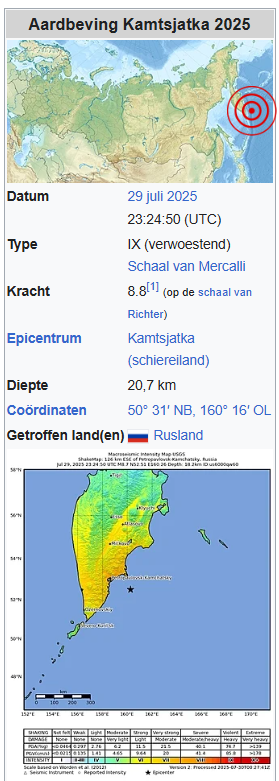
De aardbeving bij schiereiland Kamtsjatka op 30 juli 2025 om 11:24 (lokale tijd) was een beving met een magnitude 8,8 op de schaal van Richter, op 19 kilometer diepte.

Het epicentrum van de beving lag in open zee op zo’n 130 kilometer van de Russische kust. De aardbeving heeft tot tsunamiwaarschuwingen geleid in onder meer Rusland, Japan, de Verenigde Staten, China, Hawaï en Ecuador. De hoge golven hebben ook Japan bereikt en in Hawaï waren evacuaties. Er zijn geen slachtoffers gemeld, wel was er een tsunami die de Russische havenplaats Severo-Koerilsk onder water zette. Er volgden naschokken met een magnitude tot 6,9. De Kljoetsjevskaja Sopka, een vulkaan op het schiereiland Kamtsjatka en een van de hoogste vulkanen ter wereld, barstte uit als gevolg van de beving. Ook de Krasjeninnikov vulkaan op het schiereiland barstte enkele dagen later op 3 augustus 2025 voor het eerst in 475 jaar weer uit. Hetzelfde gebied was op 4 november 1952 getroffen door een aardbeving met magnitude 9,0.


Links:
Zware aardbeving Kamtsjatka

2025 Kamchatka Peninsula, Russia Earthquake

Zware beving bij Russisch schiereiland Kamtsjatka, tsunamiwaarschuwing Japan

Tsunami zet Russische havenstad onder water na zeldzaam zware aardbeving

M 6.9 – 147 km SE of Petropavlovsk-Kamchatsky, Russia

M 8.8 – 2025 Kamchatka Peninsula, Russia Earthquake

M 7.8 – 127 km E of Petropavlovsk-Kamchatsky, Russia

Disaster averted (just)

#Movember 2025

Movember (een porte-manteau van het Engelse woord ‘moustache’ (snor) en ‘november’) is een jaarlijks terugkerend evenement om aandacht te vragen voor prostaatkankerteelbalkanker en de gezondheid van de man meer in het algemeen.

Door mannen en vrouwen (Mo Bros en Mo Sistas) aan te moedigen om mee te doen streeft de stichting er naar om de vroege opsporing van kanker, diagnose en effectieve behandelingen, en uiteindelijk een vermindering van het aantal vermijdbare sterfgevallen te realiseren. Naast het ondergaan van een jaarlijkse controle stimuleert de stichting mensen zich bewust te zijn van mogelijke familiegeschiedenis van kanker en om een gezondere levensstijl aan te nemen. De Movember Foundation financiert ruim 800 onderzoeksprojecten over de hele wereld. Het Wereldwijd Wetenschappelijk Comité (GSC) komt jaarlijks bijeen om ontwikkelingen in het kankeronderzoek te bespreken en te bepalen waar het beschikbare geld heen gaat. Het GSC wil voorkomen dat onderzoek door verschillende onderzoekscentra onnodig dubbel wordt gedaan.

Links:
Movember

Waarom een bevolkingsonderzoek voor prostaatkanker nodig is

The silent epidemic: the pros and cons of screening for prostate cancer

A coalition of ten Dutch and Palestinian NGOs are accusing the Dutch State of failing to prevent genocide in Gaza and to ensure Israel respects international law – Appeal

On 3 September 2025, the Dutch Court of Appeal will hear a case brought against the Dutch government by Al Haq, Al-Mezan, the Palestinian Center for Human Rights, and Dutch NGOs Een Ander Joods Geluid (EAJG), European Legal Support Center (ELSC), Groningen Jabalya, Netherlands Palestina Komitee, SOMO, Stichting Kifaia, and Stichting Palestina, and is supported by Erev Rav and Plant een Olijfboom.

The case demands an end to the Netherlands’ role in enabling Israel’s ongoing genocide in Gaza and its unlawful military occupation and colonisation of Palestinian land. These actions are not isolated policies, but central pillars of a Zionist settler-colonial project rooted in forced displacement, land theft, and racial domination. The appeal challenges a ruling issued by The Hague District Court in December 2024, which acknowledged the Dutch state’s obligations under international law but declined to enforce them. The court accepted the government’s position that arms exports could proceed under a “case-by-case” licensing framework, even though the International Court of Justice determined that plausible genocide is being carried out in Gaza, and the Dutch territory remained actively involved in transferring weapons used in that context. The court deemed the government’s “discouragement policy” on trade with illegal settlements as sufficient, without evaluating its effectiveness or consistency with international law. In doing so, the court affirmed a model of governance in which legal commitments are treated as symbolic, accountability is optional, and bureaucratic procedures replace political responsibility. This appeal is a direct challenge to a system that reduces state complicity in atrocities to a matter of bureaucratic discretion. The Netherlands’ entanglement in Israel’s regime of apartheid and colonisation is not new. It reflects a longer arc of European complicity in Zionist state-building and the violent reordering of Palestinian land, demography, and sovereignty. As a former colonial power, the Netherlands has reconstituted its relationship to empire through trade, surveillance, and weapons supply. These entanglements expose the lie of European neutrality. For decades, Dutch governments have offered diplomatic cover, economic protection, and logistical access to a state that has made the subjugation of Palestinians its governing principle.

Links:
Infrastructure of genocide: the case confronting Dutch support for Israel’s war machine

Ruling in the case A coalition of ten Dutch and Palestinian NGOs are accusing the Dutch State of failing to prevent genocide in Gaza and to ensure Israel respects international law – Appeal

Volgens het gerechtshof Den Haag bestaat er een ernstig risico dat Israël genocide pleegt in Gaza en het humanitair oorlogsrecht schendt

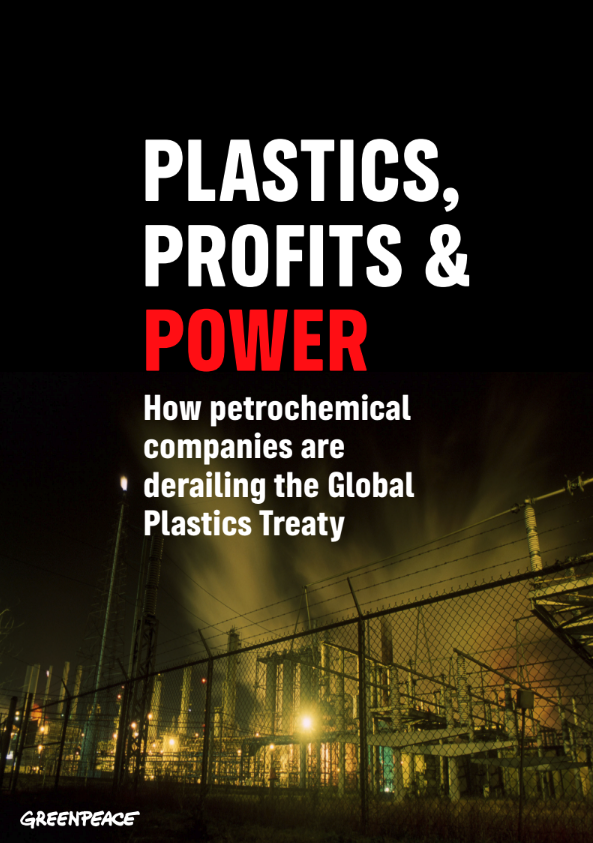
Plastics, Profits and Power: How petrochemical companies are derailing the Global Plastics Treaty – publication

The Report ‘Plastics, Profits and Power: How petrochemical companies are derailing the Global Plastics Treaty‘ exposes how fossil fuel and petrochemical companies are working to derail the Global Plastics Treaty, the world’s most ambitious effort to end plastic pollution.

While lobbying heavily to weaken the treaty, corporations like ExxonMobil, Shell, Dow and INEOS have expanded plastic production, locking in decades of future pollution. Industry lobbyists now outnumber many national delegations, scientists and Indigenous groups, and their presence creates a profound conflict of interest. Without decisive reforms, the treaty risks being captured by the very polluters it is meant to regulate. Greenpeace calls on the UN to ban fossil fuel lobbyists from the talks, embed strong conflict of interest safeguards, and ensure meaningful participation for frontline communities and independent experts.

Links:
Plastics, Profits and Power: How petrochemical companies are derailing the Global Plastics Treaty

Meteorenzwerm δ-Cassiopeiïden in juli 2025

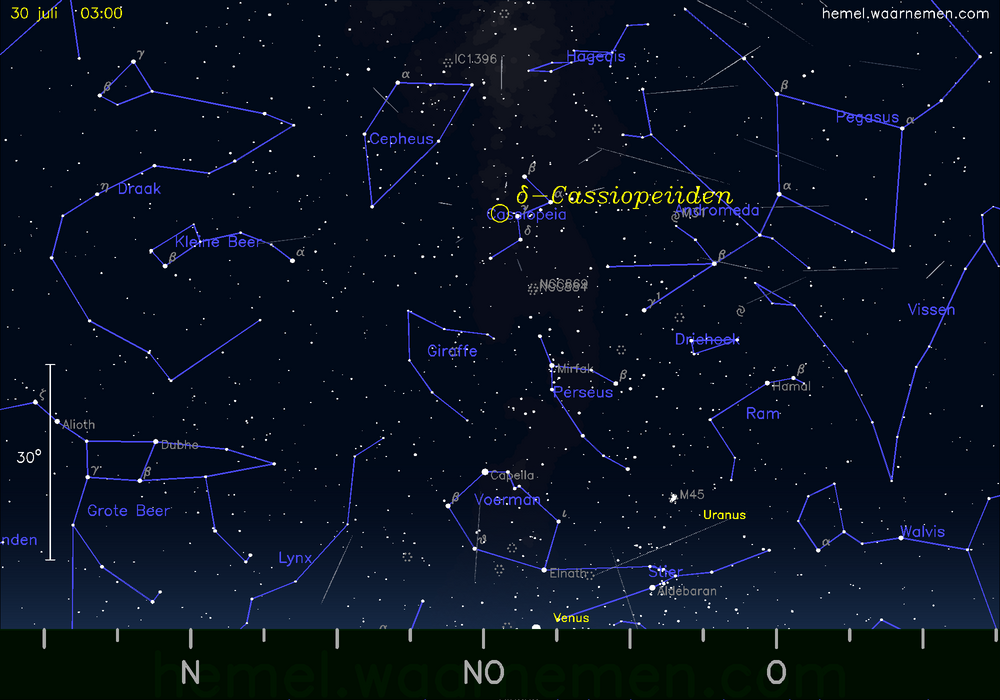
De meteorenzwerm δ-Cassiopeiïden (naar de ster Delta Cassiopeiae) bereikt op dinsdag 29 juli 2025, rond 22:00, zijn maximum.

Wanneer de radiant in het zenit zou staan, zouden er van deze zwerm naar verwachting gemiddeld zo’n 10 meteoren per uur vallen. Rond 06:00 staat de radiant van de zwerm in het hoogste punt (op 79°) aan de hemel. Het beste moment om δ-Cassiopeiïden waar te nemen is op 30 juli rond 03:00. De radiant van de zwerm staat dan ongeveer 64° boven de noordoostelijke horizon. Door de matige omstandigheden zijn er in onze streken dan vermoedelijk maar circa 3–7 meteoren per uur van deze zwerm te zien. Samen met meteoren van andere zwermen, en sporadische meteoren, zijn er bij donkere, heldere hemel in totaal circa 11–18 “vallende sterren” per uur te zien. Op een donkere locatie zijn ongeveer vijf keer zoveel meteoren te zien als in dichtbevolkt gebied. De Maan stoort niet. Rond 05:15 gaat het schemeren en om 05:58 komt de Zon op. Over het algemeen zijn de de meteoren van een zwerm niet alleen op de dag van het maximum zichtbaar. Zo is gedurende circa 5 dagen rondom het maximum meer dan 50% van het maximum aantal meteoren per uur van de δ-Cassiopeiïden te zien. Tot 6 dagen voor en na het maximum zijn nog meteoren van deze zwerm te herkennen. De zwerm heeft daarmee een relatief korte piek. Er zijn dus nog meer kansen, voor het geval het in de nacht van het maximum niet helder is. Wel is iedere dag die je eerder voor het maximum, of later na het maximum waarneemt het aantal meteoren dat zichtbaar is circa 20% kleiner. De typische snelheden van de meteoren in deze zwerm zijn met circa 60 km/s (ongeveer 216.000 km/uur) relatief hoog.

Links:
Meteorenzwerm δ-Cassiopeiïden in juli 2025

The State of Food Security and Nutrition in the World 2025

Every year, this most intensely scrutinized of FAO’s reports presents the headline number of undernourished people around the world, while advocating for strategies against hunger and malnutrition.

Following publication of the global report ‘The State of Food Security and Nutrition in the World 2025‘, a wealth of statistics is disaggregated into regional reports. SOFI is jointly produced with fellow UN agencies IFAD, UNICEF, WFP and WHO. While some progress and recovery have been made in recent years, the world is still above pre-COVID-19 pandemic levels and far from eradicating hunger and food insecurity by 2030 (SDG Target 2.1). Similarly, despite some progress in the global nutrition targets, the world is not on track to achieve SDG Target 2.2. Among other factors, persistent food price inflation has slowed this momentum.The State of Food Security and Nutrition in the World 2025 highlights how elevated inflation in many countries has undermined purchasing power and, especially among low-income populations, access to healthy diets. The report documents how high food price inflation is associated with increases in food insecurity and child malnutrition.

Vulnerable groups, including low-income households, women, and rural communities, can be particularly affected by food price inflation, risking setbacks in the fight against hunger and malnutrition.In response to these challenges and to prevent future price shocks, the report examines policy measures adopted by countries, and outlines what is necessary going forwards. It stresses the importance of coherent implementation of fiscal and monetary policies to stabilize markets, promote open and resilient trade, and protect vulnerable populations. Additionally, it calls for better data systems and sustained investment in resilient agrifood systems to build long-term food security and nutrition. These coordinated actions are vital to reignite progress towards ending hunger and malnutrition by 2030.

Links:
The State of Food Security and Nutrition in the World

Food insecurity: Nutrition and geography in a hungry world

2025-07-28, Lief dagboek

Maandag; OV Amsterdam; Wereld Tijgerdag; World Hepatitis Day; Natuurbeschermingsdag; UN conference on two-State solution for Israel and Palestine.

Deze afbeelding heeft een leeg alt-attribuut; de bestandsnaam is dagboek.png

Knipselkrant:


Agenda:

Weer:

Links:
In de geschiedenis