Transgender Day of Visibility 2026

International Transgender Day of Visibility (often referred to as TDOV or Trans Day of Visibility) is an annual event occurring on March 31 dedicated to celebrating transgender people and raising awareness of discrimination faced by transgender people worldwide, as well as a celebration of their contributions to society.

The event was created by transgender activist Rachel Crandall of Michigan in 2009 as a reaction to the lack of LGBTQ+ recognition of transgender people, citing the frustration that the only well-known transgender-centered day was the Transgender Day of Remembrance, which mourned the murders of transgender people, but did not acknowledge and celebrate living members of the transgender community. The first International Transgender Day of Visibility was held on March 31, 2009. It has since been spearheaded by the U.S.-based youth advocacy organization Trans Student Educational Resources. On February 6, 2025, President Donald Trump issued the executive order “Eradicating Anti-Christian Bias“, citing the previous year’s Transgender Day of Visibility as a reason for the order’s creation.

Links:
Transgender Day of Visibility

Transgender Day of Visibility – GLAAD

Transgender Day of Visibility – GLSEN

The impact of mining-induced earthquakes on mental health: Evidence from the Dutch Lifelines Cohort Study and Biobank – publication

The geographic distribution of accumulated peak ground acceleration in Groningen

A large body of literature demonstrates that exposure to major adverse events such as natural disasters affects physical and mental health, less is known about health consequences of long-term exposure to smaller, recurring shocks such as mining-induced earthquakes.

Leveraging data from the Dutch Lifelines Cohort Study and Biobank and the Royal Netherlands Meteorological Institute, the report ‘The impact of mining-induced earthquakes on mental health: Evidence from the Dutch Lifelines Cohort Study and Biobank‘ examines mental health effects of frequent earthquakes generated by the extraction of natural gas, which was a major source of economic revenue for the Netherlands. Long-term exposure is captured by the accumulated peak ground acceleration. The scientists employ individual-level fixed effects models to deal with selective exposure and find that exposure increases depression and anxiety symptoms. The results are robust to selective migration and to varying the exposure indicator and support a reassessment of the societal costs of the mining of natural gas.

Links:
Meer angst- en depressieklachten in Groningen door aardbevingen

Groningers zijn volgens studie vaker angstig en somber door aardbevingen

Liberties Rule of Law Report 2026 – publication

Liberties Rule of Law Report 2026

The Liberties Rule of Law Report 2026 is the seventh annual report on the state of rule of law in the European Union (EU) published by the Civil Liberties Union for Europe (Liberties).

Liberties is a non-governmental civil society organisation promoting the civil liberties of everyone in the EU, and it is built on a network of national civil liberties groups from across the EU. Currently, we have member organisations in Belgium, Bulgaria, the Czech Republic, Croatia, Denmark, Estonia, France, Germany, Hungary, Ireland, Italy, Latvia, Lithuania, Malta, the Netherlands, Poland, Romania, Slovakia, Slovenia, Spain and Sweden, as well as a contributing partner organisation in Greece. Liberties, together with its members and partner organisations, carries out advocacy, campaigning and public education activities to explain what the rule of law is, what the EU and national governments are  going to protect or harm it, and gathers public support to press leaders at EU and national level to fully respect, promote and protect our basic rights and values. Drafted by Liberties and its member and partner organisations, the 2026 report covers the situation during 2025 with the purpose of providing the European Commission with reliable information and analysis from the ground to feed its own rule of law reports, and to provide an independent analysis of the state of the rule of law in the EU in its own right. Liberties’ report represents the most in-depth reporting exercise carried out to date by a civil society network to map developments in a wide range of areas connected to the rule of law in the EU. The 2026 report includes EU-wide trend analysis in the justice system, anti-corruption framework, media freedom, checks and balances, based on 22 country reports that follow a common structure, mirroring and expanding on the priority areas and indicators identified by the European Commission for its annual rule of law monitoring cycle. Nearly 40 organisations contributed to the compilation of these country reports. The 2026 report places particular emphasis on the recommendations made by the European Commission and how, in the assessment of Liberties’ members, they have been implemented. Specific gaps were identified alongside new issues that arose in 2025.

Links:
Rapport: Nederlandse rechtsstaat in gevaar, overheid breekt demonstratierecht en sociale advocatuur af

Excess Oil Profits in Times of War : An EU-wide snapshot of higher margins on the sale of diesel and petrol since the beginning of the Iran war – publication

Excess Oil Profits in Times of War

Shortly after the outbreak of the Iran war on 28 February 2026, fuel prices at petrol stations across the EU rose steeply, the analysis ‘Excess Oil Profits in Times of War‘ shows that this increase cannot be explained by higher crude oil prices alone.

In addition, the oil companies significantly widened their profit margins, thereby generating excess profits. During the first three weeks of the war, the average excess profits across all 27 EU member states amounted to €81.4 million per day. The largest share of these excess profits was attributable to diesel fuel. Margins were expanded predominantly in countries with high purchasing power: the Netherlands, Sweden, Denmark, Austria and Germany. At the same time, there were a number of mostly smaller markets in which margins actually shrank. When the higher margins are combined with fuel consumption volumes, the data show that roughly 30 per cent of all EU-wide excess profits in the petrol station market were borne by Germany.

Links:
Onderzoek naar de oorlogswinsten van oliebedrijven: 3 conclusies

Belast de oorlogswinst van oliebedrijven! – petitie

Iran-Krise: Erste Ölkonzerne melden sprudelnde Gewinne

Week van de Teek 2026

Week van de Teek

De Week van de Teek wordt jaarlijks georganiseerd door landelijke samenwerkende organisaties.

Teken (Ixodida) kunnen ziektes overbrengen, onder andere de ziekte van Lyme en tekenencefalitis. Daarom is het belangrijk dat je weet hoe je een tekenbeet voorkomt en wat je moet doen als je toch gebeten bent. Teken vormen een orde van geleedpotige parasieten die behoren tot de klasse der spinachtigen. Samen met de mijten vormen zij de onderklasse der Acari. Teken zijn nauw verwant aan mijten, maar de precieze relatie is onduidelijk. Teken leven van het bloed van gewervelde dieren; ze bijten zich vast in de huid en laten zich na een bloedmaaltijd, die enige uren tot dagen duurt, weer vallen. Het dier waarop de teek leeft, wordt de gastheer genoemd. Bekende gastheren van teken zijn vogelsreptielen en verschillende zoogdieren. Teken kunnen verschillende ziekten overbrengen en worden daarom vectoren genoemd. Na de steekmuggen zijn teken de belangrijkste verspreiders van pathogenen. De bekendste Europese teek, die tevens een overbrenger is van lymeziekte, FSME en het alfa-galsyndroom, is de schapenteek (Ixodes ricinus).

Links:
Week van de Teek

2026-03-30, Lief dagboek

Maandag; Wat eten we vandaag?; glysofaat; paraquat, weedkiller linked to Parkinson’s disease; VS: dubieuze zorgdeals; anti-Aziatisch racisme; Parlement Israël stemt voor omstreden doodstrafwet; Vrijheid; World Bipolar Day / Vincent van Gogh; Day of Zero Waste; Wie mag er nog de opvang in?

Deze afbeelding heeft een leeg alt-attribuut; de bestandsnaam is dagboek.png

Wat eten we vandaag?:

Klik op afbeelding voor origineel

Knipselkrant:


Agenda:

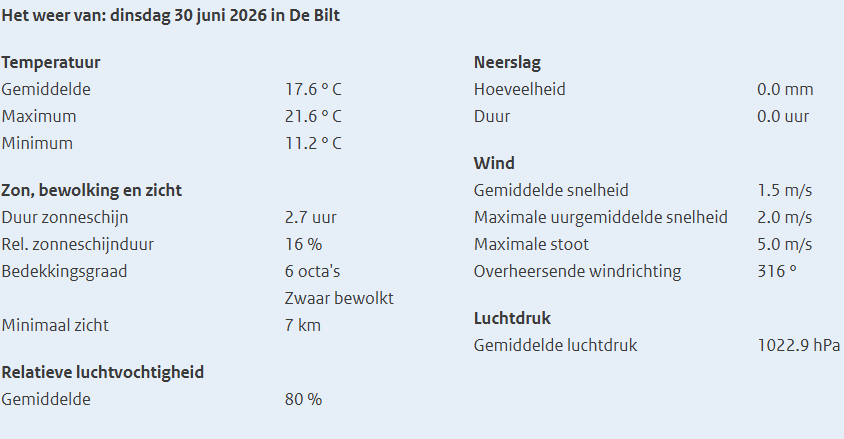
Weer:

Links:
In de geschiedenis

World Bipolar Day / Vincent van Gogh – geboortedag – birthday (1853) 2026

World Bipolar Day

Elk jaar op 30 maart, de geboortedag van Vincent van Gogh, is het World Bipolar Day.

Vincent van Gogh werd postuum gediagnosticeerd als mogelijk een bipolaire stoornis te hebben gehad. De boodschap van World Bipolar Day is om wereldwijd aandacht te vragen voor de bipolaire stoornis en stigma tegen te gaan. Door internationale samenwerking is het doel om wereldwijd informatie te geven over de bipolaire stoornis om zo meer begrip voor en kennis over de stoornis te creëren.

Links:
ISBD World Bipolar Day

World Bipolar Day

World Bipolar Day / Vincent van Gogh

Day of Zero Waste 2026

Day of Zero Waste

On 14 December 2022, the United Nations General Assembly adopted a resolution at its seventy-seventh session to proclaim 30 March as International Day of Zero Waste, to be observed annually.

Türkiye, with 105 other countries, put forward the resolution, following other high-level decisions focused on pollution, such as the UN Environment Assembly resolution “End plastic pollution: towards an internationally legally binding instrument”. The United Nations Environment Programme (UNEP) and the United Nations Human Settlements Programme (UN-Habitat) jointly facilitate the observance of International Day of Zero Waste. As part of this campaign, Member States, organizations of the United Nations system, civil society, the private sector, academia, women, youth and other stakeholders are invited to engage in activities aimed at raising awareness of national, subnational, regional and local zero-waste initiatives and their contribution to achieving sustainable development. Promoting zero-waste initiatives through this international day can help advance all the goals and targets in the 2030 Agenda for Sustainable Development, including Sustainable Development Goal 11 and Sustainable Development Goal 12. These goals address all forms of waste, including food loss and waste, natural resource extraction and electronic waste.

2026 Theme: Zero Waste Starts on Your Plate. For this year’s International Day of Zero Waste, the focus is on food – what we eat, what we waste, and how we can move towards a more circular future. The world wastes food on a staggering scale. Every year we throw away about 1 billion tonnes of edible food, nearly one-fifth of all food available to consumers. This impacts both people and the environment. Around 60 per cent of food waste happens at the household level. The rest comes mostly from food service and retail, the result of inefficient food systems – including production, distribution and consumption. Tackling this issue requires redesigning these systems, transitioning towards a more sustainable, circular approach grounded in efficiency, resilience and sustainability. For this transition to succeed, we all have a role to play.

Governments can:

  • Advance food waste prevention through climate and biodiversity plans and national policies on circularity, waste, food systems, agriculture and urban development and promote measurement and monitoring.
  • Strengthen public–private partnerships.
  • Signal leadership and take action by joining the Food Waste Breakthrough.

Businesses can:

  • Set measurable food waste reduction targets and integrate them into existing sustainability commitments.
  • Innovate to transition to circular food systems and improve efficiency across supply chains.
  • Join the Food Waste Breakthrough to scale solutions and share progress.

Consumers can:

  • Plan, buy, store and prepare food mindfully to cut waste and save resources.
  • Support food recovery, redistribution and composting initiatives.
  • Help make food waste socially unacceptable through everyday action.

A zero-waste future is possible when we all work together – do your part by consuming thoughtfully, recovering surplus food, and working to build circular food systems. Let’s ensure our food is valued, not wasted.

Links:
Day of Zero Waste