Wereld Sjögren’s Dag / World Sjögren’s Day (Syndroom van Sjögren) 2026
Op Wereld Sjögren Dag wordt wereldwijd de geboortedag (23 juli 1899) van de Zweedse oogarts Henrik Sjögren herdacht, Sjögren was de ontdekker van de systeemziekte Syndroom van Sjögren en werd naamgever.

Het vaststellen van deze aandoening heeft veel patiënten geholpen die op zoek waren naar antwoorden op hun gezondheidsproblemen. Het is ook een bewustwordingsdag voor ons allen en geeft tevens alle patiënten die aan deze ziekte lijden of de symptomen hebben de aandacht die ze verdienen. Het Syndroom van Sjögren (Sjögren) is een systemische auto-immuunziekte waarbij vochtafscheidende klieren ontstoken raken en de slijmvliezen in de mond, de ogen en op alle andere plaatsen in het lichaam uitdrogen. Het Syndroom van Sjögren komt overal ter wereld voor en maakt geen onderscheid qua huidskleur of qua leeftijd. Bij een systeemziekte kunnen ontstekingen in gewrichten en in verschillende organen ontstaan. Een systeemziekte is een auto-immuunziekte, dit betekent dat afweercellen een ontstekingsreactie beginnen tegen het eigen lichaam. Op dit moment is er geen genezing voor Sjögren, maar een vroege diagnose en een goede behandeling zijn belangrijk om de ernstiger complicaties van de ziekte te voorkomen en tegelijkertijd de kwaliteit van leven van een patiënt te helpen verbeteren. Gemiddeld duurt het 2,8 jaar vanaf het moment dat een patiënt een behandeling voor zijn symptomen zoekt tot het ontvangen van een formele diagnose. In 2012, toen de diagnosetijd bijna zes jaar in beslag nam, lanceerde de SSF een BOLD 5-Year Breakthrough Goal: “In vijf jaar tijd de tijd met 50% te verkorten om Sjögren’s te diagnosticeren!” Dit doel werd bereikt in 2018.

Links:
World Sjögren’s Day Is July 23. Here Are 4 Simple Ways You Can Make a Difference.

Make a Pledge to Honor Someone Affected by Sjögren’s for World Sjögren’s Day
Vereniging Sjögren Patiënten

Increasingly hot Europe faces more Severe Droughts and Growing Challenges for Water and Land Management – publication

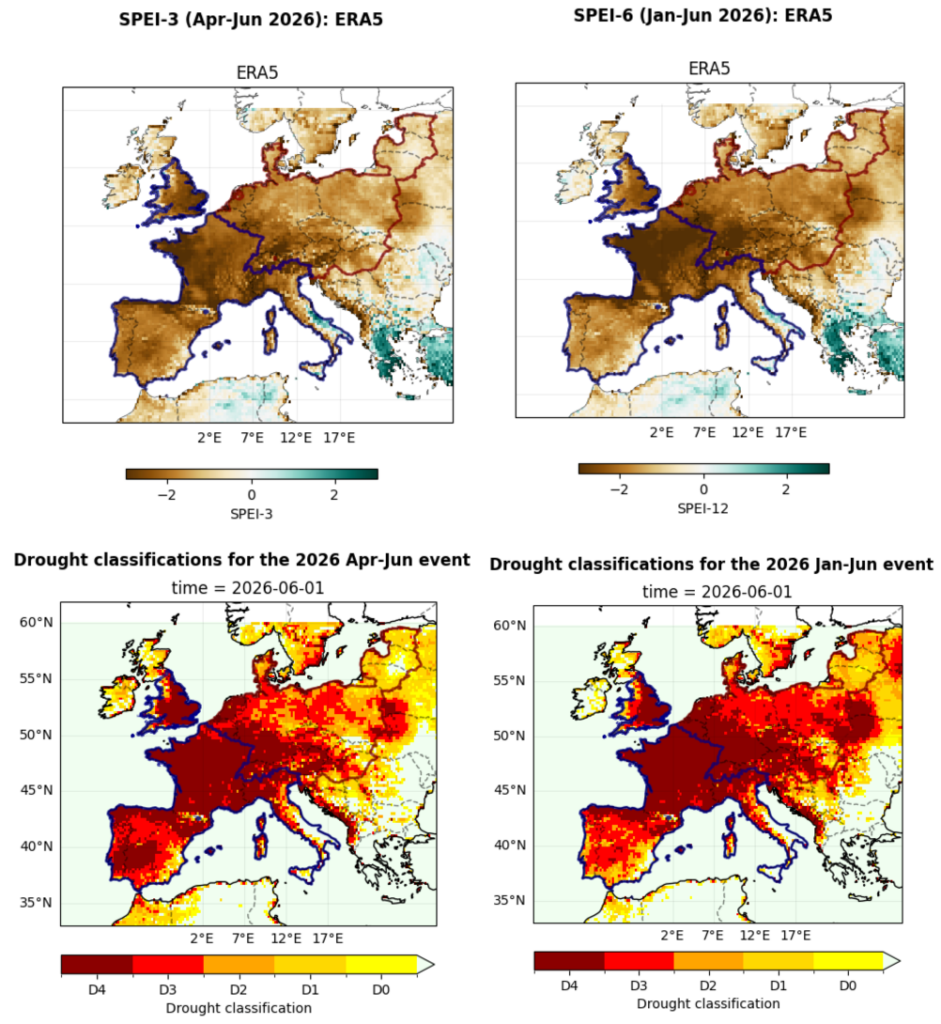
SPEI maps for 3- and 6- month accumulation periods ending in June 2026 over the region 33-60N,15W-30E. The Western Domain is highlighted in blue and the Eastern Domain is highlighted in red. Bottom: Drought classification maps categorised according to the US Drought Monitor (USDM) system. The categories are based on the n-month SPEI values in June 2026, calculated from ERA5 using the Hargreaves scheme for PET.

The European summer of 2026 has so far been characterised by exceptional heat and widespread dryness (Copernicus, 2026).

Between April and June, large parts of the continent, from Portugal in the southwest to southern Finland in the northeast, received below-average rainfall. Combined with successive heatwaves, these conditions have intensified drought across Europe, contributing to widespread agricultural and hydrological impacts, unusually low river levels (NOS, 2026), and severe wildfires, particularly in Spain and France, where 116,000 and 42,000 hectares have already been burnt, respectively (EFFIS, 2026). Although western Europe experienced a relatively wet start to the year, persistent precipitation deficits in eastern Europe carried over from 2025, resulting in different types and stages of drought developing across the continent. With forecasts indicating little relief in the near term, the summer of 2026 is emerging as one of Europe’s most significant heat and drought events in recent years. Scientists from Austria, Germany, Hungary, Latvia, the Netherlands, Romania, Slovenia, Spain, Sweden, Switzerland, the Czech Republic, the UK, and the US used established, peer-reviewed methods to assess whether, and to what extent, climate change influenced the European drought. Drought can be defined in several ways. Meteorological drought is characterised by below average rainfall, whereas agricultural drought occurs when lack of rainfall or dry soil affects farming and crop growth and is measured by soil moisture or by estimating the balance between rainfall and evapotranspiration over time. Because increased evapotranspiration driven by regional warming can substantially intensify drought impacts, we separately assess the contributions of both low rainfall and potential evapotranspiration (PET), as well as soil moisture. As the temporal extent of the drought is quite different in the western part of Europe compared to the East, we look at two different timescales: the 3 month drought in the western region and the 6-12 month drought in the eastern region.

Links:
Zonder klimaatverandering was het nu niet zo droog geweest

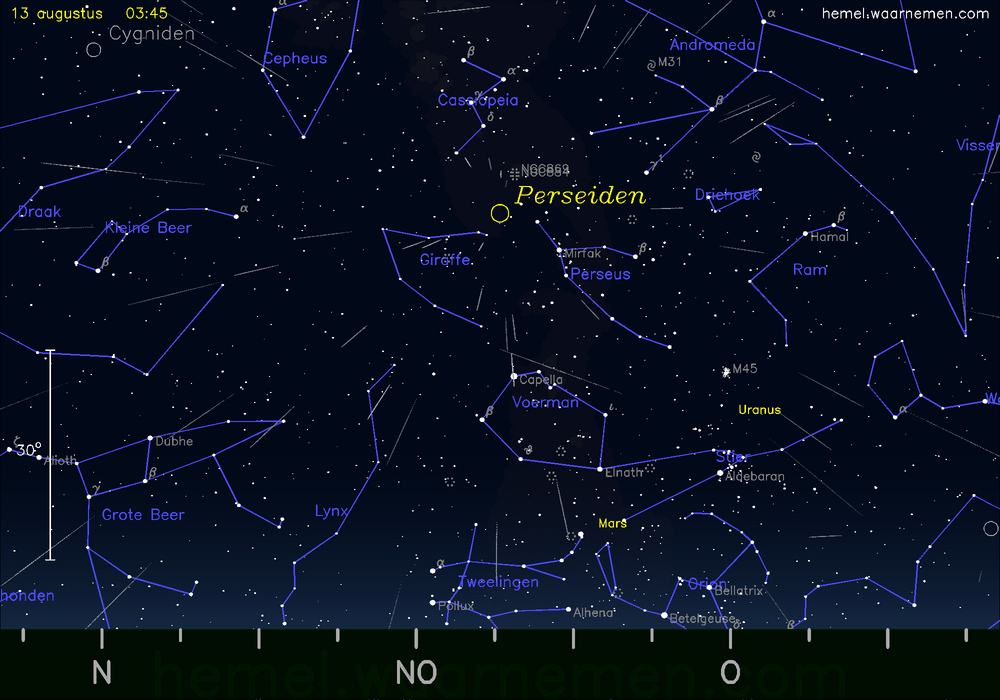
Meteorenzwerm Perseïden in augustus 2026

Perseiden

De meteorenzwerm Perseïden bereikt op donderdag 13 augustus 2026, rond 09:00, zijn maximum.

De meteoren van de Perseïden zijn helder en snel en hebben nalichtende sporen. Wanneer de radiant in het zenit zou staan, zouden er van deze zwerm naar verwachting gemiddeld zo’n 85 meteoren per uur vallen. Rond 07:30 staat de radiant van de zwerm in het hoogste punt (op 84°) aan de hemel. Het beste moment om Perseïden waar te nemen is op 13 augustus rond 03:45. De radiant staat op dat moment zo’n 60° boven de oostnoordoostelijke horizon. Er zijn dan bij ons ieder uur naar schatting ongeveer 40–55 meteoren van deze zwerm zichtbaar. In totaal zijn er, door meteoren van andere zwermen en sporadische meteoren, bij donkere en heldere hemel circa 50–65 “vallende sterren” per uur te zien. Op een goed donkere plek zijn circa drie keer zoveel meteoren zichtbaar als in een grote stad. De Maan stoort niet. Rond 05:45 gaat het schemeren en om 06:20 komt de Zon op. De meteoren van de meeste zwermen verschijnen niet allemaal op de dag van het maximum. Zo is gedurende circa 3,1 dagen rondom het maximum ruim 50% van het maximum aantal meteoren per uur (23) van de Perseïden te zien. Tot 12 dagen voor en na het maximum zijn nog meteoren van deze zwerm te herkennen. De zwerm heeft daarmee een relatief korte piek. Er zijn dus nog meer kansen, voor het geval het in de nacht van het maximum niet helder is. Iedere dag verder weg van het maximum zijn er echter wel ongeveer 40% minder meteoren per uur te zien. De typische snelheden van de meteoren in deze zwerm zijn met circa 59 km/s (ongeveer 213.840 km/uur) relatief hoog.

Links:
Meteorenzwerm Perseïden in augustus 2026

Perseids Meteor Shower

EFFecting Change Livestream Series: If You Own It, Why Can’t You Fix It? (TV webcast)

EFFecting Change: If You Own It, Why Can't You Fix It?

Owning something should mean more than just bragging rights and a receipt.

Corporations are making it harder for you to repair the devices and products you already own, and forcing you to pay them again for repairs and replacements you don’t actually need. It costs consumers millions worldwide, sends tons of perfectly fixable items to landfills, and hands corporations (ahem might we say big tech) control over your property.

Links:
EFFecting Change Livestream Series: If You Own It, Why Can’t You Fix It?

Ede Staal – sterfdag (1986) 2026

Ede Ulfert Staal (Warffum, 2 augustus 1941 – Delfzijl, 22 juli 1986) was leraar Engels en streektaalzanger en -dichter.

Hij is bekend geworden met door hemzelf geschreven en gezongen Groningse liedjes over het leven op het Groningse platteland. Hij heeft ook liedjes geschreven onder het pseudoniem E. Paltrams (‘smartlap’ achterstevoren).

Links:
Ede Staal sterfdag (1986)

Ede Staal en Radio Noord

Muziek Ede Staal nu ook op Spotify

Ede Staal hit op Spotify

40 jaar zonder Ede Staal: zoon Jasper worstelt met gemis en erfenis

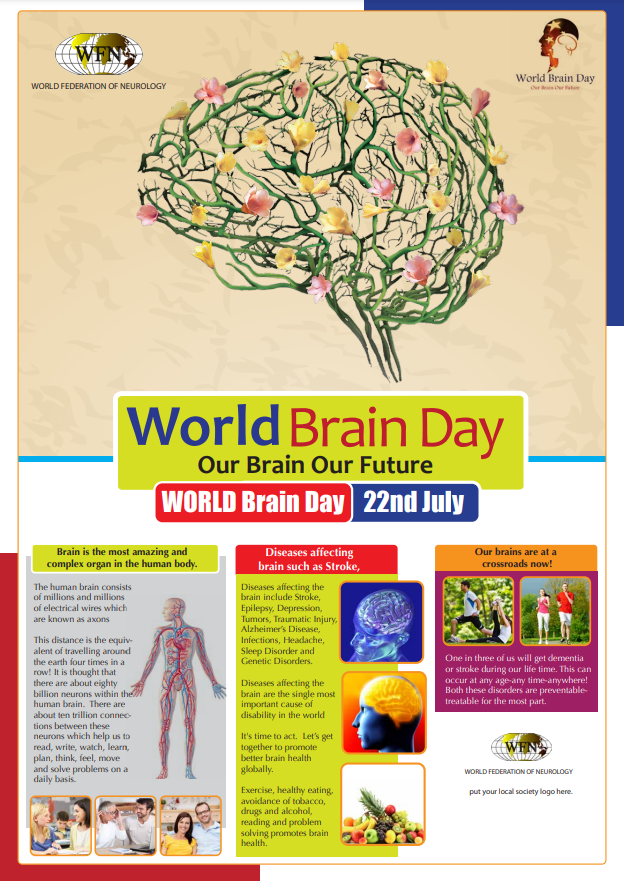
World Brain Day / Wereld Hersendag 2026

Click image to read

There are many days related to neurological diseases being celebrated by professional organizations in collaboration with World Health Organization, national organizations and local health ministries including World Stroke day, Epilepsy Day, Rabies Day.

These days have proven to be extremely helpful in promoting public awareness and generating advocacy throughout the globe including developing Asian, African and Latin American countries. The World Federation of Neurology was established on July 22 1957. It was suggested by the Public Awareness and Advocacy Committee that 22 July 2014 should be celebrated as “World Brain Day”. This proposal was announced at WCN, Council of Delegates meeting on 22 September, 2013 and the proposal was received with a warm welcome by delegates. The Board of Trustees meeting in February 2014 endorsed this proposal as an annual activity. World Brain Day 2026 is a global call to address these disparities and advocate for change. Science and medicine have made significant progress in understanding the brain, yet millions of people globally still cannot access essential care. More than 3.4 billion people currently live with neurological conditions, making brain disorders the leading cause of disability worldwide. Access to neurological care remains uneven across countries, regions, and communities.   Many people still face barriers including cost, lack of trained specialists, long waiting times, stigma, and limited access to services

Links:
World Brain Day

Pi Approximation Day / Pi-benaderingsdag 2026

Pi Approximation Day is observed every year on July 22 all around the world.

The fraction 22/7 is an approximate value of Pi, and there behind lays a specific reason why this day is observed on July 22. This day is celebrated on July 22 every year because the value of Pi is denoted by the fraction 22/7. Here, in the fraction 22/7 which denoted Pi, the numerator 22 symbolizes the date (22nd day of the month) and numerator 7 indicates the month (July). Approximations for the mathematical constant pi (π) in the history of mathematics reached an accuracy within 0.04% of the true value before the beginning of the Common Era. In Chinese mathematics, this was improved to approximations correct to what corresponds to about seven decimal digits by the 5th century. Further progress was not made until the 14th century, when Madhava of Sangamagrama developed approximations correct to eleven and then thirteen digits. Jamshīd al-Kāshī achieved sixteen digits next. Early modern mathematicians reached an accuracy of 35 digits by the beginning of the 17th century (Ludolph van Ceulen), and 126 digits by the 19th century (Jurij Vega), surpassing the accuracy required for any conceivable application outside of pure mathematics. The record of manual approximation of π is held by William Shanks, who calculated 527 decimals correctly in 1853. Since the middle of the 20th century, the approximation of π has been the task of electronic digital computers (for a comprehensive account, see Chronology of computation of π). On June 28, 2024, the current record was established by the StorageReview Lab team with Alexander Yee’s y-cruncher with 202 trillion (2.02×10¹⁴) digits.

Links:
Pi Approximation Day History, Meaning, Significance, other Celebration ideas