Ede Staal – sterfdag (1986) 2026

Ede Ulfert Staal (Warffum, 2 augustus 1941 – Delfzijl, 22 juli 1986) was leraar Engels en streektaalzanger en -dichter.

Hij is bekend geworden met door hemzelf geschreven en gezongen Groningse liedjes over het leven op het Groningse platteland. Hij heeft ook liedjes geschreven onder het pseudoniem E. Paltrams (‘smartlap’ achterstevoren).

Links:
Ede Staal sterfdag (1986)

Ede Staal en Radio Noord

Muziek Ede Staal nu ook op Spotify

Ede Staal hit op Spotify

40 jaar zonder Ede Staal: zoon Jasper worstelt met gemis en erfenis
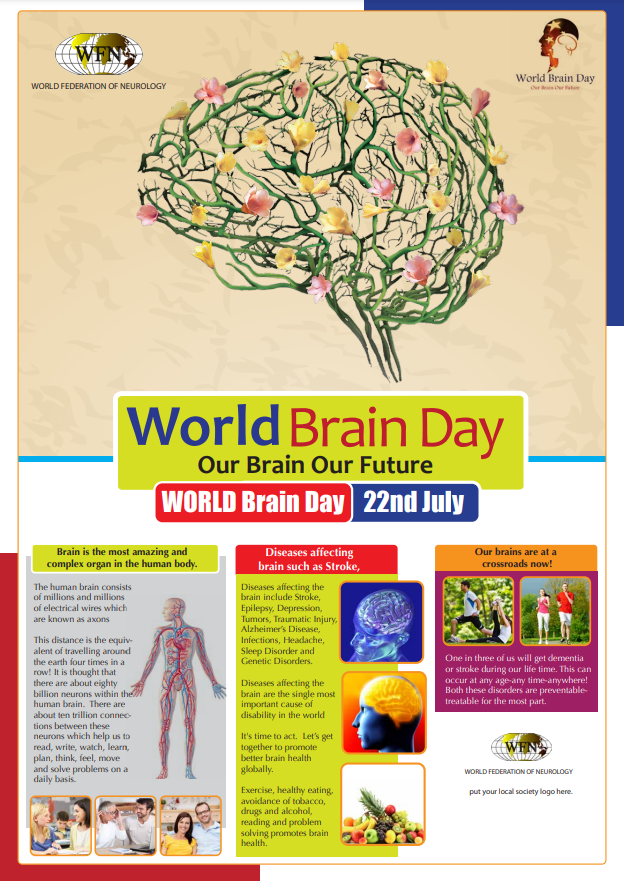
World Brain Day / Wereld Hersendag 2026

Click image to read

There are many days related to neurological diseases being celebrated by professional organizations in collaboration with World Health Organization, national organizations and local health ministries including World Stroke day, Epilepsy Day, Rabies Day.

These days have proven to be extremely helpful in promoting public awareness and generating advocacy throughout the globe including developing Asian, African and Latin American countries. The World Federation of Neurology was established on July 22 1957. It was suggested by the Public Awareness and Advocacy Committee that 22 July 2014 should be celebrated as “World Brain Day”. This proposal was announced at WCN, Council of Delegates meeting on 22 September, 2013 and the proposal was received with a warm welcome by delegates. The Board of Trustees meeting in February 2014 endorsed this proposal as an annual activity. World Brain Day 2026 is a global call to address these disparities and advocate for change. Science and medicine have made significant progress in understanding the brain, yet millions of people globally still cannot access essential care. More than 3.4 billion people currently live with neurological conditions, making brain disorders the leading cause of disability worldwide. Access to neurological care remains uneven across countries, regions, and communities.   Many people still face barriers including cost, lack of trained specialists, long waiting times, stigma, and limited access to services

Links:
World Brain Day

Pi Approximation Day / Pi-benaderingsdag 2026

Pi Approximation Day is observed every year on July 22 all around the world.

The fraction 22/7 is an approximate value of Pi, and there behind lays a specific reason why this day is observed on July 22. This day is celebrated on July 22 every year because the value of Pi is denoted by the fraction 22/7. Here, in the fraction 22/7 which denoted Pi, the numerator 22 symbolizes the date (22nd day of the month) and numerator 7 indicates the month (July). Approximations for the mathematical constant pi (π) in the history of mathematics reached an accuracy within 0.04% of the true value before the beginning of the Common Era. In Chinese mathematics, this was improved to approximations correct to what corresponds to about seven decimal digits by the 5th century. Further progress was not made until the 14th century, when Madhava of Sangamagrama developed approximations correct to eleven and then thirteen digits. Jamshīd al-Kāshī achieved sixteen digits next. Early modern mathematicians reached an accuracy of 35 digits by the beginning of the 17th century (Ludolph van Ceulen), and 126 digits by the 19th century (Jurij Vega), surpassing the accuracy required for any conceivable application outside of pure mathematics. The record of manual approximation of π is held by William Shanks, who calculated 527 decimals correctly in 1853. Since the middle of the 20th century, the approximation of π has been the task of electronic digital computers (for a comprehensive account, see Chronology of computation of π). On June 28, 2024, the current record was established by the StorageReview Lab team with Alexander Yee’s y-cruncher with 202 trillion (2.02×10¹⁴) digits.

Links:
Pi Approximation Day History, Meaning, Significance, other Celebration ideas

75th Anniversary of the Refugee Convention / Verdrag betreffende de status van vluchtelingen / Convention relating to the Status of Refugees – ondertekening (1951)

Verdrag betreffende de status van vluchtelingen

Het Verdrag betreffende de status van vluchtelingen of Vluchtelingenverdrag (Convention relating to the Status of Refugees) werd op 28 juli 1951 opgesteld tijdens een door de Verenigde Naties georganiseerde conventie na voorbereidende beraadslagingen in 1950 te New York en in 1951 te Genève.

In 2026 op 28 juli precies 75 jaar geleden spraken landen via dit VN-Vluchtelingenverdrag af dat mensen die vluchten voor oorlog en vervolging bescherming verdienen. Het verdrag definieert wie in aanmerking komt voor de status van vluchteling, het bepaalt dat landen die zijn aangesloten bij het verdrag asiel zullen verlenen aan personen die daar een aanvraag voor indienen en bepaalt dat aan een al dan niet als vluchteling erkende asielzoeker bepaalde rechten worden toegekend. Het verdrag bepaalt de rechten van vluchtelingen uit conflictsituaties voor 1951, terwijl een in 1967 opgesteld protocol bij de conventie ook de rechten van vluchtelingen van na die datum regelt. Basisbeginsel van het verdrag is de regel, dat iemand die is gevlucht niet teruggestuurd mag worden naar het herkomstland als er gegronde vrees voor vervolging bestaat, het zogenaamde non-refoulement principe. Dit beginsel heeft zich in de loop van de decennia nadat het verdrag in werking is getreden, ontwikkeld tot internationaal gewoonterecht, wat betekent dat het overal ter wereld voor alle landen is gaan gelden, ook landen die niet zijn aangesloten bij het verdrag en ongeacht de status als vluchteling of niet. Dit verdrag kwam in de plaats van de gebrekkige regelingen die er voorheen onder de Volkenbond, de voorloper van de VN, tot stand waren gekomen en stond sterk in het teken van de gebeurtenissen in de Tweede Wereldoorlog. Het verdrag (en protocol) is anno 2023 door meer dan 145 staten ondertekend en geratificeerd. Enige landen maakten een voorbehoud.

Links:
The 1951 Refugee Convention and 1967 Protocol relating to the Status of Refugees

Mensen op de vlucht help je. Toen en nu. – zet jouw naam bij dit bericht in de krant

Eén blok eruit en de toren wankelt

Mensen op de vlucht help je. Toen en nu. – zet jouw naam bij dit bericht in de krant

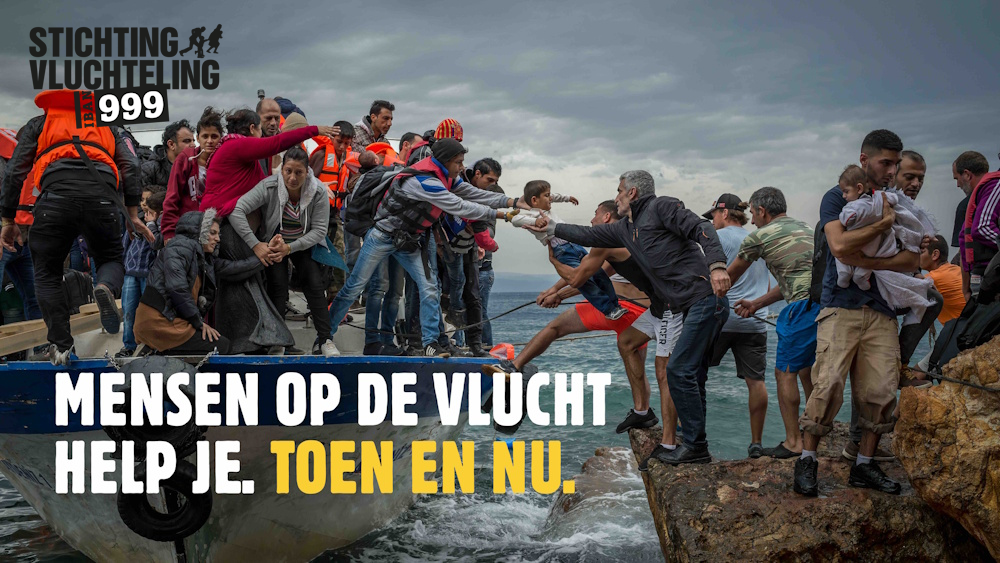
Mensen op de vlucht help je. Toen en nu.

Iemand die vlucht voor oorlog en geweld, die help je.

Precies 75 jaar geleden spraken landen via het VN-Vluchtelingenverdrag af dat mensen die vluchten voor oorlog en vervolging bescherming verdienen. Die afspraak staat vandaag de dag steeds meer onder druk. Daarom komt Stichting Vluchteling in actie! Met 1030 vierkante centimeter komt een advertentie paginagroot op dinsdag 28 juli 2026 in NRC, Volkskrant, AD, Trouw en Het Parool. De boodschap? ‘Mensen op de vlucht help je. Toen en nu’. Help mee dit bericht te verspreiden. Stichting Vluchteling zet jouw voornaam bij dit bericht in een landelijke krant. Het doel: zoveel mogelijk kranten vol met deze boodschap op dinsdag 28 juli, precies 75 jaar na het tekenen van het Vluchtelingenverdrag. Hoe meer mensen steunen, hoe luider onze stem. Help je mee? Meedoen kan tot en met 26 juli 23:59.

Links:
Doneer een vierkante centimeter

Eén blok eruit en de toren wankelt

The State of Food Security and Nutrition in the World 2026

The State of Food Security and Nutrition in the World
Global hunger declined for a third consecutive year in 2025, demonstrating that progress is possible. However, the improvements remain fragile, unevenly distributed and insufficient to achieve the Sustainable Development Goals by 2030, according to The State of Food Security and Nutrition in the World 2026 (SOFI 2026) report, released on Tuesday by five United Nations specialized agencies.

The report estimates that 7.8 percent of the global population faced hunger in 2025, down from 8.1 percent in 2024 and 8.6 percent in 2022, confirming a sustained, albeit slow, improvement. This means that around 645 million people were affected by hunger in 2025, representing a reduction of nearly 14 million compared to 2024 and 43 million compared to 2022. Despite global progress, recovery remains uneven across regions. Asia, together with Latin America and the Caribbean, has recorded steady improvements in recent years. In contrast, Africa is now home to approximately 309 million hungry people, compared with 292 million in Asia. Although Africa’s previously rising trend is beginning to stabilize, with the share of its population facing hunger decreasing from 20.3 percent in 2024 to 20.0 percent in 2025, the continent now has the highest number of hungry people in absolute terms amid a rapidly growing population. Broader measures of food access tell a similar story. In 2025, an estimated 25.8 percent of the global population (around 2.1 billion people) experienced moderate or severe food insecurity, meaning they were at times forced to compromise on the quality or quantity of the food they ate. This is down from 27.1 percent in 2024 and 28.7 percent in 2020 – equivalent to nearly 86 million fewer people than in 2024 and 135 million fewer than in 2020, though still above pre-pandemic levels. Regional disparities remain stark. More than half of Africa’s population (56.6 percent) faced moderate or severe food insecurity in 2025, compared to 20.3 percent in Asia, 22.9 percent in Latin America and the Caribbean, and 8.7 percent in Northern America and Europe. Food insecurity also continues to be more prevalent in rural areas than in peri-urban and urban areas, while women remain disproportionately affected, although the gender gap narrowed slightly in 2025.

Links:
The State of Food Security and Nutrition in the World 2026