248th AAS meeting

The American Astronomical Society (AAS) is an American society of professional astronomers and other interested individuals, headquartered in Washington, DC.

The primary objective of the AAS is to promote the advancement of astronomy and closely related branches of science, while the secondary purpose includes enhancing astronomy education and providing a political voice for its members through lobbying and grassroots activities. Its current mission is to enhance and share humanity’s scientific understanding of the universe as a diverse and inclusive astronomical community. One goal of the Society to help achieve its mission is to facilitate and strengthen the interactions among members through professional meetings and other means, including supporting AAS Divisions and others in the field. AAS Meeting Services provides comprehensive meeting planning and support to our Divisions, ourselves, and others in the astronomical sciences.

Links:
248th AAS meeting

ACTIE: Wie zit hier voor ons? De Toekomst aan Tafel

ACTIE: Wie zit hier voor ons? De Toekomst aan Tafel

📣 Fossiele lobbyisten beïnvloeden al decennia de politiek en klimaatbeleid, daarentegen wordt naar de stem van jongeren nauwelijks geluisterd.

Daarom komt Milieudefensie Jong in actie ✊. Kom op 9 juni 2026 naar Den Haag om te demonstreren! De jongeren eisen een plek aan tafel bij onderhandelingen over klimaatbeleid en dat onze stem luider klinkt dan die van de fossiele lobby🏛️. Zij nemen de stoelen mee, jij jezelf🪑.

Links:
Wie zit hier voor ons? De Toekomst aan Tafel

Agenda – Onderzoeksrapport State of Youth : Klimaat – publicatie

Big Bang / Oerknal & het Universum : Grote Aantrekker / Great Attractor

De Grote Aantrekker is een gebied in het heelal met een sterke gravitationele anomalie. Het gebied bevindt zich in het sterrenbeeld Winkelhaak, in de buurt van de Hydra-Centaurus-supercluster op een afstand van 150 tot 250 miljoen lichtjaar.

Index:

Introductie

Links

Introductie:
De massa van de Grote Aantrekker is tienduizenden malen groter dan de massa van de Melkweg. Het totale gebied dat onder invloed staat van de Grote Aantrekker heeft een diameter van honderden miljoenen lichtjaren en omvat onder andere de Virgo- of lokale supercluster waar de Melkweg deel van uitmaakt. Sinds 2014 is dit gebied gedefinieerd als de supercluster Laniakea. Op zijn beurt beweegt de Grote Aantrekker richting de Shapley-supercluster.

Alle sterrenstelsels vertonen de volgens de Wet van Hubble verwachte relatie tussen afstand en roodverschuiving, echter met schijnbare en opvallende afwijkingen. Dit kan verklaard worden met het bestaan van de Grote Aantrekker. De sterrenstelsels van Laniakea (met daaronder de Melkweg) bewegen zich met een snelheid van ongeveer duizend kilometer per seconde in de richting van de Grote Aantrekker. Er kan niet worden gesproken van een grote “massa” omdat niet bekend is wat het is. Het kan evengoed een singulariteit zijn of een nog onbekend ander fenomeen.


Links:
Big Bang / Oerknal & het Universum

10 jaar VN-verdrag handicap : Resultaten belevingsonderzoek – publicatie

10 jaar VN-verdrag handicap

Tien jaar nadat het VN-verdrag handicap in Nederland ging gelden, ervaren mensen met een beperking nog altijd dat ze niet volledig kunnen meedoen op het gebied van werk, zorg, onderwijs en sociale participatie.

Daarnaast staat voor veel van hen de financiële zekerheid onder druk. Tegelijkertijd geeft bijna een op de vier aan het gevoel te hebben niet mee te tellen in de samenleving. Dat blijkt uit het onderzoek ’10 jaar VN-verdrag handicap : Resultaten belevingsonderzoek’ van het College voor de Rechten van de Mens onder ruim 1.800 Nederlanders met een beperking. Het College benadrukt dat meer inspanningen nodig zijn om de doelstellingen van het verdrag te realiseren.

Links:
Tien jaar VN-Verdrag handicap in Nederland: barrières in werk, zorg en op sociaal vlak blijven

Mensen met beperking nog altijd achtergesteld, oordeelt toezichthouder

Robert Koch Colloquium 2026 “Navigating Public Health in Times of Global Uncertainties”

Robert Koch Colloquium

The Robert Koch Colloquium (RKC) is an annual interdisciplinary lecture series. It focuses each year on one contemporary and innovative public health topic, such as Burden of Disease (2019), Public Health Surveillance (2021), Climate Change and Public Health (2022), Social Inequities in Health (2023), Mobility and Public Health (2024) and Public Health Data (2025).

Each year, the Robert Koch Institute invites leading international experts to present and discuss their area of work at the Robert Koch Colloquium. This year’s colloquium topic was “Navigating Public Health in times of Global uncertainties”. Over two days, a series of interactive lectures addressed topics related to the impact of conflicts on Public Health systems, global sharing of health data in times of uncertainty, the current shifts in health governance at local, national and international level as well as the citizens’ trust in Public Health science. The lectures were  complemented by a panel discussion.

The Robert Koch Colloquium 2026 addressed an urgent challenge of today’s public health landscape: how to adapt to global uncertainties and political fragmentation. Armed conflicts, political and economic instability, climate-related pressures, and fluctuating public trust increasingly shape the contexts in which public health systems operate, challenging established modes-of-action and international cooperation. In response to these dynamics, the RKC 2026 brought together leading international experts to reflect on how public health can respond and evolve under conditions of crisis and transformation. Over two days, the programme examined public health action in times of crisis. We explored
1) the health impacts of armed conflict on population health including mental health and non-communicable diseases.
2) widening inequalities in times of global polycrisis.
3) the need for a resilient global health architecture during geopolitical shifts in power and interests. The colloquium also shed light on advancing health data justice and the development of resilient cross-border data-sharing frameworks that can withstand political and financial pressures. Particular attention was paid to the current challenge of building and sustaining trust in evidence-based public health science in times of widespread misinformation. The colloquium concluded with a panel discussion titled “Rethinking Global Public Health: From Crisis Response to Long-term Sustainability”, synthesizing key insights and outlining visions towards a more resilient and equitable public health future. By combining scientific perspectives with policy-oriented insights, the RKC 2026 aimed to foster interdisciplinary dialogue across sectors and governance levels.

Links:
Robert Koch Colloquium 2026 “Navigating Public Health in Times of Global Uncertainties”

Week van de HSP 2026

Tijdens de Week van de hoogsensitief persoon (HSP) laten allerlei professionals in Nederland en België zien wat ze aanbieden op het gebied van hooggevoeligheid, oftewel hoogsensitiviteit.

Voor iedere HSP is er dus van alles te proeven door middel van onder meer workshops, webinars, downloads. Laagdrempelig kennismaken op een feestelijke manier, daar staat de Week van de HSP voor.

Links:
Week van de HSP

2026-06-08, Lief dagboek

Maandag; Wat eten we vandaag?; Einde detachering gemeente Haarlemmermeer; Wereld Oceanen Dag; VN-verdrag handicap; The Sky at Night.

Deze afbeelding heeft een leeg alt-attribuut; de bestandsnaam is dagboek.png

Wat eten we vandaag?:

Klik op afbeelding voor origineel

Einde detachering gemeente Haarlemmermeer:
Bovenstaande maaltijd bleek de laatste in het zeer gewaardeerde restaurant in Hoofddorp. A3 was aangenomen wegens groot personeelstekort, nu blijken twee ingewerkte mensen te vertrekken. Omdat A3 niet de snelste leerling blijkt te zijn en dus eigenlijk al zelfstandig had moeten werken, is zijn positie onpraktisch geworden.

Agenda:

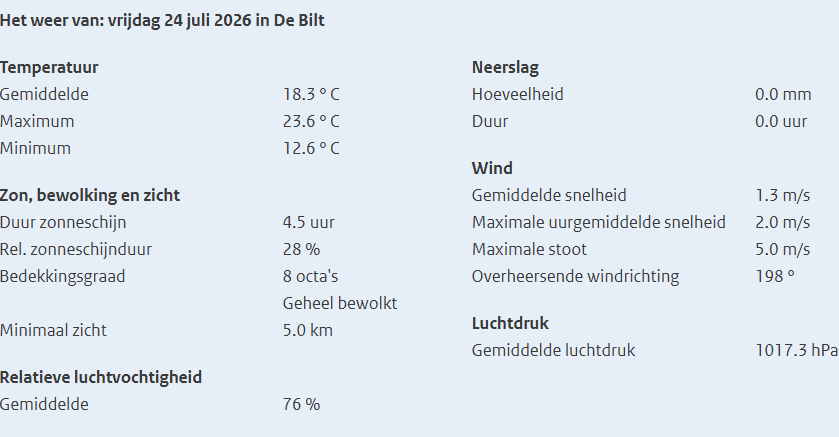
Weer:

Links:
In de geschiedenis

The Sky at Night – Space Weather: The Perfect Storm (TV BBC Four / BBC iPlayer)

The Sky at Night

The Sky at Night is a monthly documentary television programme on astronomy produced by the BBC.

The show had the same permanent presenter, Patrick Moore, from its first broadcast on 24 April 1957 until 7 January 2013. The latter date was a posthumous broadcast, which followed Moore’s death on 9 December 2012. This made it the longest-running programme with the same presenter in television history. Many early episodes are missing, either because the tapes were wiped, thrown out, or because the episode was broadcast live and never recorded in the first place. Beginning with the 3 February 2013 edition, the show was co-presented by Lucie Green and Chris Lintott. Since December 2013 Maggie Aderin-Pocock has been a presenter. The programme’s opening and closing theme music is “At the Castle Gate”, from the incidental music to Pelléas et Mélisande, written in 1905 by Jean Sibelius, performed by the Royal Philharmonic Orchestra and conducted by Sir Thomas Beecham.

This episode:
Life on Earth depends on the sun for its light and its warmth. But the activity of our nearest star also poses a serious threat to all of us. In the most extreme cases, solar storms can send billions of tons of supercharged plasma hurtling at millions of miles per hour towards us, crippling our navigation and communication systems and damaging our power grids. In this episode of The Sky at Night, we uncover a danger that humanity is only just waking up to – space weather.

We begin our journey with the first scientifically recorded instance of extreme space weather. Chris Lintott meets the president of the Royal Astronomical Society, Professor Jim Wild. With privileged access to the society’s archives, Chris learns about the Carrington Event of 1859, when a massive solar storm caused aurorae as far south as the Caribbean and sparks to jump from telegraph wires, setting fires and electrocuting operators. Worryingly, if this were to hit us today, it could be a lot worse…

But to understand how space weather functions, we need to grasp how the matter spat out by the sun interacts with the Earth. Maggie Aderin drops into Warwick University to discover how Dr Ravindra Desai’s research is helping us do just that. From the magnetosphere, the vast protective bubble generated by our planet’s magnetic core, to the Van Allen Belts – dangerous layers of radiation trapped just above the Earth – Dr Desai is developing next-generation forecasting tools that will help to protect us from future risks.

At Imperial College London, Chris Lintott gets a peek inside a groundbreaking deep space mission that will revolutionise our ability to monitor the sun’s activity and forecast solar storms. Professor Jonathan Eastwood, the magnetometer instrument lead of Vigil, takes Chris through the satellite’s capabilities. Sat 150 million kms away from Earth, Vigil will monitor the sun’s surface as it rotates towards us, giving us an extra five days’ notice of hazardous activity and a chance to avert a crisis.

In Exeter, our guest presenter, Sophia Herod, is allowed inside a very special department at the Met Office’s HQ – one of only a handful of 24/7 space weather forecasting operations in the world. There, with the help of space weather expert Krista Hammond, Sophia discovers how the Met Office is keeping a beady eye on the sun, investing in the technologies of the future, and working with government and industry to protect vital infrastructure we all rely on. Ultimately, Sophia reveals that the UK is leading the way on space weather.

Although space weather can be scary stuff, we don’t need to live through a disaster movie. This episode tells the amazing story of scientific solutions to vast and intractable problems, and how teams of people dedicate their working lives to keeping us safe from the very worst that the sun can throw at us.

Links:
The Sky at Night