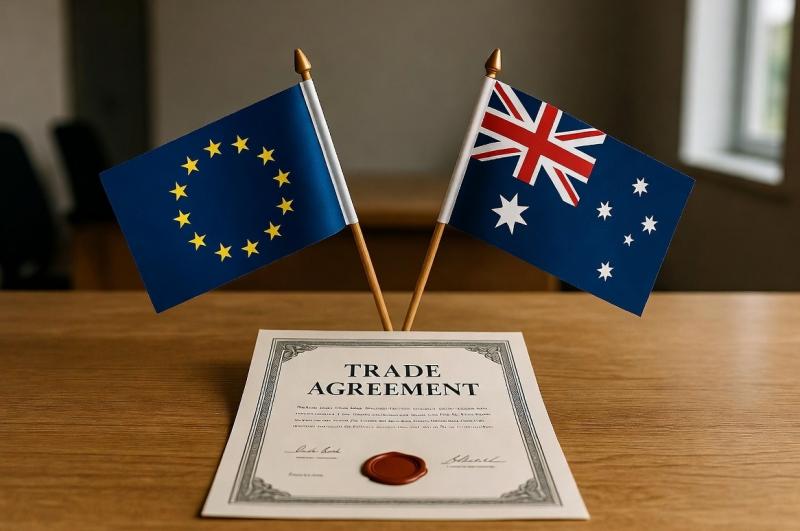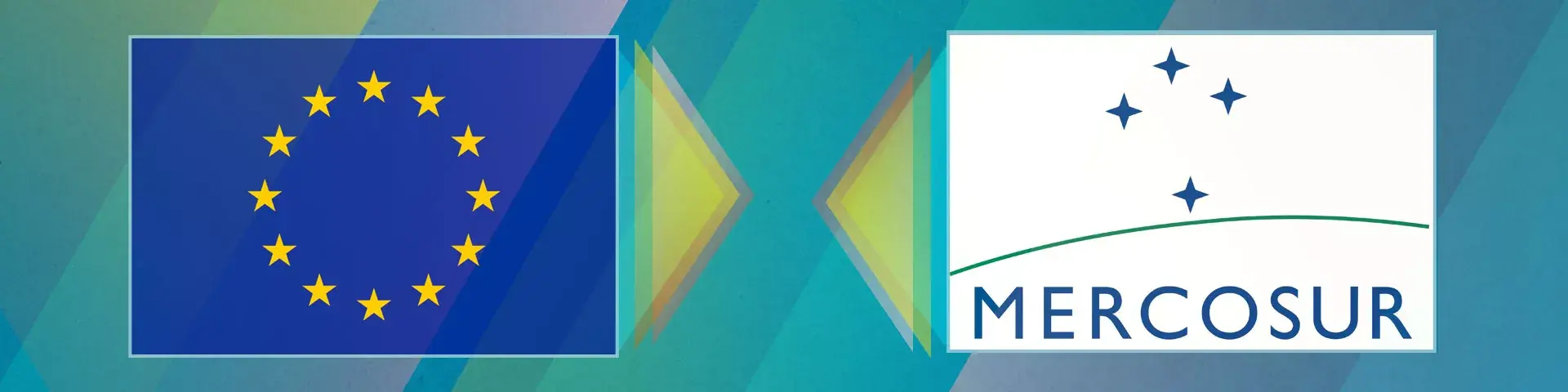
The European Union–Mercosur free trade agreement is a free trade agreement on which the European Union and Mercosur reached agreement in principle in 2019.
The planned deal was announced on 28 June at the 2019 G20 Osaka summit after twenty years of negotiations. The agreement is praised but also criticized by NGOs, scientists, unions, farmers and indigenous people with both positive and negative aspects usually balanced during discussions. Although there is agreement in principle, the final texts have not been finalised, signed, or ratified and therefore have not entered into force. If ratified, it would represent the largest trade deal struck by both the EU (512 million inhabitants before Brexit) and Mercosur (260 million inhabitants), in terms of numbers of citizens involved. The draft trade deal is part of a wider Association Agreement between the two blocs. Besides trade, the association agreement would also deal with cooperation and political dialogue. Negotiations on these two parts were concluded on 18 June 2020. The President of the European Commission Ursula von der Leyen and her counterparts from four Mercosur countries (Brazilian President Lula, Argentinian President Milei, Paraguayan President Peña, and Uruguayan President Lacalle Pou) finalised negotiations and reached a political agreement on 6 December 2024 for a EU-Mercosur partnership agreement. On January 9, 2026, a qualified majority of EU member states gave the green light to the agreement by a vote of 21 to 5, with Austria, France, Hungary, Ireland, and Poland voting against it, and Belgium abstaining. On January 17 the European Union and the Mercosur bloc on Saturday signed their long-awaited trade agreement, sealing one of the world’s biggest free-trade deals after more than 25 years of negotiations and repeated political standoffs. The deal must still be approved by the European Parliament and national legislatures on both sides of the Atlantic, where opposition — particularly from farming groups — is expected to remain fierce. On 21 January 2026, the European Parliament voted to refer the deal to the European Court of Justice for a legal opinion. This does not necessarily block the deal being implemented provisionally by the Commission before the Members of the European Parliament (MEPS) approve it. The legal opinion may take up to two years to be issued.
Links:
EU and Mercosur reach political agreement on groundbreaking partnership
Brandbrief aan de EU: het is nu of nooit – STOP het EU-Mercosur akkoord!
Approved EU-Mercosur deal could spell disaster for animals
STOP EU-Mercosur – petitie
EU-top – Europese Raad, 18-19 december 2025
E-mailactie Stop Mercosur
Stop schadelijk handelsverdrag EU-Mercosur!
EU–Mercosur: kabinet zegt ja, wij zeggen NEE
EU-Mercosur deal will have devastating impacts for animals
EU seals contentious trade deal with Mercosur countries
Klap voor Von der Leyen: uitstel dreigt voor Mercosur-verdrag
Handelsverdragen : Mercosur