2024 #HumansToMars Summit

H2M 2024 will focus on questions that include:

  • Do we have a viable mission architecture plan for Mars?
  • What are the most significant technological hurdles (or long poles) that need to be overcome before humanity steps on the surface of Mars?
  • Do we have an adequate pipeline of skilled workers to build our future in space?
  • How can governments and commercial industry collaborate to enable a human presence on Mars?
  • Can we send humans to Mars in 2033?
  • How can innovations from Mars-focused R&D drive value and improvement on Earth, and how can stakeholders contribute?
  • What are the major Mars science achievements over the past year – and what are our objectives before humans first step foot on the surface?
  • How can we most effectively protect the physical and mental health of astronauts voyaging to and from Mars?


Links:
Humans to Mars Summit

World Migration Report 2024 / Global Trends report 2023 – publication

World Migration Report 2024 Reveals Latest Global Trends and Challenges in Human Mobility and UNHCR’s Global Trends report presents key statistical trends and the latest official statistics on refugees, asylum-seekers, internally displaced and stateless people worldwide.

The International Organization for Migration (IOM) launched the World Migration Report 2024, which reveals significant shifts in global migration patterns, including a record number of displaced people and a major increase in international remittances. At the end of 2023, 117.3 million people worldwide were forcibly displaced as a result of persecution, conflict, violence, human rights violations and events seriously disturbing public order.

Links:
World Migration Report 2024 Reveals Latest Global Trends and Challenges in Human Mobility

Nooit eerder waren zoveel mensen op de vlucht

#WithRefugees Wereld Vluchtelingen Dag / #WorldRefugeeDay 2024

2024-05-07, Lief dagboek

Dinsdag; Wat eten we vandaag?; Pro-Palestina studentenprotesten; Europese Parlementsverkiezingen; Foodwatch Lunch-College; Meteorenzwerm η-Aquariden; Wereld Astma Dag; World Health Day.

Deze afbeelding heeft een leeg alt-attribuut; de bestandsnaam is dagboek.png

Wat eten we vandaag?:

Pasta, klik op afbeelding voor origineel

Knipselkrant:


Agenda:

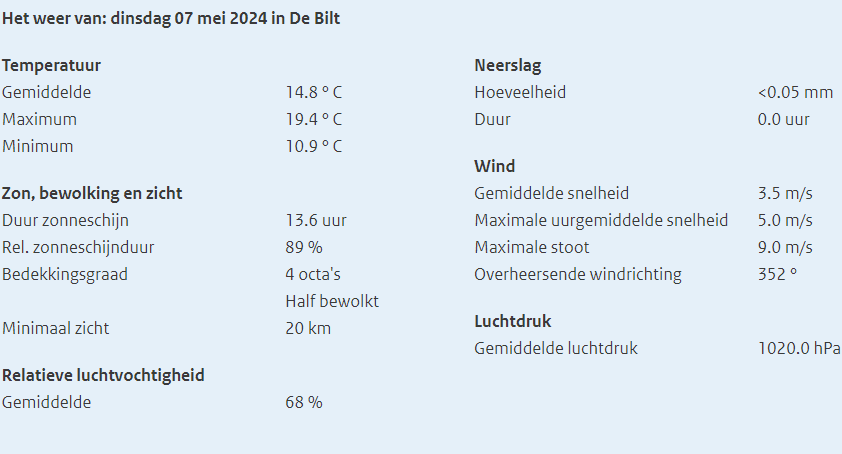
Weer:

Deze afbeelding heeft een leeg alt-attribuut; de bestandsnaam is 50813896361_463cbfec7c.jpg

Links:
In de geschiedenis

Foodwatch Lunch-College: meer weten over de EU en het eten op je bord (TV webcast)

Bij dit interactieve Foodwatch-College tijdens lunchtijd duiken we samen in de wondere wereld van het EU-voedselbeleid, het Lunch-College vindt online plaats via Teams en je ontvangt na registratie een link in je mailbox om online deel te kunnen nemen.

Wat staat er op het menu van het Lunch-College? Foodwatch expert in Brussel, Suzy Sumner, zal ons 30 mei bijpraten over diverse voedselkwesties in de EU. Eet gerust een boterhammetje terwijl thema’s als voedsellobby, gezondheid, voedselmisleiding, landbouw en voedselprijzen de revue passeren. Je krijgt inzicht in hoe besluiten over ons voedselsysteem tot stand komen in de EU en welke wetgeving hier verantwoordelijk voor is of zou moeten zijn. Welke beloftes moet de EU de komende vijf jaar waarmaken om voor structurele verbeteringen van het eten op ons bord te zorgen? Wil je nu al meer lezen over de Bende op ons bord in Europa, ga dan naar de campagne op de website en vergeet ook niet de petitie te tekenen als je dat nog niet gedaan hebt. Let op: de bijeenkomst zal zowel Nederlands als Engelstalig zijn. Suzy verstaat de Nederlandse taal uitstekend, maar zal zelf spreken in het Engels.

Links:
Foodwatch Lunch-College: meer weten over de EU en het eten op je bord

Libellentelling 2024

Wereldwijd neemt het aantal libellen af; ook in Nederland zijn diverse soorten libellen bedreigd, tijdens de Libellentelling worden daarom de libellen in de Nederlandse tuinen gemonitord.

Door het verdwijnen van natuur, klimaatverandering en watervervuiling staan veel libellensoorten onder druk. Tijdens de Landelijke Libellentelling wordt gepeild hoe het gaat met de verschillende soorten in onze tuinen. Kijk tijdens het telweekend uit naar libellen in je tuin. Tel je mee? Je waarnemingen kun je tot en met de maandagochtend erna doorgeven.

Links:
Libellentelling

Project Hephaistos – II. Dyson sphere candidates from Gaia DR3, 2MASS, and WISE – publication

Astronomers find 60 Dyson sphere megastructure candidates among millions of searched stars.

Dyson spheres are gargantuan artificial structures, built by extraterrestrial civilizations around around their stars, with the goal of capturing energy. First proposed in 1960 by physicist Freeman Dyson, they are an incredible thought experiment. Two teams of astronomers in Sweden and Italy recently conducted a new search for possible evidence of Dyson spheres. The astronomers examined 5 million stars, up to 6,500 light-years away and found 60 possible candidate stars. The stars, both red dwarfs (or M dwarfs) and larger ones including sun-like stars, are emitting up to 60 times more infrared heat than scientists expected. The results fit with what astronomers would expect to see from Dyson spheres. The teams found the candidates in the latest Gaia DR3 data from the European Gaia satellite as well as the Two Micron All Sky Survey (2MASS) and Wide-field Infrared Survey Explorer (WISE). The researchers said it is difficult to explain the observations with currently known natural processes. And even if the process is most likely a previously unknown natural phenomenon, it’s still a fascinating discovery.

Links:
Astronomers find 60 Dyson sphere candidates, among millions of searched stars

Alien ‘Dyson sphere’ megastructures could surround at least 7 stars in our galaxy, new studies suggest

Background Contamination of the Project Hephaistos Dyson Spheres Candidates

Project Hephaistos

NASA Simulation’s Plunge Into a Black Hole: Explained – publication

Ever wonder what happens when you fall into a black hole?

Thanks to an immersive visualization produced on a NASA supercomputer, viewers can plunge into the event horizon, a black hole’s point of no return. The visualizations are available in multiple forms. Explainer videos act as sightseeing guides, illuminating the bizarre effects of Einstein’s general theory of relativity. Versions rendered as 360-degree videos let viewers look all around during the trip, while others play as flat all-sky maps. To create the visualizations, Schnittman teamed up with fellow Goddard scientist Brian Powell and used the Discover supercomputer at the NASA Center for Climate Simulation. The project generated about 10 terabytes of data — equivalent to roughly half of the estimated text content in the Library of Congress — and took about 5 days running on just 0.3% of Discover’s 129,000 processors. The same feat would take more than a decade on a typical laptop. The destination is a supermassive black hole with 4.3 million times the mass of our Sun, equivalent to the monster located at the center of the Milky Way galaxy.

Links:
New NASA Black Hole Visualization Takes Viewers Beyond the Brink