Vroege Vogels TV | 5 mei 2024 | Haagse Bos (TV NPO 2)

Vroege Vogels is een live-radioprogramma, tv-programma en online community van BNNVARA over natuur en milieu.

In het radioprogramma wordt het gesproken woord omlijst door licht klassieke muziek en salonmuziek. Het radioprogramma werd in 1978 voor het eerst uitgezonden door de VARA en is een van de langst lopende en best beluisterde radioprogramma’s van de publieke omroep. Het wordt elke zondagmorgen uitgezonden tussen 07:00 en 10:00 op NPO Radio 1. De beginmuziek is een bewerking van Vivaldi’s “Piccolo Concerto in C major” (RV 443). De tv editie wordt uitgezonden op NPO 2, vaak rond een thema.

Politici en de koning, dat zijn waarschijnlijk de bekendste bewoners van onze hofstad Den Haag. Maar tussen het Binnenhof en Huis ten Bosch ligt ook het Haagse Bos, een van de oudste beschermde bossen van Nederland. Tussen de hoge bomen duiken sperwers, bosuilen en eekhoorns op. De Haagse kronkel krioelt op de bosbodem, een miljoenpoot die bijna alleen hier leeft. En we bezoeken de tuin van de koning om de prachtige bosanemoon te bewonderen.

Links:
Vroege Vogels (na afloop terugkijken)

Dawn Chorus Day / Vogelconcert 2024

Set your alarm and celebrate the dawn chorus, one of nature’s most uplifting wonders. Join Dawn Chorus Day at 05:00 – 09:00 (local time).

Spring is the best time of the year for listening to birds singing, so it’s also the perfect time for you to tell us which song you like best. Do you love the sad song of a robin? How about the amazing trill of a tiny wren, or the messy, scratchy warble of the blackcap?

Vote now on Instagram, Facebook or Twitter and tell which song is your favourite.

Links:
Dawn Chorus Day

World Hand Hygiene Day 2024

World Hand Hygiene Day campaign objectives: To recognize that people of all levels should work together to influence the culture/climate through clean hands knowledge and behaviour, to meet the common goal of safety and quality in the health care organization.

Hand hygiene, hand washing or handwashing is the act of cleaning one’s hands with soap or handwash and water to remove viruses/bacteria/microorganisms, dirt, grease, or other harmful and unwanted substances stuck to the hands. Drying of the washed hands is part of the process as wet and moist hands are more easily recontaminated. If soap and water are unavailable, hand sanitizer that is at least 60% (v/v) alcohol in water can be used instead, unless hands are visibly excessively dirty or greasy. Hand hygiene is central to preventing the spread of infectious diseases in home and everyday life settings. The World Health Organization (WHO) recommends washing hands for at least 20 seconds before and after certain activities. These include the five critical times during the day where washing hands with soap is important to reduce fecal-oral transmission of disease: after using the toilet (for urination, defecation, menstrual hygiene), after cleaning a child’s bottom (changing nappies), before feeding a child, before eating and before/after preparing food or handling raw meat, fish, or poultry. When both hand washing and using hand sanitizer are not available, hands can be cleaned with uncontaminated ash and clean water, although the benefits and harms are uncertain for reducing the spread of viral or bacterial infections. However, frequent hand washing can lead to skin damage due to drying of the skin. Moisturizing lotion is often recommended to keep the hands from drying out; dry skin can lead to skin damage which can increase the risk for the transmission of infection.

2024 Theme: Promoting knowledge and capacity building of health and care workers through innovative and impactful training and education, on infection prevention and control, including hand hygiene.  

Slogan: Why is sharing knowledge about hand hygiene still so important? Because it helps stop the spread of harmful germs in healthcare. 

Objectives of WHHD 2024

  • Strengthen learning approaches to enable implementation of innovative and effective training to empower health and care workers to improve hand hygiene and IPC at point of care with enhanced knowledge, skills and behaviours.
  • Promote access to innovative hand hygiene and IPC training resources for health and care workers.
  • Raise awareness about the importance of knowledge and learning on hand hygiene at the right times to prevent a range of infectious diseases.
  • Encourage measurement and evaluation mechanisms to assess the impact of training and education on IPC standards and practices including hand hygiene, including their effect on the prevention of HAI and AMR.

Links:
World Hand Hygiene Day

Permaculture Day / Permacultuur Dag 2024

Permaculture is an approach to land management and philosophy that adopts arrangements observed in flourishing natural ecosystems.

It includes a set of design principles derived using whole systems thinking and uses these principles in fields such as regenerative agriculture, rewilding, and community resilience. Permaculture originally came from “permanent agriculture”, but was later adjusted to mean “permanent culture”, incorporating social aspects as inspired by Masanobu Fukuoka‘s natural farming. The term was coined by Bill Mollison and David Holmgren in 1978, who formulated the concept in opposition to Western industrialized methods and in congruence with Indigenous or traditional knowledge.

Permaculture has many branches including ecological design, ecological engineering, regenerative design, environmental design, and construction. It also includes integrated water resources management that develops sustainable architecture, and regenerative and self-maintained habitat and agricultural systems modeled from natural ecosystems. Permaculture has been implemented and gained widespread visibility throughout the world as an agricultural and architectural design system and as a guiding life principle or philosophy. Much of its success has been attributed to the role of Indigenous knowledge and traditions, in which the practice itself is rooted. In turn, the rise of permaculture has revalidated Indigenous knowledge in circles where it was previously devalued.

Links:
Permaculture Day

Bevrijdingsdag NL 2024

Op 5 mei wordt Bevrijdingsdag in Nederland gevierd, de dag waarop het Duitse leger in Nederland capituleerde.

Op 5 mei 1945 bespraken de Canadese generaal Charles Foulkes en de Duitse opperbevelhebber Johannes Blaskowitz in het bijzijn van Prins Bernhard (commandant van de Binnenlandse Strijdkrachten) in Hotel De Wereld in Wageningen de capitulatie van de Duitse troepen in Nederland. Blaskowitz vroeg 24 uur bedenktijd. Een dag later (op 6 mei 1945 dus) werden de uitgewerkte voorwaarden van de capitulatie getekend in de naast het hotel gelegen aula van de Landbouwhogeschool. Na de bevrijding in 1945 werd bepaald dat Bevrijdingsdag om de vijf jaren gevierd zou worden.

Links:
4en5mei

2020-05-05, Lief dagboek

Constant Velocity Physical Warp Drive Solution – publication

‘Warp drives‘ may actually be possible someday, study ‘Constant Velocity Physical Warp Drive Solution‘ suggests.

The study provides some theoretical underpinning to warp drives, suggesting that the superfast propulsion tech may not forever elude humanity. Sci-fi fans — especially “Star Trek” devotees — are familiar with warp drives. These hypothetical engines manipulate the fabric of space-time itself, compressing the stuff in front of a spaceship and expanding it behind. This creates a “warp bubble” that allows a craft to travel at incredible velocities — in some imaginings, many times faster than the speed of light. In 1994, Mexican physicist Miguel Alcubierre published a groundbreaking paper that laid out how a real-life warp drive could work. This exciting development came with a major caveat, however: The proposed “Alcubierre drive” required negative energy, an exotic substance that may or may not exist (or, perhaps, the harnessing of dark energy, the mysterious force that seems to be causing the universe’s accelerated expansion).

Links:
‘Warp drives’ may actually be possible someday, new study suggests

LibrePlanet 2024

LibrePlanet is the annual conference hosted by the Free Software Foundation (FSF). LibrePlanet provides an opportunity for activists, hackers, law professionals, artists, educators, students, developers, policymakers, tinkerers, and anyone looking for technology that respects the user’s freedom to come together in order to discuss current issues in technology and ethics.

The conference features talks and workshops for all ages and experience levels.

Links:
LibrePlanet 2024

2024-05-04, Lief dagboek

Zaterdag; Wat eten we vandaag?; Extinction Rebellion ketent zich vast Schiphol; (Alternatieve) dodenherdenking; Jaarverslag AIVD; Dag van de Brandweer; Extinction Rebellen; Star Wars Day; Gratis Stripboekendag; Respect for Chickens Day.

Deze afbeelding heeft een leeg alt-attribuut; de bestandsnaam is dagboek.png

Wat eten we vandaag?:

Bonen, klik op afbeelding voor origineel

Knipselkrant:


Agenda:

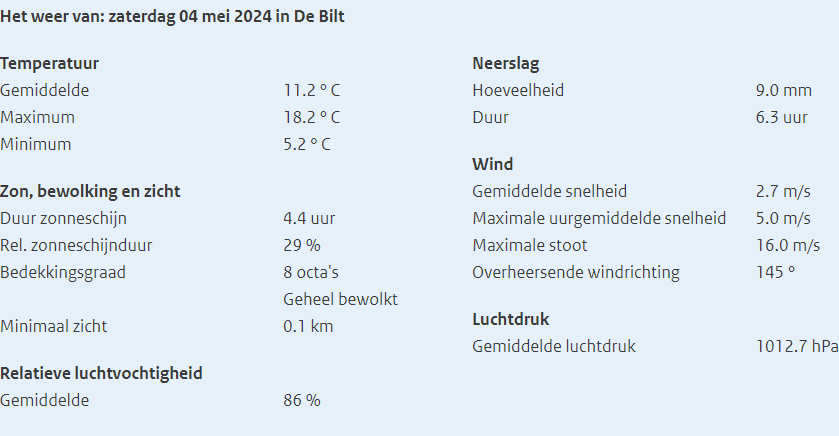
Weer:

Deze afbeelding heeft een leeg alt-attribuut; de bestandsnaam is 50813896361_463cbfec7c.jpg

Links:
In de geschiedenis

Dodenherdenking NL 2024

De Nationale Dodenherdenking, Nationale Herdenking of Dodenherdenking vindt jaarlijks in Nederland plaats op 4 mei, met onder andere twee minuten (vroeger een minuut) stilte om 20:00.

De landelijke herdenking is op de Dam in Amsterdam en wordt sinds 1988 georganiseerd door het Nationaal Comité 4 en 5 mei, terwijl honderden andere comités plaatselijke herdenkingen organiseren. In de oorspronkelijke opzet ging het om de Nederlandse slachtoffers in de Tweede Wereldoorlog, maar sinds 1961 wordt officieel een ruimere definitie gehanteerd die uitsluitend Nederlandse oorlogsslachtoffers of omgekomenen sinds het uitbreken van de Tweede Wereldoorlog omvat.

Links:
4en5mei.nl, herdenken

Wereld Feesten Almanak

Agenda – Alternatieve herdenking Knuffels, bloemen en kaarsen

‘Een herdenking zonder aan­dacht voor het heden is een betekenis­loos schouder­klopje’

2020-05-04, Lief dagboek : Dodenherdenking