De DNA dialogen : Mini-symposium ‘Hoe nu verder?’

De DNA dialogen

Knippen en plakken in het DNA van menselijke embryo’s, hoe denk jij hierover?

In 2012 is er een techniek ontwikkeld die het mogelijk maakt DNA eenvoudig te wijzigen. Nadat de Chinees He Jiankui in 2018 tegen alle regels in die techniek gebruikte om de eerste genetisch aangepaste baby’s geboren te laten worden is onderzocht hoe Nederlanders denken over het aanpassen van embryo-DNA. Het mag nog niet: knippen en plakken in het DNA van menselijke embryo’s. Het aanpassen van embryo-DNA heeft gevolgen voor ons allemaal en roept daarom veel vragen op. Bijvoorbeeld: is het oké om het DNA aan te passen om zo erfelijke ziektes uit het DNA te verwijderen? Hoe denk jij hierover? In de afgelopen jaren zijn we daarover in gesprek gegaan met diverse groepen mensen. Zij konden meepraten in dialogen om hun gedachten en gevoelens te delen. Uit de gevoerde gesprekken in een eerste Nederlands project (de DNA-dialoog van 2019 tot 2021) bleek, dat de deelnemers over het algemeen niet principieel tegen het aanpassen van DNA van toekomstige kinderen waren. Maar dat betekent niet dat ze er automatisch voorstander van waren. Ze vonden het alleen goed als het wordt gebruikt voor het voorkomen van ernstige erfelijke aandoeningen, zonder dat belangrijke (maatschappelijke) waarden onder druk komen te staan. Maar dan? Wat moesten politici daar dan mee? Hoe houd je rekening met maatschappelijke waarden? Is de ene waarde belangrijker dan de andere? Wat voor beleid konden politici daarop maken?

Het project De DNA dialogen (van 2022-2027) brengt waarden van verschillende groepen uit de samenleving in beeld en komt met opties hoe deze naar beleid kunnen worden vertaald. De afgelopen jaren zijn daarover gesprekken gevoerd op allerlei plekken in Nederland en met veel verschillende mensen. Wat is geleerd, wordt op 9 september 2026 graag gedeeld met iedereen die betrokken was, en natuurlijk ook met jou. Het belooft een bijzondere dag te worden. Niet alleen de belangrijkste uitkomsten van De DNA dialogen worden gepresenteerd, maar wordt ook getoond op welke creatieve manieren deze gesprekken zijn gevoerd. Je maakt bijvoorbeeld kennis met de Genmarkt, de Atlas van De DNA dialogen en de stellingen in Polis. Natuurlijk kun je ook zelf in gesprek gaan met de onderzoekers achter deze bijzondere methodes én met allerlei andere mensen die hebben meegedaan. Een speciaal onderdeel van het mini-symposium is de promotieplechtigheid van onderzoeker Diewertje Houtman. Zij verdedigt dan haar proefschrift over De DNA dialogen – en jij kunt daar gewoon bij zijn.

Links:
De DNA dialogen
De DNA dialogen – NEMOkennislink

Wool March

IYRP2026

The United Nations has declared the year 2026 as the International Year of Rangelands and Pastoralists (IYRP), across the world, people and organisations are coming together throughout the year to recognise and support the people, animals and landscapes that make pastoralism possible.

Shepherds and their flocks play a vital role in maintaining our landscapes. Through extensive grazing, they contribute to biodiversity, help reduce the risk of wildfires and maintain landscapes that can store and sequester carbon. Pastoralism is also part of our intangible cultural heritage, carrying knowledge, practices and traditions that have shaped our relationship with the land for generations. Yet shepherding is often overlooked and undervalued. Across the world, shepherds face growing challenges in sustaining their livelihoods. At the same time, the wool produced by their flocks is frequently treated as a waste material, despite its potential as a valuable and renewable resource. In this International Year, we are coming together to celebrate shepherds, sheep and wool, to share knowledge and experiences, and to open up a conversation about the future of pastoralism. We are calling for greater recognition, support and meaningful change. On 13 October 2026, the Wool March Brussels 2026 comes to a celebratory ending in the Ter Kamerenbos in Brussels. Together with shepherds, sheep and wool workers from across Europe, we will bring their voices to the European Parliament and demonstrate the importance of this living system.

Links:
Wool March

2026-08-21, Lief dagboek

Vrijdag; Prinsjesdag; Klimaatmars; biomassa klimaatneutraal?; Hitte en droogte; Herdenking en Eerbetoon aan de Slachtoffers van Terrorisme; El Niño; Aardbeving Gaswinning Groningen; Lowlands.

Deze afbeelding heeft een leeg alt-attribuut; de bestandsnaam is dagboek.png

Knipselkrant:


Agenda:

Weer:

Links:
In de geschiedenis

#UNiteforVictimsofTerrorism #VictimsofTerrorism Day of Remembrance and Tribute to the Victims of Terrorism / Herdenking en Eerbetoon aan de Slachtoffers van Terrorisme 2026

The Day of Remembrance and Tribute to the Victims of Terrorism was established by the United Nations General Assembly in 2017.

In its resolution 72/165 (2017), the General Assembly, established the International Day of Remembrance of and Tribute to the Victims of Terrorism to be commemorated annually on 21 August, in order to honour and support the victims and survivors of terrorism and to promote and protect the full enjoyment of their human rights and fundamental freedoms. In April 2020, mandated by General Assembly resolution 73/305, the United Nations Secretary-General António Guterres published his report on the ‘Progress of the UN system to support Member States in assisting victims of terrorism’ (A/74/790), which calls for the ‘enhancement of international cooperation to assist victims of terrorism’. Member States, through the biennial review resolutions of the Global Counter-Terrorism Strategy have emphasized the important role of victims of terrorism in countering terrorism, promoting international solidarity, preventing violent extremism, and helping Member States recognize and uphold their human rights, and support their distinct needs.

Since the sixth review of the Strategy (2018), developments at the international, regional, and national levels have increasingly demonstrated that support to victims has moved beyond symbolic solidarity towards a more robust engagement to advance their rights and needs. This is reflected in the establishment in 2019 of a Group of Friends of Victims of Terrorism, and the adoption of General Assembly resolution A/RES/73/305 on the enhancement of international cooperation to assist victims of terrorism. The eighth review resolution, adopted on 22 June 2023 (A/RES/77/298) notes the importance of upholding the rights and supporting the needs of victims of terrorism, in particular of women, children and those affected by sexual and gender-based violence committed by terrorists. It encourages all Member States to develop national comprehensive assistance plans for victims of terrorism and their families to address the immediate-, short- and long-term needs of victims of terrorism. The resolution welcomed the first United Nations Global Congress of Victims of Terrorism, held in September 2022 at UN Headquarters, encourages the UN Office of Counter-Terrorism, through the Global Victims of Terrorism Support Programme and the United Nations Victims of Terrorism Support Portal, to continue to raise awareness on victims of terrorism and the promotion and protection of their rights. This includes strengthening the capacity of Member States to assist victims of terrorism and strengthen their engagement with relevant civil society and private sector organisations, which can play a valuable role in assisting and supporting victims of terrorism.

Links:
Day of Remembrance and Tribute to the Victims of Terrorism, 21 August

An ‘unprecedented’ El Niño and its implications for the weather forecast – publication

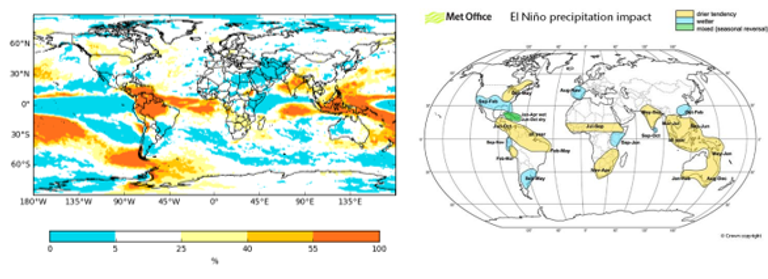
Latest global rainfall forecasts and the historical impact of El Niño. The rainfall forecast on the left indicates the chances of very low seasonal rainfall averaged over September-November. Red areas are most at risk and in many cases they agree with historical El Niño impacts (right)

2026 is going to be renowned for the development of the largest El Niño in living memory and what is probably the largest such event since the 19th century.

Analysis of historical data and computer simulations highlight the anomalous global rainfall patterns from El Niño, these are also well documented in a variety of impacts and humanitarian studies which detail the more sector-specific impacts. The Indian summer monsoon is one of the regional weather patterns affected as El Niño grows and it is already running well below normal rainfall. Other regions at risk of low rainfall include Central America, west Pacific nations and tropical South America. El Niño also affects tropical cyclones and suppresses Atlantic hurricanes by increasing wind shear in the tropical Atlantic. Consistent with this, there have only been three storms so far this season, but it only takes one large hurricane to lead to devastating impacts. The El Niño is now growing towards its peak in winter, and the impacts will affect not only the tropics but also the mid latitudes and so southern Africa and north-east Australia are expected to be at heightened risk of drought. The Met Office expects the influence of El Niño to start to increase the chances of wetter, stormier conditions for NW Europe, including the UK, in the coming autumn and early winter.

Links:
An ‘unprecedented’ El Niño and its implications for the weather forecast

“Cool” years are now hotter than the “warm” years of the past: tracking global temperatures through El Niño and La Niña – publication

Vroege Vogels Radio | 23 augustus 2026 (Radio 1 NPO)

Vroege Vogels

Vroege Vogels is een live-radioprogramma, tv-programma en online community van BNNVARA over natuur en milieu.

In het radioprogramma wordt het gesproken woord omlijst door licht klassieke muziek en salonmuziek. Het radioprogramma werd in 1978 voor het eerst uitgezonden door de VARA en is een van de langst lopende en best beluisterde radioprogramma’s van de publieke omroep. Het wordt elke zondagmorgen uitgezonden tussen 07:00 en 10:00 op NPO Radio 1. De beginmuziek is een bewerking van Vivaldi’s “Piccolo Concerto in C major” (RV 443).

Bosbranden, droogte en extreem lage rivierwaterstanden: Klimaatverandering is een bloedserieus thema. Dat ziet ook minister van Klimaat en Groene Groei Stientje van Veldhoven, maar worden de klimaatdoelen wel gehaald? Achter namen als vuurwants, groene stinkwants en bedwants schuilt een verrassend rijke en kleurrijke wereld. We spreken we met entomoloog Berend Aukema over zijn nieuwe Veldgids Wantsen. In 2009 woedde in de Schoorlse duinen een grote brand. Om te zien hoe dit duingebied zich na deze ramp heeft herstelt gaan we op pad met boswachter Jeroen Pater van Staatsbosbeheer. Verder in de uitzending: egelles, Brabara Gravendeel van de Hortus Botanicus Leiden, een nieuw aquatisch fossiel, motmuggen en de soundscape van Europa deel II. De column is van Hans Sibbel. Vogels Radio wordt gepresenteerd door Menno Bentveld vanuit het Groene Huis in Amersfoort.

Links:
Vroege Vogels Radio

Amsterdam City Swim 2026

Amsterdam City Swim

Zondag 6 september 2026 wordt in de Amsterdamse grachten zwemmend zoveel mogelijk geld opgehaald om de dodelijke ziekte Amyotrofe laterale sclerose (ALS) de wereld uit te helpen.

Duizenden zwemmers leggen een parcours van 700 meter of 2 kilometer af, dwars door het mooie Amsterdam, om zoveel mogelijk geld op te halen voor Stichting ALS. De spierziekte ALS is nog steeds onomkeerbaar en wetenschappelijk onderzoek naar een oplossing voor deze dodelijke ziekte blijft dan ook hard nodig.

Links:
Amsterdam City Swim

2026-08-20, Lief dagboek

Donderdag; Wat eten we vandaag?; Basisinkomen; Lowlands; Klimaatmars; Wereld Muggen Dag; Sit-ins voor Palestina; moord van Kerwin Lucas Duinmeijer; Noorderzon.

Deze afbeelding heeft een leeg alt-attribuut; de bestandsnaam is dagboek.png

Wat eten we vandaag?:

Klik op afbeelding voor origineel

Knipselkrant:


Agenda:

Weer:

Links:
In de geschiedenis