2025-11-10, Lief dagboek

Maandag; Wat eten we vandaag?; Wereldwetenschapdag voor Vrede en Ontwikkeling; Dag Van De Mantelzorg; Wereld Wezendag; Klimaatweek; COP30; Food Film Festival; Week van de Rechtspraak; Week of Science and Peace; Ogoni9 memorial; The Sky at Night.

Deze afbeelding heeft een leeg alt-attribuut; de bestandsnaam is dagboek.png

Wat eten we vandaag?:

Klik op afbeelding voor origineel

Agenda:

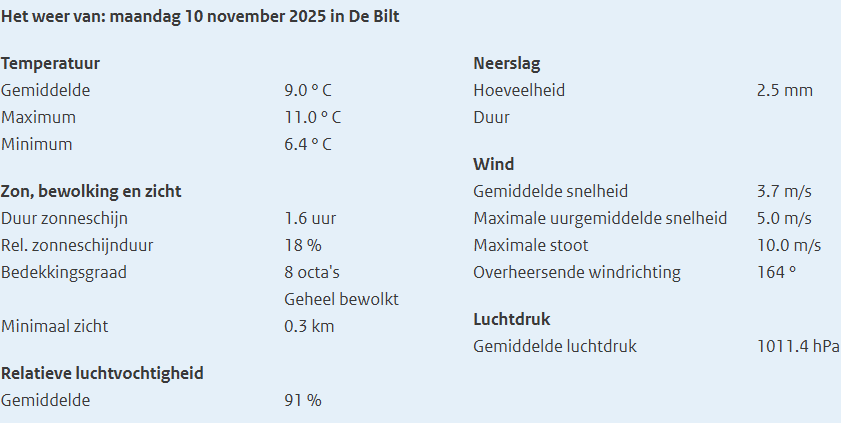
Weer:

KNMI weerrapport

Links:
In de geschiedenis

Wereld Wezendag / UN #WorldOrphansDay 2025

World Orphans Day

Two observances named World Orphans Day have been established to raise awareness of their plight; the first is observed on April 20 and the second on the second Monday of November.

Losing both parents is one of the worst things that can happen to a child. There are hundreds of millions of orphans in the world who need someone to take care of them. In common usage, an orphan is a child who has lost both parents. However, some organizations, including UNICEF and UNAIDS, label children who have lost one parents as orphans, too. The number of double orphans, i.e. those who have lost both parents, is relatively low in developed countries; the highest numbers of orphans exist in countries affected by extreme poverty, wars, and epidemics. Regions with the highest percentage of orphans are Africa (almost 12% of all children), Latin America & the Caribbean (about 7.5% of all children), and Asia (6.5% of all children).

According to statistics, every 19 seconds somewhere in the world, a child is orphaned, and 99% of orphans are never adopted. Most countries with high numbers of orphans usually don’t have a good system in place to support all orphaned children. Thousands of orphans across the globe live as street children devoid of parental care and vulnerable to abuse and exploitation. Orphans raised in orphanages often struggle to adjust to adult life once released from the orphanage because they lack education, resources, and skills to support themselves. As a result, many of them become homeless and commit crimes to survive, or even end up committing suicide.

Since governments of poor countries devastated by wars and epidemics are unable to provide orphans with proper care, international organizations have to step in. There are a lot of organizations and programs supporting orphans worldwide. Two of them have established a World Orphans Day. World Orphans Day celebrated on April 20 was founded by Worldwide Organization for Charity (WOC), previously known as World Orphan Center. The organization is working to support orphans, underprivileged children and widows with the ultimate goal of making them self-reliant through various support schemes, ranging from coverage of living expenses to adoption.

World Orphans Day celebrated on the second Monday of November was launched in 2006 by the Stars Foundation, a Nashville-based organization comprised of the entertainment industry, dignitaries, and media and sports personalities that seeks to raise money to help orphans, children in foster care, street children, and other vulnerable children. Both World Orphans Days aim to raise awareness about orphans worldwide and encourage people to support orphans any way they can. Of course, giving an orphan a new loving family is the best way to change their life for the better, but we realize that adoption isn’t for everyone. There are a lot of other ways to help orphans: you can donate to an organization that supports orphans, volunteer at an orphanage, organize an awareness event in your community, and spread the word on social media with the hashtag #WorldOrphansDay.

Links:
ACT Commemorates World Orphans Day

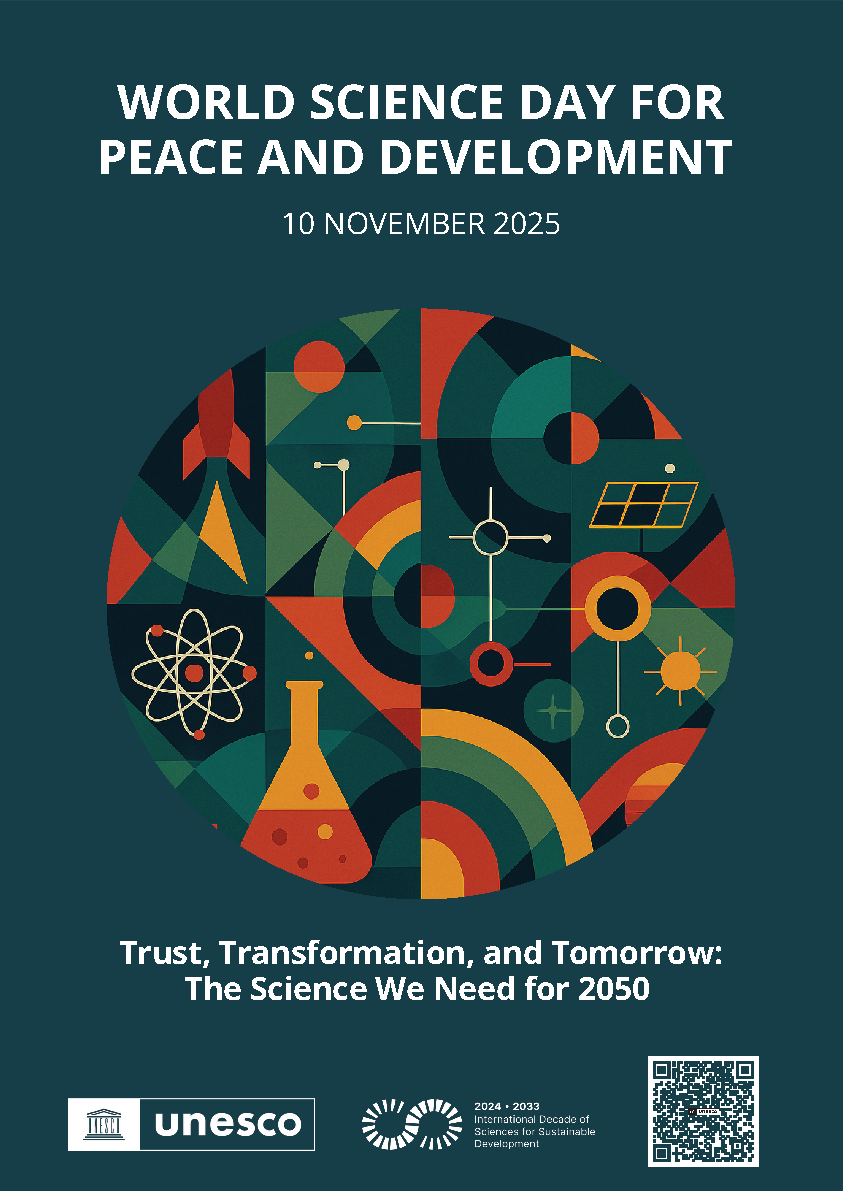
World Science Day for Peace and Development / Wereldwetenschapdag voor Vrede en Ontwikkeling 2025

Wereldwetenschapdag voor Vrede en Ontwikkeling

Celebrated every 10 November, World Science Day for Peace and Development highlights the significant role of science in society and the need to engage the wider public in debates on emerging scientific issues, it also underlines the importance and relevance of science in our daily lives.

By linking science more closely with society, World Science Day for Peace and Development aims to ensure that citizens are kept informed of developments in science. It also underscores the role scientists play in broadening our understanding of the remarkable, fragile planet we call home and in making our societies more sustainable. The Day offers the opportunity to mobilize all actors around the topic of science for peace and development – from government officials to the media to school pupils. UNESCO strongly encourages all to join in celebrating World Science Day for Peace and Development by organizing your own event or activity on the day. The organization of a focused event related to the commitment to science and society was one of the positive outcomes of the 1999 World Conference on Science in Budapest. It was considered an opportunity to reaffirm each year the commitment to attaining the goals proclaimed in the Declaration on Science and the Use of Scientific Knowledge and to follow up the recommendations of the Science Agenda: Framework for Action. Since its proclamation by UNESCO in 2001, World Science Day for Peace and Development has generated many concrete projects, programmes, and funding for science around the world. The Day has also helped foster cooperation between scientists living in regions marred by conflict—one example being the UNESCO-supported creation of the Israeli-Palestinian Science Organization (IPSO). The rationale of celebrating a World Science Day for Peace and Development has its roots in the importance of the role of science and scientists for sustainable societies and in the need to inform and involve citizens in science. In this sense, a World Science Day for Peace and Development offers an opportunity to show the general public the relevance of science in their lives and to engage them in discussions. Such a venture also brings a unique perspective to the global search for peace and development.

Links:
World Science Day for Peace and Development

#DagVanDeMantelzorg 2025

Jaarlijks op 10 november is er de Dag van de Mantelzorg, dan worden er activiteiten voor mantelzorgers georganiseerd.

Om mensen die langdurig en onbetaald voor een ander zorgen eens in het zonnetje te zetten en een hart onder de riem te steken. Mantelzorg is de zorg voor chronisch zieken, gehandicapten en hulpbehoevenden door naasten: familieleden, vrienden, kennissen en buren. Kenmerkend is de reeds bestaande persoonlijke band tussen de mantelzorger en zijn of haar naaste. Daarnaast gaat het om langdurige zorg die onbetaald is. 2025 is een bijzonder jaar: Voor het eerst worden Mantellintjes uitgereikt.

Links:
Dag van de Mantelzorg

Advies | Mantelzorg en werk in een zorgzame samenleving: Een integrale aanpak voor een werkende combinatie

#Ogoni9 memorial 2025


The Ogoni Nine were a group of nine activists from the Ogoni region of Nigeria who opposed the operating practices of the Royal Dutch Shell oil corporation.

Their members included outspoken author and playwright Ken Saro-Wiwa, Saturday Dobee, Nordu Eawo, Daniel Gbooko, Paul Levera, Felix Nuate, Baribor Bera, Barinem Kiobel, and John Kpuine (Tripathi, p.189), who were executed by hanging in 1995 by the military dictatorship of General Sani Abacha and buried in Port Harcourt Cemetery. The executions provoked international condemnation and led to the increasing treatment of Nigeria as a pariah state until General Abacha’s mysterious death in 1998. Saro-Wiwa had previously been a critic of the Royal Dutch Shell oil corporation, and had been imprisoned for a year prior to the executions in November 1995. At least two witnesses who testified that Saro-Wiwa was involved in the murders of the Ogoni elders later recanted, stating that they had been bribed with money and offers of jobs with Shell to give false testimony – in the presence of Shell’s lawyer.

Links:
Wiwa family lawsuits against Royal Dutch Shell

The story of the Ogoni

Who killed Ken Saro Wiwa and Ogoni Nine | Gen. Sani Abacha or Shell Nigeria

Eindvonnis in de rechtzaak van vier van de weduwen van de negen in 1995 in Nigeria ter dood veroordeelde mannen ( #Ogoni9 ) tegen vennootschappen uit de Shell-Groep

Het is 25 jaar geleden dat de Ogoni Negen in Nigeria werden opgehangen

Sacharovprijs – uitreiking 2025

Sacharovprijs

De Sacharovprijs voor de vrijheid van denken is een onderscheiding die sinds 1988 jaarlijks wordt uitgereikt door het Europees Parlement en die is bedoeld als onderscheiding voor een bijzondere prestatie op een van de volgende gebieden:

De prijs is genoemd naar de Russische atoomgeleerde en dissident Andrej Sacharov, die in de Sovjet-Unie pleitte voor vrijheid van meningsuiting. Rond 10 december wordt de prijs met een waarde van 50.000 euro door het Europees Parlement uitgereikt tijdens een plechtige zitting in Straatsburg. Op die datum werd in 1948 de Universele verklaring van de rechten van de mens ondertekend.

Links:
Andrzej Poczobut en Mzia Amaglobeli: winnaars Sacharovprijs 2025

2025 Sakharov Prize: interviews with laureates’ and finalists’ representatives

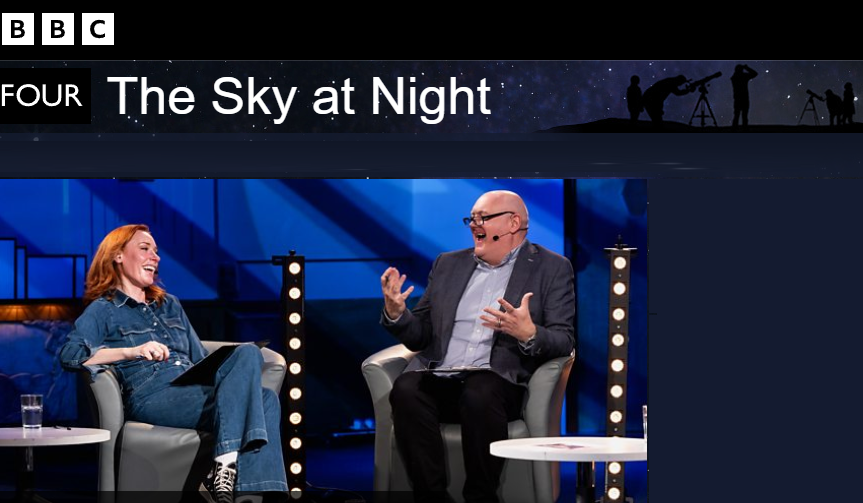
The Sky at Night – Space Mysteries: The Sky at Night Meets Curious Cases (TV BBC Four)

The Sky at Night

The Sky at Night is a monthly documentary television programme on astronomy produced by the BBC.

The show had the same permanent presenter, Patrick Moore, from its first broadcast on 24 April 1957 until 7 January 2013. The latter date was a posthumous broadcast, which followed Moore’s death on 9 December 2012. This made it the longest-running programme with the same presenter in television history. Many early episodes are missing, either because the tapes were wiped, thrown out, or because the episode was broadcast live and never recorded in the first place. Beginning with the 3 February 2013 edition, the show was co-presented by Lucie Green and Chris Lintott. Since December 2013 Maggie Aderin-Pocock has been a presenter. The programme’s opening and closing theme music is “At the Castle Gate”, from the incidental music to Pelléas et Mélisande, written in 1905 by Jean Sibelius, performed by the Royal Philharmonic Orchestra and conducted by Sir Thomas Beecham.

This episode:
Do aliens exist, and can we talk to them? What does a black hole sound like? Does the universe look like a doughnut? In a spectacular season finale, The Sky at Night teams up with hit podcast Curious Cases to answer your burning space mysteries, from the strange sounds of the
cosmos to the furthest edges of the observable universe.

Filmed in front of a live studio audience, presenters Hannah Fry and Dara Ó Briain bring their signature wit and curiosity as they quiz our stellar panel of experts – Maggie Aderin-Pocock, Chris Lintott and George Dransfield. Expect lively debate, surprising revelations, and moments of pure astronomical awe as they explore the weird and wonderful corners of space science.

Meanwhile, Pete Lawrence turns his eyes to the heavens to guide us through the incredible sights currently lighting up the night sky and offering a glimpse into the mysteries that unfold when we simply look up.

Adding another layer of intrigue, a special BBC Ideas animation explores our ongoing search for alien life and the tantalising possibility of making contact with extraterrestrial intelligence.

And for those who want to keep the curiosity flowing, Radio 4 are airing a companion episode of Curious Cases, featuring extra content from the live recording.

Join us for this unforgettable night of cosmic exploration before the programme returns in the spring of 2026 with even more wonders from the final frontier.

Links:
The Sky at Night

2025-11-09, Lief dagboek

Zondag; Wat eten we vandaag?; Carl Sagan – birthday (1934) / Carl Sagan Prize for Science Popularization; Dag van de Uitvinders / Hedy Lamarr – geboortedag; Vroege Vogels; ESCAPADE.

Deze afbeelding heeft een leeg alt-attribuut; de bestandsnaam is dagboek.png

Wat eten we vandaag?:

Klik op afbeelding voor origineel

Knipselkrant:

Agenda:

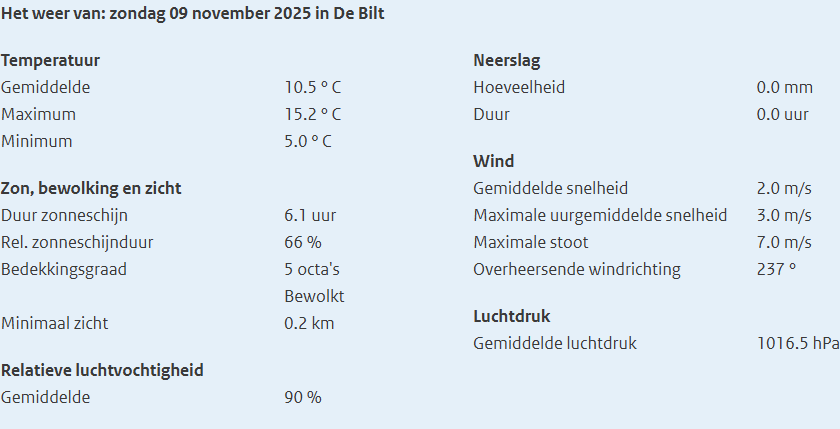
Weer:

KNMI weerrapport

Links:
In de geschiedenis

Carl Sagan – birthday (1934) / Carl Sagan Prize for Science Popularization 2025

Carl Edward Sagan (/ˈseɪɡən/; November 9, 1934 – December 20, 1996) was an American astronomer, cosmologist, astrophysicist, astrobiologist, author, science popularizer, and science communicator in astronomy and other natural sciences.

He is best known for his work as a science popularizer and communicator. His best known scientific contribution is research on extraterrestrial life, including experimental demonstration of the production of amino acids from basic chemicals by radiation. Sagan assembled the first physical messages sent into space: the Pioneer plaque and the Voyager Golden Record, universal messages that could potentially be understood by any extraterrestrial intelligence that might find them. Sagan argued the now accepted hypothesis that the high surface temperatures of Venus can be attributed to and calculated using the greenhouse effect. Sagan published more than 600 scientific papers and articles and was author, co-author or editor of more than 20 books. He wrote many popular science books, such as The Dragons of Eden, Broca’s Brain and Pale Blue Dot, and narrated and co-wrote the award-winning 1980 television series Cosmos: A Personal Voyage (+ deel 1). The most widely watched series in the history of American public television, Cosmos has been seen by at least 500 million people across 60 different countries. The book Cosmos was published to accompany the series. He also wrote the science fiction novel Contact, the basis for a 1997 film of the same name. His papers, containing 595,000 items, are archived at The Library of Congress. Sagan advocated scientific skeptical inquiry and the scientific method, pioneered exobiology and promoted the Search for Extra-Terrestrial Intelligence (SETI). He spent most of his career as a professor of astronomy at Cornell University, where he directed the Laboratory for Planetary Studies. Sagan and his works received numerous awards and honors, including the NASA Distinguished Public Service Medal, the National Academy of Sciences Public Welfare Medal, the Pulitzer Prize for General Non-Fiction for his book The Dragons of Eden, and, regarding Cosmos: A Personal Voyage, two Emmy Awards, the Peabody Award, and the Hugo Award. He married three times and had five children. After suffering from myelodysplasia, Sagan died of pneumonia at the age of 62, on December 20, 1996.

Links:
Carl Sagan Prize for Science Popularization