Najaarsronde coronaprik 2025

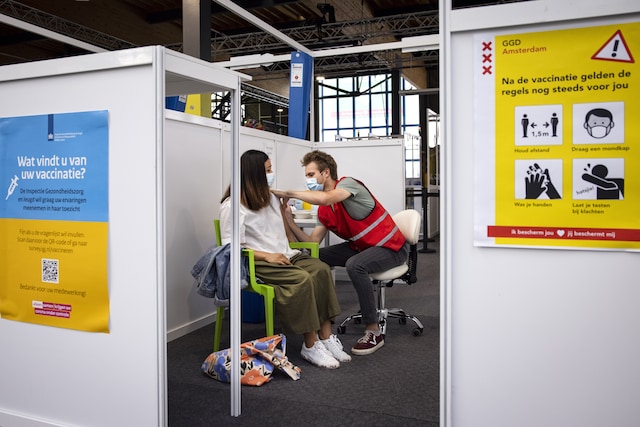
Mensen die ernstig ziek kunnen worden van corona kunnen van 15 september tot en met 5 december 2025 bij meer dan 300 GGD-priklocaties weer de coronaprik halen.

Het mRNA-vaccin is aangepast aan de varianten die nu worden verwacht. Het RIVM stuurt tussen 26 augustus en half oktober 2025 brieven naar mensen van 60 jaar en ouder. Hoor je tot de doelgroep maar krijg je geen brief? Dan kun je zelf een afspraak maken.

Dag van de Vrede / Day of Peace 2025

De Dag van de Vrede of Wereld Vrede Dag is een jaarlijkse dag ter attentie van de vrede, op 21 september, uitgeroepen door de Verenigde Naties (VN), sinds 1981 (resolutie 36/67).

Het doel is een wereldwijde dag van wapenstilstand en geweldloosheid. De Internationale Dag van de Vrede die door de VN wordt georganiseerd valt samen met de Algemene Vergadering, ieder jaar in september. Sinds 2001 vindt de dag jaarlijks plaats op 21 september (resolutie 55/282). Thema 2025: “Act Now for a Peaceful World”.

Links:
International Day of Peace

Confluence of European Water Bodies 2025

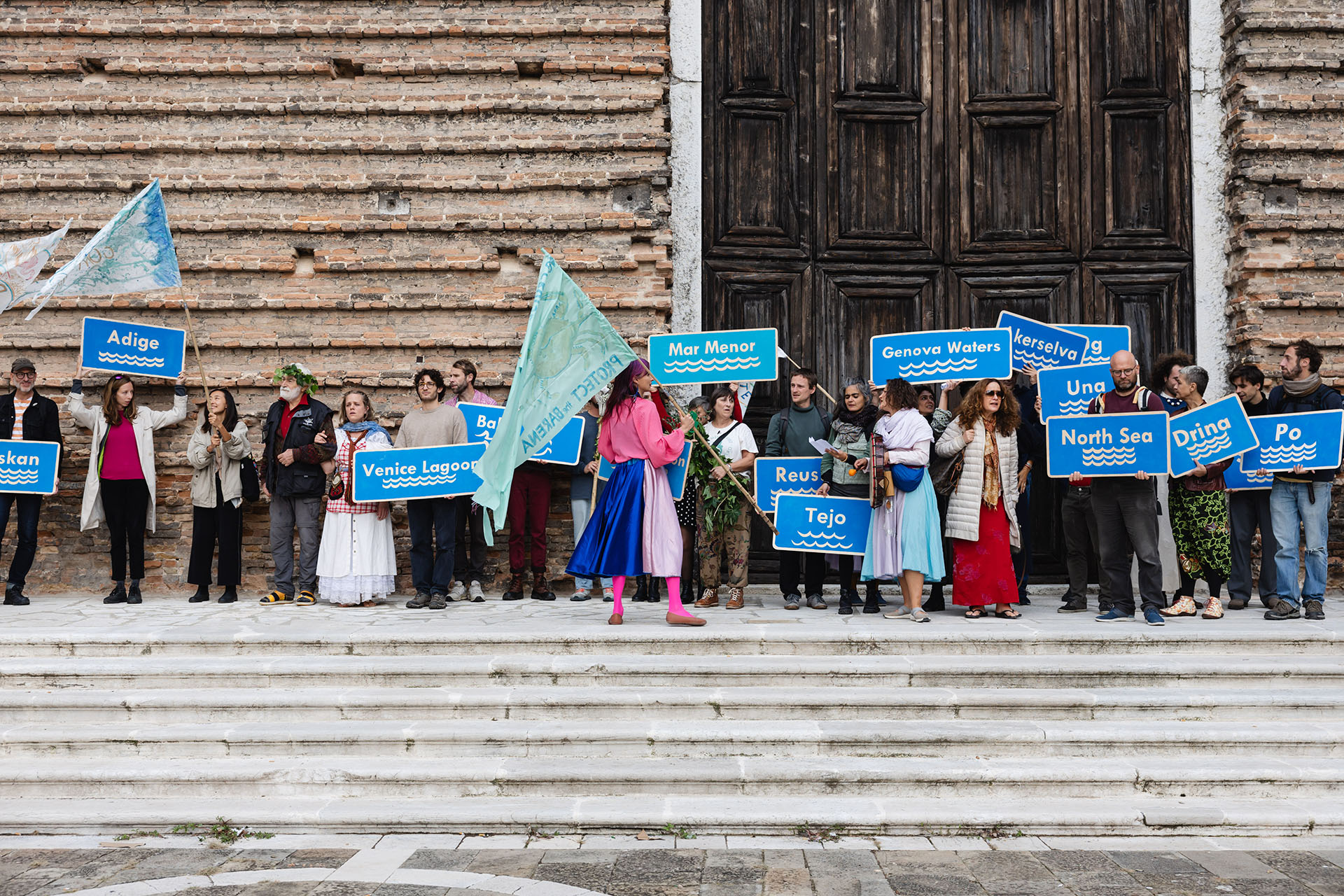
From 21 to 24 September 2025, representatives of more than 35 European seas, lakes, rivers, wetlands, lagoons, and glaciers will confluence in the Netherlands.
When two or more rivers meet in a landscape, they flow together and continue as one body of water: they ‘confluence’. The Confluence 2025 is a growing interdisciplinary community of water representatives that strives for new dialogues and relationships with Europe’s water bodies. The network was founded by the Embassy of the North Sea, TBA21–Academy, and ILP Mar Menor. The first edition of the Confluence took place in 2023 at the Mar Menor in Spain – the first European ecosystem to be granted the status of a legal entity. In 2024, this ever-growing community of water bodies gathered at the Venice lagoon. The Confluence of European Water Bodies 2025 will open in Amsterdam on 21 September 2025, inaugurated by the British writer Robert Macfarlane, followed by a three-day programme organised by the Embassy of the North Sea. During the Confluence we will be exploring new ways to represent water in the cultural, political and legal domain. The programme, taking place in Amsterdam and Bergen aan Zee, includes workshops, lectures, films, art installations, performances, concerts, and future thinking sessions. The general public is very welcome at the public venues including De Balie, UvA, Mediamatic, the Amstelkerk and Filmtheater Cinebergen.

Links:
Confluence of European Water Bodies 2025

Meren, rivieren en zeeën moeten mee kunnen praten over de toekomst

Hobbit Day / Tolkien Week 2025

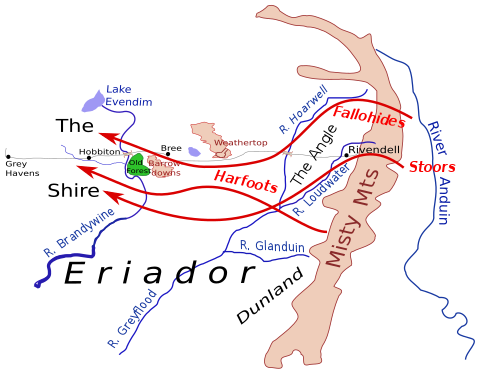
The hobbits are described as being of three types, Harfoots, Fallohides, and Stoors, all deriving from a region to the east of the Shire, in particular the Angle between two rivers, and migrating to the Shire at different times.

Tolkien Week is observed as the calendar week, starting on Sunday, containing September 22, which is always observed as Hobbit Day.

Both celebrations began in 1978. Hobbit Day in particular, and Tolkien Week as well, have gained some measure of legal dignity through a variety of proclamations, declarations, tributes and similar governmental documents prepared by elected officials who support the Society, its goals and the observance of these holidays. Both events have attracted bipartisan support, from the county courthouse to the White House and U.S. Capitol. Tolkien Week honors J. R. R. Tolkien and his son and editor, Christopher J.R. Tolkien, and celebrates the Middle-earth cycle: The Silmarillion, The Hobbit, The Lord of the Rings (The Fellowship of the Ring, The Two Towers, The Return of the King), Unfinished Tales, and The History of Middle-earth.

Hobbit Day and Tolkien Week fall during the “Back to School” season and can create a bright new interest for students in literature classes and libraries. A number of schools and libraries host seminars and art shows during the week. Those with the facilities and budget sometimes arrange for a showing of one or more of the motion pictures based on the works. A few have even presented marathon showings of the Peter Jackson Lord of the Rings films!

The most popular method of observing Tolkien Week is the library, bookstore or school display.  Most libraries have bulletin boards or cases, and some have enclosed display tables and other facilities up to and including display windows of considerable size. Many librarians among our members and friends create displays; other members contact their libraries and assist in preparing displays. The same is certainly true of schools. Tolkien Week displays and seminars have been held in places ranging from distinguished universities to libraries located in prisons, mental institutions, and army bases.  If your activities include presentation of research papers or other materials suitable for publication, please consider submitting the available works to the Society for possible publication in Minas Tirith Evening-Star: Journal of the American Tolkien Society.

Hobbit Day, on the other hand, is scheduled to fall on the hobbits Bilbo and Frodo Baggins – two fictional characters in J. R. R. Tolkien’s popular set of books The Hobbit and The Lord of the Rings –  mutual birthday, the date of the Long Awaited Party (translated in text by Tolkien as September 22).  This is perhaps the oldest festal observance associated with Tolkien fandom.  Celebration actually predates the formal designation of the holiday. A variety of names have been applied to the date and the celebrations. In large part, Hobbit Day is usually taken up with the fun activities – the feasts, games, costume events, fireworks and the like. Hobbit Day is a virtually ideal holiday, incorporating attractive elements of several others: the masquerade fun of Halloween, the feast of Thanksgiving, the exchange of greeting cards and gifts associated with Christmas and birthdays, the picnic atmosphere of Labor Day and Memorial Day, the fireworks of Independence Day (or Guy Fawkes Day)… and the study and reflection associated with many commemorative days throughout the year.

According to the fictional setting, Bilbo was born in the year of 2890 and Frodo in the year of 2968 in the Third Age (1290 and 1368 respectively in Shire-Reckoning.) Tolkien Week is the week containing Hobbit Day. The Fellowship of the Ring opened with a celebration of Bilbo’s birthday. It was a large party with food, fireworks, dancing and much merriment. Some Tolkien fans celebrate by emulating the hobbits’ parties. Other simply go barefoot in honour of the hobbits, who don’t wear shoes. Some schools and libraries use this as an opportunity to pique interest in Tolkien’s work by putting up displays and hosting events. The Lord of the Rings: “There is no record of the Shire-folk commemorating either March 25 or September 22; but in the Westfarthing, especially in the country round Hobbiton Hill, there grew a custom of making holiday and dancing in the Party Field, when weather permitted, on April 6.” In Gondor, however, “in honour of Frodo Yavannie 30, which corresponded to the former September 22, his birthday, was made a festival, and the leap-year was provided for by doubling this feast, called Cormare or Ringday.”

Links:
Hobbit Day and Tolkien Week

2025-09-20, Lief dagboek

Zaterdag; Wat eten we vandaag?; High Seas Treaty; Dag Herdenken Geweldslachtoffers; KlimaDemo; HowTheLightgetsIn London; Weekend van de Zonnebloem / Re-nature Festival; Vredesweek; Dam tot Damloop; Week of Deaf People.

Deze afbeelding heeft een leeg alt-attribuut; de bestandsnaam is dagboek.png

Wat eten we vandaag?

Knipselkrant:


Agenda:

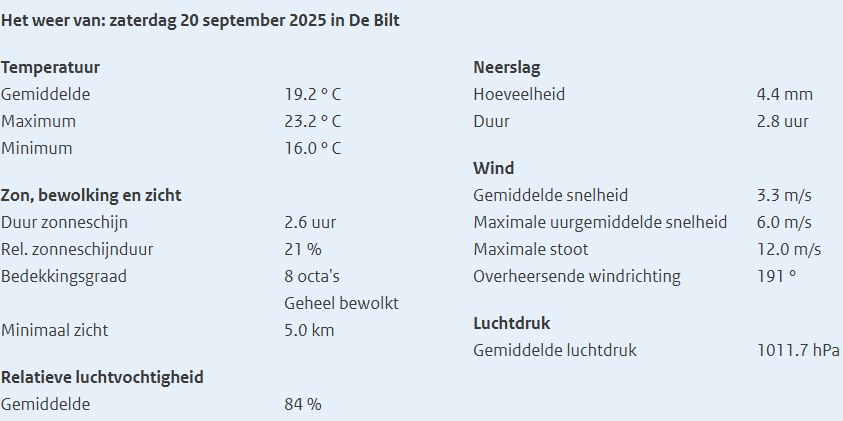
Weer:

Links:
In de geschiedenis

Intergovernmental Conference on Marine Biodiversity of Areas Beyond National Jurisdiction / BBNJ Agreement

In its resolution 77/248 on “Oceans and the law of the sea”, the General Assembly requested the Secretary-General to convene the resumed fifth session of the Intergovernmental Conference on Marine Biodiversity of Areas Beyond National Jurisdiction.

In its resolution 72/249 of 24 December 2017, the General Assembly decided to convene an Intergovernmental Conference, under the auspices of the United Nations, to consider the recommendations of the Preparatory Committee established by resolution 69/292 of 19 June 2015 on the elements and to elaborate the text of an international legally binding instrument under the United Nations Convention on the Law of Sea on the conservation and sustainable use of marine biological diversity of areas beyond national jurisdiction, with a view to developing the instrument as soon as possible. In accordance with resolution 72/249, the Conference held a three-day organizational meeting in New York, from 16 to 18 April 2018, to discuss organizational matters, including the process for the preparation of the zero draft of the instrument. The first session was convened from 4 to 17 September 2018, the second session from 25 March to 5 April 2019 and the third session from 19 to 30 August 2019. The fourth session, which was postponed by decisions 74/543 and 75/570 owing to the COVID-19 pandemic, was convened from 7 to 18 March 2022. A fifth session of the Conference was convened from 15 to 26 August 2022 pursuant to General Assembly decision 76/564 (available as A/76/L.46).

On the last day of that session, the Conference, in considering the way forward, decided to suspend the fifth session and resume it at a later date to be determined. Pursuant to resolution 77/248 of the General Assembly, the resumed fifth session of the Intergovernmental Conference met from 20 February to 3 March 2023.  At the end of that meeting, the Conference decided to resume at a later date with a view to adopting the agreement. In this connection, the General Assembly, in its decision 77/556 of 18 April 2023 (currently available as document A/77/L.62), requested the Secretary-General to convene a further resumed fifth session of the conference on 19 and 20 June 2023, tentatively, or on a date to be determined in consultation with the President of the conference. Accordingly, the further resumed fifth session was held at UN Headquarters in New York on 19 and 20 June 2023. On 19 June 2023, the Conference adopted, by consensus, the Agreement under the United Nations Convention on the Law of the Sea on the conservation and sustainable use of marine biological diversity of areas beyond national jurisdiction (A/CONF.232/2023/4). The Conference was closed on 20 June 2023.

The Agreement under the United Nations Convention on the Law of the Sea on the Conservation and Sustainable Use of Marine Biological Diversity of Areas beyond National Jurisdiction or BBNJ Agreement, commonly known as the High Seas Treaty, is a legally binding instrument for the conservation and sustainable use of marine biological diversity of areas beyond national jurisdiction. There is some controversy over the popularized name of the agreement. It is an agreement under the United Nations Convention on the Law of the Sea (UNCLOS). The text was finalised during an intergovernmental conference at the UN on 4 March 2023 and adopted on 19 June 2023. Both states and regional economic integration organizations can become parties to the Agreement. In 2017, the United Nations General Assembly (UNGA) voted to convene an intergovernmental conference (IGC) to consider establishing an international legally binding instrument (ILBI) on the conservation and sustainable use of marine biodiversity beyond national jurisdiction (BBNJ). This was considered necessary because UNCLOS did not provide a framework for areas beyond national jurisdiction. There was a particular concern for marine biodiversity and the impact of overfishing on global fish stocks and ecosystem stability. The treaty addresses four themes:

(1) marine genetic resources (MGRs) and their digital sequence information, including the fair and equitable sharing of benefits;
(2) area-based management tools (ABMTs), including marine protected areas (MPAs);
(3) environmental impact assessments (EIAs);
(4) capacity building and transfer of marine technology (CB&TMT).

The area-based management tools and environmental impact assessments relate mainly to conservation and sustainable use of marine biodiversity, while the marine genetic resources and capacity building and transfer of marine technology include issues of economic justice and equity. Greenpeace called it “the biggest conservation victory ever”. The main achievement is the new possibility to create marine protected areas in international waters. By doing so the agreement now makes it possible to protect 30% of the oceans by 2030 (part of the 30 by 30 target). Though the agreement does not directly address climate change, it also serves as a step towards protecting the ecosystems that store carbon in sediments. The High Seas Treaty has 76 articles and two annexes. One of its main aims is “s stewards of the ocean in areas beyond national jurisdiction on behalf of present and future generations by protecting, caring for and ensuring responsible use of the marine environment, maintaining the integrity of ocean ecosystems and conserving the inherent value of biological diversity of areas beyond national jurisdiction”.

The Agreement recognizes traditional knowledge. It has articles regarding the “polluter-pays” principle, and different impacts of human activities including areas beyond the national jurisdiction of the countries making those activities. The agreement was adopted by the 193 United Nations Member States. Before entering into force, the treaty needed to be ratified by at least 60 UN member states. The former treaty, UNCLOS, was adopted in 1982 and entered into force in 1994. As of October 2024, UNCLOS has 170 parties. The European Union pledged financial support for the process of ratification and implementation of the treaty. On 19 September 2025, Morocco became the 60th country to ratify the agreement, setting the stage for its entry into force on January 17, 2026.

Links:
Agreement on Marine Biological Diversity of Areas beyond National Jurisdiction

Verdrag voor de oceanen

UN delegates reach historic agreement on protecting marine biodiversity in international waters

Agreement under the United Nations Convention on the Law of the Sea on the conservation and sustainable use of marine biological diversity of areas beyond national jurisdiction (19 June 2023)

VN-verdrag is mijlpaal voor internationale oceaanbescherming

Stop diepzeemijnbouw voor het begint / Stop diepzeemijnbouw : Noorwegen, zeg NEE tegen diepzeemijnbouw! – petities

Agenda – 29th Session of the International Seabed Authority Part I (TV ISA Web TV)

2025 UN Ocean Conference

#30thSessionCouncil #DeepSeabed #TheArea #UNCLOS 30th Session of the International Seabed Authority Part I (TV ISA Web TV)

High Seas Treaty Ratification Tracker

Dag Herdenken Geweldslachtoffers 2025

In Nederland krijgen jaarlijks honderden mensen te maken met het verlies van een dierbare door een geweldsmisdrijf, tijdens de Dag Herdenken Geweldslachtoffers komen lotgenoten samen om steun te vinden bij elkaar en om hun dierbaren te herdenken.

De Dag Herdenken Geweldslachtoffers wordt jaarlijks georganiseerd door de Federatie Nabestaanden Geweldslachtoffers (FNG). De FNG behartigt de belangen van nabestaanden en slachtoffers van geweldsmisdrijven, en organiseert lotgenotencontact. Tijdens deze dag staan nabestaanden, politici, hulpverleners en belangstellenden, stil bij alle slachtoffers die door een geweldsmisdrijf om het leven kwamen. Tijdens de dag is er ruimte om samen te herdenken, om troost te vinden bij muziek en om steun en erkenning te vinden. Daarnaast is het een dag voor zichtbaarheid voor de slachtoffers. Nabestaanden, vrienden, genodigden en vrijwilligers dragen zeven linten door de stad met een totale lengte van 400 meter. Hierop staan de namen van hun overleden dierbaren. Elk jaar komen er weer namen bij, het lint wordt alsmaar langer.

Links:
Dag Herdenken Geweldslachtoffers

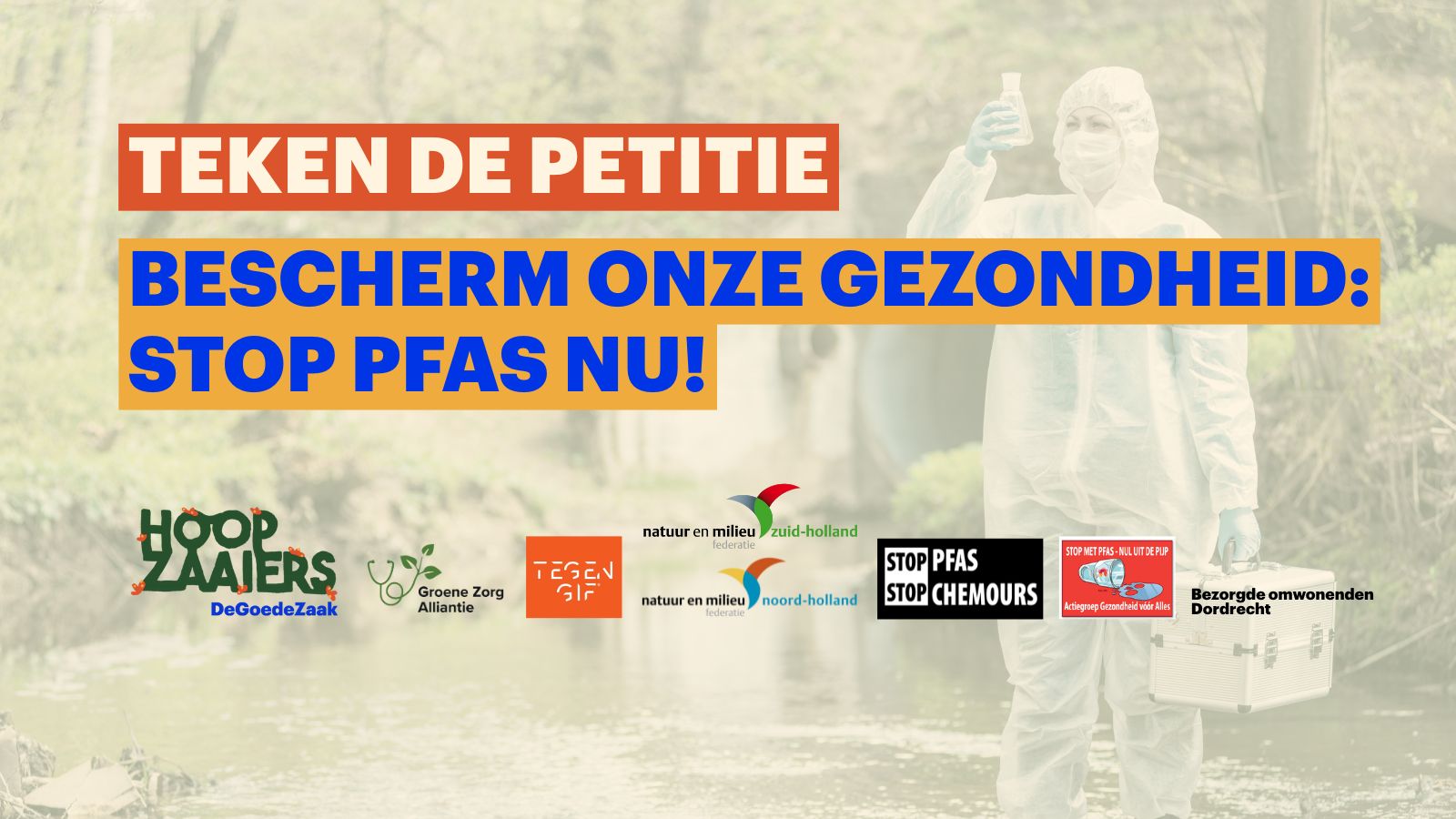
Bescherm onze gezondheid: stop PFAS nu! – petitie

PFAS – de beruchte ‘forever chemicals’ – bedreigen onze gezondheid en die van onze kinderen.

De landelijke politiek doet te weinig om ons te beschermen, terwijl bijna alle Nederlanders teveel PFAS in hun bloed hebben. Ze zijn een gevaar voor de gezondheid: hopen zich op in ons lichaam, verzwakken ons immuunsysteem en worden in verband gebracht met kanker. Deze stoffen zijn extreem slecht afbreekbaar; sommige PFAS worden zelfs helemaal niet afgebroken: ze blijven langdurig in het water, de lucht, en onze bodem aanwezig. We krijgen ze dus steeds weer binnen via ons eten en drinken. Wetenschappelijk bewijs over de schadelijke werking van PFAS stapelt zich op. Gemeenten, GGD’en en artsen spreken zich uit en dringen aan op een PFAS-verbod. Ook de meeste burgers  – negen op de tien Nederlanders –  willen meer maatregelen om de PFAS-vervuiling te beperken. Dit alles staat in schril contrast met de maatregelen die de overheid neemt om de blootstelling van burgers aan PFAS terug te dringen en bedrijven die PFAS-vervuiling veroorzaken, aan te pakken. Het resultaat: de gezondheid van mens en leefomgeving is in gevaar. Burgers worden ziek, dragen de risico’s én de kosten. Dat is onaanvaardbaar. Daarom roepen Stichting Tegengif, STOP PFAS STOP CHEMOURS, Gezondheid voor Alles, Groene Zorg Alliantie, Bezorgde Omwonenden Dordrecht, NMF Noord en Zuid Holland en DeGoedeZaak de Nederlandse regering op om:

  1. Een nationaal PFAS-verbod in te voeren.
  2. PFAS-lozingen en industriële uitstoot in lucht en water bij de bron te stoppen, zodat ons (drink)water en onze bodem niet verder vervuild raken. En onze gezondheid niet nog meer bedreigd wordt.
  3. De keten van vergunningverlening, toezicht en handhaving te versterken, zodat bedrijven niet ongestraft kunnen blijven lozen.
  4. PFAS in pesticiden, verpakkingen en consumentenproducten te verbieden, zoals in Frankrijk en Denemarken.
  5. De vervuiler te laten betalen voor het zuiveren van door PFAS vervuild drinkwater en het schoonmaken van de bodem.
  6. Investeringen in innovatie en veilige alternatieven te stimuleren, zodat onze economie schoner en toekomstbestendig wordt.
  7. Zich in te zetten voor een ambitieus Europees verbod, met alleen tijdelijke uitzonderingen waar nu nog geen alternatief voor is.

Andere Europese landen hebben al laten zien dat het anders kan:

  1. Frankrijk heeft een wet aangenomen die PFAS in cosmetica, textiel en consumentenproducten vanaf 2026 verbiedt, en breidt deze in 2030 verder uit.
  2. Denemarken verbood PFAS al in voedselverpakkingen en blusschuim en tientallen PFAS-houdende pesticiden.
  3. Zweden hanteert PFAS-vrij inkoopbeleid en beschouwt hoge PFAS-waarden in bloed als ‘persoonlijk letsel’; een erkenning van de gezondheidsschade.
  4. Vlaanderen houdt chemiebedrijf 3M verantwoordelijk voor de kosten van de grootschalige PFAS-vervuiling in de ruime omgeving van Zwijndrecht.

Nederland kan en moet dit voorbeeld volgen. Iedereen heeft recht op schoon water, gezond voedsel en een veilige leefomgeving. PFAS  horen daar niet in thuis. Een PFAS-vrije wereld is een mooie wereld, waarin kinderen gezond opgroeien en we onbezwaard groente en fruit uit eigen tuin eten – net als de eieren van onze eigen kippen. Nederland moet de moed tonen om de vervuiling aan te pakken en onze gezondheid boven de belangen van vervuilers te zetten. De overheid is er om burgers te beschermen, toch? Teken de petitie en steun de oproep voor een PFAS-vrije samenleving.

Links:
Bescherm onze gezondheid: stop PFAS nu! – petitie

Risicobeoordeling van PFAS via het eten van particuliere eieren in Nederland / Risk assessment ofPFAS through consumption of home-produced eggs in the Netherlands – publication

Brief regering : Voortgang ten aanzien van een aantal moties en ontwikkelingen op het gebied van PFAS – publicatie

Rechtzaak 11 organisaties vs de Staat vanwege PFAS

ECHA #PFAS restriction proposal – publication

Petitieaanbieding PFAS: ‘Voldoen aan regels beschermt volksgezondheid en milieu niet’

Europese Mobiliteitsweek / European #MobilityWeek 2025

Elk jaar vindt van 16-22 september de Europese Mobiliteitsweek plaats.

Deze week is uitgegroeid tot hét moment waarop gemeenten en andere organisaties in heel Europa (en ver daarbuiten) duurzame mobiliteit op de kaart zetten. Het ministerie van Infrastructuur en Waterstaat nodigt Nederlandse gemeenten en organisaties zich aan te melden voor deelname aan de Europese Mobiliteitsweek. Dat kan op verschillende manieren: hoe lees je hieronder.

Links:
Europese Mobiliteitsweek