Remembrance Day of Journalists Killed in the Line of Duty in the Russian Federation 2025

Remembrance Day of Journalists Killed in the Line of Duty

Remembrance Day of Journalists Killed in the Line of Duty (Russian: День памяти журналистов, погибших при исполнении обязанностей) is a remembrance day, observed on December 15 in Russia in memory of journalists who died while performing their professional duties.

The day was established by the Union of Journalists of Russia (RUJ) in 1991, following the deaths of journalist Viktor Nogin and cameraman Gennadi Kurennoy in the former Socialist Federal Republic of Yugoslavia in September that year. In Moscow the day is observed at Nikitsky Boulevard. According to representatives of the Union of Journalists of Russia, between 10 and 20 journalists are killed each year in Russia under various circumstances. According to the OSCE representative for the freedom of the press (RFoM) Dunja Mijatović, “journalists in Russia are far too often subject to acts of intimidation, threats and attacks”. Mijatović reminded people that “all attacks against journalists should be vigorously investigated by the state authorities, and the perpetrators and the masterminds prosecuted.

Links:
December 15 is the Remembrance Day of Journalists Killed on the Line of Duty in the Russian Federation

2025-12-14, Lief dagboek

Zondag; Wat eten we vandaag?; Meteorenzwerm Geminiden; Day Against Colonialism; Vroege Vogels Radio; Geen podium voor genocide.

Deze afbeelding heeft een leeg alt-attribuut; de bestandsnaam is dagboek.png

Wat eten we vandaag?:

Klik op afbeelding voor origineel

Knipselkrant:


Agenda:

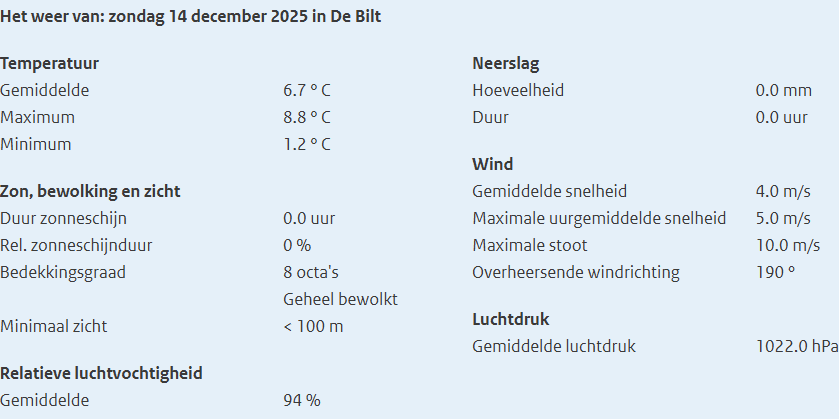
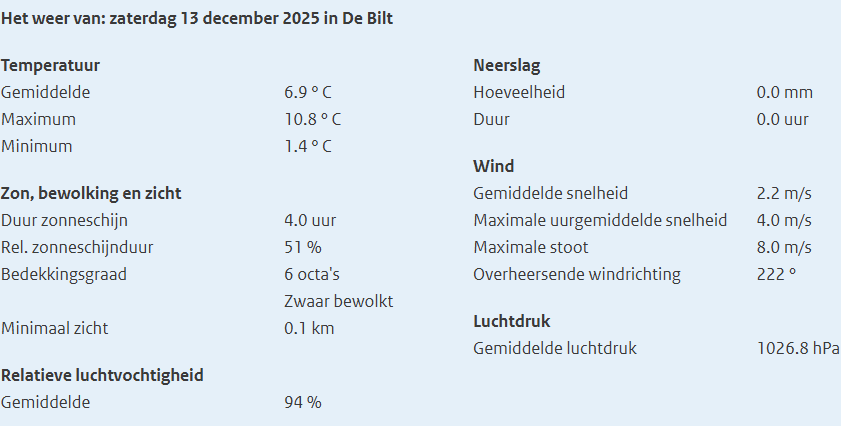
Weer:

Links:
In de geschiedenis

Day Against Colonialism in All Its Forms and Manifestations 2025

In 2025, with the adoption of resolution A/RES/80/106, the United Nations established 14 December as the International Day Against Colonialism in All Its Forms and Manifestations.

This observance reaffirms the purposes and principles of the UN Charter and the Declaration on the Granting of Independence to Colonial Countries and Peoples (Resolution 1514 (XV)), emphasizing the necessity of bringing to a speedy and unconditional end colonialism in all its forms and manifestations. This International Day supports the UN’s determination to implement the Declaration on the Granting of Independence to Colonial Countries and Peoples and related decisions, and to promote decolonization as one of its main mandates. As part of the inaugural celebration of the Day, the United Nations is hosting on 18 December, a one-day high-level plenary meeting of the General Assembly to commemorate the sixty-fifth anniversary of the Declaration on the Granting of Independence to Colonial Countries and Peoples, with the participation of Member States and observers, as well as of the President of the General Assembly, the President of the Economic and Social Council and the Secretary-General. The meeting is to advance global dialogue on the full implementation of UN resolutions on decolonization. More than sixty years after the adoption of resolution 1514 (XV), colonialism in its various forms continues to exist, undermining the principles of the UN Charter, with an impact on social, cultural, and economic development. The eradication of colonialism remains a key priority for the United Nations, particularly under the Fourth International Decade for the Eradication of Colonialism (2021-2030).

Links:
Day Against Colonialism in All Its Forms and Manifestations

VPRO #Tegenlicht – Zo nemen techplatforms de Europese economie over volgens Tim Wu (TV internet)

Tegenlicht is een informatief televisieprogramma van de VPRO via het internet.

Door de VPRO wordt het programma bestempeld als documentaire op het vlak van politiek, economie, sociologie en wetenschap. Het programma stelt zich ten doel inzicht in de werking van de samenleving te verschaffen.

Echt rijk word je niet met werken. Dat weten we allemaal. Maar ook met kapitaal word je tegenwoordig niet per se rijk meer, althans niet met kapitaal in de klassiek-economische zin van ‘het bezit van de middelen om mee te kunnen produceren’. Nee, écht schathemeltjerijk word je vandaag de dag door iets te verkopen wat helemaal niet van jou is. Iets waarvan niemand ooit had gedacht dat het geld waard was. Tot 2004 ongeveer (hallo Facebook). Precies daarover schrijft Tim Wu in The Age of Extraction. Welke activiteit levert vandaag de dag economische waarde op? Wat produceren we nou echt met onze arbeid? Welk deel van onze dag zijn we aan het werk, en voor wie? Het antwoord is vreemd. Het product waar de moderne economie werkelijk om draait, is onze aandacht. Daarom kan Donald Trump nog steeds met droge ogen beweren dat de economie fantastisch loopt, want ja, de beurskoersen staan hoog. En dat komt doordat een handvol techbedrijven zoals NVIDIA, Google, en Meta de markten omhoog duwen alsof ze helium in een ballon blazen. Bedrijven die groot zijn geworden door onze tijd, onze aandacht en zelfs onze gedachten te delven. (NVIDIA iets indirecter, via de AI-boom en hun vervlechting met OpenAI, maar het mechanisme blijft hetzelfde.) En wat krijgen wij terug? Een paar korte dopamineshots van het scrollen, een stroom AI-gegenereerde kattenplaatjes en het gevoel dat we ‘verbonden’ zijn. Niet echt een eerlijke ruil. Noem het gerust de diefstal van de eeuw. Maar in zekere zin is het juist oeroud. Wat deze nieuwe uitbuiters doen, lijkt verdacht veel op kolonisatie. Alleen koloniseren ze nu geen land, geen grondstoffen, geen natuurlijke rijkdommen, maar ons innerlijk leven. Het terrein dat ooit volledig van ons was, wordt in kaart gebracht, ontgonnen en vervolgens geclaimd door partijen die precies weten hoe ze het moeten vermarkten. Wij krijgen er, net als altijd, een paar kralen voor terug. Wu’s lens van extractie is daarom een eye-opener. Hij laat glashelder zien wanneer en hoe we verschoven zijn van een economie die waarde creëert naar een economie die waarde afroomt.

Links:
Zo nemen techplatforms de Europese economie over volgens Tim Wu

Vroege Vogels Radio | 14 december 2025 (Radio 1 NPO)

Vroege Vogels is een live-radioprogramma, tv-programma en online community van BNNVARA over natuur en milieu.

In het radioprogramma wordt het gesproken woord omlijst door licht klassieke muziek en salonmuziek. Het radioprogramma werd in 1978 voor het eerst uitgezonden door de VARA en is een van de langst lopende en best beluisterde radioprogramma’s van de publieke omroep. Het wordt elke zondagmorgen uitgezonden tussen 07:00 en 10:00 op NPO Radio 1. De beginmuziek is een bewerking van Vivaldi’s “Piccolo Concerto in C major” (RV 443).

Volgens microbioloog Han Wösten staan we aan het begin van een tijdperk waarin mycelium onze huizen, meubels en zelfs onze garderobe vormgeeft. In Amsterdam heeft een roerdomp zijn plek gevonden in het Vondelpark. Receptontwikkelaar Joeri Veul schreef het boek ‘Heilig Boontje’ waarin hij eindeloos varieert met peulvruchten. En verder: Guillty Trashures, plastic in de natuur, onbekende rivieren, ecologische woningen en korstmossen. En de column is van Patrick Jansen. Vroege Vogels Radio wordt gepresenteerd door Menno Bentveld vanuit het Groene Huis te Amersfoort.

Links:
Vroege Vogels Radio

ACAB / 1312 / All cops are bastards day 2025

ACAB is an initialism for the phrase “all cops are bastards,” often represented by the number sequence “1312,” which has historically been used as a slogan in graffiti and tattoos associated with those opposing police brutality. The abbreviation saw a significant surge in usage during the riots that occurred in late May 2020 in response to the death of George Floyd.

Links:
Happy ACAB Day