
In de geschiedenis
Links:
Wikipedia

Links:
Wikipedia
From social media feeds and AI systems to data centres and undersea cables, the digital world is built on infrastructures that shape how information flows, who gets heard and who holds power. American researcher Britt Paris, author of Radical Infrastructure: Imagining the Internet from the Ground Up, examines the architecture of power embedded in the internet. What happens when essential parts of public life become dependent on private platforms? The evening includes an artistic intermezzo by Jen Liu, whose work investigates the relationship between technology, labour and global systems of power. This edition is also together with Critical Infrastructure Lab and The Amsterdam Centre for European Studies.
Links:
The politics of the internet

The Open Science Festival has served as a catalyst for open science creativity.
Once again, the festival will bring together the open science community – from researchers to support staff – for a day filled with sessions and opportunities to learn new things, make new connections or reconnect with familiar faces. Professional research support staff and researchers across all disciplines are invited. The day will be full of interactive sessions, an information market, and plenty of opportunities to mingle and meet. Open Science or Open Scholarship stands for the transition to a new, more open and participatory way of conducting, publishing and evaluating scholarly research. Central to this concept is the goal of increasing cooperation and transparency in all research stages. This is achieved, among other ways, by sharing research data, publications, software, tools and results as early and open as possible. According to the UNESCO recommendation on Open Science, Open Science is aiming to make scientific knowledge openly available, accessible and reusable for everyone, to increase scientific collaborations and sharing of information for the benefits of science and society. Using open methods can lead to more robust scientific results, more efficient research and (faster) access to scientific results for everyone.
Links:
Open Science Festival

World Standards Day is celebrated internationally each year on 14 October, the day honours the efforts of the thousands of experts who develop voluntary standards within standards development organizations such as the American Society of Mechanical Engineers (ASME), International Electrotechnica
The aim of World Standards Day is to raise awareness among regulators, industry and consumers as to the importance of standardization to the global economy. 14 October was specifically chosen to mark the date, in 1946, when delegates from 25 countries first gathered in London and decided to create an international organization focused on facilitating standardization
Link
World Standards Day
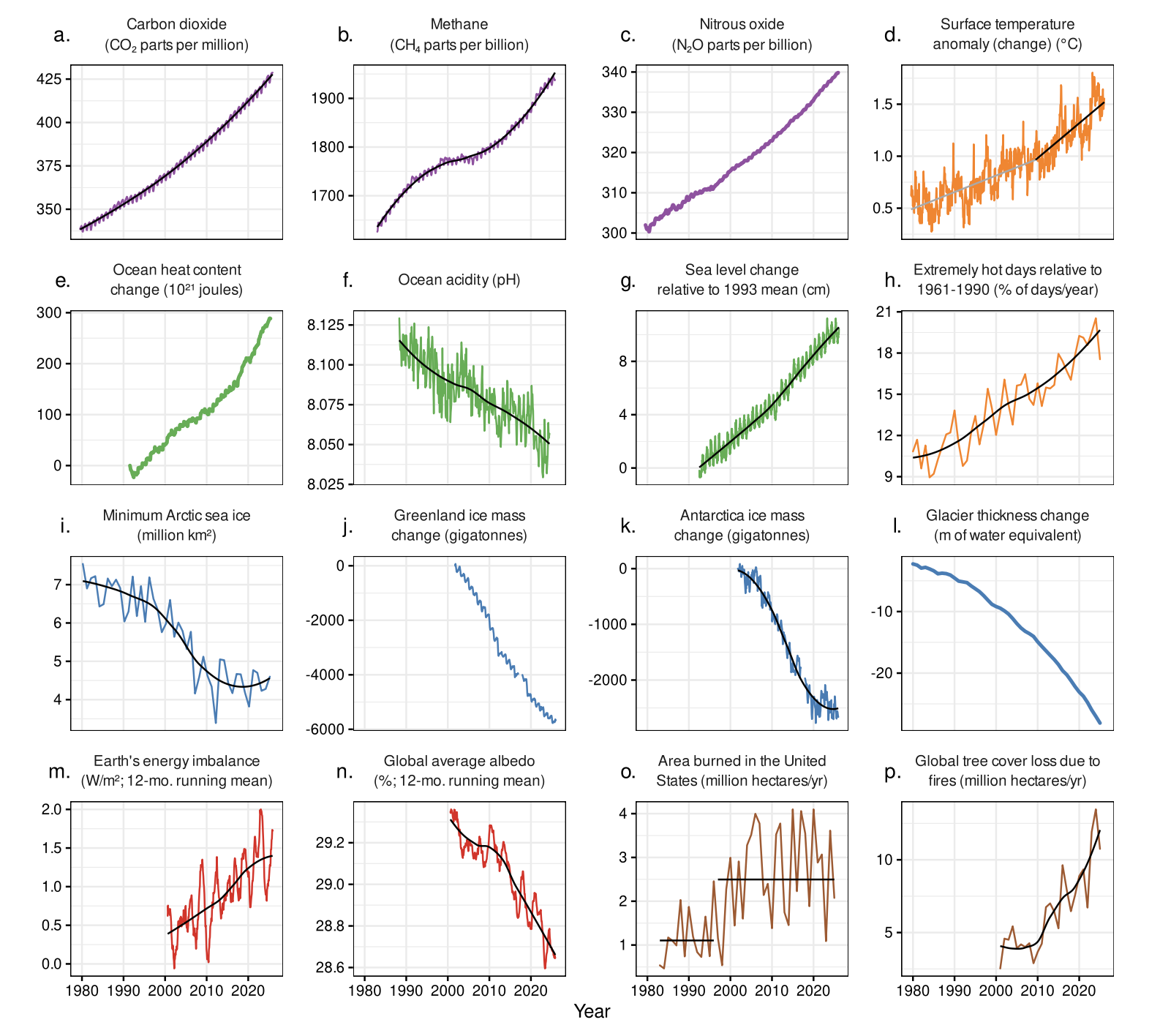
2026 State of the Climate Report shows a planet reaching its limits: Of the 16 climate indicators analyzed, seven showed record extremes.
Earth’s climate system is moving deeper into uncharted territory. Scientists present the 2026 update of planetary vital signs that track the state of Earth’s climate system, alongside indicators of the human activities driving ongoing change. Of 16 climate-related indicators, seven are currently at record extremes. Several indicators also show evidence of accelerating trends or abrupt shifts, raising concerns about increasing climate instability, interacting feedbacks, and the growing risk of crossing critical tipping points. Human activities, particularly fossil fuel combustion, remain the dominant drivers of these changes. Despite the worsening trends, encouraging signs of societal changes are emerging, including the rapid expansion of renewable electricity and battery storage, although progress remains far below the scale and speed needed to stabilize Earth’s climate system. Rapid reductions in greenhouse gas emissions, effective adaptation, ecosystem protection, and transformative societal change remain essential to reducing climate risks and securing a more resilient and sustainable future.
Links:
2026 State of the Climate Report Shows a Planet Reaching Its Limits
Dinsdag; Wat eten we vandaag?; Palestina; Biggenstaarten; Staking OV streekvervoer Dag voor Rampenrisicovermindering; Ada Lovelace Day; Patch Tuesday.

Wat eten we vandaag?:

Knipselkrant:
Agenda:
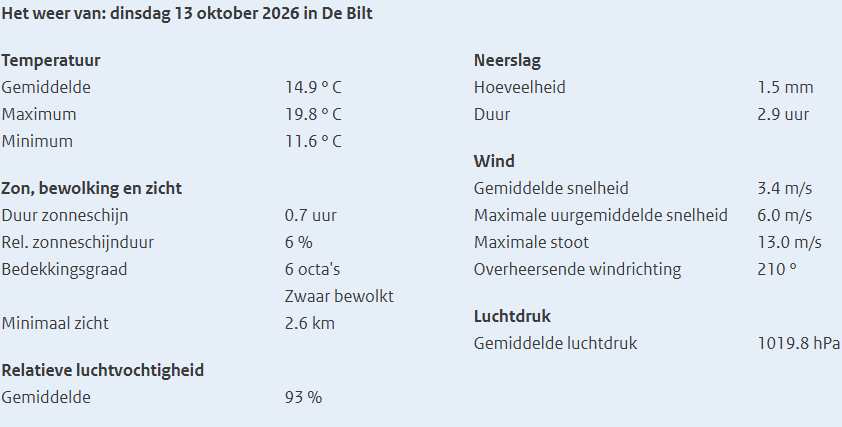
Weer:
Links:
In de geschiedenis
Links:
Wikipedia
Ada Lovelace Day is an annual event held on the second Tuesday of October to celebrate and raise awareness of the contributions of women to Science, Technology, Engineering, and Mathematics (STEM) fields, it is named after mathematician and computer science pioneer Ada Lovelace.
It started in 2009 as a “day of blogging” and has since become a multi-national event with conferences. The day was founded in the United Kingdom in 2009 by Suw Charman-Anderson on the second Tuesday in October as a means of raising awareness about the contributions of women to STEM fields. In 2022, Charman-Anderson announced that this would be the last year in which the organization that she founded, Finding Ada, would organize an annual flagship Ada Lovelace Day event in England. However, the Royal Institution stepped in with funding and the organization Ada Lovelace Day has carried on. Since its inception, Ada Lovelace Day has become international in scope, with events organized by groups ranging from museums, professional societies, universities, colleges and high schools. While Ada Lovelace Day is the second Tuesday of October, events celebrating women in STEM typically span the period of October and November, and include diverse activities ranging from in-person and virtual Wikipedia Editathons to panel discussions and film screenings. While this celebration of the often overlooked contributions of women in STEM was named for Ada Lovelace, activities have expanded since 2009 to highlight the diverse contributions of women in STEM over time and different countries. Events have featured policy initiatives and scholarship relating to equity, diversity and inclusion that provide spaces and platforms for dialogue and discussion about how unconscious bias(es) function to create barriers to women’s participation and advancement in the professional fields of STEM.
Links:
Ada Lovelace Day
From 12–15 October 2026, Sunway University will host the Global Tipping Points Conference 2026, the first to be held in Asia.
Across four days, one argument builds: shared understanding, the human conditions for change, the finance and law that make it irreversible, and action in the region’s own cities. Bringing together scientists, policymakers, financiers, faith leaders, business leaders, civil society, artists and youth, the conference will explore how positive tipping points can accelerate transformative change for people and planets. Co-organised by the Sunway Centre for Planetary Health, University of Exeter, and Potsdam Institute for Climate Impact Research (PIK).

Founded by the International Society on Thrombosis and Haemostasis (ISTH), World Thrombosis Day shines a light on thrombosis — a serious but often misunderstood or unknown condition.
Links:
This World Thrombosis Day, prevent thrombosis. Protect your health!

