World Blood Donor Day / Wereldbloeddonordag 2026

World Blood Donor Day (WBDD) is celebrated every year by people around the world on June 14, it is celebrated on the birthday anniversary of Karl Landsteiner on June 14, 1868, who was awarded the Nobel Prize for his discovery of the ABO blood group system.

WBDD was organised for the first time in 2005, by a joint initiative of World Health Organisation, the International Federation of Red Cross and Red Crescent Societies to raise awareness of the need for safe blood and blood products, and to thank blood donors for their voluntary, life-saving gifts of blood. Transfusion of blood and blood products helps and save millions of lives every year. It can help patients who suffering from life-threatening conditions live longer and with higher quality of life, and supports complex medical and surgical procedures. It also has an essential, life-saving role in maternal and perinatal care. Access to safe and sufficient blood and blood products can help reduce rates of death and disability due to severe bleeding during delivery and after childbirth. In many countries, there is not an adequate supply of safe blood, and blood services face the challenge of making sufficient blood available, while also ensuring its quality and safety. An adequate supply can only be assured through regular donations by voluntary unpaid blood donors. The WHO’s goal is for all countries to obtain all their blood supplies from voluntary unpaid donors by 2020. In 2014, 60 countries have their national blood supplies based on 99-100% voluntary unpaid blood donations, with 73 countries still largely dependent on family and paid donors.

The 2026 campaign, “One Drop of Humanity. Give Blood. Save Lives.”, places humanity at the heart of every blood donation. It reminds us that each donation is more than a medical act: it is a powerful expression of solidarity, compassion and collective responsibility. Inspired by the idea that the whole of humanity can be reflected in a single drop, the campaign highlights how every donor helps form a lifeline that connects and protects us all. While advances in science, testing and blood safety systems have made transfusion safer than ever, safe blood remains dependent on people willing to donate regularly and voluntarily. Yet many countries continue to face shortages and unequal access to safe blood and blood products, particularly in low- and middle-income settings.

Links:
World Blood Donor Day

Wereld Bloeddonordag

Five years after introduction of an opt-out consent system for organ donation; lessons learned from England and the Netherlands – publication

Vroege Vogels Radio | 14 juni 2026 (Radio 1 NPO)

Vroege Vogels

Vroege Vogels is een live-radioprogramma, tv-programma en online community van BNNVARA over natuur en milieu.

In het radioprogramma wordt het gesproken woord omlijst door licht klassieke muziek en salonmuziek. Het radioprogramma werd in 1978 voor het eerst uitgezonden door de VARA en is een van de langst lopende en best beluisterde radioprogramma’s van de publieke omroep. Het wordt elke zondagmorgen uitgezonden tussen 07:00 en 10:00 op NPO Radio 1. De beginmuziek is een bewerking van Vivaldi’s “Piccolo Concerto in C major” (RV 443).

De forten van de Hollandse Waterlinies blijken een ideaal leefgebied te zijn voor bijzondere bijen. Maar liefst een derde van alle Nederlandse bijensoorten zijn hier terug te vinden. In Middelburg leeft de grootste kolonie kwakken van Nederland. Mede doordat ze worden bijgevoerd is het aantal broedparen opgelopen tot zo’n vijfentwintig. Ondanks de stikstofcrisis groeien landbouw en natuur steeds dichter naar elkaar toe. Volgende week dinsdag viert Boerennatuur, de koepel van agrarische collectieven, zijn tienjarig bestaan. En verder: een proefzeildag voor herstel van de Doggersbank, de klimaatimpact van het WK voetbal, moerasandijvie, bodemgeluiden, ijstijdherten en mieren. De column is van Dichtwater. Vroege Vogels Radio wordt gepresenteerd door Menno Bentveld vanuit het Groene Huis in Amersfoort.

Links:
Vroege Vogels Radio

No Kings / No Kings Day – The Next 250 Starts With Us

No Kings

As America approaches its 250th anniversary, we have a choice about what story we tell.

June 14: Rise Up, Sing Out. A Concert for the First Amendment. An Evening to Build Community. While the Committee for the First Amendment leads and hosts this powerful concert, Indivisible and No Kings are proud to partner with them to build the durable, hyper-local infrastructure the movement needs to win and counter the president’s spectacle. On June 14, the national concert event celebrates the freedoms that belong to all of us: speech, assembly, protest, religion, press, and expression. Across the country, communities will gather for local watch parties to sing along, make art, share food, connect with neighbors, and take meaningful action together. Join a Rise Up, Sing Out event near you — or host one in your community. America has a long history, rooted in white supremacy, of suppressing the rights of people of color. But our history also clearly shows that people-powered movements are how we end authoritarianism. Throughout 2026, in the face of unprecedented attacks, millions of us joined together in our communities and held the largest single day of morally grounded, nonviolent direct actions by any movement in US history. Each time we show up, we disrupt President Trump’s attempts to rule through repression and remind the country, and the world, that people power is our path to a truly free America. Authoritarians want fear, silence, and isolation. We choose joy. We choose community. We choose people power. Rise Up, Sing Out is about reclaiming patriotism as something inclusive, participatory, and rooted in care for one another — not power, pageantry, or one person’s spotlight.

Links:
No Kings

#AlbinismDay Albinism Awareness Day / Albinisme Dag 2026

Albinism is a rare, non-contagious, genetically inherited difference present at birth, congenital absence of melanin in an animal or plant resulting in white hair, feathers, scales and skin and reddish pink or blue eyes.

In almost all types of albinism, both parents must carry the gene for it to be passed on, even if they do not have albinism themselves. The condition is found in both sexes regardless of ethnicity and in all countries of the world. Albinism results in a lack of pigmentation (melanin) in the hair, skin and eyes, causing vulnerability to the sun and bright light. As a result, almost all people with albinism are visually impaired and are prone to developing skin cancer. There is no cure for the absence of melanin that is central to albinism. While numbers vary, it is estimated that in North America and Europe 1 in every 17,000 to 20,000 people have some form of albinism. The condition is much more prevalent in sub-Saharan Africa, with estimates of 1 in 1,400 people being affected in Tanzania  and prevalence as high as 1 in 1,000 reported for select populations in Zimbabwe and for other specific ethnic groups in Southern Africa.

The lack of melanin means persons with albinism are highly vulnerable to developing skin cancer. In some countries, a majority of persons with albinism die from skin cancer between 30 and 40 years of age. Skin cancer is highly preventable when persons with albinism enjoy their right to health. This includes access to regular health checks, sunscreen, sunglasses and sun-protective clothing. In a significant number of countries, these life-saving means are unavailable or inaccessible to them. Consequently, in the realm of development measures, persons with albinism have been and are among those “left furthest behind.” Therefore, they ought to be targeted for human rights interventions in the manner envisioned by the Sustainable Development Goals.

Due to a lack of melanin in the skin and eyes, persons with albinism often have permanent visual impairment. They also face discrimination due to their skin colour; as such, they are often subject to multiple and intersecting discrimination on the grounds of both disability and colour. People with albinism face multiple forms of discrimination worldwide. Albinism is still profoundly misunderstood, socially and medically. The physical appearance of persons with albinism is often the object of erroneous beliefs and myths influenced by superstition, which foster their marginalization and social exclusion. This leads to various forms of stigma and discrimination.

In some communities, erroneous beliefs and myths, heavily influenced by superstition, put the security and lives of persons with albinism at constant risk. These beliefs and myths are centuries old and are present in cultural attitudes and practices around the world. While it has been reported that persons with albinism globally face discrimination and stigma, information on cases of physical attacks against persons with albinism is mainly available from countries in Africa.

Persons with albinism face more severe forms of discrimination and violence in those regions, where the majority of the general population are relatively dark-skinned. In other words, a greater degree of contrast in pigmentation often gives rise to a greater degree of discrimination. That appears to be the case in some sub-Saharan African countries where albinism is shrouded in myth and dangerous and erroneous beliefs. The figures on violations against persons with albinism are telling. There have been hundreds of cases of attacks and killings of persons with albinism reported in 28 countries in Sub-Saharan Africa in the past decade. The attacks have several root causes including ignorance, longstanding stigma, poverty and most abhorrently, harmful practices emanating from manifestation of beliefs in witchcraft. The alarming reality is that these horrendous practices continue today.

The manner in which discrimination faced by persons with albinism manifests itself, and its severity, vary from region to region. In the western world, including North America, Europe and Australia, discrimination often consists of name-calling, persistent teasing and bullying of children with albinism. Little information is available from other regions such as Asia, South America and the Pacific etc. However, some reports indicate that in China and other Asian countries, children with albinism face abandonment and rejection by their families.

Links:
Albinism Awareness Day

Attacks against people with albinism are hate crimes

Not ghosts but human beings

2026-06-12, Lief dagboek

Vrijdag; Wat eten we vandaag?; EU Pact on Migration and Asylum; Wereldkampioenschap voetbal; Wereld Dag tegen Kinderarbeid; autismefestival; Oerol.

Deze afbeelding heeft een leeg alt-attribuut; de bestandsnaam is dagboek.png

Wat eten we vandaag?:

Knipselkrant:


Agenda:

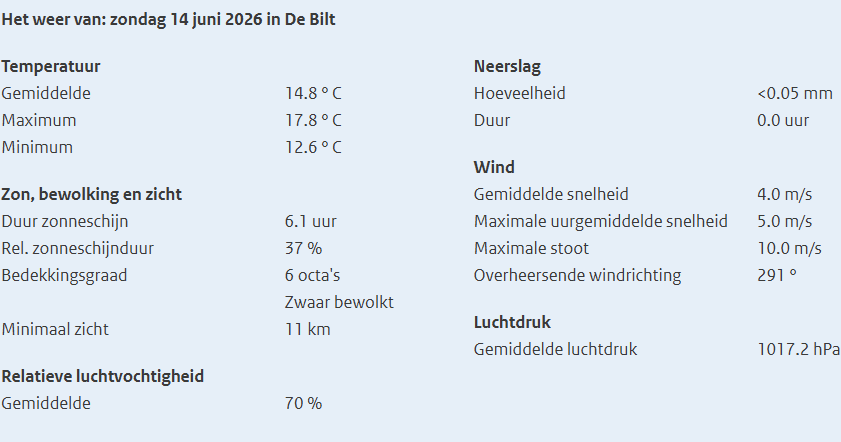
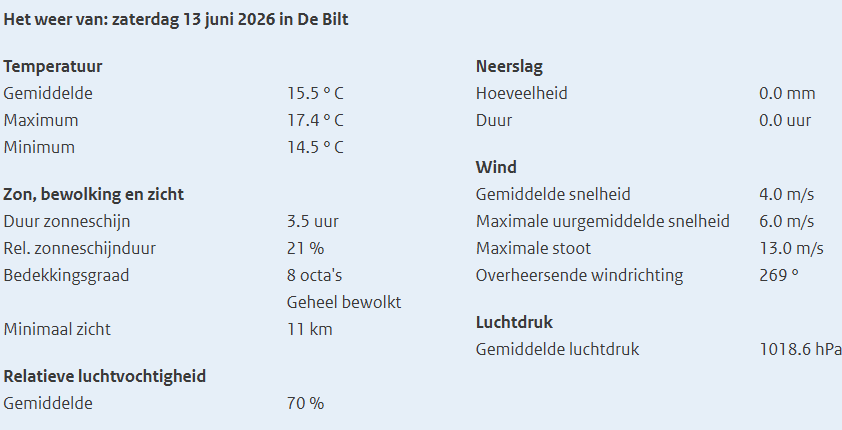
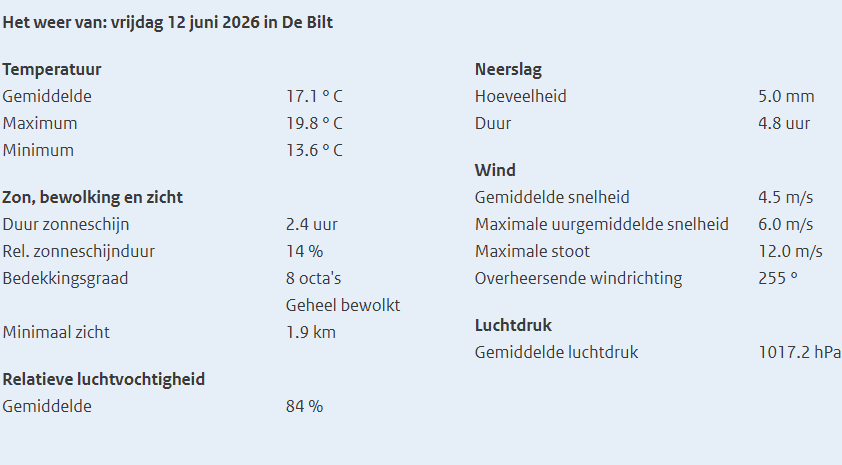
Weer:

Links:
In de geschiedenis

#EndChildLabour World Day Against Child Labour / Wereld Dag tegen Kinderarbeid 2026

World Day Against Child Labour
Klik op afbeelding om te lezen

The World Day Against Child Labour, which is held every year on June 12, is an International Labour Organization (ILO)-sanctioned holiday first launched in 2002 aiming to raise awareness and activism to prevent child labour, it was spurred by ratifications of ILO Convention No. 138 on the minimum age for employment and ILO Convention No. 182 on the worst forms of child labour.

The ILO, the United Nations body that regulates the world of work, launched the World Day Against Child Labour in 2002 in order to bring attention and join efforts to fight against child labour. This day brings together governments, local authorities, civil society and international, workers and employers organizations to point out the child labour problem and define the guidelines to help child labourers. According to ILO’s data, hundreds of millions of girls and boys throughout the world are involved in work that deprives them of receiving an adequate education, health, leisure and basic freedoms, violating this way their rights. Of these children, more than half are exposed to the worst forms of child labour. These worst forms of child labour include work in hazardous environments, slavery, or other forms of forced labour, illicit activities such as drug trafficking and prostitution, as well as involvement in armed conflict.

2026 Theme: Red card to child labour: Fair play for children, decent work for adults. The 2026 World Day comes at a decisive moment. The 6th Global Conference on the Elimination of Child Labour, held in Marrakech, reaffirmed the urgent need to accelerate action and translate commitments into concrete results. The Marrakech Global Framework for Action against Child Labour provides a concrete roadmap and indicators for tackling child labour through integrated responses that address root causes and protect every child’s rights. Under the slogan “Red card to child labour: Fair play for children, decent work for adults”, the 2026 World Day Against Child Labour campaign calls for reinforced action on the policies that prevent child labour and withdrawn children from it:  quality education, universal social protection, decent work and adequate livelihoods for adults, stronger laws and enforcement, better data and monitoring systems, and responsible action in agriculture and supply chains. This action is urgently needed. Despite progress, 138 million children remain in child labour worldwide, including nearly 54 million in hazardous work. On this World Day Against Child Labour, raise the Red card to child labour. Mobilize, speak out and act to turn the Marrakech commitments into real change for children, families and communities everywhere.

Links:
World Day Against Child Labour