#WorldMetDay World Meteorological Day / Wereld Meteorologie Dag 2026

Wereld Meteorologie Dag 2026

World Meteorological Day was established in 1951 to commemorate the establishment of the World Meteorological Organization (WMO) on 23 March 1950, this organization announces a slogan for World Meteorological Day every year, and this day is celebrated in all member countries.

The WMO, an organization of the United Nations, was created on 23 March 1950 to replace the International Meteorological Organization. It began operations in 1951 to coordinate member nations in the fields of meteorology, operational hydrology, and Earth sciences for the security of their population. The theme in 2026 is ‘Observing Today, Protecting Tomorrow’.

Links:
World Meteorological Day 2026 – 23 March

Watch the #WorldMetDay ceremony live on Monday, 23 March

State of the Global Climate 2025 – publication

Wereld Meteorologie Dag 2026 – KNMI

Meteorologen: aarde houdt meer warmte vast dan ooit, gevolgen nog eeuwen voelbaar

Frontlinie: Ticket naar Antarctica – deel 1 (TV NPO 2 / NPO Start)

Frontlinie: Ticket naar Antarctica

In ‘Frontlinie’ vertelt journalist Bram Vermeulen verdiepende en onthullende verhalen uit het buitenland, die ook jou aangaan.

Je kijkt naar documentaires op NPO Start, kunt luisteren naar interviews met reizigers in de podcast Achter de Frontlinie, je inschrijven op de nieuwsbrief voor extra verhalen, of volgen op Instagram en YouTube.

Wat als je kon ontsnappen naar de verste uithoek van de wereld? Weg van de geopolitieke spanningen die de wereldorde doen wankelen? Waar kun je heen, en tegen welke prijs? In het tweedelige ‘Frontlinie: Ticket naar Antarctica’ onderzoeken journalist Bram Vermeulen en fotograaf en filmmaker Kadir van Lohuizen de impact van luxetoerisme en klimaatverandering op Antarctica. Ze bezoeken het duurste hotel ter wereld en ontdekken er absurde situaties. Ook gaan ze naar Antarctica’s belangrijkste attractie: een met uitsterven bedreigde kolonie pinguïns.

Links:
Frontlinie: Ticket naar Antarctica

Ticket naar Antarctica, toerisme op een smeltende continent

Frontlinie Meet Up – Ticket naar Antarctica

Stop YARA – protestmars

Stop Yara

Stop kunstmest: red voedsel, bodem en klimaat.

Met belastinggeld wordt voedsel minder gezond en klimaatverandering versneld. Ondertussen put kunstmest de bodem uit en tast biodiversiteit aan. Het kan anders: biologisch en agro-ecologisch, samen met de natuur. Boeren laten zien dat het werkt. De discussie over Gronings gas voor “noodsituaties” laait weer op door de oorlog met Iran. Dat wil Extinction Rebellion Landbouw niet  laten gebeuren! Ondertussen wordt kunstmest weer neergezet als onmisbaar voor onze landbouw. Kunstmestproductie = fossiel gas. Bedrijven zoals de Noorse gigant Yara maken kunstmest vooral met fossiel gas. Dat leidt tot enorme CO₂-uitstoot en versnelt de klimaatcrisis. En toch wordt dit systeem nog steeds verdedigd als “noodzakelijk”. Tijd voor een ander geluid. Met de mars laten ze hun stem horen.

Links:
Stop Kunstmest En Red Onze Bodem, Ons Voedsel en Ons Klimaat

Sluit aan op 27 maart

The data heat island effect: quantifying the impact of AI data centers in a warming world – publication

Graphical abstract of this work: the proposed multiscale multimodal architecture for data analysis integrates records of land surface temperature trends from year 2004 to 2024, gridded population maps, and AI data centres locations worldwide, to achieve a thorough understanding of the impact of data heat islands in time, space and over communities.

The strong and continuous increase of AI-based services leads to the steady proliferation of AI data centres worldwide with the unavoidable escalation of their power consumption, it is unknown how this energy demand for computational purposes will impact the surrounding environment, scientists report in the paper ‘The data heat island effect: quantifying the impact of AI data centers in a warming world‘.

Data centres built to power AIs produce so much heat that they can raise the surface temperature of the land around them by several degrees – creating so-called data centre heat islands that may already be affecting up to 340 million people. The number of data centres built around the world is forecast to rise enormously, data centre capacity will double between 2025 and 2030 – with AI expected to account for half that demand. Andrea Marinoni at the University of Cambridge, UK, and his colleagues saw that the amount of energy needed to run a data centre had been steadily increasing of late and was likely to “explode” in the coming years, so wanted to quantify the impact. The researchers took satellite measurements of land surface temperatures over the past 20 years and cross-referenced them against the geographical coordinates of more than 8400 AI data centres. Recognising that surface temperature could be affected by other factors, the researchers chose to focus their investigation on data centres located away from densely populated areas. They discovered that land surface temperatures increased by an average of 2°C in the months after an AI data centre started operations. In the most extreme cases, the increase in temperature was 9.1°C. The effect wasn’t limited to the immediate surroundings of the data centres: the team found increased temperatures up to 10 kilometres away. Seven kilometres away, there was only a 30 per cent reduction in the intensity. Using population data, the researchers estimate that more than 340 million people live within 10 kilometres of data centres, so live in a place that is warmer than it would be if the data centre hadn’t been built there. Marinoni says that areas including the Bajío region in Mexico and the Aragon province in Spain saw a 2°C temperature increase in the 20 years between 2004 and 2024 that couldn’t otherwise be explained. Chris Preist at the University of Bristol, UK, says the results may be more nuanced than they first appear, suggesting that the building being heated by sunlight may be part of the effect. Either way, the data centre is still increasing the ground temperature, says Marinoni.

Links:
AI data centres can warm surrounding areas by up to 9.1°C

2026-03-21, Lief dagboek

Zaterdag; Wat eten we vandaag?; Tegelwippen; PFAS in particuliere eieren; Day for the Elimination of Racial Discrimination; Wereld Downsyndroom Dag; Dag van het Bos; World Day for Glaciers; Schelpenteldag; XR komt op voor omwonenden gasvelden.

Deze afbeelding heeft een leeg alt-attribuut; de bestandsnaam is dagboek.png

Wat eten we vandaag?:

Klik op afbeelding voor origineel

Knipselkrant:


Agenda:

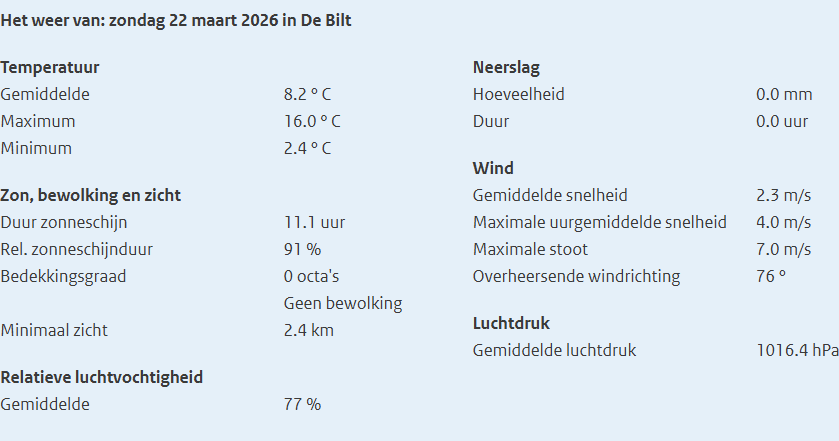
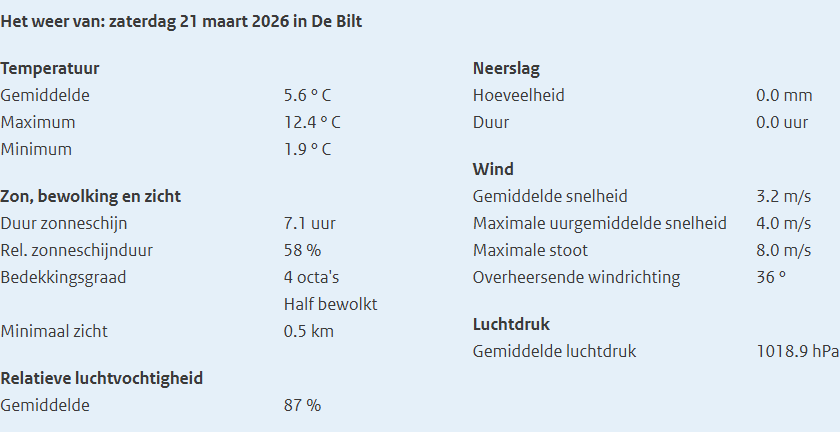
Weer:

Links:
In de geschiedenis

Day for the Elimination of Racial Discrimination 2026

International Day for the Elimination of Racial Discrimination

In 1979, the United Nations General Assembly adopted a program of activities to be undertaken during the second half of the Decade for Action to Combat Racism and Racial Discrimination.

On this occasion, the General Assembly decided that a week of solidarity with the peoples struggling against racism and racial discrimination, beginning on 21 March, would be organized annually. The International Day for the Elimination of Racial Discrimination, March 21, commemorates the anniversary of the Sharpeville Massacre in 1960 and falls at the beginning of this week of solidarity. On that day in South Africa, peaceful demonstrators against apartheid were killed. In 1966, the United Nations declared that each year on March 21, the International Day for the Elimination of Racial Discrimination should be observed as a symbol of the worldwide need to end racism.

Links:
Week of Solidarity with the Peoples Struggling against Racism and Racial Discrimination

Day for the Elimination of Racial Discrimination, 21 March