Tag: skyatnight

The Sky at Night – The Sky at Night Meets The Infinite Monkey Cage (TV BBC Four)

The Sky at Night is a monthly documentary television programme on astronomy produced by the BBC.

The show had the same permanent presenter, Patrick Moore, from its first broadcast on 24 April 1957 until 7 January 2013. The latter date was a posthumous broadcast, which followed Moore’s death on 9 December 2012. This made it the longest-running programme with the same presenter in television history. Many early episodes are missing, either because the tapes were wiped, thrown out, or because the episode was broadcast live and never recorded in the first place.

Beginning with the 3 February 2013 edition, the show was co-presented by Lucie Green and Chris Lintott. Since December 2013 Maggie Aderin-Pocock has been a presenter. The programme’s opening and closing theme music is “At the Castle Gate”, from the incidental music to Pelléas et Mélisande, written in 1905 by Jean Sibelius, performed by the Royal Philharmonic Orchestra and conducted by Sir Thomas Beecham.

This episode:
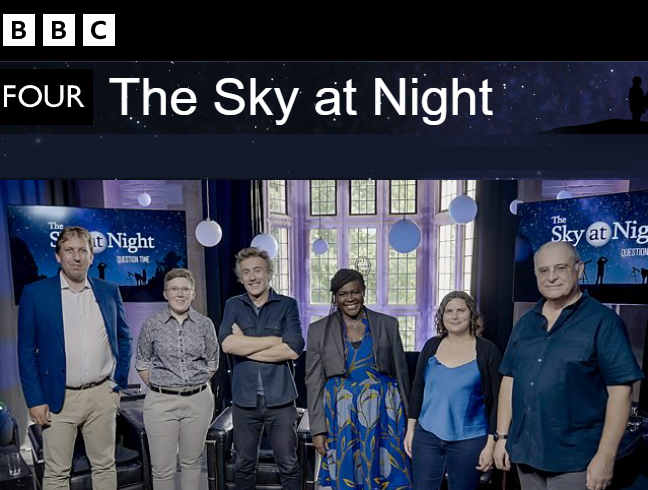
In this special episode to mark the end of another season of The Sky at Night, we team up with BBC Radio 4’s The Infinite Monkey Cage to talk all things amateur astronomy. Join Maggie, Chris and Pete, alongside Professor Brian Cox and comedians Robin Ince and Dara Ó Briain, in front of a live audience at the BBC’s Radio Theatre. Together they discuss their love of stargazing and share their top tips and favourite kit for looking up at the night sky.

Outside the Radio Theatre, Pete hosts a Star Party. He joins fellow amateur astronomers hoping to get views of the Moon, as well as the giant planets Saturn and Jupiter, using binoculars, telescopes – and the naked eye. But will the clouds part for long enough?

We look back at 66 years of stargazing – and cloudy skies – with The Sky at Night, including some very familiar, but much younger, faces. And of course, Sir Patrick Moore.

Pete invites Professor Leigh Fletcher from the University of Leicester to the Star Party. Leigh explains how images from amateur astronomers on Earth have been used to direct the camera onboard Nasa’s Juno mission to Jupiter. And amateurs are playing a critical role in processing the data and images sent back from this gas giant.

And Dr George Dransfield meets Dr Martin Archer from Imperial College London to discover how we can get involved with space science – even when it’s cloudy. Martin is involved in a Nasa project called Harp, which is asking citizen scientists to listen to outer space. Martin took inspiration from his previous career as a radio DJ to convert plasma waves that travel through space into sound waves. By analysing these sound waves, we can help scientists work out the impact these plasma waves might have on us here on Earth.

Links:
The Sky at Night

The Infinite Monkey Cage – The Monkeys meet The Sky At Night

2023-10-09, Lief dagboek

Maandag; Wat eten we vandaag?; Permanente A12-blokkade Stop Fossiele Subsidies; Tata steel; 2023 Herat earthquakes; Jacques Brel; Wecycleweek; Modelling the cosmos; Speak to your imagination; The Sky at Night; KNMI’23-klimaatscenario’s.

Wat eten we vandaag?:

Knipselkrant:


Agenda:

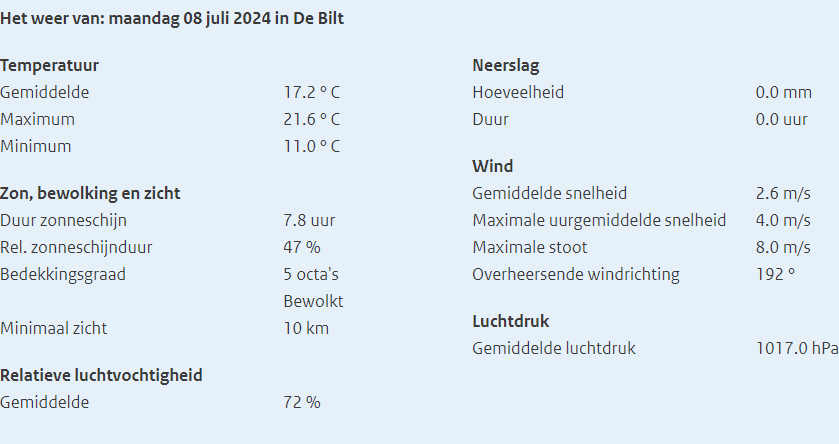
Weer:

Links:
In de geschiedenis

The Sky at Night : Question Time Special – (TV BBC Four)

The Sky at Night is a monthly documentary television programme on astronomy produced by the BBC.

The show had the same permanent presenter, Patrick Moore, from its first broadcast on 24 April 1957 until 7 January 2013. The latter date was a posthumous broadcast, which followed Moore’s death on 9 December 2012. This made it the longest-running programme with the same presenter in television history. Many early episodes are missing, either because the tapes were wiped, thrown out, or because the episode was broadcast live and never recorded in the first place.

Beginning with the 3 February 2013 edition, the show was co-presented by Lucie Green and Chris Lintott. Since December 2013 Maggie Aderin-Pocock has been a presenter. The programme’s opening and closing theme music is “At the Castle Gate”, from the incidental music to Pelléas et Mélisande, written in 1905 by Jean Sibelius, performed by the Royal Philharmonic Orchestra and conducted by Sir Thomas Beecham.

This episode:
A special Question Time edition of the programme, recorded at the University of Exeter as part of the British Science Association’s Science Festival. The panel is chaired by science journalist Dallas Campbell and made up of The Sky at Night presenters Chris Lintott, Maggie Aderin-Pocock and Pete Lawrence, who are joined on stage by Dr Claire Davies, who studies star and planet formation, and Dr Hannah Wakeford, who specialises in the atmospheres of exoplanets. The panel answer questions covering all things astronomical from The Sky at Night’s avid viewers and from audience members. We also hear about updates from the Voyager missions to life on other planets and discover where the panel would want to send future space probes if they had the chance.

Links:
The Sky at Night

The Sky at Night : The Very Large Telescope (TV BBC Four)

The Sky at Night is a monthly documentary television programme on astronomy produced by the BBC.

The show had the same permanent presenter, Patrick Moore, from its first broadcast on 24 April 1957 until 7 January 2013. The latter date was a posthumous broadcast, which followed Moore’s death on 9 December 2012. This made it the longest-running programme with the same presenter in television history. Many early episodes are missing, either because the tapes were wiped, thrown out, or because the episode was broadcast live and never recorded in the first place. Beginning with the 3 February 2013 edition, the show was co-presented by Lucie Green and Chris Lintott. Since December 2013 Maggie Aderin-Pocock has been a presenter. The programme’s opening and closing theme music is “At the Castle Gate”, from the incidental music to Pelléas et Mélisande, written in 1905 by Jean Sibelius, performed by the Royal Philharmonic Orchestra and conducted by Sir Thomas Beecham.

This episode:
The Very Large Telescope – or VLT – has been responsible for some of the greatest astronomical breakthroughs of all time, discoveries that have resulted in Nobel Prizes and transformed our understanding of the cosmos. The Sky at Night team travels to the heart of Chile’s Atacama Desert to explore one of the most advanced observatories in the world – a site at the forefront of ground-based optical astronomy.

The Very Large Telescope, or VLT, is located at the Paranal Observatory, in the Atacama Desert, one of the driest places on earth apart from the North and South Poles, which makes it the perfect place for an observatory because there is little moisture in the air distorting the view of the stars.

The VLT is actually made up of four main telescopes that can be used individually or have their observing power combined. Each telescope contains a huge 8.2 metre mirror at its heart, designed to capture as much light as possible, and the images obtained from the ground are almost as sharp as those obtained in space.

In this episode, Maggie meets some of the scientists, engineers and astronomers working at this extraordinary site. Her journey begins by meeting the head of maintenance, support and engineering, Maxime Boccas. He is leading the operation of something that only happens once every two years – the cleaning of the mirrors. Maxime explains the incredible way these huge and delicate mirrors are cleaned and maintained – including the way aluminium particles are vaporised to create perfectly reflective surfaces.

Someone using the incredible telescopes for their work is astronomer Dr Joe Anderson. Along with other scientists, Joe uses the VLT’s specialised instruments – devices that analyse light from the universe, helping scientists to see and better understand the cosmos. Joe explains that the VLT is the world’s most advanced visible-light astronomical observatory, and its huge mirrors and range of instruments mean astronomers can get readings across a broad range of spectrums, which has led to a lot of new discoveries regarding exoplanets, black holes and gamma ray bursts.

The VLT is a huge site in the middle of a desert, so Maggie next meets Vanessa Peidro, the head of logistics and responsible for maintaining not just the buildings and vehicles but also managing food, water and other facilities that cater for 150-160 people on site at any one time.

Maggie then meets physicist Francoise Delplancke-Stroebele and her colleague Frederic Gonte. They are leading the VLT’s next upgrade, Gravity+, and explain how the four massive telescopes at the VLT work in unison by combining light waves in a technique called interferometry. This technique is used by astronomer Dr Abigail Frost, who explains how interferometry helped in the recent discovery of a rare so-called ‘vampire star’.

The VLT is still a world-class observatory with cutting-edge research, but the site will soon transform into an even more powerful observatory. The Extremely Large Telescope, or ELT, is currently in construction. Maggie gets a sneak peek at what will be, when it’s completed in five years’ time, the biggest optical telescope in the world. Built on top of a mountain and the size of a cathedral, the ELT has to be one of the most spectacular and complex feats of engineering in the world.

Links:
The Sky at Night

2023-09-11, Lief dagboek

Maandag; Wat eten we vandaag?; Het demonstratierecht in Nederland; Aanslagen op 11 september 2001; De slimste mens; Belletje-trek-dag; The Sky at Night.

Deze afbeelding heeft een leeg alt-attribuut; de bestandsnaam is dagboek.png

Wat eten we vandaag?:

Vooraf: taart, klik op afbeelding voor origineel

In verband met een (50e) verjaardag van een collega van A3 werd taart gegeten.

Lunch: burger, klik op afbeelding voor origineel

Vervolgens werd in een eethuis een lunch verorberd in het kader van het (tijdelijk) vertrek van een andere collega naar een tropische werkplek in de Cariben.

Knipselkrant:

Agenda:


Weer:

Links:
In de geschiedenis

The Sky at Night – Black Holes: Searching for the Unknown (TV BBC Four)


The Sky at Night is a monthly documentary television programme on astronomy produced by the BBC.

The show had the same permanent presenter, Patrick Moore, from its first broadcast on 24 April 1957 until 7 January 2013. The latter date was a posthumous broadcast, which followed Moore’s death on 9 December 2012. This made it the longest-running programme with the same presenter in television history. Many early episodes are missing, either because the tapes were wiped, thrown out, or because the episode was broadcast live and never recorded in the first place.

Beginning with the 3 February 2013 edition, the show was co-presented by Lucie Green and Chris Lintott. Since December 2013 Maggie Aderin-Pocock has been a presenter. The programme’s opening and closing theme music is “At the Castle Gate”, from the incidental music to Pelléas et Mélisande, written in 1905 by Jean Sibelius, performed by the Royal Philharmonic Orchestra and conducted by Sir Thomas Beecham.

This episode:

There has never been a more exciting time to study one of the most mysterious phenomena in space. This month, The Sky at Night team investigate the science of black holes and discover the incredible techniques being used to uncover their secrets, and even help us answer bigger questions about our universe.

Chris meets with Dr Becky Smethurst at the University of Oxford to learn how a black hole forms from the death of a star. He also investigates whether black holes deserve their menacing portrayal in popular culture. He describes what would happen if we got too close to the event horizon and how black holes might actually play a role in lighting up the universe.

Maggie explores how scientists are trying to understand more about black holes by meeting Dr Tessa Baker, who works on LIGO. The Laser Interferometer Gravitational-Wave Observatory is one of the world’s largest physics experiments and is not your usual type of observatory; instead of looking – it listens. The next observation run has just started, and Maggie learns what they are hoping to find.

Chris meets with Dr James Nightingale, who has recently discovered one of the largest black holes in space using brand new computational technology and the age-old technique of gravitational lensing. They explore the relationship between black holes and galaxies, as it is thought that within the centre of every galaxy lies a supermassive black hole.

We visit our in-house stargazing expert, Pete Lawrence, who shows us how to find a black hole in the sky, and Saturn at its brightest and best.

Finally, George Dransfield visits Dr Silke Weinfurtner at her black hole laboratory, where they are simulating features of black holes here on Earth. They use fluid systems to perform experiments to try to determine if phenomena we think occur around black holes could actually happen.

Links:
The Sky at Night

2023-04-04, Lief dagboek

Dinsdag; Wat eten we vandaag?; In memoriam Pa; Subsidies fossiele brandstof; Treinongeluk in Voorschoten: The Sky at Night; Ruigoord; btw-nultarief groente en fruit; stikstof; aardgaswinningsproblematiek Groningen; inlichtingendiensten NL; Martin Luther King; Isidorus van Sevilla; Wereld Zwerfdierendag; Werelddag tegen Landmijnen; Phishing.

Deze afbeelding heeft een leeg alt-attribuut; de bestandsnaam is dagboek.png

Wat eten we vandaag?:

Pasta, klik op afbeelding voor origineel

In memoriam Pa:

Knipselkrant:


Agenda:


Weer:

Links:
In de geschiedenis

2022-12-26, Lief dagboek

Maandag; Uit Groningen; BlueDot festival; Royal Institution Christmas Lectures; The Sky at Night; Aardbeving Groningen.

Deze afbeelding heeft een leeg alt-attribuut; de bestandsnaam is dagboek.png

Uit Groningen:
Doordat bij aankomst in Sappemeer bleek dat een onderdeel van het CPAP-apparaat niet was meegereisd, was A3 genoodzaakt veel eerder dan gepland naar huis in Amsterdam terug te keren.

Knipselkrant:

Agenda:


Weer:

Links:
In de geschiedenis