
2026-09-14, Lief dagboek
Maandag; Wat eten we vandaag?; Big Tech vs Democratie; Schiphol; The Sky at Night.

Wat eten we vandaag?:

Knipselkrant:
Agenda:
Weer:
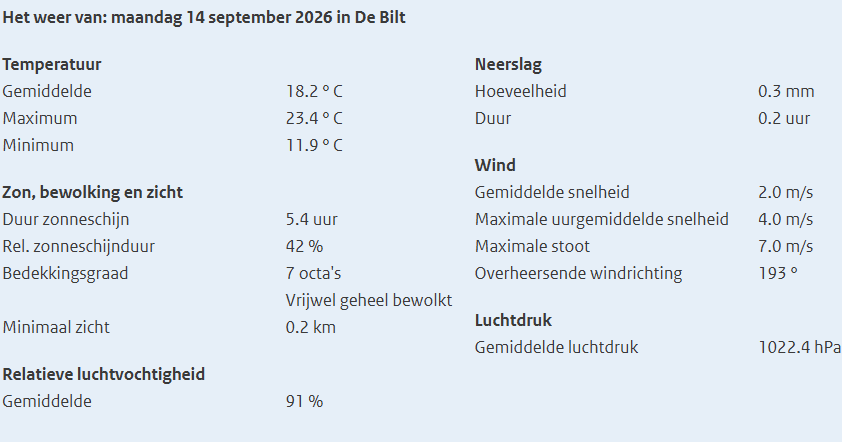
Links:
In de geschiedenis

Maandag; Wat eten we vandaag?; Big Tech vs Democratie; Schiphol; The Sky at Night.
Wat eten we vandaag?:
Knipselkrant:
Agenda:
Weer:
Links:
In de geschiedenis
Maandag; Contrast in Amsterdam; AfD; Dag van de Ziekte van Duchenne; Day of Clean Air for blue skies; Luchtalarm; Deltaprogramma.
Knipselkrant:
Agenda:
Weer:
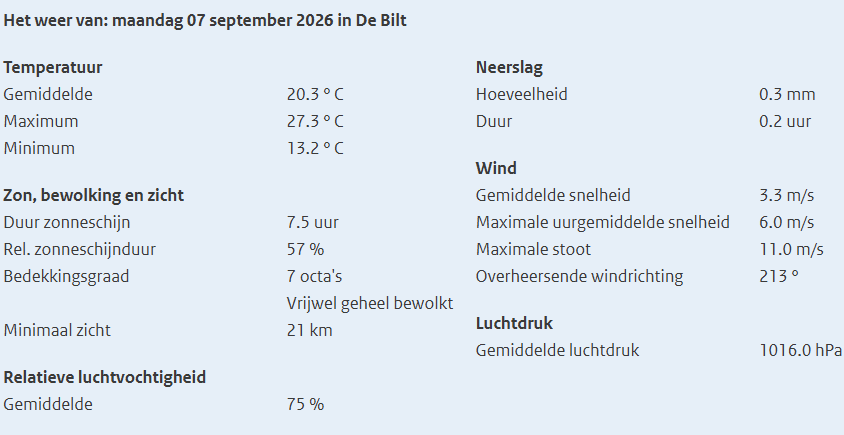
Links:
In de geschiedenis
The Sky at Night is a monthly documentary television programme on astronomy produced by the BBC.
The show had the same permanent presenter, Patrick Moore, from its first broadcast on 24 April 1957 until 7 January 2013. The latter date was a posthumous broadcast, which followed Moore’s death on 9 December 2012. This made it the longest-running programme with the same presenter in television history. Many early episodes are missing, either because the tapes were wiped, thrown out, or because the episode was broadcast live and never recorded in the first place. Beginning with the 3 February 2013 edition, the show was co-presented by Lucie Green and Chris Lintott. Since December 2013 Maggie Aderin-Pocock has been a presenter. The programme’s opening and closing theme music is “At the Castle Gate”, from the incidental music to Pelléas et Mélisande, written in 1905 by Jean Sibelius, performed by the Royal Philharmonic Orchestra and conducted by Sir Thomas Beecham.
This episode:
Chris Lintott and the team explore the extraordinary engineering, both on Earth and millions of kilometres above it in space, that is transforming modern astronomy and revealing parts of the cosmos once thought forever beyond our reach. George Dransfield travels to Marseille to investigate KM3NeT, one of the most ambitious scientific instruments ever constructed. Covering more than a cubic kilometre of the Mediterranean Sea, this vast underwater observatory is searching for neutrinos, elusive ‘ghost particles’ that pass through planets, stars and even our own bodies almost entirely unnoticed. By detecting these cosmic messengers, astronomers hope to uncover the origins of some of the most violent and energetic events in the universe, from exploding stars to the environments around supermassive black holes. The programme also explores gravitational-wave astronomy and the remarkable international network of detectors capable of measuring distortions in space-time smaller than an atom. These instruments have opened an entirely new way of observing the cosmos, allowing scientists to detect collisions between black holes and neutron stars across the Universe.
In Cambridge, Chris visits a team attempting to tackle one of cosmology’s biggest mysteries using a tabletop experiment. By cooling atoms to almost absolute zero and manipulating them with ultra-precise lasers, researchers are building a laboratory system that could one day probe some of the quantum physics thought to have shaped the universe in its earliest moments. Finally, Maggie Aderin explores Nasa’s Nancy Grace Roman Space Telescope, a new observatory designed to search for distant worlds beyond our solar system. Its revolutionary coronagraph will suppress the overwhelming glare of distant stars, potentially allowing astronomers to directly image planets orbiting them and paving the way for future missions that could search Earth-like worlds for signs of life. From particle detectors deep beneath the Mediterranean to ultra-cold quantum experiments and next-generation space telescopes, this programme reveals how human ingenuity is creating entirely new ways to explore the cosmos and uncover its deepest secrets.
Links:
Engineering the Universe
Maandag; Wat eten we vandaag?; Zonsverduistering; Meteorenzwerm η-Eridaniden; Wereld Leeuwendag; The Sky at Night.
Wat eten we vandaag?:

Knipselkrant:
Agenda:
Weer:
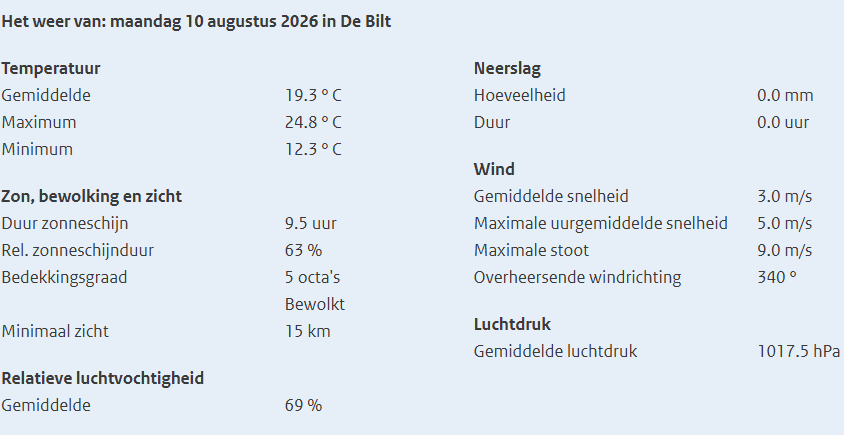
Links:
In de geschiedenis
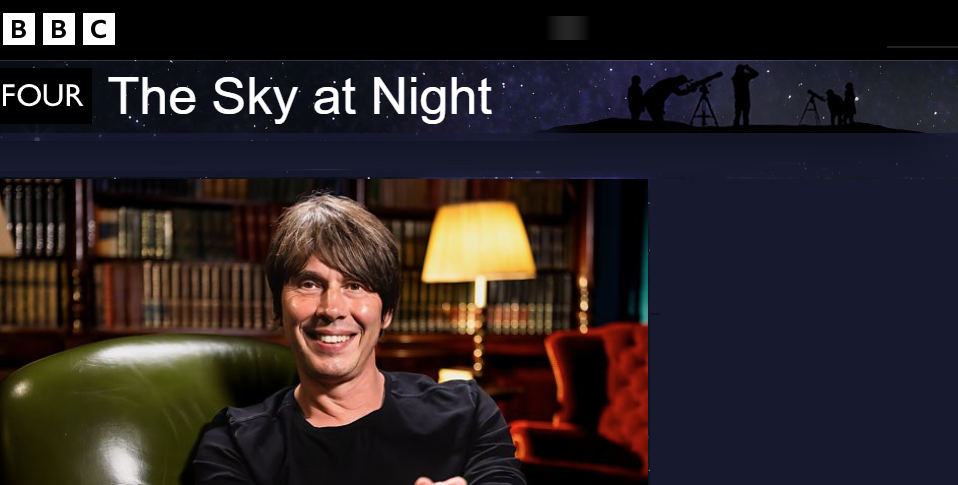
The Sky at Night is a monthly documentary television programme on astronomy produced by the BBC.
The show had the same permanent presenter, Patrick Moore, from its first broadcast on 24 April 1957 until 7 January 2013. The latter date was a posthumous broadcast, which followed Moore’s death on 9 December 2012. This made it the longest-running programme with the same presenter in television history. Many early episodes are missing, either because the tapes were wiped, thrown out, or because the episode was broadcast live and never recorded in the first place. Beginning with the 3 February 2013 edition, the show was co-presented by Lucie Green and Chris Lintott. Since December 2013 Maggie Aderin-Pocock has been a presenter. The programme’s opening and closing theme music is “At the Castle Gate”, from the incidental music to Pelléas et Mélisande, written in 1905 by Jean Sibelius, performed by the Royal Philharmonic Orchestra and conducted by Sir Thomas Beecham.
This episode:
Professor Brian Cox joins the team to explore one the greatest current mysteries in astronomy – little red dots. Discovered by the James Webb Space Telescope (JWST), they have upended everything we thought we knew about black holes and the evolution of the universe itself.
Astronomical monsters, with the power to devour stars and even to stop time itself, black holes have both fascinated and troubled physicists for decades. Their study has led to breakthroughs in our understanding of gravity, quantum mechanics and even precision manufacturing.
The journey begins with black holes 101, as Chris Lintott and Brian Cox discuss what they are. And as it turns out, that is a harder question to answer than you might think. Distortions in space-time. Regions of infinite density. Gateways to other universes. The end of time. These are all descriptions of what black holes are, yet somehow all are insufficient – mathematically accurate yet physically unproven. What we thought we knew was that they are born in the violent deaths of massive stars, but this may not always be the case, and that has huge implications for how the cosmos we see today came to be.
Maggie Aderin travels to the University of Nottingham to meet Dr Emma Chapman, a cosmologist whose work focuses on the early universe. She explains the significance of JWST’s discovery of the little red dots and why they are forcing the scientific community to re-evaluate not only how black holes form but also how galaxies themselves grow and evolve.
Returning to Chris and Brian, the discussion turns to some of the alternative theories, and some of the explanations are truly staggering, from black hole suns, created by partially collapsed stars, to primordial black holes, born in the first moments of creation, and direct collapse black holes.
At the University of Edinburgh, George Dransfield meets Professor Sadegh Khochfar. Using months of processing time on the world’s most advanced supercomputers, his team have created the most detailed simulations of the universe’s first billion years. Their findings are shedding light on whether direct collapse black holes could exist and whether the density of the early universe could provide the answer to how massive black holes form without first forming stars, something once thought impossible.
While the nature of the little red dots themselves are still contested, they are making us re-evaluate what we understand about black holes, and in doing so, they provide a window into conditions so extreme that we’re forced to question our assumptions about the very nature of reality and the fundamental physics that underpins the universe.
But while understanding the universe is a challenge, there is still always joy in looking up at the skies above, and Dr Becky Smethurst is guest presenting this month’s star guide to take us through the treats coming up in the next few weeks.
Join us on an exploration of the skies and the latest in our understanding of black holes – the cosmic Rosetta Stones that spark wonder in the scientific community and far beyond.
Links:
T
Maandag; Wat eten we vandaag?; Einde detachering gemeente Haarlemmermeer; Wereld Oceanen Dag; VN-verdrag handicap; The Sky at Night.
Wat eten we vandaag?:

Einde detachering gemeente Haarlemmermeer:
Bovenstaande maaltijd bleek de laatste in het zeer gewaardeerde restaurant in Hoofddorp. A3 was aangenomen wegens groot personeelstekort, nu blijken twee ingewerkte mensen te vertrekken. Omdat A3 niet de snelste leerling blijkt te zijn en dus eigenlijk al zelfstandig had moeten werken, is zijn positie onpraktisch geworden.
Agenda:
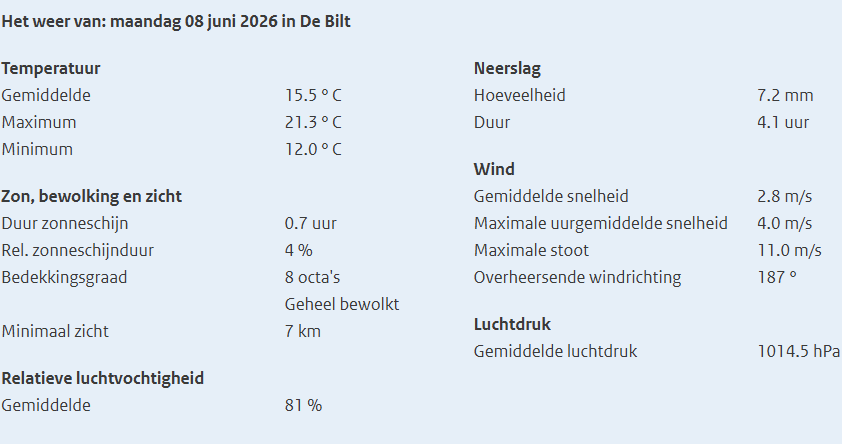
Weer:
Links:
In de geschiedenis
The Sky at Night is a monthly documentary television programme on astronomy produced by the BBC.
The show had the same permanent presenter, Patrick Moore, from its first broadcast on 24 April 1957 until 7 January 2013. The latter date was a posthumous broadcast, which followed Moore’s death on 9 December 2012. This made it the longest-running programme with the same presenter in television history. Many early episodes are missing, either because the tapes were wiped, thrown out, or because the episode was broadcast live and never recorded in the first place. Beginning with the 3 February 2013 edition, the show was co-presented by Lucie Green and Chris Lintott. Since December 2013 Maggie Aderin-Pocock has been a presenter. The programme’s opening and closing theme music is “At the Castle Gate”, from the incidental music to Pelléas et Mélisande, written in 1905 by Jean Sibelius, performed by the Royal Philharmonic Orchestra and conducted by Sir Thomas Beecham.
This episode:
Life on Earth depends on the sun for its light and its warmth. But the activity of our nearest star also poses a serious threat to all of us. In the most extreme cases, solar storms can send billions of tons of supercharged plasma hurtling at millions of miles per hour towards us, crippling our navigation and communication systems and damaging our power grids. In this episode of The Sky at Night, we uncover a danger that humanity is only just waking up to – space weather.
We begin our journey with the first scientifically recorded instance of extreme space weather. Chris Lintott meets the president of the Royal Astronomical Society, Professor Jim Wild. With privileged access to the society’s archives, Chris learns about the Carrington Event of 1859, when a massive solar storm caused aurorae as far south as the Caribbean and sparks to jump from telegraph wires, setting fires and electrocuting operators. Worryingly, if this were to hit us today, it could be a lot worse…
But to understand how space weather functions, we need to grasp how the matter spat out by the sun interacts with the Earth. Maggie Aderin drops into Warwick University to discover how Dr Ravindra Desai’s research is helping us do just that. From the magnetosphere, the vast protective bubble generated by our planet’s magnetic core, to the Van Allen Belts – dangerous layers of radiation trapped just above the Earth – Dr Desai is developing next-generation forecasting tools that will help to protect us from future risks.
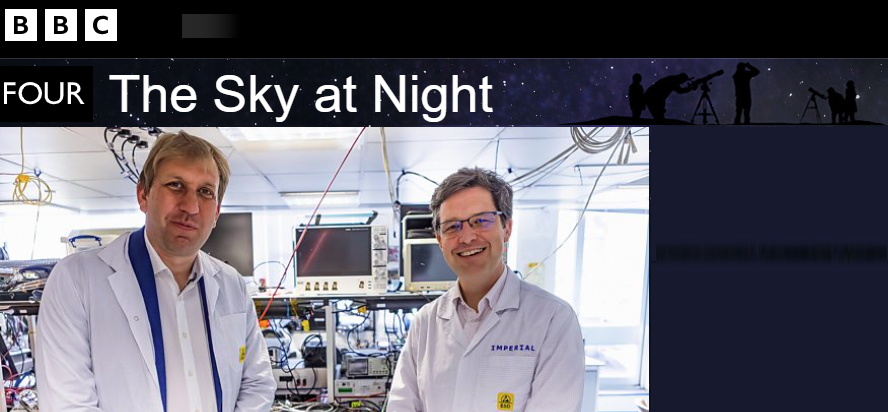
At Imperial College London, Chris Lintott gets a peek inside a groundbreaking deep space mission that will revolutionise our ability to monitor the sun’s activity and forecast solar storms. Professor Jonathan Eastwood, the magnetometer instrument lead of Vigil, takes Chris through the satellite’s capabilities. Sat 150 million kms away from Earth, Vigil will monitor the sun’s surface as it rotates towards us, giving us an extra five days’ notice of hazardous activity and a chance to avert a crisis.
In Exeter, our guest presenter, Sophia Herod, is allowed inside a very special department at the Met Office’s HQ – one of only a handful of 24/7 space weather forecasting operations in the world. There, with the help of space weather expert Krista Hammond, Sophia discovers how the Met Office is keeping a beady eye on the sun, investing in the technologies of the future, and working with government and industry to protect vital infrastructure we all rely on. Ultimately, Sophia reveals that the UK is leading the way on space weather.
Although space weather can be scary stuff, we don’t need to live through a disaster movie. This episode tells the amazing story of scientific solutions to vast and intractable problems, and how teams of people dedicate their working lives to keeping us safe from the very worst that the sun can throw at us.
Links:
T
Maandag; Wat eten we vandaag?; EU sancties tegen Israëlische kolonisten; Bob Marley; Ultimatum van vakbonden; Aardbeving Gaswinning Groningen; The Sky at Night.
Wat eten we vandaag?:
Knipselkrant:
Agenda:
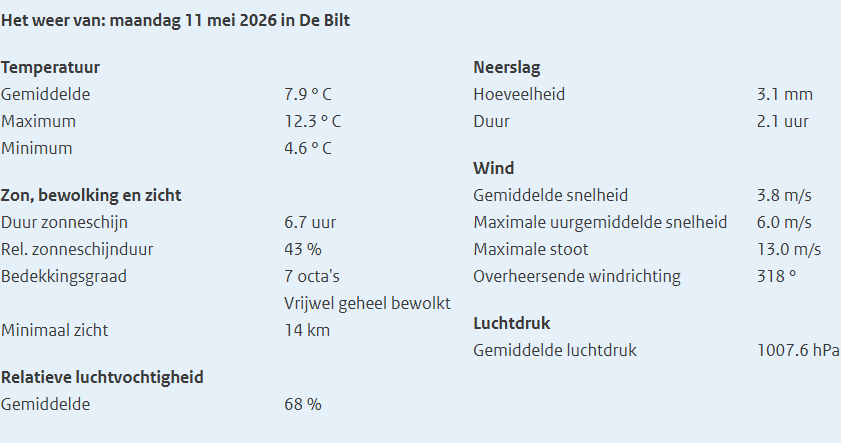
Weer:
Links:
In de geschiedenis
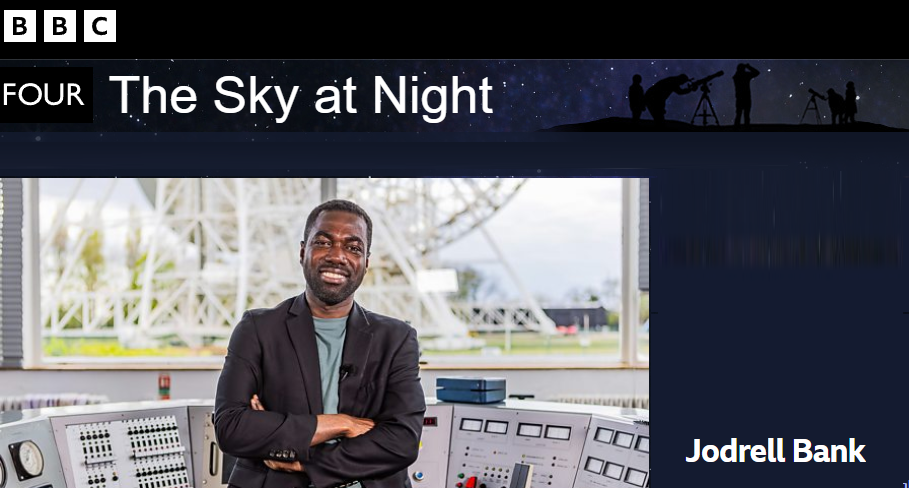
The Sky at Night is a monthly documentary television programme on astronomy produced by the BBC.
The show had the same permanent presenter, Patrick Moore, from its first broadcast on 24 April 1957 until 7 January 2013. The latter date was a posthumous broadcast, which followed Moore’s death on 9 December 2012. This made it the longest-running programme with the same presenter in television history. Many early episodes are missing, either because the tapes were wiped, thrown out, or because the episode was broadcast live and never recorded in the first place. Beginning with the 3 February 2013 edition, the show was co-presented by Lucie Green and Chris Lintott. Since December 2013 Maggie Aderin-Pocock has been a presenter. The programme’s opening and closing theme music is “At the Castle Gate”, from the incidental music to Pelléas et Mélisande, written in 1905 by Jean Sibelius, performed by the Royal Philharmonic Orchestra and conducted by Sir Thomas Beecham.
This episode:
It started 80 years ago with a field, army surplus, wartime radar and a visionary idea – and it changed how we see the universe forever. In this episode, we step inside the remarkable story of Jodrell Bank Observatory and its towering Lovell Telescope, an instrument that scientists have used to listen to the cosmos for almost 70 years. Taking us on this journey, Maggie Aderin meets research scientist Dr Emmanuel K Bempong-Manful to discover how the team he is in decide who gets time on the renowned Lovell Telescope, and what it can reveal. But connect this giant telescope with telescopes across the UK, and it becomes the headquarters of E-Merlin. That gives astronomers incredible resolution with which to view the universe in ways never seen before – delivering powerful results that deepen our understanding of how the cosmos works.
But how did this site become home to such an iconic scientific landmark, nestled in the Cheshire countryside? Professor Tim O’Brien takes Maggie on a tour of Jodrell Bank’s early history, from its beginnings as a botanist’s field, through the adaptation of wartime radar using army surplus, to the construction of what was, at the time, the world’s largest steerable radio telescope – an ambition many believed impossible. Driven by the vision of Bernard Lovell, the project ran dramatically over budget and needed a miracle to be completed – which arrived with the onset of the Cold War.
At the University of Manchester Library, Chris Lintott joins Professor Danielle George, GCHQ’s chief scientific adviser for national security, to examine previously top-secret files revealing Jodrell Bank’s role at the height of Cold War tensions. From tracking potential intercontinental missiles to listening in on the Soviet race to the moon, Chris uncovers the ingenious technologies and human stories playing out during one of the most perilous periods in modern history. Back at Jodrell Bank, the telescope’s constant watch on the sky continues. George Dransfield meets PhD student Phoebe Ryder, who is exploring how the Lovell’s extraordinary sensitivity can be adapted to study threats orbiting Earth – helping scientists anticipate potentially catastrophic collisions that could prevent any space launches – for years to come. Moving between past, present and future, this is a story of ambition, ingenuity and quiet vigilance – a reminder that some of the most important frontiers are explored not just by looking deeper into space, but by listening carefully to what the universe is telling us.
Links:
T
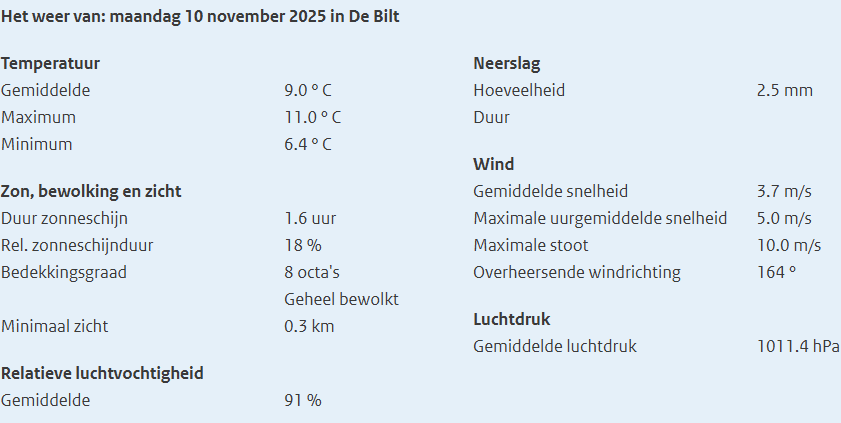
Maandag; Wat eten we vandaag?; Wereldwetenschapdag voor Vrede en Ontwikkeling; Dag Van De Mantelzorg; Wereld Wezendag; Klimaatweek; COP30; Food Film Festival; Week van de Rechtspraak; Week of Science and Peace; Ogoni9 memorial; The Sky at Night.
Wat eten we vandaag?:

Agenda:
Weer:
Links:
In de geschiedenis