2026 BRICS Summit

BRICS 2026

The 18th BRICS Summit is an international summit of the BRICS nations, scheduled to be hosted by India in 2026 as part of its BRICS chairmanship.

BRICS is an intergovernmental organization comprising Brazil, Russia, India, China, South Africa, and additional member states admitted in recent years. The BRICS summit is held annually, with the chairmanship rotating among member countries. Between 14 and 15 May 2026, the foreign ministers of BRICS member states met in Delhi, India, ahead of the leaders’ summit.

Links:
2026 BRICS Summit

#nzon2026 Noorderzon Festival of Performing Arts & Society 2026

Noorderzon

Noorderzon is een jaarlijkse elfdaagse internationale kunstenmanifestatie die plaatsvindt in het Noorderplantsoen en op diverse nabijgelegen locaties in en rondom het centrum van Groningen.

Noorderzon combineert hedendaagse podiumkunsten met een toegankelijk zomerfestival in het Noorderplantsoen. Bezoekers komen niet alleen voor de culturele voorstellingen, maar ook voor de foodtrucks en het samenzijn in het park. Een bijzonder kenmerk van Noorderzon zijn de containervoorstellingen, kleinschalige optredens in compacte ruimtes die populair zijn bij bezoekers vanwege hun intieme sfeer, deze voorstellingen zijn een vast onderdeel van het festivalprogramma.

Links:
Noorderzon

Studium Generale op Noorderzon

Invisible Rainbows: The hidden physics of light (TV Royal Institution)

Astronomer and science journalist Alfredo Carpineti explains the science beyond the visible light spectrum.

The light visible to the human eye is only a fraction of what exists out there. A myriad of hidden phenomena exist in our universe, beyond our sight and senses. How do we know this? Astronomers have been uncovering their secrets for all to see! From the most powerful explosions in the cosmos captured in gamma-rays, to the black holes we study in radio waves, the universe is filled with invisible rainbows. The kaleidoscope of colours we cannot see has allowed us to look for alien life and protect us from dangerous asteroids, kept an eye on the Sun’s activity, and even permit us to look as far as light would allow, right back to the first light emitted by the universe. Astronomer and author Alfredo Carpineti will lead you on a journey to explore the phenomenal objects and events beyond the visible in this fascinating talk. Filled with demonstrations and even a many-billion year old meteorite, this is not to be missed.

Links:
Invisible Rainbows: The hidden physics of light

2026-07-06, Lief dagboek

Maandag; Wat eten we vandaag?; WK voetbal corrupt; Wespen; Day of Cooperatives; Wereld Zoönosen Dag; Global Dialogue on AI Governance; Luchtalarm.

Deze afbeelding heeft een leeg alt-attribuut; de bestandsnaam is dagboek.png

Wat eten we vandaag?:

Klik op afbeelding voor origineel

Knipselkrant:


Agenda:

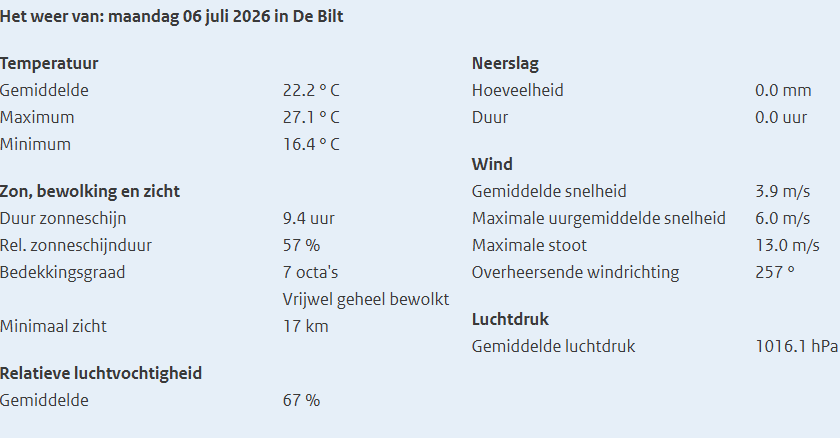
Weer:

Links:
In de geschiedenis

Waarschuwingsstelsel sirene en NL-alert test / #Luchtalarm – dit is een noodgeval! / #Ballenalarm

In heel Nederland klinkt op elke eerste maandag van de maand om 12:00 het luchtalarm van het waarschuwingsstelsel of waarschuwings- en alarmeringssysteem (WAS), behalve op feestdagen, Nationale Dodenherdenking of bij andere speciale gebeurtenissen.

De test duurt 1 minuut en 26 seconden. In juni en december wordt tevens een NL-Alert testbericht verstuurd naar mobiele (GSM) telefoons. Het WAS is een netwerk van 4278 sirenes in Nederland die draadloos en onafhankelijk van elkaar aangezet kunnen worden vanuit de alarmcentrale van de regionale brandweer. De sirenes worden gebruikt om te waarschuwen via een luchtalarm voor (dreigend) gevaar, met name indien er gevaarlijke stoffen in de lucht aanwezig (kunnen) zijn. Het systeem is ontwikkeld door Siemens, en gebruikt elektronische sirenes op basis van de Federal Signal Modulator 2008 en 1004. Het waarschuwingsstelsel is eigendom van het Ministerie van Justitie en Veiligheid, en is op 3 juni 1998 in gebruik genomen. De bevolking is van tevoren geïnstrueerd om in het geval dat de sirene afgaat naar binnen te gaan, ramen en deuren te sluiten en radio of televisie aan te zetten. Op de aangewezen calamiteitenzenders kan de overheid verdere aanwijzingen geven, bijvoorbeeld dat een gebied geëvacueerd zal worden.

Extinction Rebellion maakt er met de actie Luchtalarm – dit is een noodgeval! telkens met kleurrijke vlaggen en banners een mooi maar bloedserieus moment van. Met deze actie wil Extinction Rebellion NL aandacht vragen voor de klimaatcrisis en de biodiversiteitscrisis en duidelijk maken dat het al vijf over twaalf is. Sluit je voor een paar minuten aan bij deze actie en laat zien dat je ook vindt dat de overheid in actie moet komen om een leefbare toekomst voor ons en onze kinderen te waarborgen. Kom langs en doe mee! Iedereen is welkom. Neem borden mee, we delen tijdens de actie ook patches uit waarmee we onze boodschap kunnen uitdragen.

‘Het Ballenalarm‘ is een ludieke actie waarmee de Stichting Zaadbalkanker vraagt om extra aandacht voor zaadbalkanker, ook wel teelbalkanker genoemd. Het idee is dat mannen op de eerste maandag van de maand om 12:00 – als de maandelijkse alarmsirenes loeien – hun teelballen checken, en dit elke maand opnieuw. Dit moet leiden tot de vroegtijdige ontdekking van zaadbalkanker, de meest voorkomende kanker bij mannen tussen de 15 en 40 jaar.

Links:
crisis.nl

Wanneer wordt de sirene getest?

Veiligheidsregio’s: geen goed alternatief voor luchtalarm na 2027 is onacceptabel

Global Dialogue on AI Governance – first session

Global Dialogue on AI Governance

The first session of the Global Dialogue on AI Governance will be held on 6 and 7 July 2026 in Geneva.

The Global Digital Compact (A/RES/79/1), adopted at the 2024 Summit of the Future, set out a shared vision for an open, safe, and inclusive digital future. Among its commitments was the creation of Global Dialogue on AI Governance to serve as an inclusive space within the United Nations for governments and stakeholders to deliberate on today’s most pressing AI challenges. The United Nations General Assembly established the Global Dialogue on AI Governance in Resolution A/RES/79/325, following intergovernmental negotiations and broad consultations with diverse stakeholders.

Links:
Global Dialogue on AI Governance

Roadmap

From AI to ‘killer robots’: UN chief issues urgent governance call

Agenda – We Must Act Now – publication

#CoopsDay Day of Cooperatives 2026

Day of Cooperatives

On July 6, cooperatives around the world will celebrate the Day of Cooperatives.

Co-operatives have been acknowledged as associations and enterprises through which citizens can effectively improve their lives while contributing to the economic, social, cultural and political advancement of their community and nation. The co-operative movement has been also recognized as a distinct and major stakeholder in both national and international affairs. Co-operatives’ open membership model affords access to wealth creation and poverty elimination. This results from the co-operative principle of members’ economic participation: ‘Members contribute equitably to, and democratically control, the capital of their co-operative.’ Because co-operatives are people-centred, not capital-centred , they do not perpetuate, nor accelerate capital concentration and they distribute wealth in a more fair way. Co-operatives also foster external equality. As they are community-based, they are committed to the sustainable development of their communities – environmentally, socially and economically. This commitment can be seen in their support for community activities, local sourcing of supplies to benefit the local economy, and in decision-making that considers the impact on their communities. Despite their local community focus, co-operatives also aspire to bring the benefits of their economic and social model to all people in the world. Globalization should be governed by a set of values such as those of the co-operative movement; otherwise, it creates more inequality and excesses that render it unsustainable. The cooperative movement is highly democratic, locally autonomous, but internationally integrated, and a form of organization of associations and enterprises whereby citizens themselves rely on self-help and their own responsibility to meet goals that include not only economic, but also social and environmental objectives, such as overcoming poverty, securing productive employment and encouraging social integration.

The 2026 theme of the United Nations International Day of Cooperatives, “Cooperatives for a peaceful world”, affirms the contribution of cooperative enterprises to social justice, inclusion and solidarity. It recognizes cooperatives as people-centered institutions that can help build trust, strengthen social cohesion and bring communities together around shared needs and aspirations. In a world marked by conflict, inequality, social fragmentation and declining trust, the theme recalls that peace is more than the absence of violence: it also requires inclusion, fairness, dialogue and economic security. Announced by the International Cooperative Alliance, this year’s theme also reflects the capacity of the cooperative model to serve as a bridge between people and communities. Through democratic ownership, open membership and collective responsibility, cooperatives create spaces in which people can participate, be heard and work together across social and economic divides. Rooted in communities and connected through an international movement, they support livelihoods, decent work, poverty reduction, social integration and peacebuilding among peoples, communities and nations.

Links:
Day of Cooperatives

Wereld Zoönosen Dag / World Zoonoses Day 2026

Wereld Zoönosen Dag

Een zoönose is elke ziekte of infectie die van nature overdraagbaar is van gewervelde dieren op mensen.

Dieren spelen dus een essentiële rol bij het in stand houden van zoönotische infecties in de natuur. Zoönosen kunnen bacterieel, viraal of parasitair zijn of onconventionele agentia omvatten. Zoönosen zijn vaak diersoortspecifiek en hebben meestal consequenties voor de volksgezondheid. Het woord zoönose is afgeleid van de Griekse woorden zoön (dier) en nosos (ziekte). Veel fulminant  (levensbedreigend) verlopende infectieziekten zijn zoönosen, daar deze bacteriën, protozoa, virussen of wormen vaak zijn aangepast om in hun specifieke gastheer te overleven zonder al te veel schade aan te richten, maar deze bij andere gastheren een heftige immuunreactie oproepen. Het verschijnsel waarbij menselijke aandoeningen worden overgedragen op dieren, wordt antroponose genoemd.

Links:
World Zoonosis Day 6 July