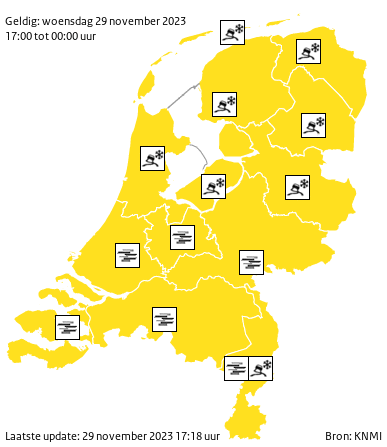
#KNMI #CodeGeel : plaatselijk dichte mist en gladheid

In het noorden en in Zuid-Limburg kan het plaatselijk glad worden door bevriezing van natte weggedeelten, in het noorden mogelijk ook door een sneeuwbui.

Verder ontstaat er in de loop van de avond en nacht met name in het zuiden en midden plaatselijk dichte mist. Verkeer en buitenactiviteiten kunnen hinder ondervinden van zowel de dichte mist als de gladheid. Dichte mist en gladheid verdwijnen in de loop van donderdagochtend weer.

Links:
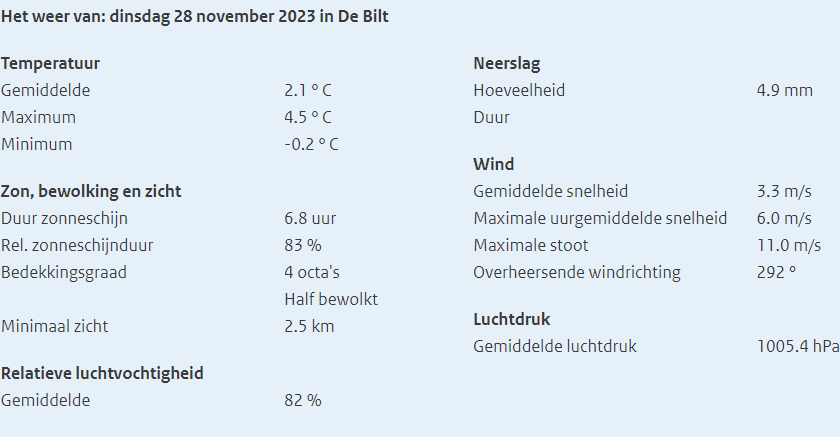
Weerstation

Wat kan ik verwachten en wat kan ik doen bij gladheid door sneeuw?

2023-11-29, Lief dagboek

Woensdag; Wat eten we vandaag?; Slaapapneu; Gaza−Israël oorlog van 2023; Cyprus Confidential; United Nations Climate Change Conference COP28; PalestineDay; Sint Pannekoek.

Wat eten we vandaag?:

Lunch, klik op afbeelding voor origineel

Slaapapneu:

DreamStation 2, klik op afbeelding voor origineel

Op 29 november 2023 komt A3 er achter dat ook het nieuwe slaapapneu-apparaat van Philips, de DreamStation 2, niet betrouwbaar lijkt, De apparaten kunnen brand, rook en brandplekken veroorzaken volgens de Amerikaanse toezichthouder FDA.

Knipselkrant:


Agenda:

Weer:

Links:
In de geschiedenis

#SintPannekoek 2023

Sint Pannekoek, ook wel geschreven als Sint Pannenkoek, is een fictieve feestdag op 29 november, die voor het eerst werd beschreven in een strip van Jan, Jans en de kinderen van Jan Kruis.

In 1986 maakte striptekenaar Jan Kruis voor het blad Libelle een strip uit de reeks Jan, Jans en de kinderen, waarin opa en dochter Catootje geen trek hebben in de boontjes die Jans, de moeder van het gezin, heeft klaargemaakt. Opa oppert hierop dat het, omdat het 29 november is, Sint Pannekoek is. Hij noemt het in de strip een oude Rotterdamse feestdag, waarbij de moeder van het gezin pannenkoeken bakt. Het gezin wacht op de thuiskomst van de “heer des huizes” met een pannenkoek op het hoofd en wenst hem bij binnenkomst een gezegende Sint Pannekoek toe. Jan Kruis gebruikte de term voor het eerst in de schoolagenda Jan, Jans en de kinderen 1986-1987, waar hij 29 november als Sint Pannekoek markeerde. In november 1986 was Sint Pannekoek onderwerp van een aflevering van de wekelijkse strip in het vrouwentijdschrift Libelle. In het stripverhaal heeft Catootje geen trek in de boontjes die Jans voor het avondeten wil klaarmaken, maar juist wel in pannenkoeken.

Nadat opa Tromp aan Jans gevraagd heeft welke datum het is (29 november), vertelt hij dat dit Sint Pannekoek is. Dit is volgens hem een oude Rotterdamse traditie, waarbij de moeder van het gezin pannenkoeken bakt. De gezinsleden wachten volgens deze traditie op de thuiskomst van de heer des huizes met elk een pannenkoek op het hoofd en wensen hem bij binnenkomst “een vrolijke en gezegende Sint Pannekoek” toe. Jans vindt het geweldig en gaat meteen bakken. Op het laatste plaatje zit iedereen met een pannenkoek op het hoofd aan de eettafel, terwijl vader Jan, net thuisgekomen, stomverbaasd toekijkt. Het oneigenlijke gebruik van het woord ‘Sint’ door de stripopa zou Jan Kruis hebben ontleend aan uitspraken van zijn vader. In 2015 breidde Kruis zijn idee uit met ‘Het evangelie van Sint Pannekoek’, dat zich afspeelt in de 12e eeuw in een klooster aan de Rotte. Het verhaal gaat over de 15e verjaardag van de monnik Gerrit (de voornaam van opa Tromp). In oktober 2016 richtte Kruis met enkele aanhangers het Nationaal Comité Sint Pannekoek op. Tevens ontwierp Kruis dat jaar een ansichtkaart met bijpassende postzegel.

Links:
29 november: Sint Pannekoek!

Sint Pannekoek 2017

31st edition of the press freedom RSFAwards 2023

The 31st Reporters Without Borders (RSF) Press Freedom Awards ceremony will be held in Brussels on 28 November 2023, as well as the three traditional prize categories – Courage, Impact and Independence – there is a new category this year: the “Lucas Dolega-SAIF” Photo Prize.

German TV journalist Annette Gerlach will host the awards ceremony, whose participants will also include Oleksandra Matviichuk, the 2022 Nobel peace laureate and head of Ukraine’s Centre for Civil Liberties, and the French comedian and journalist Daniel Morin.

Links:
31st edition of the press freedom RSFAwards

Special Report on Solar PV Global Supply Chains – publication

China has driven down solar photovoltaics (PV) manufacturing costs, helping spur the vital technology’s success while at the same time resulting in a major concentration of global PV supplies.

Ensuring a secure transition to net zero emissions will require increased efforts to expand and diversify global production of solar panels whose global supply chains are currently heavily concentrated in China, the IEA said in a new special report released today. Chinese industrial and innovation policies focused on expanding solar panel production and markets have helped solar PV become the most affordable electricity generation technology in many parts of the world. However, this has also led to imbalances in solar PV supply chains, according to the IEA Special Report on Solar PV Global Supply Chains, the first study of its kind by the Agency. Global manufacturing capacity for solar panels has increasingly moved out of Europe, Japan and the United States over the last decade and into China, which has taken the lead on investment and innovation. China’s share in all the key manufacturing stages of solar panels exceeds 80% today, according to the report, and for key elements including polysilicon and wafers, this is set to rise to more than 95% in the coming years, based on current manufacturing capacity under construction.

“China has been instrumental in bringing down costs worldwide for solar PV, with multiple benefits for clean energy transitions,” said IEA Executive Director Fatih Birol. “At the same time, the level of geographical concentration in global supply chains also poses potential challenges that governments need to address. Accelerating clean energy transitions around the world will put further strain on these supply chains to meet growing demand, but this also offers opportunities for other countries and regions to help diversify production and make it more resilient.” Meeting international energy and climate goals requires the global deployment of solar PV to grow on an unprecedented scale. This in turn demands a major additional expansion in manufacturing capacity, raising concerns about the world’s ability to rapidly develop resilient supply chains. For example, annual additions of solar PV capacity to electricity systems around the world need to more than quadruple by 2030 to be on track with the IEA’s pathway to reaching net zero emissions by 2050. Global production capacity for the key building blocks of solar panels – polysilicon, ingots, wafers, cells and modules – would need to more than double by 2030 from today’s levels and existing production facilities would need to be modernised.

“As countries accelerate their efforts to reduce emissions, they need to ensure that their transition towards a sustainable energy system is built on secure foundations,” Dr Birol said. “Solar PV’s global supply chains will need to be scaled up in a way that ensures they are resilient, affordable and sustainable.” Governments and other stakeholders around the world have begun to pay increasing attention to solar PV’s manufacturing supply chains as high commodity prices and supply chain bottlenecks have led to an increase of around 20% in solar panel prices over the last year. These challenges – particularly apparent in the market for polysilicon, a key material for making solar panels – have resulted in delays in solar PV deliveries across the globe and higher prices. The IEA special report argues that these challenges call for even greater attention and efforts by policy makers going forward.

The report examines solar PV supply chains from raw materials all the way to the finished product, covering areas such as energy consumption, emissions, employment, production costs, investment, trade and financial performance. It finds, for example, that the electricity-intensive manufacturing of solar PV is mostly powered by fossil fuels today because of the prominent role of coal in the parts of China where production is concentrated – but that solar panels still only need to operate for four to eight months to offset their manufacturing emissions. This brief payback period compares with the average solar panel lifetime of around 25 to 30 years. Increasing decarbonisation of electricity supplies and greater diversification of solar PV supply chains should both help reduce this footprint in the future, the report notes.

Because diversification is one of the key strategies for reducing supply chain risks worldwide, the special report assesses the opportunities and challenges of developing solar PV supply chains in terms of job creation, investment requirements, manufacturing costs, emissions and recycling. It finds that new solar PV manufacturing facilities along the global supply chain could attract USD 120 billion of investment by 2030. And the solar PV sector has the potential to double the number of PV manufacturing jobs to 1 million by 2030, with the most job-intensive areas in the manufacturing of modules and cells. The special report summarises policy approaches that governments have taken to support domestic solar PV manufacturing and highlights priority areas for action to improve security of supply and to address key challenges such as environmental and social sustainability, investment risks and cost competitiveness.

Links:
The world needs more diverse solar panel supply chains to ensure a secure transition to net zero emissions

Cyber Security Cooperative Research Center: “Power out? Solar inverters and the silent cyber threat” (augustus 2023)

CyberScoop Media: “US electric grid facing cyber risks from renawble energy tech” (juli 2023)

Rijksinspectie Digitale Infrastructuur: “Onderzoek storingsproblematiek en cyberveiligheid omvormers voor zonnepanelen” (mei 2023)

DNV: “Energy Cyber Priority” (april 2023)

CyberScoop Media: “US energy sector facing cyber risk from Chinese-made grid tech” (maart 2023)

DWIRE: “Huawei dominates the Solar Inverter Market in Europe” (januari 2023)

Nederlandse Tweede Kamer: Antwoord minister van Energie Jetten op cyberaanvallen via Chinese omvormers (september 2022)

Follow the Money: “Hacker ontdekt dat Chinese zonnepanelen een bedreiging zijn voor ons stroomnet” (juli 2022)

Wood-Mackenzie: “Global top 10 solar PV inverter vendors” (juli 2022)

BRUGEL: “Studie betreffende het fotovoltaïsche Park in het Brussels Gewest” (juli 2022)

Internationaal Energie Agentschap: “The world needs more diverse solar panel supply chains” (juli 2022)

“Ze kunnen heel Europa platleggen”: kan de Chinese greep op zonne-energie echt het Europese stroomnet doen instorten?

2021-… global energy crisis / Globale Energiecrisis : Zonne-energie

Yeşilgöz en Omtzigt: maak wilders geen premier – E-mail actie

Mail Yeşilgöz en Omtzigt: Maak Wilders Geen Premier!

Op woensdag 22 november 2023 is Nederland naar de stembus gegaan en is er massaal voor de PVV gestemd. Ondanks dat Yesilgöz en Omtzigt zich terughoudend hebben uitgesproken over een samenwerking met Wilders, ligt een extreemrechtse coalitie op de loer, met steun van NSC en/of gedoogsteun van de VVD. Dit zou dramatisch zijn en mag niet gebeuren! Een kabinet onder leiding van de PVV zou een ramp zijn voor vluchtelingen, LHBTI+ gemeenschappen en mensen met een beperking. Als Pieter Omtzigt en Dilan Yeşilgöz staan voor een democratische rechtsstaat kunnen ze niet samenwerken met de PVV van Geert Wilders. Roep ze daarom nu op om de rechtsstaat te beschermen en dus niet samen te werken met de PVV! Veel van de standpunten uit het verkiezingsprogramma van de PVV zijn een nachtmerrie voor Nederland. Het opzeggen van het VN-vluchtelingenverdrag; geen geld naar ‘klimaatwaanzin’; en het stappen uit de Europese Unie. Niet alleen zijn ze onverenigbaar met een democratische rechtsstaat, ze gaan ook in tegen de kernwaarden van de VVD en NSC. Op social media en in het nieuws wordt nu vooral gekeken naar de poppetjes; wie heeft wie nodig voor een meerderheid. DeGoedeZaak vindt dat daarmee wordt afgeleid van de fundamentele onmogelijkheid voor een kabinet waar Geert Wilders zijn plannen kan uitvoeren met steun van de VVD en/of het NSC. Daarom moeten we nu massaal deze partijen aanschrijven en ze wijzen op de verantwoordelijkheid die ze dragen. Stuur de politicus die je wil aanschrijven een mail! Je kan daarna terugkomen om ook de andere politicus te mailen. Doe mee, en maak Wilders Geen Premier!

Links:
Mail Yeşilgöz en Omtzigt: Maak Wilders Geen Premier!

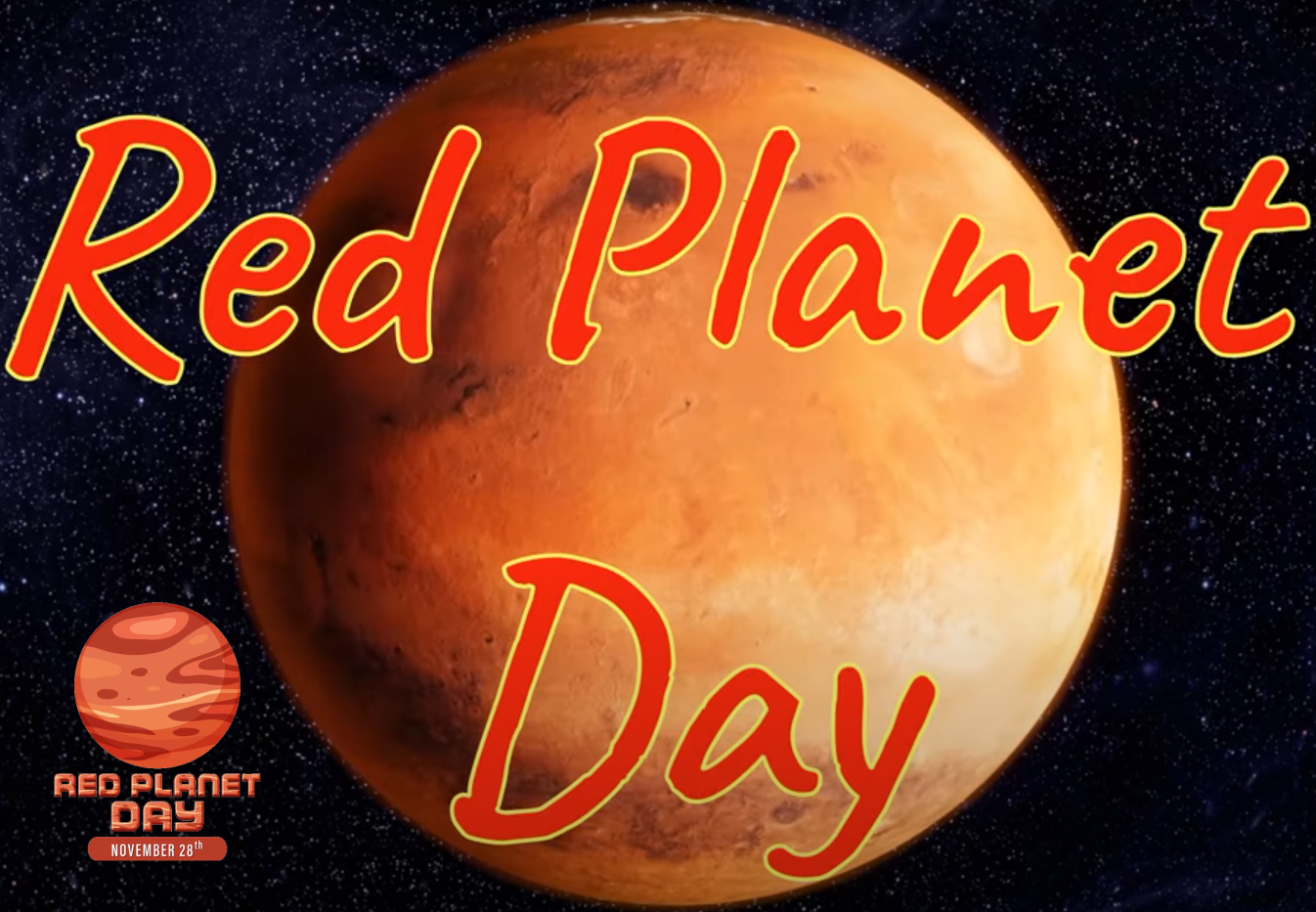
#RedPlanetDay 2023

Red Planet Day commemorates the launch of the Mariner 4 spacecraft on November 28, 1964 which was the first craft to ever reach Mars.

Since the late 20th century, Mars has been explored by uncrewed spacecraft and rovers, with the first flyby by the Mariner 4 probe in 1965, the first Mars orbiter by the Mars 2 probe in 1971, and the first landing by Viking 1 in 1976. As of 2023, there are at least 11 active probes orbiting Mars or at the Martian surface. Mars is an attractive target for human missions. Mars is the fourth planet and the furthest terrestrial planet from the Sun. The reddish color of its surface is due to finely grained iron(III) oxide dust in the soil, giving it the nickname “the Red Planet”. Mars’s radius is second smallest among the planets in the Solar System at 3,389.5 km (2,106 mi). The Martian dichotomy is visible on the surface: on average, the terrain on Mars’s northern hemisphere is flatter and lower than its southern hemisphere. Mars has a thin atmosphere made primarily of carbon dioxide, and two irregularly shaped natural satellites, Phobos and Deimos. Geologically, Mars is fairly active, with dust devils sweeping across the landscape and marsquakes (Martian analog to earthquakes) trembling underneath the ground. The surface of Mars hosts a large shield volcano (Olympus Mons) and one of the largest canyons in the Solar System (Valles Marineris).

Mars’s significant orbital eccentricity and axial tilt cause large seasonal changes to the polar ice caps‘ coverage and temperature swings between 163K / −110 °C to 308K / 35 °C on the surface. A Martian solar day (sol) is equal to 24.5 hours and a Martian solar year is equal to 1.88 Earth years. Like the other planets in the Solar System, Mars was formed approximately 4.5 billion years ago. During the Noachian period from about 4.1 to 3.7 billion years ago, Mars’s surface was marked by meteor impacts, valley formation, erosion, and the possible presence of water oceans. The Hesperian period from 3.7 to 3.2–2 billion years ago was dominated by widespread volcanic activity and flooding that carved immense outflow channels. The Amazonian period, which continues to the present, was marked by the wind’s influence on geological processes. It is unknown whether life has ever existed on Mars. Mars is among the brightest objects in Earth’s sky, and thus has been known from ancient times. Its high-contrast albedo features make it a common subject for viewing with a telescope.

Links:
Red Planet Day 2023: How Did Mars Get Its Name, Ways It Is Different From Earth; Things To Know

(Exo)Planeet : Mars