Unwrapped: The Plastic Crisis (Part 1) | The Origins of Plastic Pollution (TV WWF webcast)

Plastic pollution didn’t happen overnight.

In the first episode of Unwrapped: The Plastic Crisis, a special three-part miniseries from Nature Breaking, host Seth Larson and WWF plastics expert Erin Simon take a step back to examine how we got here—and why solving this crisis requires understanding the decisions that shaped it. This episode is about more than plastic—it’s about how societies make decisions, how systems evolve, and what we can learn from the past as we work toward a future with less waste and healthier ecosystems. Joining the conversation is Dr. Jenna Jambeck, the University of Georgia researcher whose landmark 2015 study was the first to quantify how much plastic enters the ocean each year. Her work transformed our understanding of plastic pollution and helped shift the conversation from cleanup to prevention. Together, they explore:
Where plastic comes from and why it became so ubiquitous
The surprising history of recycling—and why it can’t keep up
How plastic pollution became a global environmental challenge
What Jenna’s groundbreaking research revealed about plastic entering the ocean
Why scientists, policymakers, businesses, and communities are increasingly focused on the root causes of the problem

Links:
WWF Plastics page

An ambitious treaty on plastic pollution – petition

Weekend van de Wetenschap 2026

Weekend van de Wetenschap

Weekend van de Wetenschap is sinds 2012 een Nederlands wetenschapsevenement, jaarlijks organiseert het NEMO wetenschap en technologiemuseum met steun van het ministerie van Onderwijs, Cultuur en Wetenschap dit weekend.

Doel van het evenement is om een breed publiek kennis te laten maken met wetenschap en techniek. Veel (onderzoeks)instellingen, bedrijven, universiteiten, science centra en sterrenwachten organiseren dan publieksactiviteiten zoals rondleidingen, workshops, debatten en lezingen. Wetenschap is overal en altijd om ons heen, soms zonder dat we het doorhebben. Het is de basis van onze technologie, de geneeskunde en onze kennis over de wereld om ons heen. Maar hoeveel weten we eigenlijk over de wetenschap achter ons dagelijks leven? Tijdens Weekend van de Wetenschap kunnen kinderen op zoek naar antwoorden op deze en vele andere vragen, en worden ze meegenomen op een fascinerende reis door de wetenschap. Weekend van de Wetenschap is een gratis festival voor jong en oud met wetenschappers, spannende experimenten, boeiende lezingen en inspirerende ontdekkingen.

Links:
Weekend van de Wetenschap

Tijdens het Weekend van de Wetenschap ben je van harte welkom op de Open Dag van het KNMI

Nederlands Journalistiek Festival 2026

Nederlands Journalistiek Festival

Tijdens het Nederlands Journalistiek Festival (NLJF) kunnen collega’s uit het hele land elkaar ontmoeten; van onderzoeksjournalisten tot podcastmakers, van starters tot hoofdredacteuren en wetenschappers.

Het NLJF is de jaarlijkse ontmoetingsplek voor iedereen die betrokken is bij journalistiek. Van redacties en freelancers tot publiek en maatschappelijke partners. Het festival is nadrukkelijk geen traditioneel congres, maar een levendige werkplaats voor ontmoeting, samenwerking en reflectie. Hier delen we ervaringen, wisselen we kennis uit en onderzoeken we samen de rol van journalistiek in een snel veranderende samenleving. Het festival vindt plaats in Deventer, de boekenstad met een rijke geschiedenis van debat en vernieuwende ideeën. Op verschillende locaties in de historische binnenstad praten we over de toekomst van het vak, delen we ideeën, twijfels en plannen. Met panels, lezingen, workshops, live journalism-theater, filmvertoningen en exposities is er voor elke journalist iets te halen. Het festival is een initiatief van Stichting Huis voor de Journalistiek.

Links:
Nederlands Journalistiek Festival 2026

2026-08-10, Lief dagboek

Maandag; Wat eten we vandaag?; Zonsverduistering; Meteorenzwerm η-Eridaniden; Wereld Leeuwendag; The Sky at Night.

Deze afbeelding heeft een leeg alt-attribuut; de bestandsnaam is dagboek.png

Wat eten we vandaag?:

Klik op afbeelding voor origineel

Knipselkrant:


Agenda:

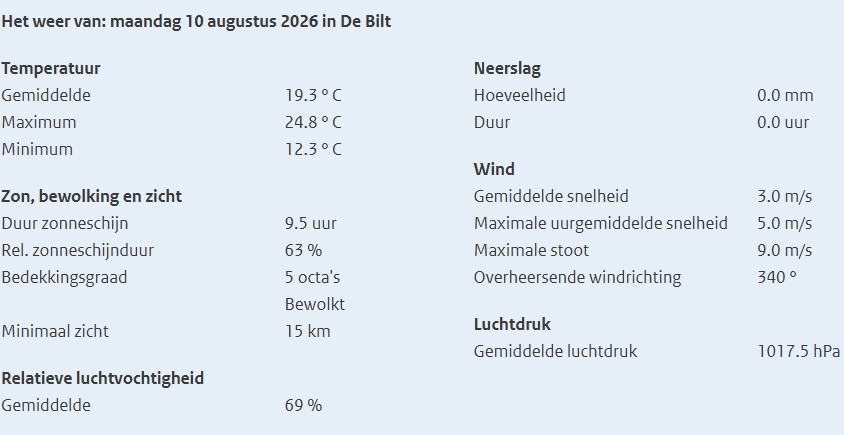
Weer:

Links:
In de geschiedenis

Meteorenzwerm η-Eridaniden in augustus 2026

η-Eridaniden in augustus 2026

De meteorenzwerm η-Eridaniden bereikt op maandag 10 augustus 2026, rond 14:00, zijn maximum.

Wanneer de radiant in het zenit zou staan, zouden er van deze zwerm naar verwachting gemiddeld zo’n 5 meteoren per uur vallen. Rond 07:30 staat de radiant van de zwerm in het hoogste punt (op 25°) aan de hemel. Het beste moment om η-Eridaniden waar te nemen is op 11 augustus rond 04:00. De radiant staat op dat moment zo’n 12° boven de zuidoostelijke horizon; niet erg gunstig. Er is dan bij ons ieder uur niet meer dan één meteoor zichtbaar van deze zwerm. Samen met meteoren van andere zwermen, en sporadische meteoren, zijn er bij donkere, heldere hemel in totaal circa 21–32 meteoren per uur zichtbaar. Op een goed donkere locatie zijn ongeveer 20% meer meteoren te zien dan in een grote stad. De Maan komt om 03:58 op, is voor ongeveer 4% verlicht en stoort niet. Rond 05:45 gaat het schemeren en om 06:17 komt de Zon op. Over het algemeen zijn de de meteoren van een zwerm niet alleen op de dag van het maximum zichtbaar. Zo is gedurende circa 4 dagen rondom het maximum ruim de helft van het maximum aantal meteoren per uur van de η-Eridaniden te zien. Tot 3 dagen voor en na het maximum zijn nog meteoren van deze zwerm te herkennen. De zwerm heeft daarmee een relatief korte piek. Probeer dus ook enkele nachten voor en na het maximum meteoren waar te nemen. Wel is iedere dag die je eerder voor het maximum, of later na het maximum waarneemt het aantal meteoren dat zichtbaar is circa 30% kleiner. De snelheden van de meteoren van de η-Eridaniden zijn behoorlijk hoog: zo’n 64 km/s, dat is circa 230.400 km/uur.

Links:
Meteorenzwerm η-Eridaniden in augustus 2026

#WorldLionDay #SaveTheLions #WildlifeConservation Wereld Leeuwendag 2026

World Lion Day is an international annual event on August 10, dedicated to raising awareness and support for the conservation of lions.

Conceived by conservationists Rae Kokeš and David Youldon, then both working for the conservation charity The African Lion & Environmental Research Trust (ALERT), with the launch event taking place in Livingstone, Zambia on August 10, 2013. Since that time, World Lion Day is now recognized by many wildlife organizations and celebrated annually across the globe.

Links:
World Lion Day

World Lion Day – panthera

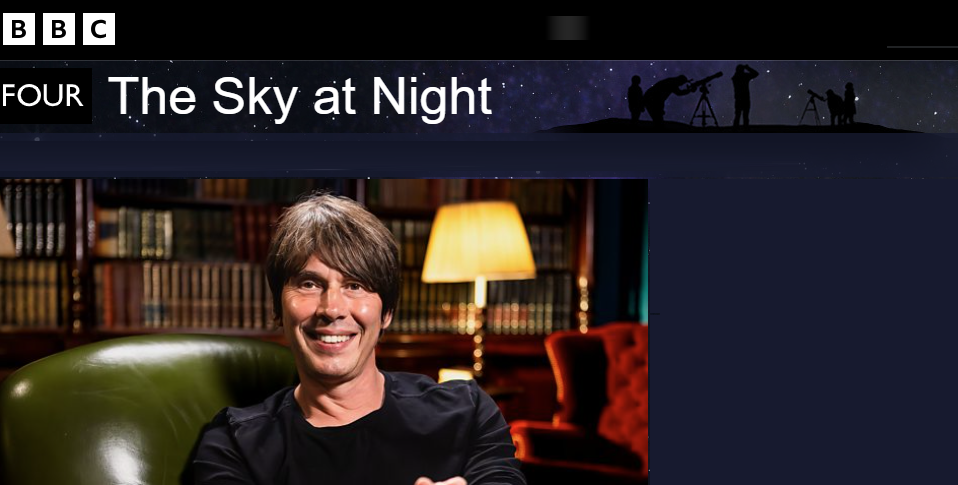
The Sky at Night – Big Black Holes and Little Red Dots (TV BBC Four / BBC iPlayer)

The Sky at Night

The Sky at Night is a monthly documentary television programme on astronomy produced by the BBC.

The show had the same permanent presenter, Patrick Moore, from its first broadcast on 24 April 1957 until 7 January 2013. The latter date was a posthumous broadcast, which followed Moore’s death on 9 December 2012. This made it the longest-running programme with the same presenter in television history. Many early episodes are missing, either because the tapes were wiped, thrown out, or because the episode was broadcast live and never recorded in the first place. Beginning with the 3 February 2013 edition, the show was co-presented by Lucie Green and Chris Lintott. Since December 2013 Maggie Aderin-Pocock has been a presenter. The programme’s opening and closing theme music is “At the Castle Gate”, from the incidental music to Pelléas et Mélisande, written in 1905 by Jean Sibelius, performed by the Royal Philharmonic Orchestra and conducted by Sir Thomas Beecham.

This episode:
Professor Brian Cox joins the team to explore one the greatest current mysteries in astronomy – little red dots. Discovered by the James Webb Space Telescope (JWST), they have upended everything we thought we knew about black holes and the evolution of the universe itself.

Astronomical monsters, with the power to devour stars and even to stop time itself, black holes have both fascinated and troubled physicists for decades. Their study has led to breakthroughs in our understanding of gravity, quantum mechanics and even precision manufacturing.

The journey begins with black holes 101, as Chris Lintott and Brian Cox discuss what they are. And as it turns out, that is a harder question to answer than you might think. Distortions in space-time. Regions of infinite density. Gateways to other universes. The end of time. These are all descriptions of what black holes are, yet somehow all are insufficient – mathematically accurate yet physically unproven. What we thought we knew was that they are born in the violent deaths of massive stars, but this may not always be the case, and that has huge implications for how the cosmos we see today came to be.

Maggie Aderin travels to the University of Nottingham to meet Dr Emma Chapman, a cosmologist whose work focuses on the early universe. She explains the significance of JWST’s discovery of the little red dots and why they are forcing the scientific community to re-evaluate not only how black holes form but also how galaxies themselves grow and evolve.

Returning to Chris and Brian, the discussion turns to some of the alternative theories, and some of the explanations are truly staggering, from black hole suns, created by partially collapsed stars, to primordial black holes, born in the first moments of creation, and direct collapse black holes.

At the University of Edinburgh, George Dransfield meets Professor Sadegh Khochfar. Using months of processing time on the world’s most advanced supercomputers, his team have created the most detailed simulations of the universe’s first billion years. Their findings are shedding light on whether direct collapse black holes could exist and whether the density of the early universe could provide the answer to how massive black holes form without first forming stars, something once thought impossible.

While the nature of the little red dots themselves are still contested, they are making us re-evaluate what we understand about black holes, and in doing so, they provide a window into conditions so extreme that we’re forced to question our assumptions about the very nature of reality and the fundamental physics that underpins the universe.

But while understanding the universe is a challenge, there is still always joy in looking up at the skies above, and Dr Becky Smethurst is guest presenting this month’s star guide to take us through the treats coming up in the next few weeks.

Join us on an exploration of the skies and the latest in our understanding of black holes – the cosmic Rosetta Stones that spark wonder in the scientific community and far beyond.

Links:
The Sky at Night

100 km Dodentocht Bornem 2026

Dodentocht Bornem

De Dodentocht is een wandeltocht georganiseerd in en rond de Belgische gemeente Bornem die jaarlijks van start gaat op de tweede vrijdag van augustus.

Het doel van de Dodentocht is om binnen 24 uur een parcours af te leggen van 100 kilometer door Klein-Brabant. Het evenement is geen wedstrijd, en net als bij bijvoorbeeld de Kennedymars is het uitlopen al een doel op zich voor de meeste deelnemers. Het evenement wordt georganiseerd door de vzw 100 km Dodentocht® Kadee Bornem. De Dodentocht werd voor de eerste keer georganiseerd in 1970 door de wandelclub Kadee met 65 deelnemers. De inspiratie voor de tocht was opgedaan na deelname aan de Nijmeegse Vierdaagse. Sinds deze eerste editie groeide de Dodentocht uit tot een internationaal evenement. Sinds de tweede helft van de jaren 2000 nemen mensen deel uit onder meer België, Nederland, Duitsland, Frankrijk en Groot-Brittannië. Vanaf 2017 wordt er enkel nog met voorinschrijvingen gewerkt, en sinds 2018 geldt er een maximum aantal inschrijvingen van 13.000 deelnemers.

Links:
Dodentocht

#Zomergasten : 09-08-2026 [Laatste seizoen] (TV NPO 2 / NPO Start)

Zomergasten is een Nederlands televisieprogramma van de VPRO dat elk jaar in de zomer, meer bepaald rond augustus, op zondagavond rechtstreeks uitgezonden wordt.

Het programma bestaat sinds 1988. In een avondvullend programma mag iedere zondag een bekende of interessante Nederlander, Vlaming of Nederlandssprekende buitenlander zijn of haar favoriete televisieavond samenstellen. De gast komt meestal uit de literatuur, wetenschap, televisie, de politiek of het bedrijfsleven. De gekozen fragmenten worden getoond en aan de hand daarvan wordt de gast geïnterviewd door een interviewer/presentator. Het programma is gaandeweg uitgegroeid tot een van de bekendste programma’s van de Nederlandse publieke omroep. Sinds 2003 wordt na elke aflevering een film uitgezonden die door de gast van de avond is uitgekozen. Janine Abbring presenteert het allerlaatste seizoen van VPRO Zomergasten. Ze was tussen 2017 en 2022 al te zien als vaste interviewer van het programma. Van 26 juli tot en met 30 augustus is VPRO Zomergasten elke zondagavond live te zien op NPO 2 en NPO Start.

Theatermaker en artiest Merel Pauw (Amsterdam, 1995) is op zondag 9 augustus de derde gast in VPRO Zomergasten. Janine Abbring interviewt haar aan de hand van door haar geselecteerde tv-, online- en filmfragmenten. Pauw: ‘Mijn ideale televisieavond is zoals mijn identiteit: grenzeloos, absurd en vol angsten. Ik houd niet van kunst die de wereld laat zien zoals ‘ie is. Maar ik houd van kunst die de wereld groter maakt én je de wereld laat voelen, dus van fantasie en absurdisme.’

Links:
Zomergasten

VPRO stopt met Zomergasten en verwacht tientallen ontslagen door bezuinigingen

NPO 2 live stream (NL)