Vroege Vogels Radio | 17 mei 2026 (Radio 1 NPO)

Vroege Vogels

Vroege Vogels is een live-radioprogramma, tv-programma en online community van BNNVARA over natuur en milieu.

In het radioprogramma wordt het gesproken woord omlijst door licht klassieke muziek en salonmuziek. Het radioprogramma werd in 1978 voor het eerst uitgezonden door de VARA en is een van de langst lopende en best beluisterde radioprogramma’s van de publieke omroep. Het wordt elke zondagmorgen uitgezonden tussen 07:00 en 10:00 op NPO Radio 1. De beginmuziek is een bewerking van Vivaldi’s “Piccolo Concerto in C major” (RV 443).

Veel natuurvolkeren zien de natuur als een complex samenhangend geheel waar je zelf ook onderdeel van bent. In die geest geven Michel Grobbe en Diederik Pomstra de opleiding ‘Educational Professional Bushcraft’. Voor de inheemse bevolking in de Filipijnen kan wilde honing wel eens de sleutel zijn tot het verkrijgen van landrechten. Merlijn van Weerd doet al meer dan twintig jaar onderzoek naar het beschermen van de lokale natuur op de archipel. We sluiten het Nationaal Vogelconcert af met de kleine karekiet. De column is van Jocelyn de Kwant. Vroege Vogels Radio wordt gepresenteerd door Menno Bentveld vanuit het Groene Huis in Amersfoort.

Links:
Vroege Vogels Radio

#WorldHypertensionDay / Wereld Hypertensie Dag 2026

World Hypertension Day

World Hypertension Day is observed every May 17th in order to raise awareness and promote hypertension prevention, detection and control.

High blood pressure is the main risk factor to develop cardiovascular disease. More than one billion people around the world live with hypertension (high blood pressure), which is a major cause of cardiovascular disease and premature death worldwide. The burden of hypertension is felt disproportionately in low- and middle-income countries, where two thirds of cases are found, largely due to increased risk factors in those populations in recent decades. What’s more, around half of people living with hypertension are unaware of their condition, putting them at risk of avoidable medical complications and death.

Links:
World Hypertension Day 2026

World #SaltAwarenessWeek / Wereld Zout Bewustwordingsweek 2026


#WHA79 79th World Health Assembly

World Health Organization

The World Health Assembly (WHA) is the forum through which the World Health Organization (WHO) is governed by its 193 member states, it is the world’s highest health policy setting body and is composed of health ministers from member states.

The members of the WHA generally meet every year in May in Geneva, Switzerland, at the Palace of Nations, the location of WHO Headquarters. The main tasks of the WHA are to decide major policy questions, as well as to approve the WHO work programme and budget and elect its Director-General (every fifth year) and annually to elect ten members to renew part of its executive board. Its main functions are to determine the policies of the Organization, supervise financial policies, and review and approve the proposed programme budget. The Seventy-ninth World Health Assembly (WHA79) takes place in Geneva, Switzerland from 18 to 23 May 2026, bringing together delegations from WHO Member States to set global health policy and advance the Organization’s strategic priorities. It will build upon the momentum of the last year’s 78th World Health Assembly, which adopted the Global Action Plan on Climate Change and Healthan updated road map for an enhanced global response to the adverse health effects of air pollution, and the elevation of climate change as the first strategic objective of WHO’s Fourteenth General Programme of Work (GPW14, 2025–2028). Looking forward to COP31, co-hosted by Türkiye and Australia, this Assembly offers an opportunity for the global climate and health community to convene and sustain the political momentum secured at WHA78.

Links:
79th World Health Assembly

Klimaatverandering bedreigt ook de volksgezondheid, waarschuwen experts

Ebola Bundibugyo outbreak in 2026

By Chaotic Enby - Own work based on: Democratic Republic of the Congo adm location map.svg, DR Congo Provinces Blank.svg and Map of the Ituri Province Ebola outbreak.png, CC BY-SA 4.0, https://commons.wikimedia.org/w/index.php?curid=192550149
By Chaotic Enby – Own work based on: Democratic Republic of the Congo adm location map.svg, DR Congo Provinces Blank.svg and Map of the Ituri Province Ebola outbreak.png, CC BY-SA 4.0

In May 2026, an epidemic of Ebola was reported in the Ituri Province of the Democratic Republic of the Congo (DRC), it is the 17th Ebola outbreak in DRC and only five months after the end of the previous outbreak.

Imported cases from Ituri have been reported in North Kivu Province, as well as in Uganda’s capital city of Kampala. A case in South Kivu was also reported to have been imported from Tshopo province on 21 May. The epidemic is caused by the Bundibugyo ebolavirus, which may complicate response efforts as existing Ebola treatments were created for a different strain, the Zaire ebolavirus. The outbreak was declared a Public Health Emergency of International Concern (PHEIC) by the World Health Organization (WHO) on 16 May 2026. There have been 101 confirmed deaths in D.R. Congo and two deaths in Uganda, as of 7 June and 8 June 2026 respectively. Poor healthcare infrastructure in the region and an ongoing armed conflict hinder detection, treatment and prevention of the disease; it is considered likely that the true scale of the outbreak could considerably exceed the confirmed numbers.

Links:
Epidemic of Ebola Disease caused by Bundibugyo virus in the Democratic Republic of the Congo and Uganda determined a public health emergency of international concern

Ebola disease outbreak in the Democratic Republic of the Congo and Uganda

Kenyan court blocks Trump admin from dumping Ebola-exposed Americans there

Current information about Ebola – RIVM

Ebola disease – WHO

Ebola outbreak – DRC 2026

‘Als het zo doorgaat, wordt dit de grootste ebola-uitbraak ooit’

Africa CDC and WHO call for urgent, community-led action to contain Ebola in the DRC

Cockroach Janta Party / Kakkerlak Volkspartij – founded

Cockroach Janta Party

The Cockroach Janta Party (CJP; lit.Cockroach People’s Party) is an Indian satirical political movement founded on 16 May 2026 by Abhijeet Dipke, a political communications strategist who formerly worked with the Aam Aadmi Party.

During a Supreme Court hearing concerning fake professional degrees and institutional criticism, CJP emerged in response to remarks made by the incumbent Chief Justice of India (CJI) Surya Kant, on 15 May 2026, in which he criticized fraudulent credentials by drawing an analogy that compared certain confrontational activists and unemployed youth to “cockroaches” and “parasites of society”, an analogy that sparked immediate national outrage and led to the creation of the satirical protest movement. The name is a wordplay parodying the ruling party in India, the Bharatiya Janata Party. Within days of its founding, the movement garnered over 350,000 sign-ups and over 20 million followers on Instagram. The movement has also engaged in offline activities, with volunteers participating in protests and clean-up drives dressed in cockroach costumes. Though the movement is not registered as a political party with the Election Commission of India, it campaigns against broader societal, economic, and political issues affecting the Indian youth.

Links:
Voice of the Lazy & Unemployed

India has a new political superstar – a cockroach

India ‘cockroach’ activist Sonam Wangchuk ends hunger strike as protests spread

2026-05-16, Lief dagboek

Zaterdag; Wat eten we vandaag?; Sponsor een extreemrechtse demonstrant; AH belastingontduiking; Internetprivacy; Love a Tree Day; Dag van de Coeliakie / Glutenintolerantie; Dag van het Licht; Day of Living Together in Peace; Wear Purple for Peace Day.

Deze afbeelding heeft een leeg alt-attribuut; de bestandsnaam is dagboek.png

Wat eten we vandaag?:

Knipselkrant:


Agenda:

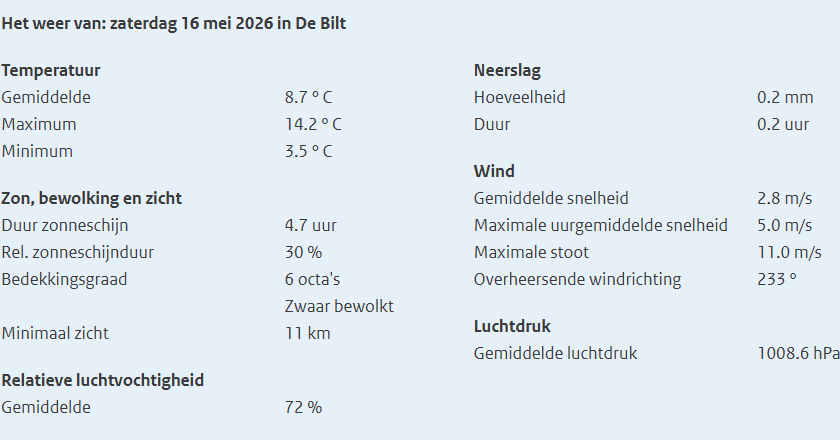
Weer:

Links:
In de geschiedenis

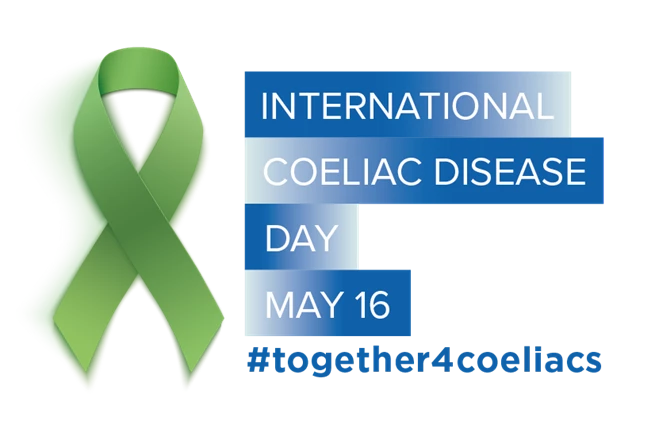
Dag van de Coeliakie / Glutenintolerantie / Coeliac Disease Awareness Day 2026

De Europese organisaties die aangesloten zijn bij de Association of European Coeliac Societies (AOECS) organiseren gedurende de maand mei workshops en voorlichtingsbijeenkomsten waarin extra aandacht gevraagd wordt voor coeliakie en NCGS (Non-Celiac Gluten Sensitivity).

Iemand met coeliakie (glutenintolerantie) kan niet tegen gluten. Gluten is een eiwit dat van nature voorkomt in tarwe (waaronder spelt), rogge en gerst (gort). Gluten zit in brood, crackers, pizza, pasta, paneermeel, koek, cake en taart. Het zit ook verstopt in de ingrediënten van soepen (bindmiddel, vermicelli of vlees), in sauzen, sommige snoepjes, ijssoorten en bier.  Overstappen op producten van en met haver is geen optie want haver is vaak gecontamineerd (besmet) en daardoor niet zonder meer veilig te gebruiken in een glutenvrij dieet. Glutenvrij eten kan dan wel populair zijn als gezondheidsdieet maar voor mensen met coeliakie en NCGS is het geen hype, het is gewoon medisch noodzakelijk! Het doel van International Coeliac Day is coeliakie extra onder de aandacht te brengen.

Links:
Coeliac Disease Awareness Day

#Lightday2026 Day of Light / Dag van het Licht 2026

The Day of Light

The Day of Light is a global initiative that provides an annual focal point for the continued appreciation of light and the role it plays in science, culture and art, education, and sustainable development, and in fields as diverse as medicine, communications, and energy.

The broad theme of light will allow many different sectors of society worldwide to participate in activities that demonstrates how science, technology, art and culture can help achieve the goals of UNESCO – education, equality, and peace.

Links:
Day of Light

Day of Living Together in Peace 2026

Living together in peace is all about accepting differences and having the ability to listen to, recognize, respect and appreciate others, as well as living in a peaceful and united way.

The UN General-Assembly, in its resolution 72/130, declared 16 May the International Day of Living Together in Peace, as a means of regularly mobilizing the efforts of the international community to promote peace, tolerance, inclusion, understanding and solidarity. The Day aims to uphold the desire to live and act together, united in differences and diversity, in order to build a sustainable world of peace, solidarity and harmony. The Day invites countries to further promote reconciliation to help to ensure peace and sustainable development, including by working with communities, faith leaders and other relevant actors, through reconciliatory measures and acts of service and by encouraging forgiveness and compassion among individuals.

Following the devastation of the Second World War, the United Nations was established to save succeeding generations from the scourge of war. One of its purposes is to achieve international cooperation in solving international problems, including by promoting and encouraging respect for human rights and for fundamental freedoms for all without distinction as to race, sex, language or religion. In 1997, the General-Assembly proclaimed – by its resolution 52/15 — the year 2000 as the “International Year for a Culture of Peace”. In 1998, it proclaimed the period 2001-2010 as the “International Decade for a Culture of Peace and Non-Violence for Children of the World.” In 1999, The General-Assembly adopted, by resolution 53/243, the Declaration and Programme of Action on a Culture of Peace, which serves as the universal mandate for the international community, particularly the United Nations system, to promote a culture of peace and non-violence that benefits all of humanity, including future generations.

The declaration came about as a result of the long-held and cherished concept — contained within the Constitution of UNESCO — that “since wars begin in the minds of men, it is in the minds of men that the defenses of peace must be constructed.” The Declaration embraces the principle that peace is not merely the absence of conflict, but also requires a positive, dynamic participatory process, in which dialogue is encouraged and conflicts are resolved in a spirit of mutual understanding and cooperation. The Declaration also recognizes that to fulfill such an aspiration, there is a need to eliminate all forms of discrimination and intolerance, including those based on race, color, sex, language, religion, political or other opinion, national, ethnic or social origin, property, disability, birth or other status. 2026 Theme: Building Trust through Dialogue, Inclusion and Reconciliation.

Links:
Day of Living Together in Peace