2024-07-29, Lief dagboek

Maandag; Wat eten we vandaag?; Gaza−Israël oorlog 2023 – …; Olympische Zomerspelen; Wereld Tijgerdag; Meteorenzwerm δ-Cassiopeiïden.

Deze afbeelding heeft een leeg alt-attribuut; de bestandsnaam is dagboek.png

Wat eten we vandaag?:

Verjaardagsvlaai. klik op afbeelding voor origineel

Een collega van A3 was jarig en trakteerde met vlaai.

Klik op afbeelding voor origineel

Knipselkrant:


Agenda:

Weer:

Deze afbeelding heeft een leeg alt-attribuut; de bestandsnaam is 50813896361_463cbfec7c.jpg

Links:
In de geschiedenis

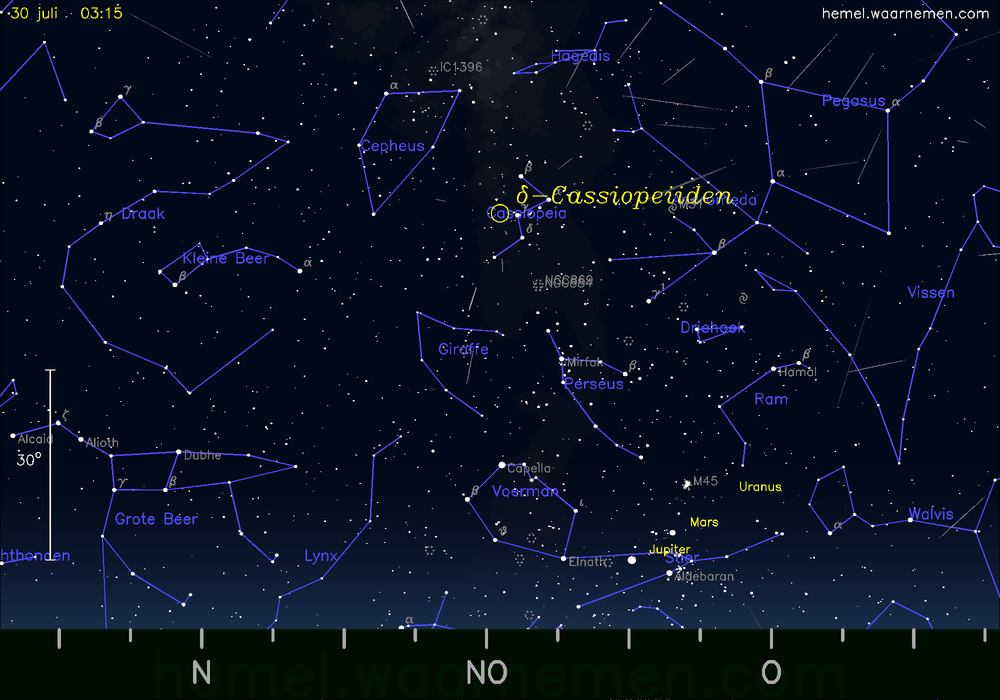
Meteorenzwerm δ-Cassiopeiïden in juli 2024

De meteorenzwerm δ-Cassiopeiïden bereikt op maandag 29 juli 2024, rond 16:00, zijn maximum.

Wanneer de radiant in het zenit zou staan, zouden er van deze zwerm naar verwachting gemiddeld zo’n 10 meteoren per uur vallen. De radiant van de zwerm staat rond 06:00 in het hoogste punt aan de hemel, op 79° boven de horizon. Het beste moment om δ-Cassiopeiïden waar te nemen is op 30 juli rond 03:15. De radiant van de zwerm staat dan ongeveer 66° boven de horizon, in het noordoosten. Door de matige omstandigheden zijn er in onze streken dan vermoedelijk maar circa 2–6 meteoren per uur van deze zwerm te zien. In totaal zijn er, door meteoren van andere zwermen en sporadische meteoren, bij donkere en heldere hemel circa 8–15 meteoren per uur zichtbaar. Op een goed donkere plek zijn bijna vier keer zoveel meteoren te zien als in dichtbevolkt gebied. De Maan komt om 00:38 op, is voor ongeveer 30% verlicht en kan eventueel storen. Rond 05:15 gaat het schemeren en om 05:58 komt de Zon op. Over het algemeen zijn de de meteoren van een zwerm niet alleen op de dag van het maximum zichtbaar. Zo is gedurende circa 5 dagen rondom het maximum meer dan 50% van het maximale aantal meteoren (2 per uur) van de δ-Cassiopeiïden te zien. Tot 6 dagen voor en na het maximum zijn nog meteoren van deze zwerm te herkennen. De zwerm heeft daarmee een relatief korte piek. Er zijn dus nog meer kansen, voor het geval het in de nacht van het maximum niet helder is. Iedere dag verder weg van het maximum zijn er echter wel ongeveer 20% minder meteoren per uur te zien. De snelheden van de meteoren van de δ-Cassiopeiïden zijn behoorlijk hoog: zo’n 60 km/s, dat is circa 216.000 km/uur!

Links:
Meteorenzwerm δ-Cassiopeiïden in juli 2024

Global Tiger Day / Wereld Tijgerdag 2024

Global Tiger Day is an annual celebration to raise awareness for tiger conservation, held annually on 29 July, it was created in 2010 at the Saint Petersburg Tiger Summit.

The goal of the day is to promote a global system for protecting the natural habitats of tigers and to raise public awareness and support for tiger conservation issues. Around 3,900 tigers (in 2019) remain in the wild, but much more work is needed to protect this species if we are to secure its future in the wild. After a century of decline, overall wild tiger numbers are starting to tick upward. In some areas, including much of Southeast Asia, tigers are still in crisis and declining in number. Based on the best available information, tiger populations are stable or increasing in India, Nepal, Bhutan, Russia and China.

Links:
Global Tiger Day

Tiger summit aims to double numbers

1st Asia Ministerial Conference on Tiger Conservation

World Hepatitis Day 2024

World Hepatitis Day, 28 July, is an opportunity to step up national and international efforts on hepatitis, encourage actions and engagement by individuals, partners and the public and highlight the need for a greater global response as outlined in the WHO’s Global hepatitis report of 2017.

The date of 28 July was chosen because it is the birthday of Nobel-prize winning scientist Dr Baruch Blumberg, who discovered hepatitis B virus (HBV) and developed a diagnostic test and vaccine for the virus. Low coverage of testing and treatment is the most important gap to be addressed in order to achieve the global elimination goals by 2030. 2024 theme is: “It’s time for action“.

Links:
28 July is World Hepatitis Day

#WorldNatureConservationDay / Natuurbeschermingsdag 2024

World Nature Conservation Day is observed on 28th July all over the world with the objective of increasing awareness about and protecting the natural resources.

On this day, let us make a conscious effort to contribute to the local, national, and global efforts in conserving nature and the benefits they provide for the present and future generations. World Nature Conservation Day recognizes that a healthy environment is the foundation for a stable and productive society and to ensure the well-being of present and future generations, we all must participate to protect, conserve, and sustainably manage our natural resources.

Links:
World Nature Conservation Day

Opening a 60-year time capsule: sequences of historical poliovirus cold variants shed a new light on a contemporary strain – publication

Poliovirus that infected a Chinese child in 2014 may have leaked from a lab, samples destined for destruction at a Paris institute trigger a virological “detective story”.

Researchers at the Pasteur Institute in Paris working under strict biosafety conditions recently opened an old box that contained a virological time capsule: four poliovirus samples, each with a handwritten label on the vial, sent to the institute more than 60 years earlier by Albert Sabin, a giant in the field of poliovirus research. The viruses had to be destroyed, as part of a global campaign to get rid of old poliovirus samples. But first, the Pasteur team would sequence them to preserve their genetic information. A paper about those sequences, published in Virus Evolutionin July, has raised an unexpected and troubling possibility: A poliovirus that infected a 4-year old child in China in 2014 may have originated in a research laboratory or a vaccine production facility.

Links:
Poliovirus that infected a Chinese child in 2014 may have leaked from a lab