
#Aardbeving #Groningen #Gaswinning

Datum en tijd (UTC):
2024-10-30 10:22:29
Latitude:
53.385 °
Longitude:
6.648 °
Diepte:
3.0 km
Type:
Geïnduceerde aardbeving
Plaats:
Rottum
Magnitude:
1.1
Links:
KNMI

Datum en tijd (UTC):
2024-10-30 10:22:29
Latitude:
53.385 °
Longitude:
6.648 °
Diepte:
3.0 km
Type:
Geïnduceerde aardbeving
Plaats:
Rottum
Magnitude:
1.1
Links:
KNMI

The ‘Time for $5’ Campaign calls on US diagnostics corporation Cepheid, and its parent company Danaher, to drop the price of its lifesaving GeneXpert tests to US$5 a test, so that many more people can get fast, accurate disease diagnosis, and receive treatment right away.
The ‘Time for $5’ coalition is coordinated by MSF Access Campaign, Partners in Health and Treatment Action Group (TAG), together with more than 150 civil society organizations working to improve access to GeneXpert instruments and tests. Since 2019, we have been calling on Cepheid and Danaher to lower the price of GeneXpert tests to $5 (based on publicly available evidence of Cepheid’s cost of production of GeneXpert tests) per test for all diseases. You can take action now with us to urge Danaher and Cepheid to put people over profits and drop the price of ALL tests across diseases, including XDR-TB (the deadliest form of TB), HIV, hepatitis, Ebola and sexually transmitted infections. Together, we can make a difference to end corporate greed and ensure access to lifesaving tests for all! How can you help? 👇
Links:
Time for $5
Aantal geneesmiddelentekorten stijgt in 2023 naar recordhoogte

The World Health Organization (WHO) published the report ‘Global Tuberculosis Report 2024‘ on tuberculosis (TB) revealing that approximately 8.2 million people were newly diagnosed with TB in 2023 – the highest number recorded since WHO began global TB monitoring in 1995.
This represents a notable increase from 7.5 million reported in 2022, placing TB again as the leading infectious disease killer in 2023, surpassing COVID-19. WHO’s Global Tuberculosis Report 2024 highlights mixed progress in the global fight against TB, with persistent challenges such as significant underfunding. While the number of TB-related deaths decreased from 1.32 million in 2022 to 1.25 million in 2023, the total number of people falling ill with TB rose slightly to an estimated 10.8 million in 2023. With the disease disproportionately affecting people in 30 high-burden countries, India (26%), Indonesia (10%), China (6.8%), the Philippines (6.8%) and Pakistan (6.3%) together accounted for 56% of the global TB burden. According to the report, 55% of people who developed TB were men, 33% were women and 12% were children and young adolescents. In 2023, the gap between the estimated number of new TB cases and those reported narrowed to about 2.7 million, down from COVID-19 pandemic levels of around 4 million in 2020 and 2021. This follows substantial national and global efforts to recover from COVID-related disruptions to TB services. The coverage of TB preventive treatment has been sustained for people living with HIV and continues to improve for household contacts of people diagnosed with TB. However, multidrug-resistant TB remains a public health crisis. Treatment success rates for multidrug-resistant or rifampicin-resistant TB (MDR/RR-TB) have now reached 68%. But, of the 400 000 people estimated to have developed MDR/RR-TB, only 44% were diagnosed and treated in 2023.
Links:
Tuberculosis resurges as top infectious disease killer

Between 2006 and 2024, over 1,700 journalists have been killed around the world, with close to 9 out of 10 cases of these killings remaining judicially unresolved, according to the UNESCO Observatory of Killed Journalists.
Impunity leads to more killings and is often a symptom of worsening conflict and the breakdown of law and judicial systems. UNESCO is concerned that impunity damages whole societies by covering up serious human rights abuses, corruption, and crime. Governments, civil society, the media, and everyone concerned to uphold the rule of law are being asked to join in the global efforts to end impunity. It is in recognition of the far-reaching consequences of impunity, especially of crimes against journalists, that the United Nations General Assembly adopted Resolution A/RES/68/163 at its 68th session in 2013 which proclaimed 2 November as the ‘International Day to End Impunity for Crimes against Journalists’ (IDEI). The Resolution urged Member States to implement definite measures countering the present culture of impunity. The date was chosen in commemoration of the assassination of two French journalists in Mali on 2 November 2013. Every two years, the awareness raising campaign for the commemoration of the International Day to End Impunity for Crimes against Journalists coincides with the findings of the UNESCO Director-General’s Report outlining the current state of global and regional impunity.
Links:
Day to End Impunity for Crimes against Journalists
2024 Global Commemoration and Day of Action: Safety of Journalists in Crises and Emergencies
Coding is more than just a technical skill; it blends logic with creativity, connecting various disciplines, including science, technology, communication, engineering, mathematics, arts, and languages. Learning to code fosters logical thinking, enhances problem-solving skills, and sparks innovation.
Computer code is the language that narrates and defines the digital world we live in. It is material to the development of Artificial Intelligence (AI) systems that permeate all facets of our lives. It is therefore concerning that there is a severe lack of diversity, inclusion, and representation among those who master this language. Without diverse voices in coding and AI development, the digitalization of our society risks reflecting and reinforcing biases and perpetuating inequalities. Recognizing the importance of coding to our digital world, UNESCO Member States designated 29 October World Coding Day. It will be celebrated for the first time in 2024.

Disarmament Week seeks to promote awareness and better understanding of disarmament issues and their cross-cutting importance.
Starting on 24 October, the anniversary of the founding of the United Nations, the week-long annual observance was first called for in the Final Document of the General Assembly’s 1978 special session on disarmament (resolution S-10/2). In 1995, the General Assembly invited governments, as well as NGOs, to continue taking an active part in Disarmament Week (resolution 50/72 B, 12 December 1995) in order to promote a better understanding among the public of disarmament issues. Throughout history, countries have pursued disarmament to build a safer, more secure world and to protect people from harm. Since the foundation of the United Nations, disarmament and arms control have played a critical role in preventing and ending crises and armed conflict. Heightened tensions and dangers are better resolved through serious political dialogue and negotiation—not by more arms. Weapons of mass destruction, in particular nuclear weapons, continue to be of primary concern, owing to their destructive power and the threat that they pose to humanity. The excessive accumulation and illicit trade in conventional weapons jeopardize international peace and security and sustainable development, while the use of heavy conventional weapons in populated areas is seriously endangering civilians.
New and emerging weapon technologies, such as autonomous weapons, imperil global security and have received increased attention from the international community in recent years. Measures for disarmament are pursued for many reasons, including to maintain international peace and security, uphold the principles of humanity, protect civilians, promote sustainable development, foster confidence and trust among States, and prevent and end armed conflict. Disarmament and arms control measures help ensure international and human security in the 21st Century and therefore must be an integral part of a credible and effective collective security system. The United Nations continues to celebrate the efforts and involvement of a range of actors contributing to a safer, more peaceful common future through disarmament, arms control and non-proliferation efforts. In a world threatened by weapons of mass destruction, conventional arms and emerging cyberwarfare, United Nations Secretary-General António Guterres presented an agenda for disarmament to save humanity, save lives and secure our common future.
Links:
Wikipedia
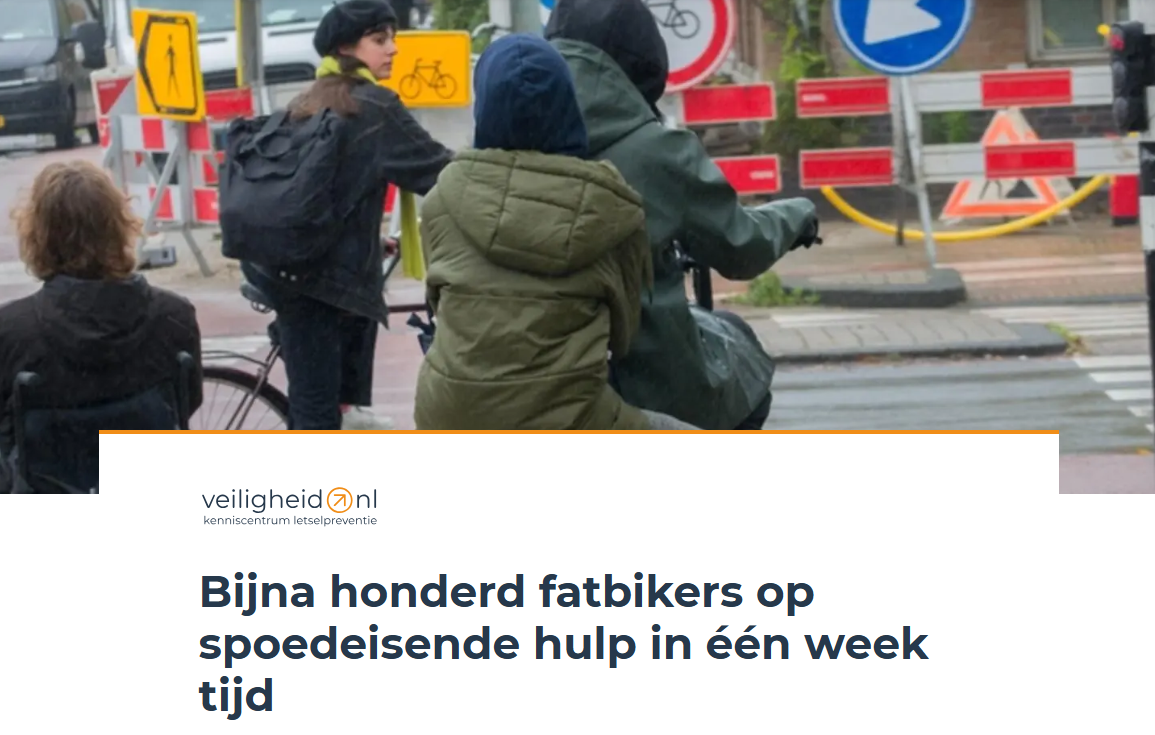
Tijdens de meetweek fietsongevallen van 30 september tot en met 6 oktober 2024 belandden 1.291 mensen op de spoedeisende hulp (SEH) door een fietsongeval.
96 slachtoffers zaten op een fatbike als bestuurder of passagier. Overige e-bikes en andere fietsen waren verantwoordelijk voor respectievelijk 480 en 715 SEH-bezoeken. Daarnaast vond twee derde van de fatbike-ongevallen plaats in een Randstedelijke provincie. Dit blijkt uit de resultaten van de meetweek fietsongevallen, waarvoor alle 82 Nederlandse SEH’s het aantal fietsongevallen registreerden. Bij de aanname dat deze week een gemiddelde week was, is de grove schatting dat er jaarlijks 5000 fatbikers op de SEH worden behandeld. Fatbikers die na een ongeval met letsel op de SEH terecht kwamen werden relatief vaker opgenomen in het ziekenhuis voor verdere behandeling. Waar dit voor e-bikers en andere fietsers ging om 16 procent en 13 procent, was dit voor fatbikers 22 procent, wat een indicatie geeft voor gemiddeld ernstiger letsel. Naast de 96 fatbikers die de SEH bezochten, waren 31 personen aangereden door een fatbike. Verder viel op dat slechts drie procent van de fatbikers en zes procent van de e-bikers die zich meldden op de SEH een helm droegen.
Links:
Bijna honderd fatbikers op spoedeisende hulp in één week tijd
Oproep aan de Tweede Kamer: Leg opgevoerde fatbikes aan banden!

On and around October 31st, 2024, the world will celebrate the historic hunt for the unseen—something that scientists refer to as dark matter.
Since 2017, more than 350 global, regional, and local events have been held on and around October 31 by institutions and individuals looking to engage the public in discussions about what we already know about dark matter and the many experiments seeking to solve its mysteries. Scientists believe that dark matter, which we have so far only detected through its gravity-based effects in space, makes up about a quarter (26.8 percent) of the total mass and energy of the universe, and something that is driving the universe’s accelerating expansion—which scientists call dark energy—accounts for another 68.3 percent. The ordinary matter, like stars and planets and galaxies, makes up just 4.9 percent of the total mass and energy of the universe.
China probeert actief kritische stemmen over het land het zwijgen op te leggen, ook in Nederland.
Dat is de belangrijkste conclusie van het rapport ‘Chinese invloed en inmenging in het Nederlandse medialandschap‘ over Chinese inmenging en intimidatie in het Nederlandse medialandschap. De media zijn hier vaak niet goed op voorbereid. De tactieken van China zijn vaak subtiel en sociaalpsychologisch van aard en om deze te kunnen herkennen en begrijpen is diepgaande kennis van het land en zijn politiek vereist, staat onder meer in het rapport dat geschreven is door onderzoekers verbonden aan het LeidenAsiaCentre (LAC) in opdracht van het China Kennis Netwerk (CKN). Aanleiding voor het rapport is de Tweede Kamer-motie Brekelmans uit april 2023, waarin wordt verzocht om een onderzoek naar de werkcondities van Nederlandse correspondenten in China en Chinese intimidatie van, en inmenging in, de Nederlandse media.
Links:
Rapport: Nederlandse media onvoldoende voorbereid op psychologische intimidatie China
