
In de geschiedenis
Links:
Wikipedia

Links:
Wikipedia

De zomer is een van de vier seizoenen op Aarde.
Het astronomisch bepaalde begin van de zomer is de zomerzonnewende (rond 21 juni op het noordelijk halfrond en rond 21 december op het zuidelijk halfrond). De zon gaat dan door het zomerpunt, de zon bereikt die dag de hoogste stand boven de horizon en de dag duurt het langst. De zomer eindigt met de herfst-equinox (rond 23 september op het noordelijk halfrond en 20 maart op het zuidelijk halfrond).
Links:
Zomer

Vroege Vogels is een live-radioprogramma, tv-programma en online community van BNNVARA over natuur en milieu.
In het radioprogramma wordt het gesproken woord omlijst door licht klassieke muziek en salonmuziek. Het radioprogramma werd in 1978 voor het eerst uitgezonden door de VARA en is een van de langst lopende en best beluisterde radioprogramma’s van de publieke omroep. Het wordt elke zondagmorgen uitgezonden tussen 07:00 en 10:00 op NPO Radio 1. De beginmuziek is een bewerking van Vivaldi’s “Piccolo Concerto in C major” (RV 443).
Waarom is de overleving van gruttokuikens in de Nederlandse weiden zo slecht? Met 160 uitgebroede gruttokuikens gaan onderzoekers dit de komende vijf jaar proberen te achterhalen. Met tienduizenden gewone bruinvissen voor onze kust en nog eens tientallen in de Oosterschelde heb je toch een grote kans een walvis te spotten. Rondom midzomer bestonden veel volksgebruiken en -verhalen gerelateerd aan planten. Sommige hebben het tot in de huidige tijd overleefd, zoals de de Sint Janstros. En verder: Marters in huis, exoten bij het Groene Huis, wasplaten, Actie Kievit, Hans Dorrestijn en verzuring van het Loobos. De column is van Katinka Polderman. Vroege Vogels Radio wordt gepresenteerd door Andrea van Pol vanuit het Groene Huis in Amersfoort.
Links:
Vroege Vogels Radio
Vroege Vogels is een live-radioprogr
In het radioprogramma wordt het gesproken woord omlijst door licht klassieke muziek en salonmuziek. He
Nergens anders in Europa vind je een coulisselandschap zo groot als de Noardlike Fryske Wâlden. In dit agrarisch landschap in Oost-Friesland barst het van de gekraagde roodstaarten en de spotvogels. Zij nestelen in houtwallen en elzensingels, die de boeren hier al eeuwenlang in stand houden. Omdat schaalvergroting er bijna niet heeft plaatsgevonden, grazen de koeien nog steeds op kleine perceeltjes. Aan de randen groeien planten die je misschien niet verwacht op het boerenland zoals heide, muizenoor en zelfs varens als dubbelloof. ’s Nachts vliegen er volop nachtvlinders en de daarop jagende vleermuizen, die gebruik maken van de lijnen in het landschap.
Links:
Vroe
Zaterdag; Wereld Vluchtelingen Dag; Nacht van de Vluchteling; London Climate Action Week.

Knipselkrant:
Agenda:
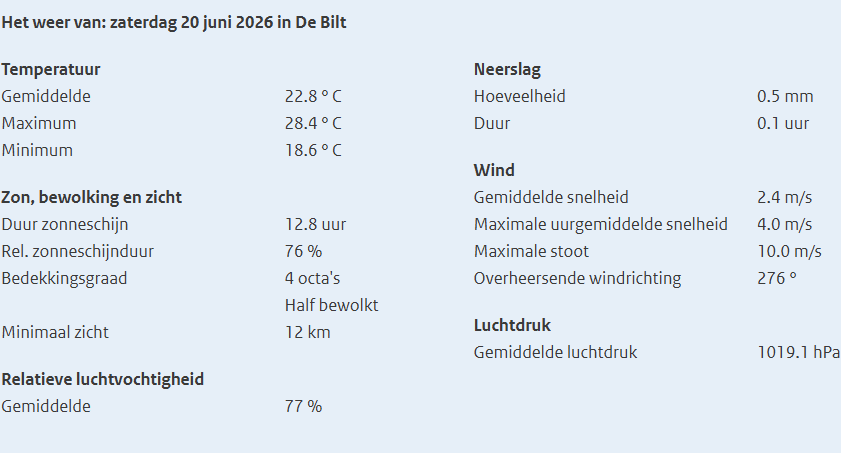
Weer:
Links:
In de geschiedenis
Links:
Wikipedia

World Refugee Day is an international day designated by the United Nations to honour refugees around the globe, it falls each year on June 20 and celebrates the strength and courage of people who have been forced to flee their home country to escape conflict or persecution.
World Refugee Day is an occasion to build empathy and understanding for their plight and to recognize their resilience in rebuilding their lives. Every minute 20 people leave everything behind to escape war, persecution or terror. World Refugee Day 2026 comes at a time when the promise of safety is being tested in every region of the world. Seventy-five years after the adoption of the 1951 Convention relating to the Status of Refugees, that promise remains one of the clearest undertakings of the international community: that people forced to flee should not be returned to danger, and should be able to live in dignity while displaced. Born from the ruins of war, it was never meant for one region, one generation or one people, but for humanity as a whole. That safeguard is urgently needed today. More than 117 million people are forcibly displaced worldwide, including families uprooted by war in the Sudan, violence in the Democratic Republic of the Congo and prolonged crises in Ukraine, Afghanistan, the Syrian Arab Republic, Myanmar and beyond. When people fleeing danger are denied protection, insecurity deepens: families are driven on to perilous routes, children lose years of learning, women and girls face greater risks, and host communities are left without the support they need. Protecting refugees is therefore not only an act of compassion; it is a condition of stability and peace. “Until Everyone Is Safe” is a call to keep that promise alive. It calls on Governments to uphold fair and accessible asylum systems, donors to sustain life-saving support, communities to welcome those forced to flee and each of us to defend the principle that safety must never depend on nationality, wealth, race, religion, gender, political opinion or migration status. Protection is fulfilled only when people forced to flee can live without fear, rebuild their lives, contribute to their communities and, when conditions allow, return home voluntarily, safely and with dignity.
Links:
World Refugee Day

London Climate Action Week (LCAW) is an annual event harnessing the power of London for global and local climate action.
Founded in 2019, LCAW is one of the world’s largest independent climate events. It brings together more than 75,000 people across more than 1,000 events over nine days each June. LCAW is a key moment in the global climate calendar, where climate action happens between COPs, where the UN Global Climate Action Agenda comes alive in cities and communities, and where the international climate community gathers to build the cooperation for progress and action. The LCAW Secretariat provides an open and inclusive platform, while event organisers are responsible for organising and hosting their own events. Events can take place at any time and place during the LCAW dates — in-person, hybrid, or virtual, in London and internationally with partners. From panel discussions and conferences to workshops, cultural gatherings, and art installations, the choice of format is open to organisers to design as appropriate to their desired outcomes.
Links:
London Climate Action Week
Vrijdag; Wat eten we vandaag?; BlackRock; Trump & gas; Dag voor het Tegengaan van Haatzaaien; Archeologiedagen; Kabelbreuk; Pinkpop.
Wat eten we vandaag?:

Kabelbreuk:
In de ochtend van vrijdag 19 juni 2026 brak de bovenleiding van de tram boven de Ceintuurbaan in Amsterdam, vlak bij de woonplek van A3. Dit deel van de straat werd daarom voor al het rijdend verkeer afgesloten met rood-witte linten.
Knipselkrant:
Agenda:
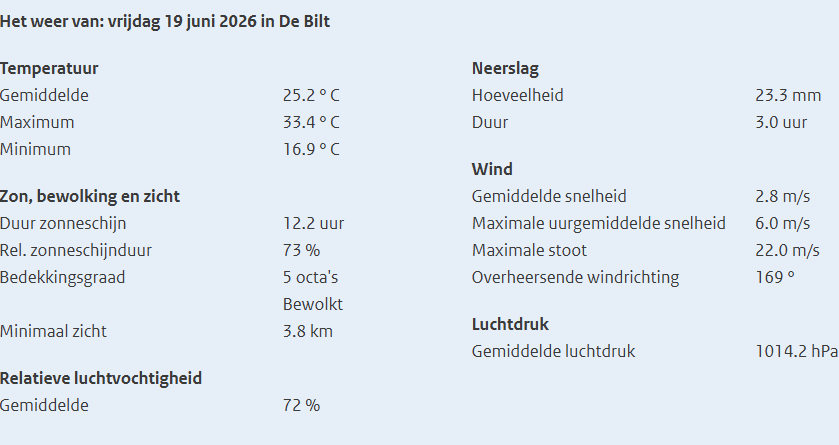
Weer:
Links:
In de geschiedenis
Links:
Wikipedia