Welfare of American mink, red and Arctic foxes, raccoon dog and chinchilla kept for fur production – publication

The Scientific Opinion (SO) ‘Welfare of American mink, red and Arctic foxes, raccoon dog and chinchilla kept for fur production‘ addresses a mandate from the EC regarding welfare of animals when farmed for their fur.

The request was to identify the most relevant welfare consequences (WCs) for each species and to determine whether these could be prevented or substantially mitigated in the current husbandry systems. ‘Current system’ refers strictly to the cage systems and cage dimensions as described in the EFSA Technical report produced under this mandate, as there was no or very limited information available on animals kept in alternative farming systems. Using information obtained from a review of literature, consultations with stakeholders and consideration by EFSA experts, the SO addresses for each species these WCs along with their underlying hazards and potential preventive or mitigating measures. In all species, Restriction of movement, Inability to perform exploratory or foraging behaviour, and Sensorial under- and overstimulation were selected as the most relevant WCs, sharing common hazards linked to current cage size and barrenness. Species-specific WCs include: soft tissue lesions and integument damage (mink), and handling stress (mink and foxes); locomotory disorders (Arctic fox); group stress (red fox), locomotory disorders and isolation stress (raccoon dog); and inability to perform comfort behaviour, resting problems and predation stress (chinchilla). In the majority of cases, it is concluded that neither prevention nor substantial mitigation of the identified WCs is possible in the current system. The SO also includes conclusions on limited or substantial mitigation measures in the current system and, when not possible, on substantial mitigating measures which would require a change to a different system.

Links:
EFSA: serious animal suffering unavoidable on fur farms

2025-07-30, Lief dagboek

Woensdag; prostaatkanker; kabel onder Schiermonnikoog en door de Waddenzee; Gaza−Israël oorlog 2023 – …; Werelddag tegen Mensenhandel; Increasing Isolation of Internet Users in Russia; Aardbeving Kamtsjatka.

Deze afbeelding heeft een leeg alt-attribuut; de bestandsnaam is dagboek.png

Knipselkrant:


Agenda:

Weer:

Links:
In de geschiedenis

Disrupted, Throttled, and Blocked: State Censorship, Control, and Increasing Isolation of Internet Users in Russia – publication

The report, “Disrupted, Throttled, and Blocked: State Censorship, Control, and Increasing Isolation of Internet Users in Russia”, documents the impact of the government’s increasing technological capacities and control over the country’s internet infrastructure.

Human Rights Watch (HRW) found that this allows the authorities to carry out more widespread and nontransparent blocking and throttling of unwanted websites and censorship circumvention tools, as well as internet disruptions and shutdowns under the pretext of ensuring public safety and national security.

Links:
Russia: Internet Blocking, Disruptions and Increasing Isolation

#HumanTrafficking #EndHumanTrafficking World Day Against Trafficking in Persons / Werelddag tegen Mensenhandel 2025

Human trafficking is a crime that exploits children, men and women for numerous purposes including forced labour and sex.

Trafficking in persons is a serious crime and a grave violation of human rights. Every year, thousands of men, women and children fall into the hands of traffickers, in their own countries and abroad. Almost every country in the world is affected by trafficking, whether as a country of origin, transit or destination for victims. UNODC, as guardian of the United Nations Convention against Transnational Organized Crime (UNTOC) and the Protocols thereto, assists States in their efforts to implement the Protocol to Prevent, Suppress and Punish Trafficking in Persons (Trafficking in Persons Protocol). The Protocol to Prevent, Suppress and Punish Trafficking in Persons defines Trafficking in Persons as the recruitment, transportation, transfer, harbouring or receipt of persons, by means of the threat or use of force or other forms of coercion, of abduction, of fraud, of deception, of the abuse of power or of a position of vulnerability or of the giving or receiving of payments or benefits to achieve the consent of a person having control over another person, for the purpose of exploitation. Exploitation shall include, at a minimum, the exploitation of the prostitution of others or other forms of sexual exploitation, forced labour or services, slavery or practices similar to slavery, servitude or the removal of organs. The World Day against Trafficking in Persons was proclaimed by the United Nations General Assembly, in its resolution A/RES/68/192. Theme 2024: “Leave No Child Behind in the Fight Against Human Trafficking“.

Links:
World Day Against Trafficking in Persons – 30 July

Explainer: Understanding Child Trafficking

8 facts you need to know about human trafficking in the 21st century

#DontForgetGaza Sit-ins op elk centraal station in Nederland

Zolang Den Haag wegkijkt, wordt er herrie gemaakt – voor sancties, voor een wapenembargo en voor echte maatregelen tegen Israël.

Een week geleden, op 24 juli 2025, klonk op 32 stations in Nederland een oorverdovend lawaai van potten en pannen. Duizenden mensen lieten horen dat zij de uithongering van Gaza en het stilzwijgen van de politiek niet langer accepteren. De indrukwekkende opkomst bleef niet onopgemerkt: de Tweede Kamer komt zelfs terug van reces om de situatie in Gaza te bespreken. Minister Veldkamp heeft inmiddels enkele maatregelen aangekondigd – kleine stapjes vooruit, zonder twijfel mede zijn ingegeven door de druk van de protesten. Maar: deze maatregelen zijn vooral symbolisch en lang niet voldoende. Terwijl kinderen in Gaza sterven van honger en geweld, kiest Nederland nog altijd voor kruimels en woorden in plaats van echte, daadkrachtige actie. De Tweede Kamercommissie Buitenlandse Zaken praat op 7 augustus 2025 over de situatie in Gaza. Daarom moeten juist nu onze stem juist luider laten horen. Sluit je aan; neem potten, pannen en pollepels mee en laat samen zien dat zwijgen geen optie is.

Links:
Protesteer tegen uithongering en genocide – kom morgen om 18:00 naar het station

31 July: SIT-IN’s for Gaza NEW EMERGENCY CALL!

📣 31 Cities Rise for Gaza 📣

Sit-in van Rijksambtenaren in Den Haag

Zeebeving Kamtsjatka 2025

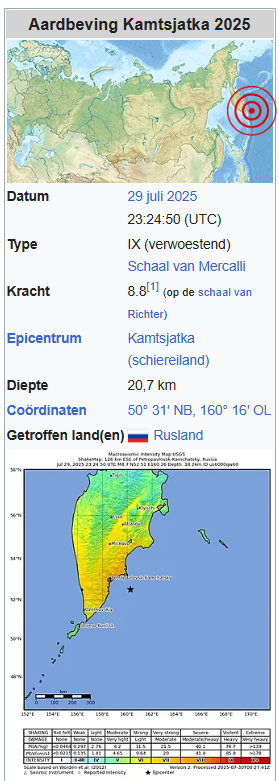
De aardbeving bij schiereiland Kamtsjatka op 30 juli 2025 om 11:24 (lokale tijd) was een beving met een magnitude 8,8 op de schaal van Richter, op 19 kilometer diepte.

Het epicentrum van de beving lag in open zee op zo’n 130 kilometer van de Russische kust. De aardbeving heeft tot tsunamiwaarschuwingen geleid in onder meer Rusland, Japan, de Verenigde Staten, China, Hawaï en Ecuador. De hoge golven hebben ook Japan bereikt en in Hawaï waren evacuaties. Er zijn geen slachtoffers gemeld, wel was er een tsunami die de Russische havenplaats Severo-Koerilsk onder water zette. Er volgden naschokken met een magnitude tot 6,9. De Kljoetsjevskaja Sopka, een vulkaan op het schiereiland Kamtsjatka en een van de hoogste vulkanen ter wereld, barstte uit als gevolg van de beving. Ook de Krasjeninnikov vulkaan op het schiereiland barstte enkele dagen later op 3 augustus 2025 voor het eerst in 475 jaar weer uit. Hetzelfde gebied was op 4 november 1952 getroffen door een aardbeving met magnitude 9,0.


Links:
Zware aardbeving Kamtsjatka

2025 Kamchatka Peninsula, Russia Earthquake

Zware beving bij Russisch schiereiland Kamtsjatka, tsunamiwaarschuwing Japan

Tsunami zet Russische havenstad onder water na zeldzaam zware aardbeving

M 6.9 – 147 km SE of Petropavlovsk-Kamchatsky, Russia

M 8.8 – 2025 Kamchatka Peninsula, Russia Earthquake

M 7.8 – 127 km E of Petropavlovsk-Kamchatsky, Russia

Disaster averted (just)

#Movember 2025

Movember (een porte-manteau van het Engelse woord ‘moustache’ (snor) en ‘november’) is een jaarlijks terugkerend evenement om aandacht te vragen voor prostaatkanker, teelbalkanker en de gezondheid van de man meer in het algemeen.

Door mannen en vrouwen (Mo Bros en Mo Sistas) aan te moedigen om mee te doen streeft de stichting er naar om de vroege opsporing van kanker, diagnose en effectieve behandelingen, en uiteindelijk een vermindering van het aantal vermijdbare sterfgevallen te realiseren. Naast het ondergaan van een jaarlijkse controle stimuleert de stichting mensen zich bewust te zijn van mogelijke familiegeschiedenis van kanker en om een gezondere levensstijl aan te nemen. De Movember Foundation financiert ruim 800 onderzoeksprojecten over de hele wereld. Het Wereldwijd Wetenschappelijk Comité (GSC) komt jaarlijks bijeen om ontwikkelingen in het kankeronderzoek te bespreken en te bepalen waar het beschikbare geld heen gaat. Het GSC wil voorkomen dat onderzoek door verschillende onderzoekscentra onnodig dubbel wordt gedaan.

Links:
Movember

Waarom een bevolkingsonderzoek voor prostaatkanker nodig is

The silent epidemic: the pros and cons of screening for prostate cancer

A coalition of ten Dutch and Palestinian NGOs are accusing the Dutch State of failing to prevent genocide in Gaza and to ensure Israel respects international law – Appeal

On 3 September 2025, the Dutch Court of Appeal will hear a case brought against the Dutch government by Al Haq, Al-Mezan, the Palestinian Center for Human Rights, and Dutch NGOs Een Ander Joods Geluid (EAJG), European Legal Support Center (ELSC), Groningen Jabalya, Netherlands Palestina Komitee, SOMO, Stichting Kifaia, and Stichting Palestina, and is supported by Erev Rav and Plant een Olijfboom.

The case demands an end to the Netherlands’ role in enabling Israel’s ongoing genocide in Gaza and its unlawful military occupation and colonisation of Palestinian land. These actions are not isolated policies, but central pillars of a Zionist settler-colonial project rooted in forced displacement, land theft, and racial domination. The appeal challenges a ruling issued by The Hague District Court in December 2024, which acknowledged the Dutch state’s obligations under international law but declined to enforce them. The court accepted the government’s position that arms exports could proceed under a “case-by-case” licensing framework, even though the International Court of Justice determined that plausible genocide is being carried out in Gaza, and the Dutch territory remained actively involved in transferring weapons used in that context. The court deemed the government’s “discouragement policy” on trade with illegal settlements as sufficient, without evaluating its effectiveness or consistency with international law. In doing so, the court affirmed a model of governance in which legal commitments are treated as symbolic, accountability is optional, and bureaucratic procedures replace political responsibility. This appeal is a direct challenge to a system that reduces state complicity in atrocities to a matter of bureaucratic discretion. The Netherlands’ entanglement in Israel’s regime of apartheid and colonisation is not new. It reflects a longer arc of European complicity in Zionist state-building and the violent reordering of Palestinian land, demography, and sovereignty. As a former colonial power, the Netherlands has reconstituted its relationship to empire through trade, surveillance, and weapons supply. These entanglements expose the lie of European neutrality. For decades, Dutch governments have offered diplomatic cover, economic protection, and logistical access to a state that has made the subjugation of Palestinians its governing principle.

Links:
Infrastructure of genocide: the case confronting Dutch support for Israel’s war machine

Ruling in the case A coalition of ten Dutch and Palestinian NGOs are accusing the Dutch State of failing to prevent genocide in Gaza and to ensure Israel respects international law – Appeal

Volgens het gerechtshof Den Haag bestaat er een ernstig risico dat Israël genocide pleegt in Gaza en het humanitair oorlogsrecht schendt

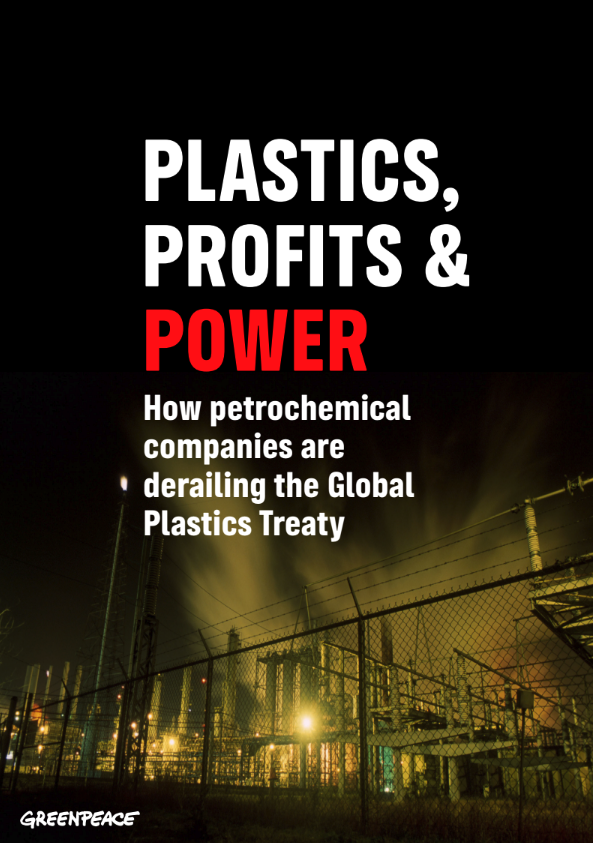
Plastics, Profits and Power: How petrochemical companies are derailing the Global Plastics Treaty – publication

The Report ‘Plastics, Profits and Power: How petrochemical companies are derailing the Global Plastics Treaty‘ exposes how fossil fuel and petrochemical companies are working to derail the Global Plastics Treaty, the world’s most ambitious effort to end plastic pollution.

While lobbying heavily to weaken the treaty, corporations like ExxonMobil, Shell, Dow and INEOS have expanded plastic production, locking in decades of future pollution. Industry lobbyists now outnumber many national delegations, scientists and Indigenous groups, and their presence creates a profound conflict of interest. Without decisive reforms, the treaty risks being captured by the very polluters it is meant to regulate. Greenpeace calls on the UN to ban fossil fuel lobbyists from the talks, embed strong conflict of interest safeguards, and ensure meaningful participation for frontline communities and independent experts.

Links:
Plastics, Profits and Power: How petrochemical companies are derailing the Global Plastics Treaty