
2025-07-29, Lief dagboek
Dinsdag; Wat eten we vandaag?; Gaza−Israël oorlog 2023 – …; Trumpgas; Wereld Tijgerdag; Meteorenzwerm δ-Cassiopeiïden.

Wat eten we vandaag?

Knipselkrant:
Agenda:
Weer:
Links:
In de geschiedenis

Dinsdag; Wat eten we vandaag?; Gaza−Israël oorlog 2023 – …; Trumpgas; Wereld Tijgerdag; Meteorenzwerm δ-Cassiopeiïden.
Wat eten we vandaag?
Knipselkrant:
Agenda:
Weer:
Links:
In de geschiedenis
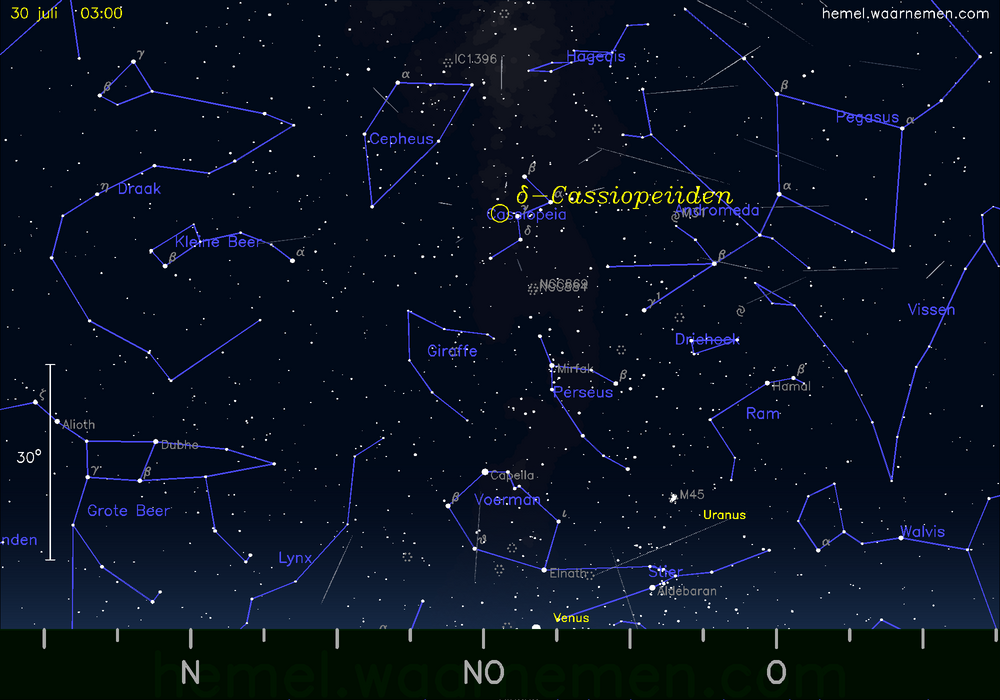
De meteorenzwerm δ-Cassiopeiïden (naar de ster Delta Cassiopeiae) bereikt op dinsdag 29 juli 2025, rond 22:00, zijn maximum.
Wanneer de radiant in het zenit zou staan, zouden er van deze zwerm naar verwachting gemiddeld zo’n 10 meteoren per uur vallen. Rond 06:00 staat de radiant van de zwerm in het hoogste punt (op 79°) aan de hemel. Het beste moment om δ-Cassiopeiïden waar te nemen is op 30 juli rond 03:00. De radiant van de zwerm staat dan ongeveer 64° boven de noordoostelijke horizon. Door de matige omstandigheden zijn er in onze streken dan vermoedelijk maar circa 3–7 meteoren per uur van deze zwerm te zien. Samen met meteoren van andere zwermen, en sporadische meteoren, zijn er bij donkere, heldere hemel in totaal circa 11–18 “vallende sterren” per uur te zien. Op een donkere locatie zijn ongeveer vijf keer zoveel meteoren te zien als in dichtbevolkt gebied. De Maan stoort niet. Rond 05:15 gaat het schemeren en om 05:58 komt de Zon op. Over het algemeen zijn de de meteoren van een zwerm niet alleen op de dag van het maximum zichtbaar. Zo is gedurende circa 5 dagen rondom het maximum meer dan 50% van het maximum aantal meteoren per uur van de δ-Cassiopeiïden te zien. Tot 6 dagen voor en na het maximum zijn nog meteoren van deze zwerm te herkennen. De zwerm heeft daarmee een relatief korte piek. Er zijn dus nog meer kansen, voor het geval het in de nacht van het maximum niet helder is. Wel is iedere dag die je eerder voor het maximum, of later na het maximum waarneemt het aantal meteoren dat zichtbaar is circa 20% kleiner. De typische snelheden van de meteoren in deze zwerm zijn met circa 60 km/s (ongeveer 216.000 km/uur) relatief hoog.
Links:
Wikipedia
Every year, this most intensely scrutinized of FAO’s reports presents the headline number of undernourished people around the world, while advocating for strategies against hunger and malnutrition.
Following publication of the global report ‘The State of Food Security and Nutrition in the World 2025‘, a wealth of statistics is disaggregated into regional reports. SOFI is jointly produced with fellow UN agencies IFAD, UNICEF, WFP and WHO. While some progress and recovery have been made in recent years, the world is still above pre-COVID-19 pandemic levels and far from eradicating hunger and food insecurity by 2030 (SDG Target 2.1). Similarly, despite some progress in the global nutrition targets, the world is not on track to achieve SDG Target 2.2. Among other factors, persistent food price inflation has slowed this momentum.The State of Food Security and Nutrition in the World 2025 highlights how elevated inflation in many countries has undermined purchasing power and, especially among low-income populations, access to healthy diets. The report documents how high food price inflation is associated with increases in food insecurity and child malnutrition.
Vulnerable groups, including low-income households, women, and rural communities, can be particularly affected by food price inflation, risking setbacks in the fight against hunger and malnutrition.In response to these challenges and to prevent future price shocks, the report examines policy measures adopted by countries, and outlines what is necessary going forwards. It stresses the importance of coherent implementation of fiscal and monetary policies to stabilize markets, promote open and resilient trade, and protect vulnerable populations. Additionally, it calls for better data systems and sustained investment in resilient agrifood systems to build long-term food security and nutrition. These coordinated actions are vital to reignite progress towards ending hunger and malnutrition by 2030.
Links:
The State of Food Security and Nutrition in the World
Maandag; OV Amsterdam; Wereld Tijgerdag; World Hepatitis Day; Natuurbeschermingsdag; UN conference on two-State solution for Israel and Palestine.
Knipselkrant:
Agenda:
Weer:

Links:
In de geschiedenis

World Nature Conservation Day is observed on 28th July all over the world with the objective of increasing awareness about and protecting the natural resources.
On this day, let us make a conscious effort to contribute to the local, national, and global efforts in conserving nature and the benefits they provide for the present and future generations. Wo

World Hepatitis Day, 28 July, is an opportunity to step up national and international efforts on hepatitis, encourage actions and engagement by individuals, partners and the public and highlight the need for a greater global response as outlined in the WHO’s Global hepatitis report of 2017.
The date of 28 July was chosen because it is the birthday of Nobel-prize winning scientist Dr Baruch Blumberg, who discovered hepatitis B virus (HBV) and developed a diagnostic test and vaccine for the virus. Low coverage of testing and treatment is the most important gap to be addressed in order to achieve the global elimination goals by 2030. World Hepatitis Day 2025 theme: ‘Hepatitis: Break It Down’.
Links:
Wikipedia

Global Tiger Day is an annual celebration to raise awareness for tiger conse
The goal of the day is to promote a global system for protecting the natural habitats of tigers and to raise public awareness and support for tiger conservation issues. Around 3,900 tigers (in 2019) remain in the wild, but much more work is needed to protect this species if we are to secure its future in the wild. After a century of decline, overall wild tiger numbers are starting to tick upward. In some areas, including much of Southeast Asia, tigers are still in crisis and declining in number. Based on the best available information, tiger populations are stable or increasing in India, Nepal, Bhutan, Russia and China.
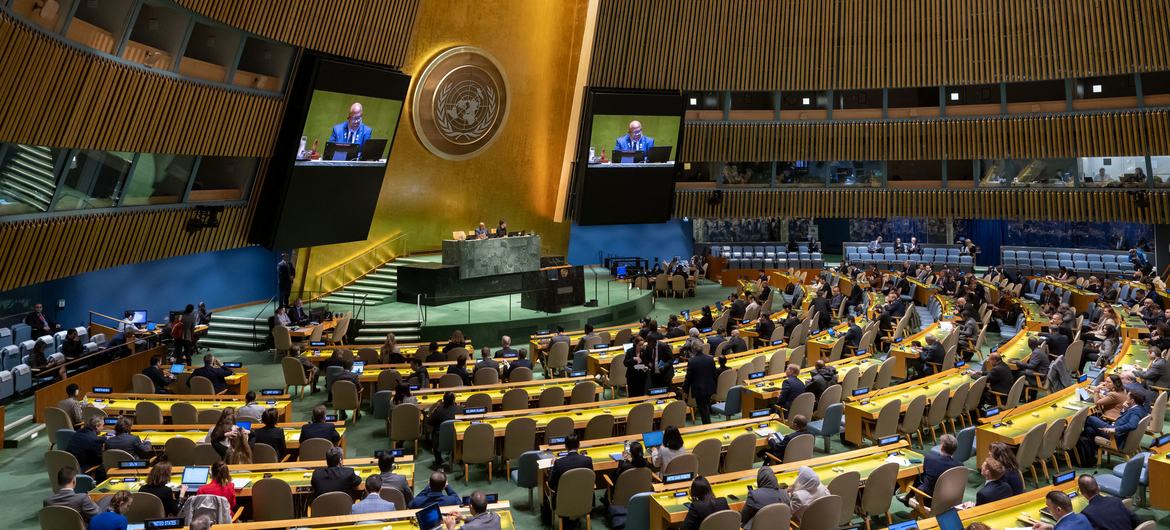
The United Nations (UN) High-level conference on two-State solution for Israel and Palestine is a three-day conference, mandated by the General Assembly through resolutions ES-10/24 and 79/81 and co-organized by France and Saudi Arabia, brings together Member States, observers and regional stakeholders.
The UN has scheduled a high-level conference on the two-state solution in New York, co-chaired by Saudi Arabia and France. The conference was originally set to take place on June 17-20, 2025, but rescheduled to July 28-29, 2025. As detailed below, the original aim of the conference was to obtain recognition of a Palestinian state from UN member states. On July 25, 2025, French President Emmanuel Macron announced that France would recognize a Palestinian State at the UN General Assembly in September. It features plenary discussions and thematic roundtables on issues ranging from security arrangements and humanitarian response to reconstruction and economic viability. This ministerial high-level session brings together the outcomes of the thematic roundtables and working groups convened under the auspices of the High-Level Conference on the Implementation of the Two-State Solution. It provides a platform to consolidate key insights, highlight consensus across political, legal, economic, and humanitarian tracks, and articulate concrete next steps. The session is both a culmination of months of coordinated diplomatic work and a launchpad for action, and laying the groundwork for sustained international engagement, accountability, and implementation in support of a just and lasting peace.
LIVE COVERAGE: Day 2 of high-level conference on two-State solution for Israel and Palestine
UN chief: Israeli-Palestinian conflict at ‘breaking point,’ urges push for two-State solution
Background to July 2025 UN Conference on Two-State Solution
Exclusive: US slams UN conference on Israel-Palestinian issue, warns of consequences
Conference to recognise Palestinian state to weaken scope of its ambition, diplomats say