#PlantHealthDay Day of Plant Health 2025

The United Nations designated 12 May the International Day of Plant Health (IDPH) to raise global awareness on how protecting plant health can help end hunger, reduce poverty, protect biodiversity and the environment, and boost economic development.

Plants are life – we depend on them for 80 percent of the food we eat and 98 percent of the oxygen we breathe. But international travel and trade has been associated with the introduction and spread of plant pests. Invasive pest species are one of the main drivers of biodiversity loss and threaten the delicate web of life that sustains our planet. Pests and diseases have also been associated with rising temperatures which create new niches for pests to populate and spread. In response, the use of pesticides could increase, which harms pollinators, natural pest enemies and organisms crucial for a healthy environment. Protecting plant health is essential by promoting environmentally friendly practices such as integrated pest management. International standards for phytosanitary measures (ISPMs) in trade also help prevent the introduction and spread of plant pests across borders.

Links:
Day of Plant Health

Dag van de Verpleging / Dag van de Zorg / Dag van het Bewustzijn & ME / Dag voor Chronische Immunologische en Neurologische Aandoeningen / Florence Nightingale – geboortedag (1820) 2025

Op de geboortedag van Florence Nightingale, de grondlegster van het verpleegkundige beroep, wordt internationaal de Dag van de Verpleging gevierd.

Sinds 1964 wordt deze dag ook in Nederland gevierd. De Internationale Raad voor Verpleegkundigen en de Internationale Rode Kruis- en Rode Halve Maan-beweging vieren dit jaar gezamenlijk de Internationale Dag van de Verpleging. Zij willen alle verpleegkundigen, waar dan ook ter wereld, prijzen voor hun inzet. Het zijn mensen die alleen maar ons respect verdienen. Want aan de frontlinie staan in een oorlog is angstig en levensbedreigend.

Dag van het Bewustzijn / Awareness Day werd door Thomas Michael Hennessy, Jr. bedacht, de oprichter van Repeal Existing Stereotypes about Chronic Immunological and Neurological Diseases (CIND). De Amerikaanse Tom wilde deze dag niet alleen nationaal lanceren, hij richtte zijn pijlen op de hele wereld. Internationale Dag van Bewustzijn wil met deze dag meer (bewuste) aandacht vragen voor het hele spectrum van chronische immunologische en neurologische ziekten waaronder ook ME/CVS valt. Niet vreemd dat op de geboortedatum van Florence Nightingale, de grondlegger van de moderne verpleegkunde, Dag van Bewustzijn wordt gevierd. In 1992 heeft de Wereldgezondheidsorganisatie (WHO) ME/CVS erkend als ziekte. Vandaar dat sinds 12 mei 1992 jaarlijks de Internationale ME-dag op de Dag voor Chronische Immunologische en Neurologische Aandoeningen valt. Het staat in de boeken vermeld dat Florence vanaf haar 35e levensjaar worstelde met ME-achtige klachten zoals pijn op de borst, hoofdpijn, snelle spiervermoeidheid, aanhoudende pijn in de bovenrug en concentratieproblemen. Dat is de link.

Links:
Dag van de Verpleging

May 12th

Therapie voor kinderen met uitputtingsziekte ME/CVS in twijfel getrokken

Bellingcat Open Source Challenges – LIVE!

Join Bellingcat Director for Research and Training Giancarlo Fiorella as he takes on the latest Bellingcat challenges live on Patreon, and play along!

You can find the exercises they’ll be attempting, designed by guest contributor Sofia Santos at Bellingcat Open Source Challenges. Open to all members we will be streaming on the Bellingcat Patreon channel.

Links:
Bellingcat Open Source Challenges- LIVE!

Day for the Total Elimination of Nuclear Weapons 2025

The General Assembly commemorates 26 September as the International Day for the Total Elimination of Nuclear Weapons, this Day provides an occasion for the world community to reaffirm its commitment to global nuclear disarmament as a priority.

It provides an opportunity to educate the public – and their leaders – about the real benefits of eliminating such weapons, and the social and economic costs of perpetuating them. Achieving global nuclear disarmament is one of the oldest goals of the United Nations. It was the subject of the General Assembly’s first resolution in 1946, which established the Atomic Energy Commission, which was dissolved in 1952, with a mandate to make specific proposals for the control of nuclear energy and the elimination of atomic weapons and all other major weapons adaptable to mass destruction. The United Nations has been at the forefront of many major diplomatic efforts to advance nuclear disarmament since. In 1959, the General Assembly endorsed the objective of general and complete disarmament. In 1978, the first Special Session of the General Assembly Devoted to Disarmament further recognized that nuclear disarmament should be the priority objective in the field of disarmament. Every United Nations Secretary-General has actively promoted this goal.

The General Assembly declared the International Day in December 2013, in its resolution 68/32 as a follow-up to the high-level meeting of the General Assembly on nuclear disarmament held on 26 September 2013, in New York. This was the latest in a series of efforts by the General Assembly to raise public awareness and to seek deeper engagement on nuclear disarmament matters. In 2009, the General Assembly had declared 29 August as the International Day against Nuclear Tests (resolution 64/35). In resolution 68/32, the General Assembly called for the “urgent commencement of negotiations in the Conference on Disarmament of a comprehensive convention on nuclear weapons to prohibit their possession, development, production, acquisition, testing, stockpiling, transfer and use or threat of use, and to provide for their destruction.”

In 2014, in its resolution 69/58, the General Assembly further expressed its desire to commemorate the Day, and requested the Secretary-General and the President of the General Assembly to make all arrangements necessary to commemorate the International Day and promote it, including by convening an annual meeting of the Assembly to provide a platform for the promotion of these activities. The General Assembly repeated these requests and call in subsequent years in resolutions  70/3471/7172/25173/4074/5475/4576/3677/47 and 78/27. The International Day for the Total Elimination of Nuclear Weapons has been observed annually since 2014. Pursuant to the resolutions of the General Assembly, Member States, the United Nations system and civil society, including non-governmental organizations, academia, parliamentarians, the mass media and individuals are encouraged to commemorate and promote the International Day through enhancing public awareness and education about the threat posed to humanity by nuclear weapons and the necessity for their total elimination. To observe the International Day, the United Nations is supporting events both in New York and Geneva. United Nations Information Centres around the world are encouraged to raise awareness to the observance of International Day for the Total Elimination of Nuclear Weapons.

Yet, today nearly around 12,100 nuclear weapons remain. Countries possessing such weapons have well-funded, long-term plans to modernize their nuclear arsenals. More than half of the world’s population still lives in countries that either have such weapons or are members of nuclear alliances. While the number of deployed nuclear weapons has appreciably declined since the height of the Cold War, not one nuclear weapon has been physically destroyed pursuant to a treaty. In addition, no nuclear disarmament negotiations are currently underway. Meanwhile, the doctrine of nuclear deterrence persists as an element in the security policies of all possessor states and many of their allies. The international arms-control framework that contributed to international security since the Cold War, acted as a brake on the use of nuclear weapons and advanced nuclear disarmament, has come under increasing strain. Most recently, on 2 August 2019, the United States’ withdrawal spelled the end of the Intermediate-Range Nuclear Forces Treaty, through with the United States and the Russian Federation had previously committed to eliminating an entire class of nuclear missiles.

Frustration has been growing amongst Member States regarding what is perceived as the slow pace of nuclear disarmament. This frustration has been put into sharper focus with growing concerns about the catastrophic humanitarian consequences of the use of even a single nuclear weapon, let alone a regional or global nuclear war. Commemorating this Day at the United Nations is especially important, given its universal membership and its long experience in grappling with nuclear disarmament issues. It is the right place to address one of humanity’s greatest challenges; achieving the peace and security of a world without nuclear weapons.

Links:
Day for the Total Elimination of Nuclear Weapons

Treaty on the Prohibition of Nuclear Weapons – adopted (2017) 2024

Krijgen we meer nucleaire proliferatie?

2025-05-11, Lief dagboek

Zondag; Wat eten we vandaag?; Trump; Faber; Bob Marley; Tegenlicht; Vroege Vogels.

Deze afbeelding heeft een leeg alt-attribuut; de bestandsnaam is dagboek.png

Wat eten we vandaag?:

Klik op afbeelding voor origineel

Knipselkrant:


Agenda:

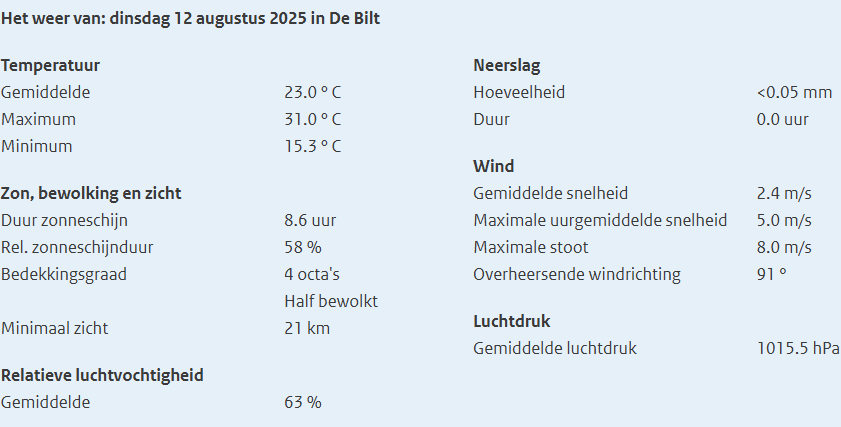
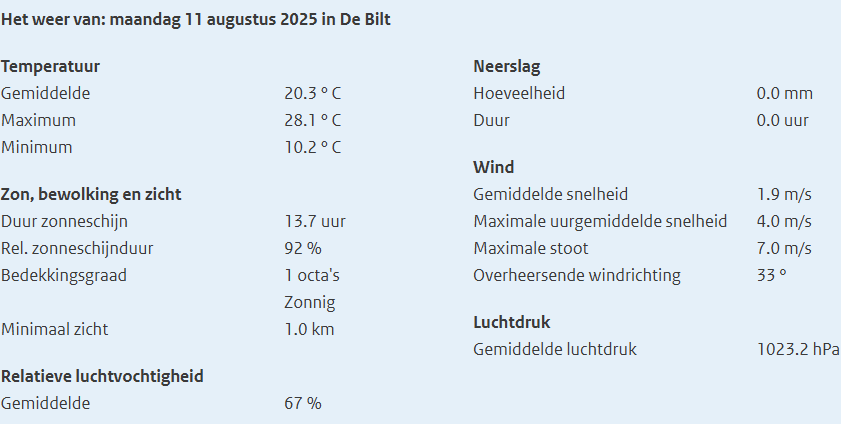
Weer:

Links:
In de geschiedenis

Vroege Vogels TV | 11 mei 2025 | Kuinderbos (TV NPO 2)

Vroege Vogels is een live-radioprogramma, tv-programma en online community van BNNVARA over natuur en milieu.

In het radioprogramma wordt het gesproken woord omlijst door licht klassieke muziek en salonmuziek. Het radioprogramma werd in 1978 voor het eerst uitgezonden door de VARA en is een van de langst lopende en best beluisterde radioprogramma’s van de publieke omroep. Het wordt elke zondagmorgen uitgezonden tussen 07:00 en 10:00 op NPO Radio 1. De beginmuziek is een bewerking van Vivaldi’s “Piccolo Concerto in C major” (RV 443). De tv editie wordt uitgezonden via NPO 2 op zondag, vaak rond een thema.

Deze week zijn we in het oudste en grootste bos van de Noordoostpolder, het Kuinderbos. Dit natuurgebied is een bolwerk voor koolmeesjes die nauwlettend in de gaten worden gehouden. En ook meer unieke soorten hebben dit bos op het strand van de voormalige Zuiderzee gevonden. Zo zien we hier de zeldzame noordse winterjuffer vliegen en gaan we naar de eerste groeiplaats van lansvarens, planten die goed gedijen op de oude schelpenbodem. Menno Bentveld gaat mee om broeihopen te maken voor de ringslangen. We volgen de paddentrek, en zien hoe allerlei amfibieën het water bereiken om eitjes te leggen.

Links:
Vroege Vogels (na afloop terugkijken)

Vroege Vogels Radio | 11 mei 2025 (Radio 1 NPO)

Vroege Vogels is een live-radioprogramma, tv-programma en online community van BNNVARA over natuur en milieu.

In het radioprogramma wordt het gesproken woord omlijst door licht klassieke muziek en salonmuziek. Het radioprogramma werd in 1978 voor het eerst uitgezonden door de VARA en is een van de langst lopende en best beluisterde radioprogramma’s van de publieke omroep. Het wordt elke zondagmorgen uitgezonden tussen 07:00 en 10:00 op NPO Radio 1. De beginmuziek is een bewerking van Vivaldi’s “Piccolo Concerto in C major” (RV 443).

De Nationale Parken vinden dat het kabinet hen laat vallen en roepen op om de voorgestelde bezuiniging van bijna 24 miljoen euro terug te draaien. Een maand lang luisteren we hoe de vogels ontwaken. Deze week is onze richtmicrofoon op de Hoorneboegse heide. Drie mannen hebben samen 125 jaar ervaring met het beschermen van kerkuilen. En verder: podcast tjif en tjaf, bomen op moederdag en natuurlijk de fenolijn. De column is deze week van Bibi Dumon Tak. Dit keer presenteert Menno Bentveld de uitzending van Vroege Vogels Radio vanuit Het Groene Huis op het landgoed Schothorst te Amersfoort.

Links:
Vroege Vogels (na afloop terugluisteren)

World Migratory Bird Day May 2025

World Migratory Bird Day (WMBD) is an annual awareness-raising campaign highlighting the need for the conservation of migratory birds and their habitats.

It has a global outreach and is an effective tool to help raise global awareness of the threats faced by migratory birds, their ecological importance, and the need for international cooperation to conserve them. Every year people around the world take action and organize public events such as bird festivals, education programmes, exhibitions and bird-watching excursions to celebrate WMBD. All these activities can also be undertaken at any time on the year because that countries or regions observing the peak of migrations at different times, but the main days for the international celebrations on the second Saturday in May and in October.

Links:
World Migratory Bird Day

Bob Marley sterfdag (1981) 2025

Robert Nesta (Bob) Marley (*6 februari 1945 – +11 mei 1981) was een Jamaicaans reggae-artiest.

Bob Marley had tijdens de jaren 70 van de 20e eeuw over de hele wereld enorme reggaehits, als No Woman, No Cry en I Shot the Sheriff. Hij bracht wereldberoemde reggaealbums uit als Exodus en Uprising. Hij was een van de belangrijkste verantwoordelijken voor de doorbraak van reggae buiten Jamaica en gold tevens als belangrijk voorvechter van het rastageloof. Samen met zijn vrouw Rita Marley is hij het symbool voor de rastafari-beweging.

Links:
Bobmarley.com

Bob Marley profiel

Bob Marley YouTube

Bob Marley & The Wailers afspeellijst Spotify

Bob Marley LEGACY Series

Bob Marley’s funeral, 21 May 1981: a day of Jamaican history