#Ogoni9 memorial 2025


The Ogoni Nine were a group of nine activists from the Ogoni region of Nigeria who opposed the operating practices of the Royal Dutch Shell oil corporation.

Their members included outspoken author and playwright Ken Saro-Wiwa, Saturday Dobee, Nordu Eawo, Daniel Gbooko, Paul Levera, Felix Nuate, Baribor Bera, Barinem Kiobel, and John Kpuine (Tripathi, p.189), who were executed by hanging in 1995 by the military dictatorship of General Sani Abacha and buried in Port Harcourt Cemetery. The executions provoked international condemnation and led to the increasing treatment of Nigeria as a pariah state until General Abacha’s mysterious death in 1998. Saro-Wiwa had previously been a critic of the Royal Dutch Shell oil corporation, and had been imprisoned for a year prior to the executions in November 1995. At least two witnesses who testified that Saro-Wiwa was involved in the murders of the Ogoni elders later recanted, stating that they had been bribed with money and offers of jobs with Shell to give false testimony – in the presence of Shell’s lawyer.

Links:
Wiwa family lawsuits against Royal Dutch Shell

The story of the Ogoni

Who killed Ken Saro Wiwa and Ogoni Nine | Gen. Sani Abacha or Shell Nigeria

Eindvonnis in de rechtzaak van vier van de weduwen van de negen in 1995 in Nigeria ter dood veroordeelde mannen ( #Ogoni9 ) tegen vennootschappen uit de Shell-Groep

Het is 25 jaar geleden dat de Ogoni Negen in Nigeria werden opgehangen

Sacharovprijs – uitreiking 2025

Sacharovprijs

De Sacharovprijs voor de vrijheid van denken is een onderscheiding die sinds 1988 jaarlijks wordt uitgereikt door het Europees Parlement en die is bedoeld als onderscheiding voor een bijzondere prestatie op een van de volgende gebieden:

De prijs is genoemd naar de Russische atoomgeleerde en dissident Andrej Sacharov, die in de Sovjet-Unie pleitte voor vrijheid van meningsuiting. Rond 10 december wordt de prijs met een waarde van 50.000 euro door het Europees Parlement uitgereikt tijdens een plechtige zitting in Straatsburg. Op die datum werd in 1948 de Universele verklaring van de rechten van de mens ondertekend.

Links:
Andrzej Poczobut en Mzia Amaglobeli: winnaars Sacharovprijs 2025

2025 Sakharov Prize: interviews with laureates’ and finalists’ representatives

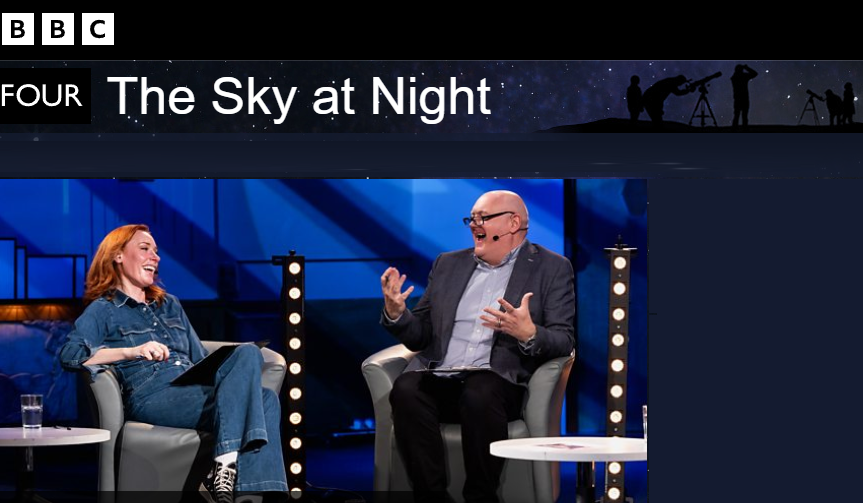
The Sky at Night – Space Mysteries: The Sky at Night Meets Curious Cases (TV BBC Four)

The Sky at Night

The Sky at Night is a monthly documentary television programme on astronomy produced by the BBC.

The show had the same permanent presenter, Patrick Moore, from its first broadcast on 24 April 1957 until 7 January 2013. The latter date was a posthumous broadcast, which followed Moore’s death on 9 December 2012. This made it the longest-running programme with the same presenter in television history. Many early episodes are missing, either because the tapes were wiped, thrown out, or because the episode was broadcast live and never recorded in the first place. Beginning with the 3 February 2013 edition, the show was co-presented by Lucie Green and Chris Lintott. Since December 2013 Maggie Aderin-Pocock has been a presenter. The programme’s opening and closing theme music is “At the Castle Gate”, from the incidental music to Pelléas et Mélisande, written in 1905 by Jean Sibelius, performed by the Royal Philharmonic Orchestra and conducted by Sir Thomas Beecham.

This episode:
Do aliens exist, and can we talk to them? What does a black hole sound like? Does the universe look like a doughnut? In a spectacular season finale, The Sky at Night teams up with hit podcast Curious Cases to answer your burning space mysteries, from the strange sounds of the
cosmos to the furthest edges of the observable universe.

Filmed in front of a live studio audience, presenters Hannah Fry and Dara Ó Briain bring their signature wit and curiosity as they quiz our stellar panel of experts – Maggie Aderin-Pocock, Chris Lintott and George Dransfield. Expect lively debate, surprising revelations, and moments of pure astronomical awe as they explore the weird and wonderful corners of space science.

Meanwhile, Pete Lawrence turns his eyes to the heavens to guide us through the incredible sights currently lighting up the night sky and offering a glimpse into the mysteries that unfold when we simply look up.

Adding another layer of intrigue, a special BBC Ideas animation explores our ongoing search for alien life and the tantalising possibility of making contact with extraterrestrial intelligence.

And for those who want to keep the curiosity flowing, Radio 4 are airing a companion episode of Curious Cases, featuring extra content from the live recording.

Join us for this unforgettable night of cosmic exploration before the programme returns in the spring of 2026 with even more wonders from the final frontier.

Do aliens exist, and can we talk to them? What does a black hole sound like? Does the universe look like a doughnut? In a spectacular season finale, The Sky at Night teams up with hit podcast Curious Cases to answer your burning space mysteries, from the strange sounds of the
cosmos to the furthest edges of the observable universe.

Filmed in front of a live studio audience, presenters Hannah Fry and Dara Ó Briain bring their signature wit and curiosity as they quiz our stellar panel of experts – Maggie Aderin-Pocock, Chris Lintott and George Dransfield. Expect lively debate, surprising revelations, and moments of pure astronomical awe as they explore the weird and wonderful corners of space science.

Meanwhile, Pete Lawrence turns his eyes to the heavens to guide us through the incredible sights currently lighting up the night sky and offering a glimpse into the mysteries that unfold when we simply look up.

Adding another layer of intrigue, a special BBC Ideas animation explores our ongoing search for alien life and the tantalising possibility of making contact with extraterrestrial intelligence.

And for those who want to keep the curiosity flowing, Radio 4 are airing a companion episode of Curious Cases, featuring extra content from the live recording.

Join us for this unforgettable night of cosmic exploration before the programme returns in the spring of 2026 with even more wonders from the final frontier.

Links:
The Sky at Night

2025-11-09, Lief dagboek

Zondag; Wat eten we vandaag?; Carl Sagan – birthday (1934) / Carl Sagan Prize for Science Popularization; Dag van de Uitvinders / Hedy Lamarr – geboortedag; Vroege Vogels; ESCAPADE.

Deze afbeelding heeft een leeg alt-attribuut; de bestandsnaam is dagboek.png

Wat eten we vandaag?:

Klik op afbeelding voor origineel

Knipselkrant:

Agenda:

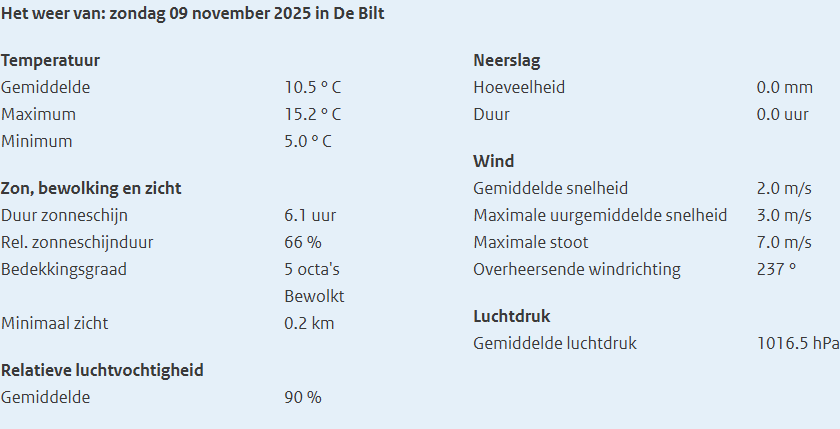
Weer:

KNMI weerrapport

Links:
In de geschiedenis

Carl Sagan – birthday (1934) / Carl Sagan Prize for Science Popularization 2025

Carl Edward Sagan (/ˈseɪɡən/; November 9, 1934 – December 20, 1996) was an American astronomer, cosmologist, astrophysicist, astrobiologist, author, science popularizer, and science communicator in astronomy and other natural sciences.

He is best known for his work as a science popularizer and communicator. His best known scientific contribution is research on extraterrestrial life, including experimental demonstration of the production of amino acids from basic chemicals by radiation. Sagan assembled the first physical messages sent into space: the Pioneer plaque and the Voyager Golden Record, universal messages that could potentially be understood by any extraterrestrial intelligence that might find them. Sagan argued the now accepted hypothesis that the high surface temperatures of Venus can be attributed to and calculated using the greenhouse effect. Sagan published more than 600 scientific papers and articles and was author, co-author or editor of more than 20 books. He wrote many popular science books, such as The Dragons of Eden, Broca’s Brain and Pale Blue Dot, and narrated and co-wrote the award-winning 1980 television series Cosmos: A Personal Voyage (+ deel 1). The most widely watched series in the history of American public television, Cosmos has been seen by at least 500 million people across 60 different countries. The book Cosmos was published to accompany the series. He also wrote the science fiction novel Contact, the basis for a 1997 film of the same name. His papers, containing 595,000 items, are archived at The Library of Congress. Sagan advocated scientific skeptical inquiry and the scientific method, pioneered exobiology and promoted the Search for Extra-Terrestrial Intelligence (SETI). He spent most of his career as a professor of astronomy at Cornell University, where he directed the Laboratory for Planetary Studies. Sagan and his works received numerous awards and honors, including the NASA Distinguished Public Service Medal, the National Academy of Sciences Public Welfare Medal, the Pulitzer Prize for General Non-Fiction for his book The Dragons of Eden, and, regarding Cosmos: A Personal Voyage, two Emmy Awards, the Peabody Award, and the Hugo Award. He married three times and had five children. After suffering from myelodysplasia, Sagan died of pneumonia at the age of 62, on December 20, 1996.

Links:
Carl Sagan Prize for Science Popularization

Dag van de Uitvinders / Hedy Lamarr – geboortedag (1914) / Inventors’ Day 2025

De Dag van de Uitvinders wordt gevierd op 9 november, de verjaardag van de uitvindster en actrice Hedy Lamarr.

De dag werd afgekondigd door de uitvinder en ondernemer Gerhard Muthenthaler van Berlijn. Volgens de website van organisatie streeft het de volgende doelstellingen na:

  • Mensen aan te moedigen ideeën na te streven om dingen te verbeteren
  • Herinnering van vergeten uitvinders
  • Herinnering van grote uitvinders, die ons leven verbeterden

Links:
Tag der Erfinder/innen

ESCAPADE mission to Mars

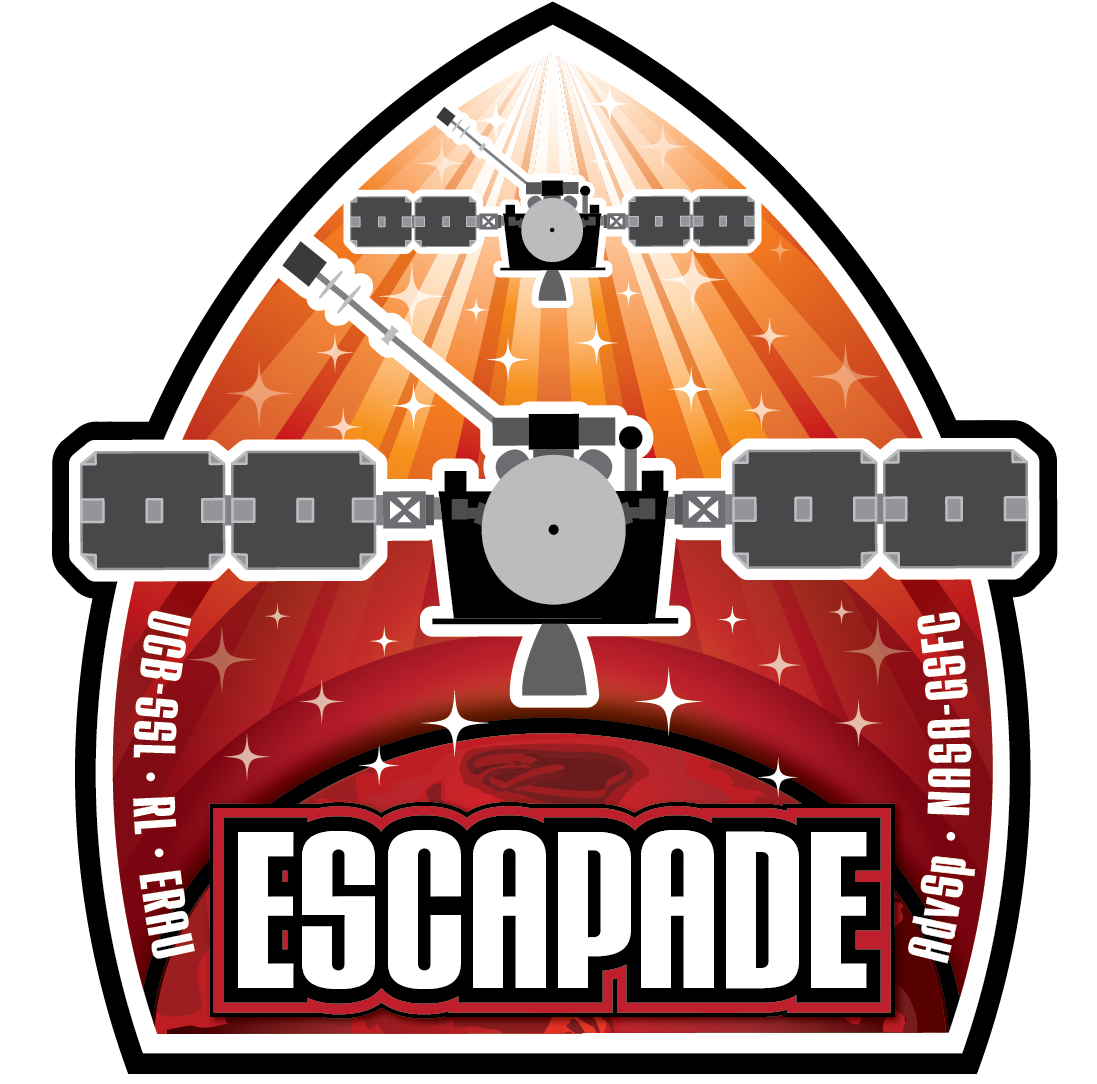
ESCAPADE

Escape and Plasma Acceleration and Dynamics Explorers (ESCAPADE) is a planned spacecraft mission to Mars consisting of two spacecraft known as Blue and Gold, the mission is led by UC Berkeley’s Space Sciences Laboratory.

Once expected to launch in October 2024, it is part of NASA‘s SIMPLEx program. In August 2024 the spacecraft arrived at the launch site. However, NASA postponed the launch due to schedule and technical issues involved with the mission’s New Glenn launch vehicle, which was set to debut with the launch of these spacecraft. Launch on the New Glenn is now planned for no earlier than November 9, 2025. The science goals of ESCAPADE are to:

  • understand the processes controlling the structure of Mars’ hybrid magnetosphere and how it guides ion flows
  • understand how energy and momentum are transported from the solar wind through Mars’ magnetosphere
  • understand the processes controlling the flow of energy and matter into and out of the collisional atmosphere

There are three science experiments onboard each identical spacecraft: EMAG, EESA, and ELP. EMAG, which was developed by the NASA Goddard Spaceflight Center, is a magnetometer that will measure DC magnetic fields up to 1000 nT, mounted at the end of the boom to reduce magnetic noise from the spacecraft. EESA is an electrostatic analyzer designed to measure the energies, fluxes, and masses of suprathermal ions from 2 eV to 20 keV and energies and fluxes of suprathermal electrons from 3 eV to 10 keV. It is mounted on the upper deck of the spacecraft bus, with a 240° x 120° field of view for electrons and 247.5° x 90° field of view for ions. ELP, developed by the Space and Atmospheric Instrumentation Lab at Embry-Riddle Aeronautical University, is a Langmuir probe consisting of three separate sensors: the multi-needle Langmuir probe (mNLP) consists of 4 thin needles mounted in two pairs ~3/4 way up the boom and measures thermal electron density; the two planar ion probes (PIPs) are mounted on the instrument deck and measure thermal ion density, and the floating potential probe (FPP) is also mounted on the spacecraft deck and measures changes in relative spacecraft electrostatic potential. Once the nominal science orbit is achieved, approximately six months after arriving at Mars, Science Campaign A involves both spacecraft flying in the same orbit at varying distances from one another, ~170 × 8,400 km (5.66 hours) with an inclination of 65 degrees. This will last approximately six months, at which time Blue will lower its apoapsis to 7,000 km and Gold will raise its apoapsis to 10,000 km. With different orbital periods (4.9 and 6.6 hours), the orbits will precess (due to Mars’ nonuniform gravity field) at different rates and thus separate, allowing simultaneous measurements of distant parts of the Mars magnetosphere. This campaign will operate for approximately five months until the end of the nominal science mission less than three years after launch. Launches on November 9 and 12, 2025, were scrubbed due to weather conditions and solar storms; the next launch attempt is scheduled for November 13, 2025. The launch window opens at 19:57 UTC and runs through 21:25 UTC.

Links:
ESCAPADE

Voor het eerst in jaren missie naar Mars, vuurproef voor raket Jeff Bezos

2025-11-08, Lief dagboek

Zaterdag; Wat eten we vandaag?; COP30; Dutch and Palestinian NGOs are accusing the Dutch State of failing to prevent genocide in Gaza; Dag van de Stralende Beroepen; Werelddag van de Stedenbouw; Bomen voor Amsterdam; STEMday; Aaron Swartz Day.

Deze afbeelding heeft een leeg alt-attribuut; de bestandsnaam is dagboek.png

Wat eten we vandaag?:

Klik op afbeelding voor origineel

Knipselkrant:


Agenda:

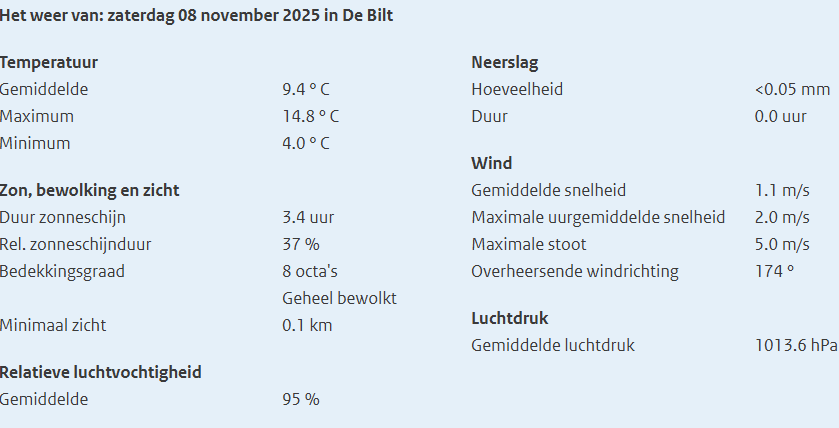
Weer:

KNMI weerrapport

Links:
In de geschiedenis

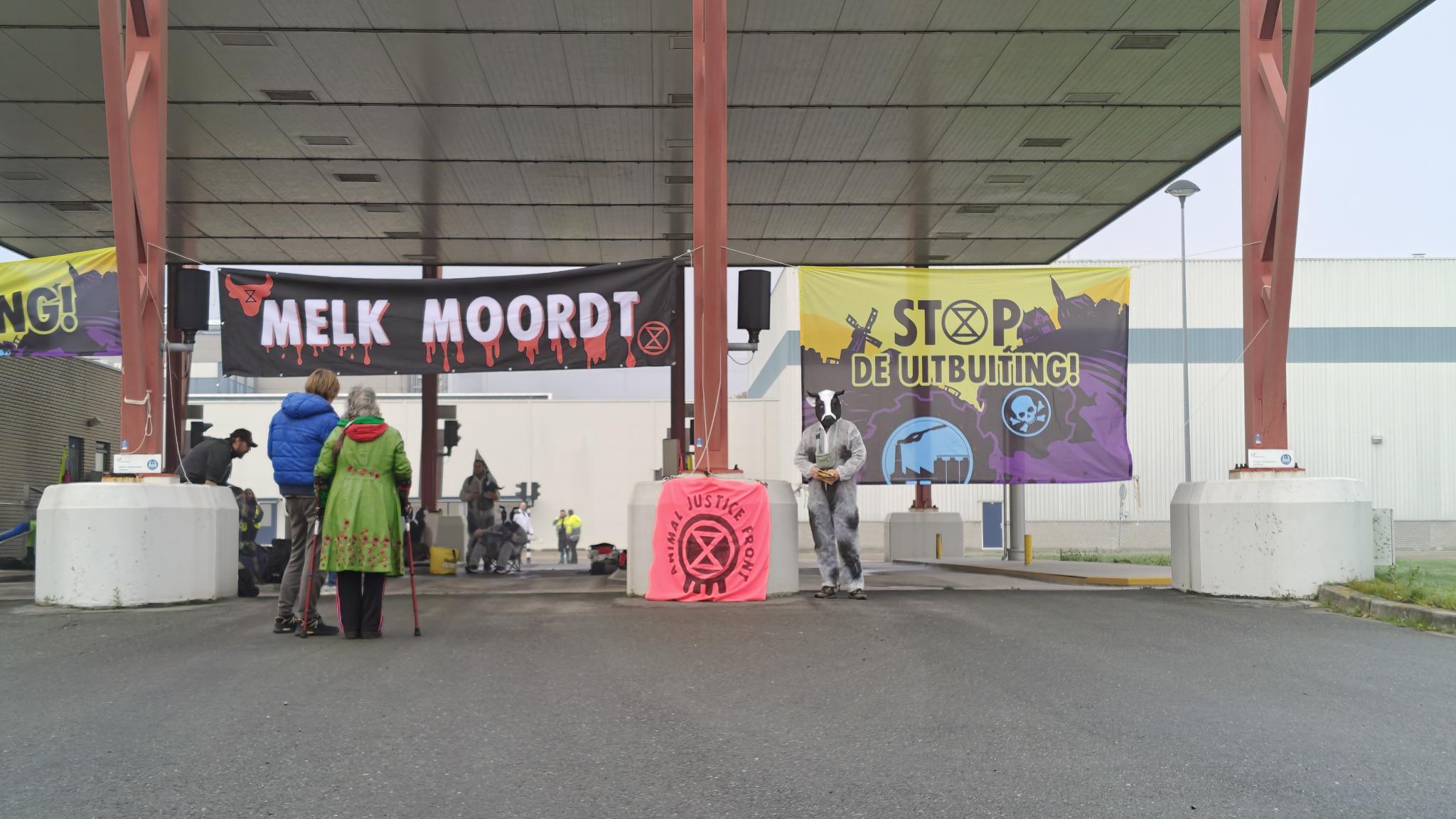
Stop de uitbuiting! – Landelijke blokkade zuivelfabrieken FrieslandCampina

FrieslandCampina, Stop de Uitbuiting!

Op 8 november 2025 voeren Extinction Rebellion Landbouw en XR Animal Justice Front acties bij vestigingen van FrieslandCampina in Noord-Brabant (Veghel), Friesland (Leeuwarden) en Zuid-Holland (Maasdam) met als slogan ‘Stop de uitbuiting!’.

FrieslandCampina heeft onlangs een (vernieuwd) ‘Klimaatplan 2025’ opgesteld. In dit plan ontbreekt iedere urgentie. De plannen voor het terugdringen van de CO₂-uitstoot zijn volstrekt onvoldoende en er zijn geen concrete doelen voor natuurbehoud, waterkwaliteit en dierenwelzijn. De wereldwijde  landbouw is goed voor 30 procent van de wereldwijde uitstoot van broeikasgassen. In Nederland veroorzaakt de zuivelsector daarnaast tal van ernstige milieuproblemen, waaronder de stikstofcrisis en grove vervuiling van het grondwater. Om rond te komen worden boeren gedwongen om hun dieren krachtvoer te geven, en op het land kunstmest en bestrijdingsmiddelen te gebruiken. Die hebben een desastreuze impact op mens, dier en natuur. Om ons vee met soja te voeden worden bovendien massaal oerwouden gekapt. Voor de broodnodige verandering van dit destructieve systeem wordt de boer aangekeken, maar die zit ook helemaal klem. Boeren worden steeds afhankelijker van grote bedrijven zoals FrieslandCampina die daardoor steeds meer macht krijgen. Linksom of rechtsom: de productie van zuivel moet drastisch omlaag. FrieslandCampina kan daarbij een voorbeeld nemen aan zuivelproducenten die volledig op de productie van plantaardige zuivel zijn overgestapt. Extinction Rebellion is het zat dat bedrijven uit de agro-industrie (“Big Agro”) zoals FrieslandCampina ongezien mens, dier en natuur uitbuiten voor hun eigen winst en eist:

  1. Stop de uitbuiting van miljoenen dieren
  2. Stop de uitbuiting van natuur en milieu
  3. Stop de uitbuiting van boeren, in Nederland en daarbuiten

Deze actie maakt deel uit van de lopende ‘Melk Moordt’-campagne van XR Animal Justice Front en is de aftrap van de nieuwe ‘Stop de uitbuiting’-campagne van XR Landbouw, in samenwerking met lokale afdelingen van XR. Zolang de agro-industrie de macht houdt over onze voedselproductie, zijn mens, dier en natuur de dupe. In deze campagnes zet Extinction Rebellion het spotlicht op deze bedrijven, die zich voor de consument onzichtbaar weten te houden, en houdt ze verantwoordelijk voor de schade die ze aanrichten.

Links:
Landelijke blokkade zuivelfabrieken FrieslandCampina

PRIMAP-hist dataset

Met de slogan ‘Stop de uitbuiting!’ blokkeren XR Landbouw en XR Animal Justice Front in het hele land zuivelfabrieken van FrieslandCampina