2026-01-24, Lief dagboek

Zaterdag; Klimaatzaak Bonaire en Greenpeace; Dag van het Onderwijs; Bewustmakingsdag voor Syndroom van Alagille; Wereld Moebius Syndroom Bewustwordingsdag; Het Grote Vogelweekend; KNMI Code Oranje.

Deze afbeelding heeft een leeg alt-attribuut; de bestandsnaam is dagboek.png

Wat eten we vandaag?:

Knipselkrant:


Agenda:

Weer:

Links:
In de geschiedenis

Het Grote Vogelweekend 2026

Het Grote Vogelweekend

Doe op 24 en 25 januari 2026 mee aan Het Grote Vogelweekend en help de vogels en de wetenschap vooruit!

Het Grote Vogelweekend is het grootste tuinvogelonderzoek in Vlaanderen. Door elk jaar met z’n allen te tellen, krijgen we zicht op hoe vogels tuinen gebruiken en welke soorten vooruit- of achteruitgaan. En jij beleeft een moment van pure natuur en ontspanning. Al wat je nodig hebt is een kwartier tijd en pen en papier. Of print op voorhand het voorbeeldtellijstje af. Niet zeker hoe je moet tellen? Bekijk in één minuut hoe het werkt.

Links:
Het Grote Vogelweekend

Tuinvogeltelling NL

Bewustmakingsdag voor Syndroom van Alagille / Alagille Syndrome Awareness Day 2026

Het syndroom van Alagille (Alagille syndrome), genoemd naar Daniel Alagille, is een complexe aandoening van een aantal orgaansystemen, voornamelijk de lever, het hart, de ogen, het gelaat en het skelet.

De belangrijkste symptomen zijn die van cholestase (gepaard gaand met jeuk en geelzucht), herkenbaar aan weinig galwegen in een leverbiopt; aangeboren hartafwijkingen, vooral van de longarterieën, oogafwijkingen, een typische gelaatsvorm, en ‘vlinderwervels’. Nierafwijkingen en afwijkingen aan het centraal zenuwstelsel komen ook voor. De mortaliteit is ongeveer 10% waarbij vaatproblemen in het centraal zenuwstelsel, hartziekte en leverziekte de belangrijkste doodsoorzaken zijn. De verschijnselen zijn ook binnen 1 familie zeer variabel. De ziekte is autosomaal dominant erfelijk. Nieuwe mutaties (sporadische gevallen) komen frequent voor. Als bekend is wat de aard van de afwijking in een familie is, is prenatale diagnostiek in principe mogelijk. Genetisch onderzoek louter om de diagnose te verifiëren bij iemand die aan de klinische criteria voldoet, heeft geen consequenties en wordt nog niet aanbevolen. Nog niet volledig opgehelderd. Bij ca 70% van de patiënten zijn afwijkingen in een gen genaamd JAG1 aantoonbaar. Het gen ligt op chromosoom 20, locatie 20p12. Het codeert voor een eiwit, Jagged 1, dat op de celmembraan van sommige cellen wordt gevonden en dat een functie heeft bij signaaluitwisseling tussen cellen zowel tijdens de embryonale ontwikkeling als daarna. Het is niet mogelijk het syndroom van Alagille te genezen. Het is echter mogelijk dat de klachten verdwijnen als het kind ouder wordt.

Links:
Alagille Syndrome Awareness Day

Day of the Endangered Lawyer 2026

Ever since lawyers Symone Gaasbeek-Wielinga and Hans Gaasbeek went onto a fact finding mission in the Philippines in 1990 (lawyers are being intimidated, threatened and even murdered because they aide their clients in politically sensitive cases) they have been active for their threatened colleagues all across the world.

The creation of this special international day is an international effort put together with like-minded colleagues. The first ever Day of the Endangered Lawyer was organized in 2009. Hans and Symone created the foundation Day of the Endangered Lawyer to strengthen the work. Together with AED and ELDH they created the Coalition for the Endangered Lawyer, which comes together every year to choose the new country and to discuss the progress. The purpose of the Day of the Endangered Lawyer is a call for attention on that day to threatened human rights lawyers with special attention to one designated country. The course of action is to draw a centralized petition in as many cities as possible, in and across Europe’s borders, which will be offered to ambassadors, consulates and other bodies of authority. The petition will call for attention to the problematic situation of endangered lawyers in that country. Another aim is to engage in a dialogue with the representatives of the government of the country. Furthermore, forum discussions are being organized with local fellow lawyers and publications are made about the lawyers’ situation.

Links:
Day of the Endangered Lawyer

#MSAD Moebius Syndrome Awareness Day / Wereld Moebius Syndroom Bewustwordingsdag 2026

Moebius Syndrome Awareness Day is an annual event celebrated globally each year on January 24th — the birth date of Professor Paul Julius Moebius, the doctor who first diagnosed the condition in 1888.

In 2011, Moebius Syndrome Awareness Day was started by the Many Faces of Moebius Syndrome, and has been embraced globally by other organizations that support efforts to raise awareness. The Moebius Syndrome Foundation recognizes the month of January as a time to raise awareness about this rare condition and educate the world about Moebius syndrome. We celebrate #MSAD by sharing information about Moebius syndrome, offering financial support and resources to approved events, encouraging people to wear purple, and raising awareness through various means and channels. “This is Moebius” is the 2024 Moebius Syndrome Foundation’s theme for Moebius Syndrome Awareness Day, and will be used to highlight the unique stories, challenges, and triumphs of individuals living with Moebius syndrome. We invite you to follow us on our social media and email platforms as we share these messages. Would you like to participate? Please email a photo, a brief write-up, or short video (less than 1 minute), and share your story with us. Individuals with Moebius of all ages, and their family members and supporters who make up our rare community are invited to contribute.

Links:
Moebius Syndrome Awareness Day

#EducationDay World Day of Education / Dag van het Onderwijs 2026

The right to education is enshrined in article 26 of the Universal Declaration of Human Rights. The declaration calls for free and compulsory elementary education.

The Convention on the Rights of the Child, adopted in 1989, goes further to stipulate that countries shall make higher education accessible to all. When it adopted the 2030 Agenda for Sustainable Development in September 2015, the international community recognized that education is essential for the success of all 17 of its goals. Sustainable Development Goal 4, in particular, aims to “ensure inclusive and equitable quality education and promote lifelong learning opportunities for all” by 2030. Education offers children a ladder out of poverty and a path to a promising future. But about 265 million children and adolescents around the world do not have the opportunity to enter or complete school; 617 million children and adolescents cannot read and do basic math; less than 40% of girls in sub-Saharan Africa complete lower secondary school and some four million children and youth refugees are out of school. Their right to education is being violated and it is unacceptable. Without inclusive and equitable quality education and lifelong opportunities for all, countries will not succeed in achieving gender equality and breaking the cycle of poverty that is leaving millions of children, youth and adults behind.

Links:
International Day of Education

How you can join the International Day of Education 2026

Global Education Cooperation Mechanism #Education2030

85e vredesprotest – Stop de Oorlog in Oekraine en Gaza (Radio Patapoe)

Op de 24e van elke maand samenkomst om 18:00 samen op het Spui tegenover het Lieverdje voor een einde aan oorlog en herdenking slachtoffers.

Met sprekers, dichters en muziek wordt iedere maand geprotesteerd tegen het voortduren van de bloedige oorlog in Oekraïne – en Gaza – en gepleit voor een wapenstilstand, diplomatie en onderhandelingen. Met twee minuten stilte herdenking de slachtoffers aan beide kanten. Luisteren naar een update over de stand van zaken aan het front. Na afloop samen “Dona Nobis Pacem – Geef Ons Vrede” zingen. Guido van Leemput – schrijver van ‘De gelaagde oorlog’ en medeoprichter van Stop de Oorlog Amsterdam – geeft zijn maandelijkse analyse van de situatie aan het front én de onderhandelingstafels. Nog niet eerder was een einde van het massale bloedvergieten zo dichtbij. Komt er een vrede in het belang van de Oekraïense en Russische bevolking? Of kijken we naar oligarchen en kapitalisten die op een nietsontziende manier de wereld opnieuw aan het verdelen zijn? De bijeenkomsten op het Spui worden live uitgezonden door Radio Patapoe. Alle vorige uitzendingen staan bij elkaar op een plekRadio Patapoe is vrije radio zonder censuur of commercie en voorstander van vrijheid van meningsuiting en denken.

Links:
Stop de Oorlog

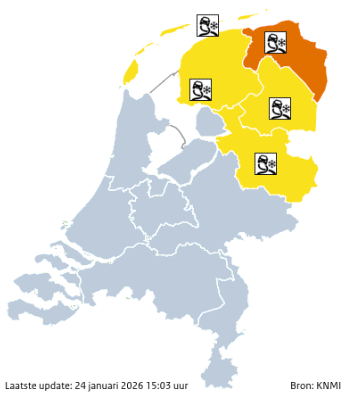
#KNMI #CodeOranje In het noordoosten van Nederland verraderlijke gladheid door ijzel

code oranje

Tot het einde van de middag van 24 januari 2026 is het in Groningen op veel plaatsen verraderlijk glad door ijzel, hiervoor geldt code oranje.

In de namiddag wordt het noordoosten geleidelijk op steeds meer plaatsen droog. De gladheid blijft echter wel plaatselijk aanhouden en vanaf de avond is er bovendien ook kans op gladheid door bevriezing van natte weggedeelten. Hiervoor blijft dan tot zondag in de ochtend een code geel van kracht. In de provincie Groningen valt op veel plaatsen lichte regen. Bij temperaturen onder nul geeft dit ijzel en verraderlijke gladheid.

Links:
Weerstation

Wat kan ik verwachten en wat kan ik doen?

Artemis II – mission

Artemis II

Artemis II is a planned lunar spaceflight mission under the Artemis program, led by NASA. It is intended to be the second flight of the Space Launch System (SLS), and is both the first crewed mission of the Orion spacecraft and the first crewed mission to the vicinity of the Moon since Apollo 17 in 1972.

Launch is scheduled for no earlier than April, 2026. The 10-day mission will carry NASA astronauts Reid WisemanVictor Glover, and Christina Koch, along with Canadian Space Agency astronaut Jeremy Hansen, on a free-return trajectory around the Moon and back to Earth. Glover will become the first person of color, Koch the first woman, and Hansen the first non-American to travel to the Moon. The flight will take the crew farther from Earth than any previous human mission before reentering Earth’s atmosphere at a record speed of approximately 40,000 km/h. Artemis II was originally designated Exploration Mission-2 (EM-2) and was initially intended to support the now-canceled Asteroid Redirect Mission. Its objectives were revised following the establishment of the Artemis program. The Artemis II mission plan is to send four astronauts in the first crewed Orion spacecraft into a lunar flyby using the Block 1 variant of the Space Launch System. The mission profile is a multi-trans-lunar injection (MTLI), or multiple departure burns, and includes a free-return trajectory from the Moon. The Orion spacecraft will be sent to a high Earth orbit with a period of roughly 24 hours. During this time the crew will perform various checkouts of the spacecraft’s life support systems as well as an in-space rendezvous and proximity operations demonstration using the spent Interim Cryogenic Propulsion Stage (ICPS) as a target. When Orion reaches perigee once again, it will fire its main engine to complete the TLI maneuver, which will send it onto a lunar free-return trajectory, before returning to Earth. Artemis II will test and demonstrate optical communications to and from Earth using the Orion Artemis II Optical Communications System (O2O). The O2O hardware will be integrated into the Orion spacecraft and includes an optical module (a 100 mm telescope and two gimbals), a modem and control electronics. O2O will communicate with ground stations in California and New Mexico. The test device will send data to Earth with a downlink rate of up to 260 megabits per second.

NASA concluded a wet dress rehearsal for the agency’s Artemis II test flight early Tuesday morning February 3, 2026, successfully loading cryogenic propellant into the SLS (Space Launch System) tanks, sending a team out to the launch pad to closeout Orion, and safely draining the rocket. The wet dress rehearsal was a prelaunch test to fuel the rocket, designed to identify any issues and resolve them before attempting a launch. Engineers pushed through several challenges during the two-day test and met many of the planned objectives. To allow teams to review data and conduct a second wet dress rehearsal. NASA will roll the SLS (Space Launch System) rocket and Orion spacecraft for Artemis II off the launch pad at the agency’s Kennedy Space Center in Florida as soon as Tuesday, Feb. 24. On Feb. 21, managers decided to remove recently installed platforms before high winds descend on the Space Coast, which poised teams for rollback while discussions about the issue were ongoing. Returning to the Vehicle Assembly Building at Kennedy is required to determine the cause of the issue and fix it. Once NASA’s Artemis II SLS (Space Launch System) rocket and Orion spacecraft arrived at the Vehicle Assembly Building (VAB) Feb. 25, technicians immediately began addressing why the flow of helium to the SLS upper stage was interrupted as engineers were reconfiguring the rocket following a successful wet dress rehearsal on Feb. 21. To make the repairs, teams are installing two sets of internal access platforms inside the launch vehicle stage adapter and must remove thermal blankets that cover the area they are interested in – a point on the rocket’s interim cryogenic propulsion system, or upper stage. The area provides connections for multiple umbilicals, including tubing used to fill the upper stage with helium. Helium is used to maintain proper environmental conditions, and to pressurize the stage for flight.

On Friday, March 20, NASA’s Artemis II SLS rocket and Orion spacecraft arrived at Launch Pad 39B after an 11-hour journey from the Vehicle Assembly Building at the agency’s Kennedy Space Center in Florida. NASA’s crawler-transporter 2 began its  6 km trek with the integrated SLS and Orion stacked on top of the mobile launcher at 18:20 CEST. The crawler carried the Moon rocket and spacecraft slowly and steadily toward the pad. At Pad 39B, NASA teams were gearing up for the final stretch of prelaunch preparations ahead of launch as soon as Thursday, April 2 at 00:24 CEST. The early April launch window includes opportunities through Monday, April 6. NASA’s SLS rocket lifted off at 00:35 CEST Wednesday April 2 sending four astronauts aboard the Orion spacecraft on a planned test flight around the Moon and back. After the mission management team polled “Go” Thursday, NASA’s Orion spacecraft fired its main engine for five minutes and 50 seconds beginning April 3 at 01:49 CEST, to successfully complete the translunar injection (TLI) burn, sending the crew in Orion out of Earth orbit and on a trajectory toward the Moon. On April 7, the Artemis II mission wrapped up a seven-hour lunar flyby, marking humanity’s first return to the Moon since Apollo 17 in 1972 and capturing images of the lunar far side. The momentous day began at 01:02:51 CEST as the astronauts set the record for the farthest distance from Earth traveled by any human. During a planned 40-minute loss of signal as Orion passed behind the Moon, the spacecraft and its crew made their closest approach at 01:00:46 CEST, flying at about 6544 kilometer above the surface. Two minutes later, the crew reached the mission’s maximum distance from Earth at 406.771 km, setting a new record for human spaceflight. The Orion spacecraft is scheduled to splash down off the coast of San Diego at approximately 02:07 on Saturday, April 11 (CEST).

Links:
Artemis II, at NASA

Mission Overview, at NASA

Artemis II “Send Your Name to Space”, at NASA

Focus : Mens op de maan

Artemis 2 moon mission shouldn’t launch until late 2026, new analysis of solar superflares suggests

Historische maanvlucht van start: ‘Heftiger nu er mensen aan boord zijn’

Wat hébben we nu eigenlijk aan een menselijke maanlanding?

Artemisprogramma / Artemis program : Artemis II