VPRO Tegenlicht : Maak ’t simpel (TV NPO 2)

VPRO Tegenlicht is een informatief televisieprogramma van de VPRO, elke vier weken uitgezonden op donderdagavond op NPO 2, door de VPRO wordt het programma bestempeld als documentaire op het vlak van politiek, economie, sociologie en wetenschap en stelt zich ten doel inzicht in de werking van de samenleving te verschaffen.

Van toeslagenaffaire tot woningentekort, van erfpacht tot uitvoeringsorganen. Noem een overheidsdossier en het zit muurvast. Waar de meeste vingers wijzen naar de politiek, wordt de echte reden niet vaak genoemd: we hebben alles te complex gemaakt. VPRO Tegenlicht werpt een blik op vastgelopen dossiers. Kan het ook simpel? Wat gebeurt er als we er niet met z’n allen in slagen om te ‘ont-compliceren’? Is het überhaupt nog wel mogelijk om de vele kwesties rondom de toeslagenaffaire, stikstof en gaswinning te versimpelen? VPRO Tegenlicht kijkt mee met verschillende dossiers waarin de overheid vastloopt en zelf niet meer lijkt te weten wat ze doet. De redactie tuurt meewarig uit over een Afsluitdijk waarvan de renovatie langer gaat duren dan de bouw zélf negentig jaar geleden, en bladert mee in documentbestanden van burgers die de dupe zijn van overmatig complexe overheidsregels.

Links:
VPRO Tegenlicht : Maak ’t simpel (online bekijken)

Is There an Earth-like Planet in the Distant Kuiper Belt? – publication

The study ‘Is There an Earth-like Planet in the Distant Kuiper Belt?‘ suggests that a thus far undetected Earth-like planet hovering in the Kuiper Belt region could be deviating orbits of Sedna and a handful of similar trans-Neptunian objects (TNOs), which are the countless icy bodies orbiting the sun at gigantic distances.

Many TNOs have oddly inclined and egg-shaped orbits, possibly due to being tugged at by a hidden planet, astronomers say. Two Japanese researchers used computer simulations to analyze the effects of such an undiscovered planet on the TNOs. Those simulations, which included evolutions of numerous real and model TNOs in the furthest reaches of an icy region, known as the Kuiper Belt, produced the extreme orbits observed for Sedna and other TNOs. Such a planet would be between 1.5 to three times Earth’s size and would reside somewhere between 37 billion km to 74 billion km from the sun.

Searching for planets lurking in the frigid edges of our solar system is not a new concept. The so-called Planet Nine, a world 10 times more massive than Earth, is thought to be responsible for at least five strange features in the solar system including the oddly inclined orbits of a few Kuiper Belt objects. This theoretical orb has captured the attention of many, but remains undetected. But research suggests if Planet Nine exists out there, it could be residing somewhere between 59 billion km to 119 billion km from the sun.

Although the possibility of Planet Nine gained significant traction from research groups worldwide, the theory has also been controversial. Some astronomers argue that the highly eccentric orbits of TNOs, for which Planet Nine’s presence was considered necessary, could occur without the hidden planet’s presence. In 2021, an independent study in fact claimed data used by the team behind the discovery paper first theorizing Planet Nine was biased, and concluded that there’s a very low chance of such a planet existing. In comparison to Planet Nine, the newly hypothesized planet — dubbed “Kuiper Belt Planet (KBP)” — would be much closer and more influential on the orbits of Kuiper Belt’s objects, especially those beyond 7 billion km, according to the study.

Links:
Could an ‘Earth-like’ planet be hiding in our solar system’s outer reaches?

Metals from spacecraft reentry in stratospheric aerosol particles – publication

Large increases in the number of low earth orbit satellites are projected in the coming decades [L. Schulz, K.-H. Glassmeier, Adv. Space Res. 67, 1002–1025 (2021)] withperhaps 50,000 additional satellites in orbit by 2030 [GAO, Large constellations of satellites: Mitigating environmental and other effects (2022)].

When spent rocketbodies and defunct satellites reenter the atmosphere, they produce metal vapors that condense into aerosol particles that descend into the stratosphere. So far, models of spacecraft reentry have focused on understanding the hazard presented by objects that survive to the surface rather than on the fate of the metals that vaporize. Here, the research shows that metals that vaporized during spacecraft reentries can be clearly measured instratospheric sulfuric acid particles. Over 20 elements from reentry were detected and were present in ratios consistent with alloys used in spacecraft. The mass of lithium, aluminum, copper, and lead from the reentry of spacecraft was found to exceed the cosmic dust influx of those metals. About 10% of stratospheric sulfuric acid particles larger than 120 nm in diameter contain aluminum and other elements from spacecraft reentry. Planned increases in the number of low earth orbit satellites within the next few decades could cause up to half of stratospheric sulfuric acid particles to contain metals from reentry. The influence of this level of metallic content on the properties of stratospheric aerosol is unknown.

Links:
Metals from spacecraft reentry in stratospheric aerosol particles

Measurement of a lithium plume from the uncontrolled re-entry of a Falcon 9 rocket – publication

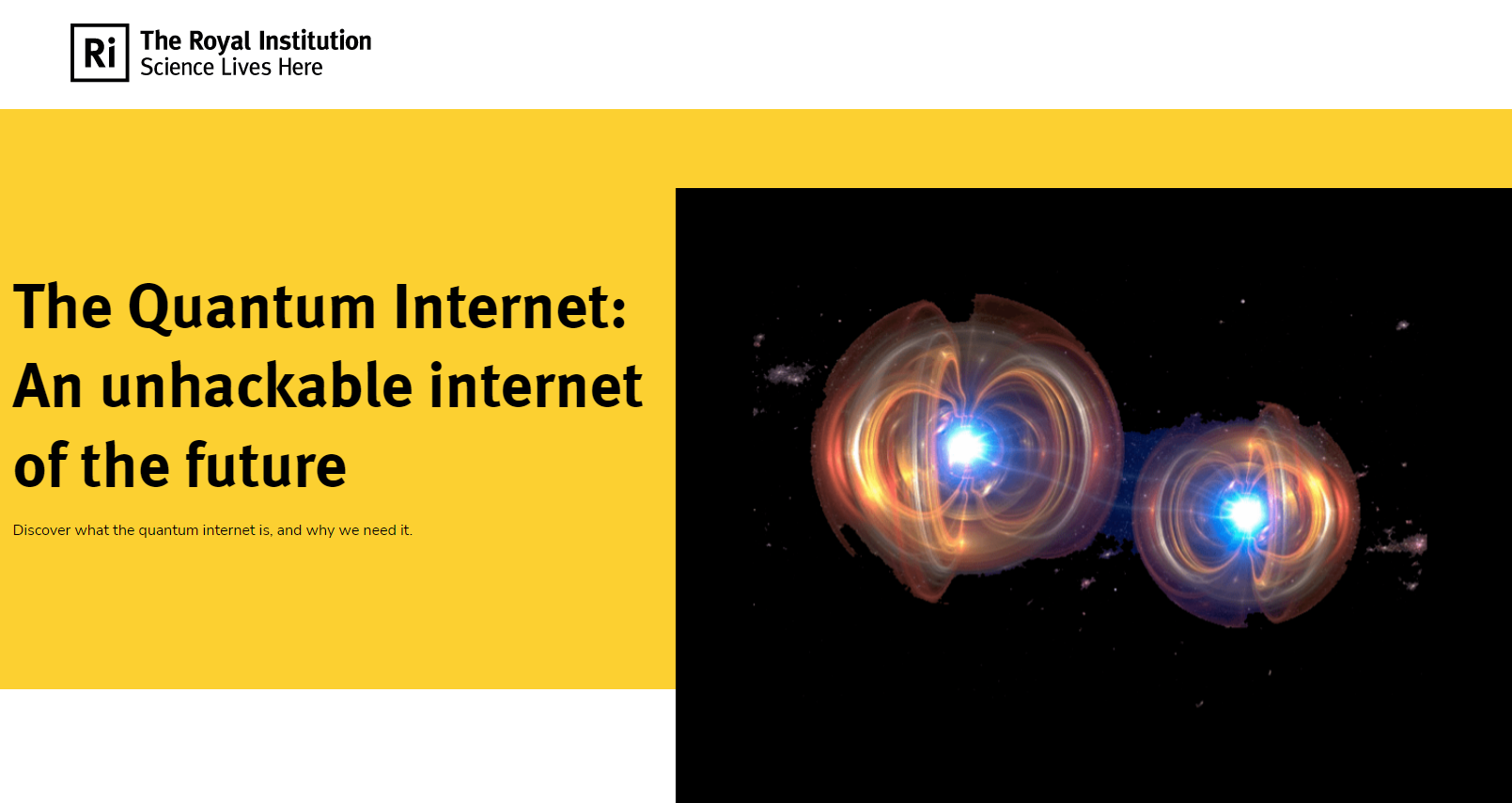
The Quantum Internet: An unhackable internet of the future (TV RIGB webcast)

The information quantum computers can provide us with will be worlds away from standard computers.

Because of this, the standard internet alone will not suffice in allowing us to access this quantum information; a quantum internet must be developed to keep up with the immense increase in computational power. Join Kian van der Enden as he explores how we can build the internet the future will need, a quantum internet and whether it will be truly unhackable. In this talk, discover everything about this exciting technology and its applications both for the quantum and current internet. From the usefulness of quantum teleportation to how this could shape our world.

Thanks to the Embassy of the Kingdom of the Netherlands, the Royal Institution has some free tickets available for this talk. These are reserved for those that would not normally be able to attend our lectures at full cost. These tickets are available on a first come, first served basis, so please email events@ri.ac.uk.

Links:
The Quantum Internet: An unhackable internet of the future

Kwantuminternet

Day of Clean Air for blue skies 2023

Аir pollution is the single greatest environmental risk to human health and one of the main avoidable causes of death and disease globally, with some estimated 6.5 million premature deaths (2016) across the world attributed to indoor and outdoor air pollution.

Particularly in developing countries, air pollution disproportionately affects women, children and the elderly, especially in low-income populations as they are often exposed to high levels of ambient air pollution and indoor air pollution from cooking and heating with wood fuel and kerosene. Аir pollution is a global problem with far-reaching impacts owing to its transport over long distances. In the absence of aggressive intervention, the number of premature deaths resulting from ambient air pollution is estimated to be on track to increase by more than 50 per cent by 2050. Society bears a high cost of air pollution due to the negative impacts on the economy, work productivity, healthcare costs and tourism, among others. Hence, the economic benefits of investing in air pollution control cannot be overestimated, and it must be understood that there is also an economic rationale to act and that cost-effective solutions exist to address air pollution.

Poor air quality is a challenge in the context of sustainable development for all countries, in particular in cities and urban areas in developing countries, with levels of air pollution that are higher than the limits set out in the World Health Organization air quality guidelines. Some air pollutants, such as black carbon, methane and ground-level ozone, are also short-lived climate pollutants and are responsible for a significant portion of air pollution-related deaths, as well as impacts on crops and hence food security, so their reduction has co-benefits for the climate. UN Member States recognize the need to substantially reduce the number of deaths and illnesses from hazardous chemicals and air, water and soil pollution and contamination by 2030, as well as to reduce the adverse per capita environmental impact of cities, including by paying special attention to air quality and municipal and other waste management by 2030.

Clean air is important for the health and day-to-day lives of people, while air pollution is the single greatest environmental risk to human health and one of the main avoidable causes of death and disease globally. Air pollution disproportionately affects women, children and older persons, and also has a negative impact on ecosystems. Today, the international community acknowledges that improving air quality can enhance climate change mitigation and that climate change mitigation efforts can improve air quality. Encouraged by the increasing interest of the international community in clean air, and emphasizing the need to make further efforts to improve air quality, including reducing air pollution, to protect human health, the General Assembly decided to designate 7 September as the Day of Clean Air for blue skies.

Links:
Day of Clean Air for blue skies

2023-09-07, Lief dagboek

Donderdag; Wat eten we vandaag?; Rechteroor; Earth-like Planet in the Distant Kuiper Belt; Binnenhoflezing; Stop Poetins voedseloorlog; Dag van de Ziekte van Duchenne; Day of Clean Air for blue skies; Rondetafelgesprek : Het demonstratierecht in Nederland; VPRO Tegenlicht.

Deze afbeelding heeft een leeg alt-attribuut; de bestandsnaam is dagboek.png

Wat eten we vandaag?:

Lunch, klik op afbeelding voor origineel

Rechteroor:
A3 was voor controle bij de KNO-arts in verband met de operatie die eerder aan het rechteroor is uitgevoerd. Nog steeds is een ontsteking in het middenoor erger dan verwacht, er is een monster genomen en de antibiotica kuur wordt verlengd.

Knipselkrant:


Agenda:


Weer:

Links:
In de geschiedenis

Stop Poetins voedseloorlog – petitie

Poetins raketten en drones hebben tijdens de Russisch-Oekraïense oorlog al 220.000 ton Oekraïens graan in vlammen doen opgaan — dat is genoeg om bijna een miljoen mensen een jaar lang van eten te voorzien.

Oekraïne is de broodmand van de wereld, en Oost-Afrikaanse landen die op de rand van hongersnood staan, zijn afhankelijk van Oekraïense tarwe. Nu behandelt Rusland vrachtschepen met graan als potentiële militaire doelwitten — en de voedingsprijzen rijzen overal de pan uit. We mogen de wereld niet laten verhongeren door Poetins blokkade. Rusland houdt de vinger aan de pols bij de internationale gemeenschap: Afrikaanse landen, en zelfs China, Ruslands belangrijkste bondgenoot, hebben zich al uitgesproken tegen zijn wrede voedseloorlog — en de internationale verontwaardiging zou Rusland kunnen overtuigen om graantransport uit Oekraïne weer toe te laten. Sluit je nu aan. Als er genoeg handtekeningen zijn, zal deze oproep naar invloedrijke leiders worden gebracht die de druk op Poetin kunnen opvoeren.

Links:
Stop Poetins voedseloorlog

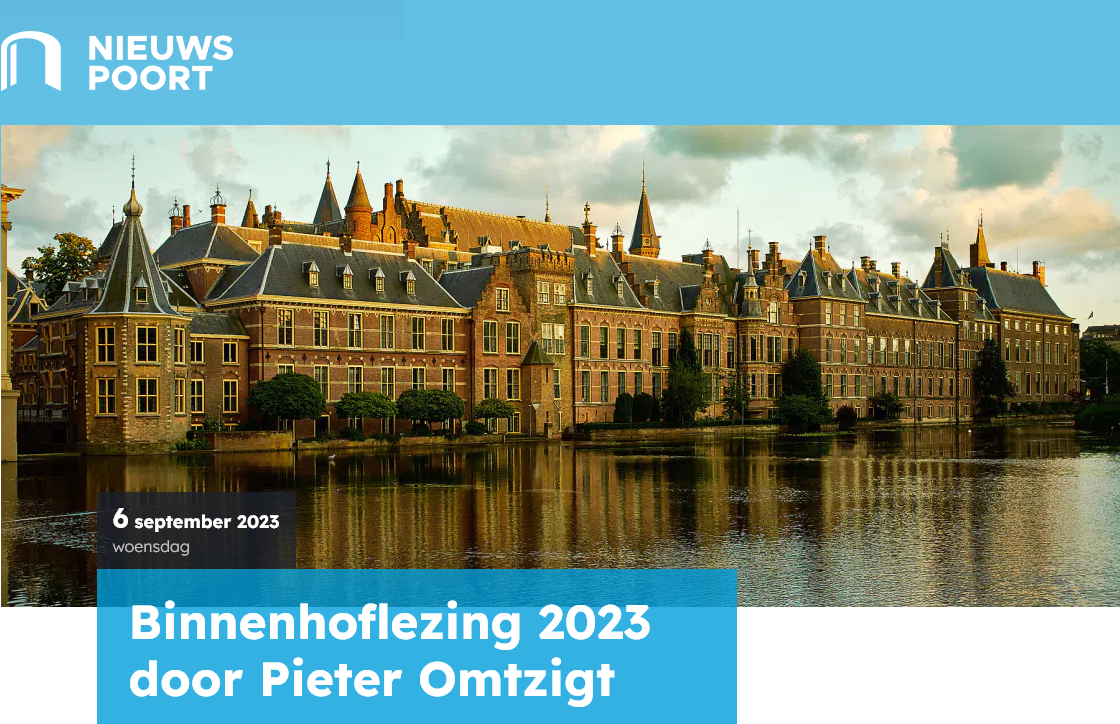
Binnenhoflezing 2023

De Binnenhoflezing 2023 wordt gehouden door onafhankelijk Tweede Kamerlid Pieter Omtzigt, het onderwerp van zijn lezing is ‘De Nieuwe  Volksvertegenwoordiger’.

Op 22 november 2023 vinden vervroegde Tweede Kamerverkiezingen plaats. In de afgelopen parlementaire periode maakten we een herwaardering mee van het ambt van volksvertegenwoordiger, na jaren van verzakelijking van de politiek, centralisatie binnen politieke partijen, negatieve aandacht van gevestigde partijen voor zogeheten afsplitsers, zorgen om versplintering en een groeiende kloof tussen kiezer en gekozene. De een meer dan de ander geeft een nieuwe generatie Kamerleden vorm aan De Nieuwe Volksvertegenwoordiger. Hoe komen zij verder? Kort na het parlementaire jaar reflecteert de Binnenhoflezing hierop om er inzichten aan te ontlenen voor de komende tijd.

Na de lezing volgt een paneldiscussie onder leiding van Michiel Breedveld (politiek verslaggever NOS) en Elodie Verweij (chef politiek van RTL Talkshow) tussen Pieter Omtzigt, Tom van der Meer (Hoogleraar Politicologie, in het bijzonder Legitimiteit, Ongelijkheid en Burgerschap, aan de Universiteit van Amsterdam, schrijver van het pamflet Niet de kiezer is gek), Maxim Februari (filosoof, jurist, columnist, met Doe zelf normaal dit jaar genomineerd voor PrinsjesBoekenprijs) en Frits van der Meer (bekleedt de bijzondere leerstoel ‘Comparative Public Sector en Civil Service Reform’ aan de Universiteit Leiden, ingesteld door Stichting Leerstoelen CAOP). Met de Binnenhoflezing brengt de gelijknamige stichting in oprichting ook een bescheiden hommage aan dit eeuwenoude regeringscentrum, waarvan de grootscheepse renovatie en vernieuwing loopt.

Links:
Binnenhoflezing 2023 door Pieter Omtzigt