
Long COVID is a double curse in low-income nations — here’s why – publication
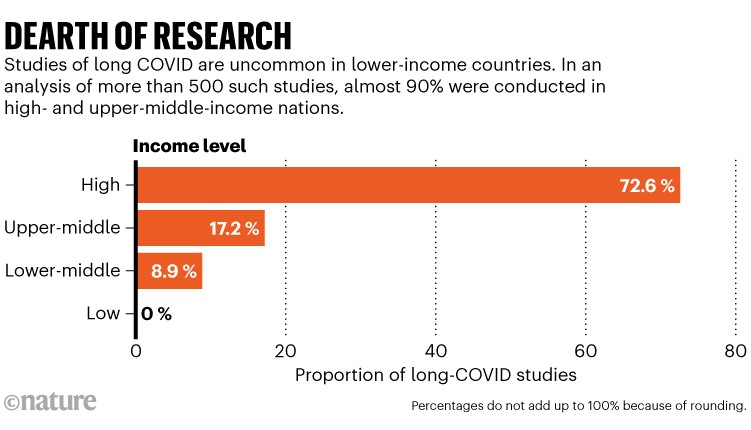
Not only is the prevalence of the condition poorly understood, but it’s also often ignored by physicians and the wider public.

Much of the world’s research on long COVID is conducted in wealthy regions, and data on the prevalence or severity of the condition in other locales are more limited. Evidence so far suggests that the prevalence of long COVID in LMICs could be similar to that of wealthier countries — although, in both settings, the numbers vary a lot. One review1 found that between 8% and 41% of people who had a SARS-CoV-2 infection but weren’t hospitalized had symptoms. But a dearth of research on the condition in less-wealthy countries creates a double curse. An absence of information about prevalence and risk factors leaves advocates hamstrung: few physicians acknowledge that long COVID exists. The lack of data also hampers efforts to search for the mechanisms of the condition and tailor treatments.

Links:
Long COVID is a double curse in low-income nations — here’s why

World Braille Day / Louis Braille – geboortedag (1809) 2024

World Braille Day is an annual international day on 4 January and celebrates awareness of the importance of braille as a means of communication in the full realization of the human rights for blind and visually impaired people.

The date for the event was chosen by the United Nations General Assembly via a proclamation in November 2018, and marks the birthday of Louis Braille, creator of this writing system. The first World Braille Day was celebrated on January 4, 2019. Braille is a tactile representation of alphabetic and numerical symbols using six dots to represent each letter and number, and even musical, mathematical and scientific symbols. Braille (named after its inventor in 19th century France, Louis Braille) is used by blind and partially sighted people to read the same books and periodicals as those printed in a visual font. Braille is essential in the context of education, freedom of expression and opinion, as well as social inclusion, as reflected in article 2 of the Convention on the Rights of Persons with Disabilities.

Links:
World Braille Day

Meteorenzwerm Boötiden in januari 2024

De meteorenzwerm Boötiden bereikt op donderdag 4 januari 2024, rond 11:30 uur, zijn maximum.

De meteoren van de Boötiden hebben lange sporen en zijn zwak en blauwachtig. Wanneer de radiant in het zenit zou staan, zouden er van deze zwerm naar verwachting gemiddeld zo’n 130 meteoren per uur vallen. Rond 9:00 uur staat de radiant van de zwerm in het hoogste punt (op 86°) aan de hemel. Het beste moment om Boötiden waar te nemen is op 4 januari rond 7:00 uur (zie het kaartje). Dat is ongveer 4.5 uur voor het maximum van deze meteoren, wat ongunstig is voor een meteorenzwerm met een dermate korte piek. Daardoor zijn ten minste 55% minder meteoren te zien dan in het ideale geval. De radiant staat op dat moment zo’n 69° boven de oostelijke horizon. Door de matige omstandigheden zijn er in onze streken dan vermoedelijk “maar” circa 23–34 meteoren per uur van deze zwerm te zien, altijd nog de moeite waard om te gaan waarnemen. Samen met meteoren van andere zwermen, en sporadische meteoren, zijn er bij donkere, heldere hemel in totaal circa 27–39 “vallende sterren” per uur te zien. Op een donkere plek zijn circa 80% meer meteoren te zien dan in een grote stad. De Maan komt om 0:50 uur op, is voor ongeveer 50% verlicht en kan eventueel storen. Rond 8:00 uur gaat het schemeren en om 8:48 uur komt de Zon op. De Boötidenzwerm is dermate scherp gepiekt dat het zaak is zo dicht mogelijk bij het maximum waar te nemen.

Links:
Meteorenzwerm Boötiden in januari 2024

Veel misleidende claims bij eiwitrijke producten – publicatie

Bijna de helft van de door de Nederlandse Voedsel- en Warenautoriteit (NVWA) onderzochte eiwitrijke levensmiddelen voldoet niet aan de regels voor voedings- en gezondheidsclaims.

Bij 25 van de 54 onderzochte levensmiddelen met bijbehorende website is sprake van misleiding of ernstige misleiding. Hiervoor heeft de NVWA officiële waarschuwingen gegeven en bestuurlijke boetes opgelegd. Ook moeten verpakkingen van deze producten en informatie op websites worden aangepast.

Links:
Veel misleidende claims bij eiwitrijke producten

E-mailactie : Eis strengere straffen tegen misleiding

Report on the Quality of life in European cities 2023 – publication

Running since 2007, the Quality of life in European cities survey provides a unique insight into city life, it gathers the experiences and opinions of city dwellers across Europe.

Results from the 2023 survey shows that overall satisfaction across European cities remains high, with almost nine out of ten people reporting to be satisfied with living in their city. Results also confirms significant improvements in perceived quality of life in cities in eastern Member States. While capital cities are perceived as offering more opportunities for jobs, smaller cities are perceived as a better place to live, especially for older people, and for families with young children. People feel safer walking alone at night in smaller cities, and they perceive their city as being cleaner and less noisy than people living in larger cities. On average, people in non-capital cities are more satisfied with the availability of public spaces and health care, and with housing. Non-capital cities are also seen as a better place to live for migrants and for families with young children, and people in non-capital cities are more satisfied with their local public administration. Interactive maps and charts are available below. You will also find additional information, including downloadable maps and charts for all questions covered by the survey, the underlying data, at the city level, as well as in the form of anonymized microdata, the full questionnaire and the accompanying methodological reports.

Links:
Quality of life in European cities

2024-01-04, Lief dagboek

Donderdag; Wat eten we vandaag?; misleidende claims bij eiwitrijke producten; Meteorenzwerm Boötiden; World Braille Day; Aardbeving Groningen.

Deze afbeelding heeft een leeg alt-attribuut; de bestandsnaam is dagboek.png

Wat eten we vandaag?:

Zuurkool, klik op afbeelding voor origineel

Knipselkrant:

Agenda:

Weer:

Deze afbeelding heeft een leeg alt-attribuut; de bestandsnaam is 50813896361_463cbfec7c.jpg

Links:
In de geschiedenis