
HowTheLightgetsIn London 2025
The world’s largest philosophy and music festival with dance, debate, and discovery.
Links:
HowTheLightgetsIn London

The world’s largest philosophy and music festival with dance, debate, and discovery.
Links:
HowTheLightgetsIn London

De zomer is een van de vier seizoenen op Aarde.
Het astronomisch bepaalde begin van de zomer is de zomerzonnewende (rond 21 juni op het noordelijk halfrond en rond 21 december op het zuidelijk halfrond). De zon gaat dan door het zomerpunt, de zon bereikt die dag de hoogste stand boven de horizon en de dag duurt het langst. De zomer eindigt met de herfst-equinox (rond 23 september op het noordelijk halfrond en 20 maart op het zuidelijk halfrond).
Links:

Pinkpop is een jaarlijks, driedaags popfestival in Landgraaf, dat sinds 1970 normaal gesproken in het weekeinde van Pinksteren plaatsvindt en duurt drie dagen.
Links:
Pinkpop
Pinkpop #livegoals: vooraan bij optredens van Olivia Rodrigo, Muse en Oscar and the Wolf
Donderdag; Wat eten we vandaag?; NAVO Top; Budapest Pride March; Day for the Elimination of Sexual Violence in Conflict; WorldSickleCellDay; Graspop; Hellfest; Babelsberger Sternennächte.

Wat eten we vandaag?:

Knipselkrant:
Agenda:
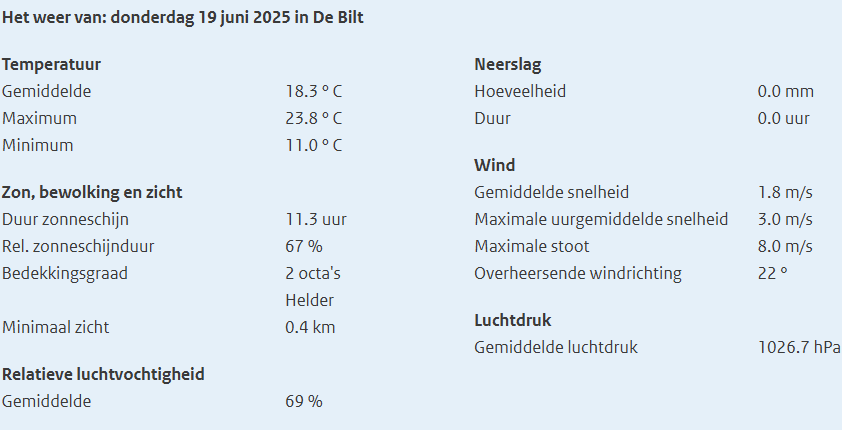
Weer:
Links:
In de geschiedenis
The World Sickle Cell Day aims to unite participants worldwide, emphasizing the global significance of the genetic Sickle Cell disorder.
Die Babelsberger Sternennächte finden online statt, in der Regel gibt es immer am 3. Donnerstag im Monat einen neuen Vortrag einer Wissenschaftlerin oder eines Wissenschaftlers des AIP, der ab 20 Uhr auf dem YouTube-Kanal von Urknall, Weltall und das Leben ausgestrahlt wird (Playlist).
In einem Doppelsternsystem kreisen zwei Sterne umeinander. Im Vortrag geht es jedoch nicht um die Umlaufbewegung der beiden Sterne umeinander, sondern um ihre jeweils eigene Drehung um sich selbst. Die Eigenrotation verändert sich im Laufe des Lebens eines Sterns und kann zur Bestimmung des Sternalters genutzt werden. Die zwei Sterne eines Doppelsterns sind gemeinsam aus derselben Gaswolke entstanden und daher gleich alt. Der Vortrag beleuchtet, wie diese Gleichaltrigkeit dazu genutzt werden kann, den Zusammenhang zwischen Alter und Rotation von Sternen zu untersuchen.
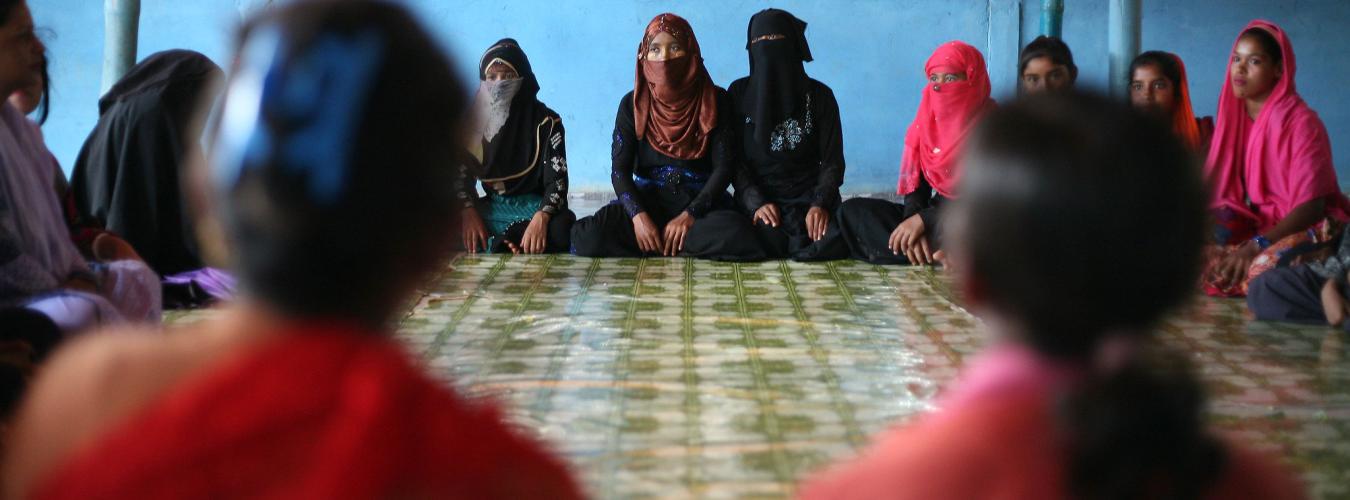
The term “conflict-related sexual violence” refers to rape, sexual slavery, forced prostitution, forced pregnancy, forced abortion, enforced sterilization, forced marriage and any other form of sexual violence of comparable gravity perpetrated against women, men, girls or boys that is directly or indirectly linked to a conflict.
The term also encompasses trafficking in persons when committed in situations of conflict for the purpose of sexual violence or exploitation. A consistent concern is that fear and cultural stigma converge to prevent the vast majority of survivors of conflict-related sexual violence from coming forward to report such violence. Practitioners in the field estimate that for each rape reported in connection with a conflict, 10 to 20 cases go undocumented. On 19 June 2015, the United Nations General Assembly (A/RES/69/293) proclaimed 19 June of each year the International Day for the Elimination of Sexual Violence in Conflict, in order to raise awareness of the need to put an end to conflict-related sexual violence, to honour the victims and survivors of sexual violence around the world and to pay tribute to all those who have courageously devoted their lives to and lost their lives in standing up for the eradication of these crimes. The date was chosen to commemorate the adoption on 19 June 2008 of Security Council resolution 1820 (2008), in which the Council condemned sexual violence as a tactic of war and an impediment to peacebuilding. In response to the rise in violent extremism, the Security Council adopted resolution S/RES/2331 (2016), the first to address the nexus between trafficking, sexual violence, terrorism and transnational organized crime. Acknowledging sexual violence as a tactic of terrorism, it further affirmed that victims of trafficking and sexual violence committed by terrorist groups should be eligible for official redress as victims of terrorism.
Links:
Day for the Elimination of Sexual Violence in Conflict

Juneteenth (off
It is also often observed for celebrating Afr
Celebratio
Links:
June
Essentia
Juneteenth: Fact Sheet Congressi
Juneteent
Links:
Wikipedia
Hellfest is een metalfestival dat sinds 2006 jaarlijks plaatsvindt in de Franse gemeente Clisson, in het département Loire-Atlantique.
Het festival duurt drie dagen en vindt plaats in juni, meestal in hetzelfde weekend als het Belgische Graspop Metal Meeting.
Links:
Hellfest
