The Sky at Night – Queen of Pulsars (TV BBC Four)
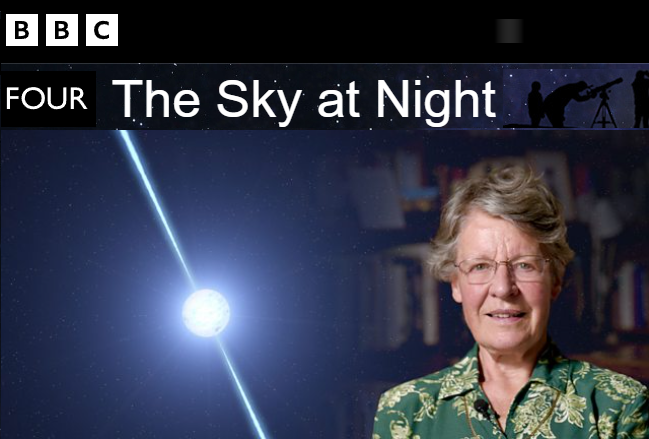
The Sky at Night is a monthly documentary television programme on astronomy produced by the BBC.

The show had the same permanent presenter, Patrick Moore, from its first broadcast on 24 April 1957 until 7 January 2013. The latter date was a posthumous broadcast, which followed Moore’s death on 9 December 2012. This made it the longest-running programme with the same presenter in television history. Many early episodes are missing, either because the tapes were wiped, thrown out, or because the episode was broadcast live and never recorded in the first place. Beginning with the 3 February 2013 edition, the show was co-presented by Lucie Green and Chris Lintott. Since December 2013 Maggie Aderin-Pocock has been a presenter. The programme’s opening and closing theme music is “At the Castle Gate”, from the incidental music to Pelléas et Mélisande, written in 1905 by Jean Sibelius, performed by the Royal Philharmonic Orchestra and conducted by Sir Thomas Beecham.

This episode:
Dame Jocelyn Bell Burnell is a discoverer and an explorer of the distant cosmos, and she has walked among the stars. She discovered the first pulsar in 1967 – a discovery so important in our understanding of the universe that it would earn a Nobel Prize. But Jocelyn didn’t receive it.

All her life a deep thinker, a dedicated Quaker and a fierce advocate for equal opportunity in physics, Jocelyn has carved an astonishing career doing and communicating science, changing the face of astronomy as a result.

Jocelyn was determined to succeed in an environment not made for her, and her story resonates with young and old, student and professor – and anyone who has ever felt like they may not really belong.

In this film, we hear Jocelyn’s story direct from the subject herself and learn how, from the small town of Lurgan in Northern Ireland, she rose to worldwide recognition. It is a tale of determination and triumph against the prejudice and misogyny of the time.

Alongside the history are the enigmas themselves: pulsars. The conditions surrounding these objects make them the most extreme laboratories in the cosmos, uniting the most complex and cutting-edge physics under one roof. Matter crushed down into its densest form, encased within extreme magnetic fields – and they are even telling us the secrets of the very make-up of our universe. Some flavours of these objects are so dramatic that just one outburst can briefly outshine an entire galaxy.

With Dr Vanessa Graber from Royal Holloway, University of London, Maggie delves into the concealed interiors of pulsars and the exotic states of matter that form them. With superfluids of neutrons hosting quantum tornados and searing hundred-million-degree plasma, pulsars are not the once-predictable characters we thought them.

Chris, meanwhile, is at the University of Oxford with Dr Kaustubh Rajwade, studying the oddballs of the pulsar family and how to decode their messages. As a blast of radiation travels from a pulsar to our detectors, the history of its journey through the universe is imprinted on the signal. We learn how to use this to see the unseen – the parts of the cosmos that are almost impossible for us to observe – revealing its detailed structure for the first time.

In conversation, Jocelyn joins PhD student Aida Seye to discuss shared passions and challenges in chasing cosmic dreams. Aida is a recipient of the Bell Burnell Graduate Scholarship Fund, instigated by Jocelyn to support PhD students from underrepresented groups. Aida is studying the structure of the Milky Way, with the aim of bringing us closer to solving the mystery of dark matter.

Links:
The Sky at Night

#IndigenousDay Day of the World’s #IndigenousPeoples / Dag van de #InheemseVolken 2025

The Day of the World’s Indigenous Peoples is observed on 9 August each year to promote and protect the rights of the world’s indigenous population.

This event also recognizes the achievements and contributions that indigenous people make to improve world issues such as environmental protection. It was first pronounced by the General Assembly of the United Nations in December 1994, marking the day of the first meeting of the UN Working Group on Indigenous Populations of the Subcommission on the Promotion and Protection of Human Rights, in 1982.

Links:
International Day of the World’s Indigenous Peoples – 9 August

United Nations Declaration on the Rights of Indigenous Peoples / VN-Verklaring van de Rechten van Inheemse Volken

Lula: vergiftig het Amazonewoud niet! – petitie

Why Indigenous Forest Guardianship is Crucial to Climate Action | Nonette Royo | TED

Vroege Vogels Radio | 10 augustus 2025 (Radio 1 NPO)

Vroege Vogels is een live-radioprogramma, tv-programma en online community van BNNVARA over natuur en milieu.

In het radioprogramma wordt het gesproken woord omlijst door licht klassieke muziek en salonmuziek. Het radioprogramma werd in 1978 voor het eerst uitgezonden door de VARA en is een van de langst lopende en best beluisterde radioprogramma’s van de publieke omroep. Het wordt elke zondagmorgen uitgezonden tussen 07:00 en 10:00 op NPO Radio 1. De beginmuziek is een bewerking van Vivaldi’s “Piccolo Concerto in C major” (RV 443).

Unieke natuur op de Groote Heide bij Venlo door een militair verleden. Op zoek naar het Insect van het Jaar: de zorgzame harkwesp. En kan de VN-conferentie in Genève nog iets doen tegen het wereldwijde plasticprobleem? Verder in de uitzending: bedreigingen voor de wilde kat, biodiverse buurttuin wordt mogelijk beachvolleybalveld, een snelcursus biologie, de 7 vinkjes van duurzame landbouw en dwergplantjes. De column is deze week van Patrick Jansen. Vroege Vogels Radio wordt gepresenteerd door Janine Abbring vanuit het Groene Huis te Amersfoort.

Links:
Vroege Vogels (na afloop terugluisteren)

Wilde kat, Peter Berx, duurzame landbouw en overige onderwerpen

Fenolijn

Intergovernmental Negotiating Committee on Plastic Pollution – second part of the fifth session

Meteorenzwerm δ-Aquariden noord

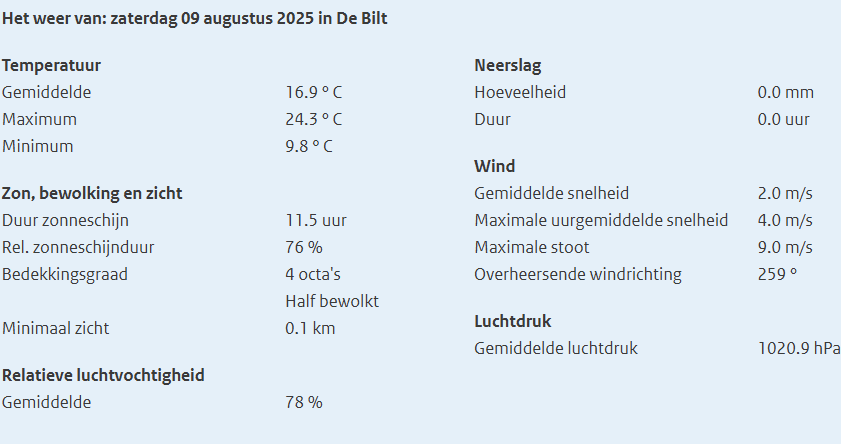
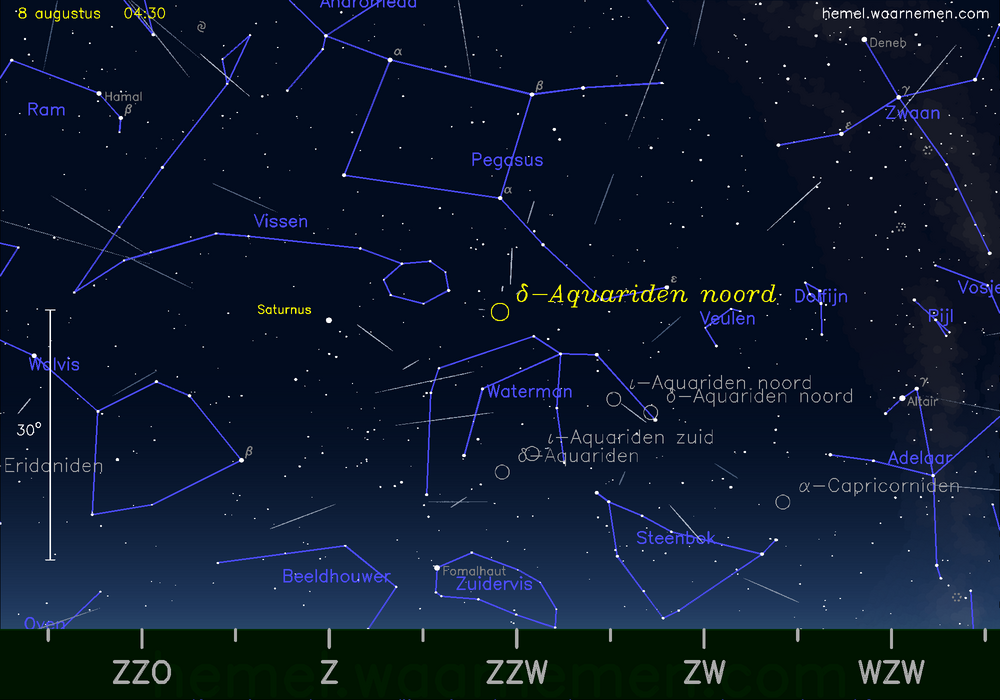
De meteorenzwerm δ-Aquariden noord bereikt op vrijdag 8 augustus 2025, rond 18:00, zijn maximum.

Zelfs wanneer de radiant in het zenit zou staan, zouden er van deze zwerm naar verwachting gemiddeld slechts zo’n 4 meteoren per uur vallen. Rond 03:30 staat de radiant van de zwerm in het hoogste punt (op 40°) aan de hemel. Het beste moment om δ-Aquariden noord waar te nemen is op 8 augustus rond 04:30. De radiant van de zwerm staat dan ongeveer 38° boven de horizon, in het zuidzuidwesten. Er is dan bij ons ieder uur niet meer dan één meteoor zichtbaar van deze zwerm. In totaal zijn er, door meteoren van andere zwermen en sporadische meteoren, bij donkere en heldere hemel circa 4–10 meteoren per uur zichtbaar. Op een goed donkere locatie zijn ongeveer 50% meer meteoren te zien dan in een grote stad. De Maan is voor ongeveer 100% verlicht en is een flinke stoorzender; alleen de helderste meteoren zijn hierdoor dit jaar zichtbaar. De Maan gaat om 04:28 onder, en stoort daarna natuurlijk niet. Rond 5:30 uur gaat het schemeren en om 06:12 komt de Zon op.

Links:
Meteorenzwerm δ-Aquariden noord

Dodentocht Bornem 2025

De Dodentocht is een wandeltocht georganiseerd in en rond de Belgische gemeente Bornem die jaarlijks van start gaat op de tweede vrijdag van augustus.

Het doel van de Dodentocht is om binnen 24 uur een parcours af te leggen van 100 kilometer door Klein-Brabant. Het evenement is geen wedstrijd, en net als bij bijvoorbeeld de Kennedymars is het uitlopen al een doel op zich voor de meeste deelnemers. Het evenement wordt georganiseerd door de vzw 100 km Dodentocht® Kadee Bornem. De Dodentocht werd voor de eerste keer georganiseerd in 1970 door de wandelclub Kadee met 65 deelnemers. De inspiratie voor de tocht was opgedaan na deelname aan de Nijmeegse Vierdaagse. Sinds deze eerste editie groeide de Dodentocht uit tot een internationaal evenement. Sinds de tweede helft van de jaren 2000 nemen mensen deel uit onder meer BelgiëNederlandDuitslandFrankrijk en Groot-Brittannië. Vanaf 2017 wordt er enkel nog met voorinschrijvingen gewerkt, en sinds 2018 geldt er een maximum aantal inschrijvingen van 13.000 deelnemers.

Links:
Dodentocht

Blokkade Haarlem : Massa-actie tegen Tata Steel

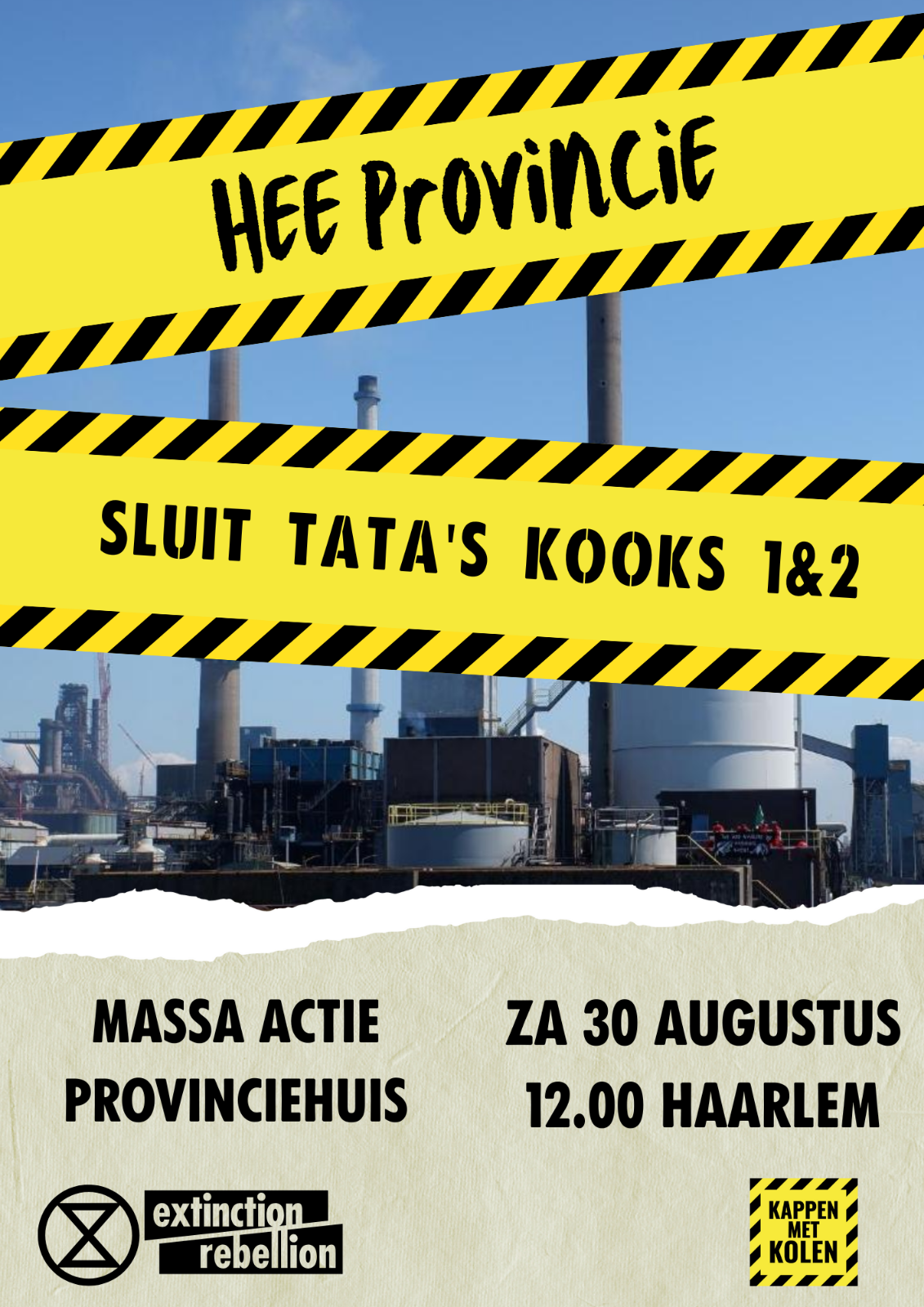
Zaterdag 30 augustus 2025 massa-actie bij het provinciehuis van Noord-Holland in Haarlem voor de sluiting van kooksgasfabrieken 1 en 2 van Tata Steel.

Deze kooksgasfabrieken – waarin kolen tot kooks worden verwerkt – zijn zwaar verouderd en hadden allang gesloten moeten zijn. Ze lekken aan alle kanten en stoten vrijwel dagelijks gifwolken uit. Mensen die in de omgeving wonen, leven daardoor aantoonbaar korter en in slechtere gezondheid. We roepen iedereen die het ook onacceptabel vindt dat Tata Steel ongehinderd gifwolken kan uitstoten en die het ook schandalig vindt dat de overheid niet opkomt voor de gezondheid van burgers en bescherming van natuur en milieu, op om zich aan te sluiten. Het eindspel voor Tata is begonnen, want we gaan net zo lang door tot de kooksgasfabrieken dichtgaan. Tata Steel zegt dat ze ook willen kappen met kolen, maar in hun plannen blijven de kooksfabrieken nog jaren open. Maar we kunnen niet langer wachten, want er gaan letterlijk mensen dood door de giftige uitstoot van deze fabrieken. Een kooksfabriek in een dichtbevolkt gebied als de IJmond is niet meer van deze tijd.

Links:
Blokkade Haarlem

Hee Provincie – sluit Tata’s Kooks 1 & 2!