2025-10-24, Lief dagboek

Vrijdag; Wat eten we vandaag?; Tweede Kamer verkiezing; Zon; Gaza−Israël oorlog 2023 – …; Open Science Festival; Dag van de Verenigde Naties; World Kangaroo Day; Rosa Parks; Disarmament Week; World Development Information Day; Global Media and Information Literacy Week; Het grote Politieke Jongeren verkiezingsdebat; Code Oranje.

Deze afbeelding heeft een leeg alt-attribuut; de bestandsnaam is dagboek.png

Wat eten we vandaag?:

Klik op afbeelding voor origineel

Knipselkrant:


Agenda:

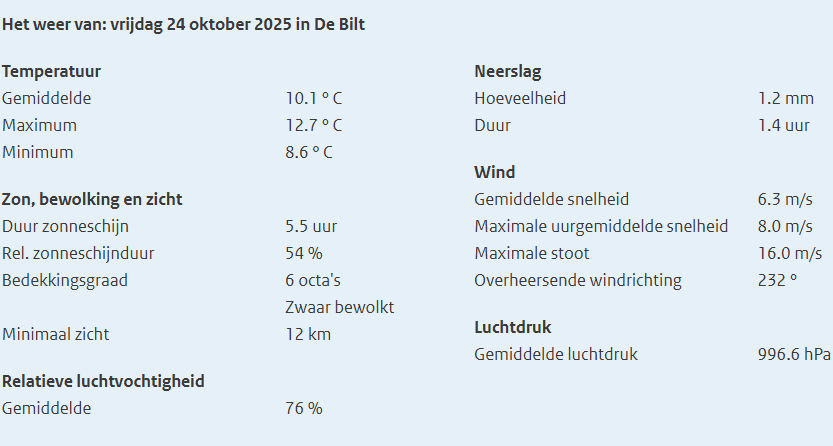
Weer:

Links:
In de geschiedenis

World Development Information Day 2025

World Development Information Day

In 1972, the United Nations (UN) General Assembly established World Development Information Day to draw the attention of the world to development problems and the need to strengthen international cooperation to solve them (resolution 3038(XXVII)).

The Assembly decided that the date for the Day should coincide with United Nations Day, 24 October, which was also the date of the adoption, in 1970, of the International Development Strategy for the Second United Nations Development Decade. Since the 1970s, Governments dedicated themselves to the fundamental objectives enshrined in the Charter of the United Nations to create conditions of stability and well-being and to ensure a minimum standard of living consistent with human dignity through economic and social progress and development. The launching of the First United Nations Development Decade in 1961 marked a major world-wide endeavor to give concrete substance to that solemn pledge. Since then, attempts have continued to adopt measures for that purpose. Unfortunately, however, the standard of living for millions of people in the world is still pitifully low: they are often still undernourished, uneducated, unemployed and wanting in many basic amenities. Nonetheless, the current frustrations and disappointments must not be allowed to cloud the vision or stand in the way of the development objectives. The success of international development activities depend in large measure on improvement in the general international situation that requires concrete progress particularly in the promotion of equal political, economic, social and cultural rights for all members of society. The ultimate objective of development must be to bring about sustained improvement in the well-being of the individual and to bestow benefits on all. If undue privilege, extremes of wealth, and social injustice persist, then development fails in its essential purpose. The international community must rise to the challenge of the present age of unprecedented opportunities offered by science and technological advances, such that they may be equitably shared by all countries and, in turn, may contribute to the accelerated economic development throughout the world.

Links:
World Development Information Day

Disarmament Week 2025

Disarmament Week seeks to promote awareness and better understanding of disarmament issues and their cross-cutting importance.

Starting on 24 October, the anniversary of the founding of the United Nations, the week-long annual observance was first called for in the Final Document of the General Assembly’s 1978 special session on disarmament (resolution S-10/2). In 1995, the General Assembly invited governments, as well as NGOs, to continue taking an active part in Disarmament Week (resolution 50/72 B, 12 December 1995) in order to promote a better understanding among the public of disarmament issues. Throughout history, countries have pursued disarmament to build a safer, more secure world and to protect people from harm. Since the foundation of the United Nations, disarmament and arms control have played a critical role in preventing and ending crises and armed conflict. Heightened tensions and dangers are better resolved through serious political dialogue and negotiation—not by more arms. Weapons of mass destruction, in particular nuclear weapons, continue to be of primary concern, owing to their destructive power and the threat that they pose to humanity. The excessive accumulation and illicit trade in conventional weapons jeopardize international peace and security and sustainable development, while the use of heavy conventional weapons in populated areas is seriously endangering civilians.

New and emerging weapon technologies, such as autonomous weapons, imperil global security and have received increased attention from the international community in recent years. Measures for disarmament are pursued for many reasons, including to maintain international peace and security, uphold the principles of humanity, protect civilians, promote sustainable development, foster confidence and trust among States, and prevent and end armed conflict. Disarmament and arms control measures help ensure international and human security in the 21st Century and therefore must be an integral part of a credible and effective collective security system. The United Nations continues to celebrate the efforts and involvement of a range of actors contributing to a safer, more peaceful common future through disarmament, arms control and non-proliferation efforts. In a world threatened by weapons of mass destruction, conventional arms and emerging cyberwarfare, United Nations Secretary-General António Guterres presented an agenda for disarmament to save humanity, save lives and secure our common future.

Links:
Disarmament Week

2023 UN Disarmament Yearbook

#GlobalMILWeek Global Media and Information Literacy Week 2025

Global Media and Information Literacy Week

In 2021, the UN General Assembly decided (A/RES/75/267) to commemorate Media and Information Literacy (MIL) week, citing the need for the dissemination of factual, timely, targeted, clear, accessible, multilingual and science-based information.

The resolution recognizes that the substantial digital divide and data inequalities that exist among different countries and within them, can be addressed in part by improving people’s competencies to seek, receive and impart information in the digital realm. In the current ecosystem of complex and sometimes contradictory messages and meanings, it is hard to conceive of the public good being advanced, if the public is disempowered in the face of opportunities and threats. Each individual needs to be equipped with media and information literacy competencies to understand the stakes, and to contribute to and benefit from information and communication opportunities. Global Media and Information Literacy Week, commemorated annually, is a major occasion for stakeholders to review and celebrate the progress achieved towards “Media and Information Literacy for All.” Our brains depend on information to work optimally. The quality of information we engage with largely determines our perceptions, beliefs and attitudes. It could be information from other persons, the media, libraries, archives, museums, publishers, or other information providers including those on the Internet.

People across the world are witnessing a dramatic increase in access to information and communication. While some people are starved for information, others are flooded with print, broadcast and digital content. Media and Information Literacy (MIL) provides answers to the questions that we all ask ourselves at some point. How can we access, search, critically assess, use and contribute content wisely, both online and offline? What are our rights online and offline? What are the ethical issues surrounding the access and use of information? How can we engage with media and information and communications technologies (ICTs) to promote equality, intercultural and interreligious dialogue, peace, freedom of expression and access to information? Through capacity-building resources, such as curricula development, policy guidelines and articulation, and assessment framework, UNESCO supports the development of MIL competencies among people.

2025 Theme: “Minds Over AI” – MIL in Digital Spaces. Artificial intelligence is rapidly transforming the way information is produced, distributed, and consumed in digital spaces. As AI technologies become more integrated into everyday communication, shaping news feeds, search results, and even content creation, the need for strong media and information literacy (MIL) has become increasingly urgent. MIL equips individuals with the critical thinking skills necessary to recognize, evaluate, and responsibly interact with AI-generated content. It empowers people to question sources, understand algorithmic influence, and make informed decisions in a digital environment dominated by automated systems. Emphasizing “Minds Over AI,” the focus is on ensuring that human judgment, ethics, and critical awareness guide the use and interpretation of AI in our media landscapes.

Links:
Global Media and Information Literacy Week

Rosa Parks sterfdag (2005) 2025

Rosa Parks

Rosa Louise Parks-McCauley (*04-02-1913 – +24-10-2005), beter bekend als Rosa Parks, was een Amerikaans burgerrechtenactiviste.

Ze staat vooral bekend om het feit dat ze in 1955 weigerde haar zitplaats in een bus af te staan aan een blanke medepassagier. Martin Luther King kreeg lucht van de zaak, en begon de “Montgomery bus boycot”, waardoor het busbedrijf bijna failliet ging en uiteindelijk de scheiding van blanken en zwarten in haar bussen moest afschaffen. Dit leidde tot meer protesten tegen de segegratie. Intussen was de rechtszaak van Rosa Parks bij het United States Supreme Court beland, die haar in het gelijk stelde en de scheiding tussen blanken en zwarten onconstitutioneel verklaarde. In 2004 bleek uit een medisch rapport dat ze leed aan dementie, ze overleed uiteindelijk in haar slaap te Detroit.

Links:
Rosa Parks, biografie

World Kangaroo Day 2025

World Kangaroo Day

In 2020 not-for-profit organisation Kangaroos Alive created World Kangaroo Day to be held every year on October 24th, the mission is to create an international day to celebrate this icon.

Kangaroos are marsupials from the subfamily Macropodinae (macropods, meaning “large foot”). In common use, the term is used to describe the largest species from this family, the red kangaroo, as well as the antilopine kangarooeastern grey kangaroo, and western grey kangaroo. Kangaroos are indigenous to Australia and New Guinea. World Kangaroo Day is a global movement campaigning for the ethical treatment of kangaroos. Kangaroos Alive runs education campaigns, supports scientific research, and advocates globally to end the commercial kangaroo trade. It works in partnership with First Nations organisations to amplify Indigenous voices and cultural knowledge in kangaroo conservation. The day celebrates kangaroos as iconic and culturally significant native animals, and draws attention to the threats they face from habitat loss, commercial slaughter, and misinformation. As part of the celebrations, World Kangaroo Day will feature a series of Walks and Talks. These immersive, family-friendly events invite communities to connect with Country, learn about kangaroo behaviour and habitats, and hear stories from Aboriginal Elders about the kangaroo’s role as a sacred totem. The World Kangaroo Day Photo Competition, has closed and winners of this year’s competition will be announced on 24 October. The competition was open to amateur and professional photographers with the objective of showcasing the beauty, strength and spirit of kangaroos.


Links:
World Kangaroo Day

Celebrate World Kangaroo Day

2025-10-23, Lief dagboek

Donderdag; Wat eten we vandaag?; Dag van de Sneeuwluipaard; Soedan; doelgroepenregister; Plastic kauwgom; Wereld Mol Dag; KNMI KMI CodeOranje.

Deze afbeelding heeft een leeg alt-attribuut; de bestandsnaam is dagboek.png

Wat eten we vandaag?:

Klik op afbeelding voor origineel

Knipselkrant:


Is doelgroepenregister echt zo erg?
byu/a3veen inu_a3veen

Agenda:

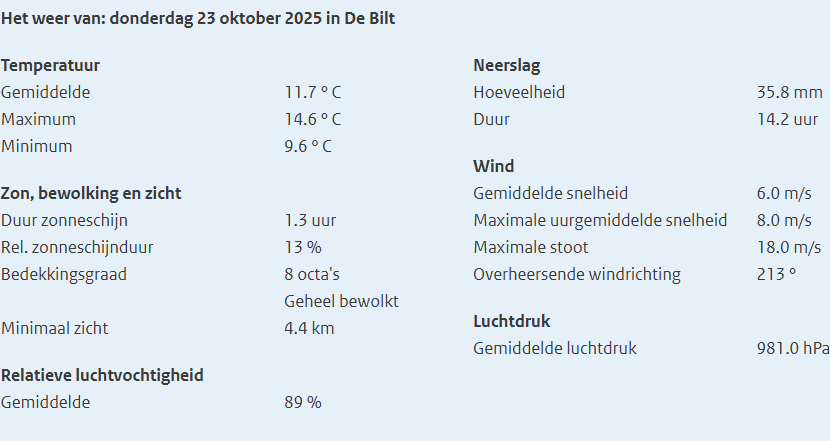
Weer:

Links:
In de geschiedenis
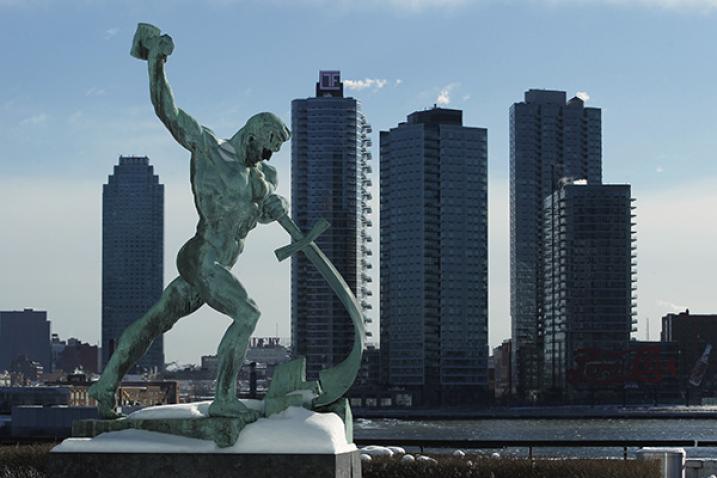
#MoleDay / Wereld Mol Dag 2025

Mole Day is an unofficial holiday celebrated among chemists, chemistry students and chemistry enthusiasts on October 23, between 06:02 and 18:02 (6:02 pm), making the date 6:02 10/23 in the American style of writing dates.

The time and date are derived from the Avogadro number, which is approximately 6.02×10²³, defining the number of particles (atoms or molecules) in one mole (mol) of substance, one of the seven base SI units. Schools around the world celebrate Mole Day with various activities related to chemistry and/or moles. For a given molecule, one mole is a mass (in grams) whose number is equal to the molar mass of the molecule. For example, the water molecule has an molar mass of 18, therefore one mole of water weighs 18 grams. Similarly, a mole of neon has a molar mass of 20 grams. In general, one mole of any substance contains Avogadro’s Number of molecules or atoms of that substance. This relationship was first discovered by Amedeo Avogadro (1776-1858) and he received credit for this after his death. 

Links:
Mole Day

Mol (eenheid)

Dag van de Sneeuwluipaard / World Snow Leopard Day 2025

Dag van de Sneeuwluipaard

De Algemene vergadering van de Verenigde Naties heeft 23 oktober uitgeroepen tot Dag van de Sneeuwluipaard / Snow Leopard Day (A/RES/79/143).

De sneeuwluipaard, sneeuwpanter of irbis (Uncia uncia) is een zoogdier uit de familie der katachtigen (Felidae). De 12 landen van het leefgebied van dit dier: Republiek Afghanistan, het Koninkrijk Bhutan, de Volksrepubliek China, de Republiek India, de Republiek Kazachstan, de Kirgizische Republiek, Mongolië, de Federale Democratische Republiek Nepal, de Islamitische Republiek Pakistan, de Russische Federatie, de Republiek van Tadzjikistan en de Republiek Oezbekistan hebben het initiatief genomen voor de Snow Leopard Day. Zij ondertekenden in 2013 de Bishkek Declaration on the Conservation of the Snow Leopard, een verklaring met als gemeenschappelijk doel het behoud van sneeuwluipaarden en hun kwetsbare leefgebieden.

Links:
Day of the Snow Leopard