
#EducationDay World Day of Education / Dag van het Onderwijs 2026

The right to education is enshrined in article 26 of the Universal Declaration of Human Rights. The declaration calls for free and compulsory elementary education.
The C
Links:
I

The right to education is enshrined in article 26 of the Universal Declaration of Human Rights. The declaration calls for free and compulsory elementary education.
The C
Links:
I
Links:
Wikipedia

Op de 24e van elke maand samenkomst om 18:00 samen op het Spui tegenover het Lieverdje voor een einde aan oorlog en herdenking slachtoffers.
Met sprekers, dichters en muziek wordt iedere maand geprotesteerd tegen het voortduren van de bloedige oorlog in Oekraïne – en Gaza – en gepleit voor een wapenstilstand, diplomatie en onderhandelingen. Met twee minuten stilte herdenking de slachtoffers aan beide kanten. Luisteren naar een update over de stand van zaken aan het front. Na afloop samen “Dona Nobis Pacem – Geef Ons Vrede” zingen. Guido van Leemput – schrijver van ‘De gelaagde oorlog’ en medeoprichter van Stop de Oorlog Amsterdam – geeft zijn maandelijkse analyse van de situatie aan het front én de onderhandelingstafels. Nog niet eerder was een einde van het massale bloedvergieten zo dichtbij. Komt er een vrede in het belang van de Oekraïense en Russische bevolking? Of kijken we naar oligarchen en kapitalisten die op een nietsontziende manier de wereld opnieuw aan het verdelen zijn? De bijeenkomsten op het Spui worden live uitgezonden door Radio Patapoe. Alle vorige uitzendingen staan bij elkaar op een plek. Radio Patapoe is vrije radio zonder censuur of commercie en voorstander van vrijheid van meningsuiting en denken.
Links:
Stop de Oorlog
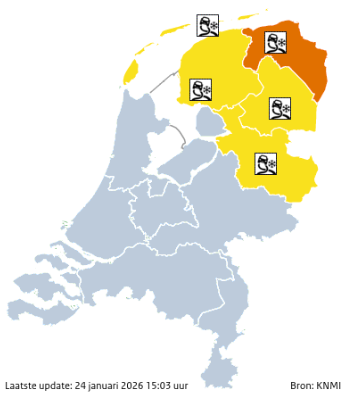
Tot het einde van de middag van 24 januari 2026 is het in Groningen op veel plaatsen verraderlijk glad door ijzel, hiervoor geldt code oranje.
In de namiddag wordt het noordoosten geleidelijk op steeds meer plaatsen droog. De gladheid blijft echter wel plaatselijk aanhouden en vanaf de avond is er bovendien ook kans op gladheid door bevriezing van natte weggedeelten. Hiervoor blijft dan tot zondag in de ochtend een code geel van kracht. In de provincie Groningen valt op veel plaatsen lichte regen. Bij temperaturen onder nul geeft dit ijzel en verraderlijke gladheid.
Links:
Weerstation

Artemis II is a planned lunar spaceflight mission under the Artemis program, led by NASA. It is intended to be the second flight of the Space Launch System (SLS), and is both the first crewed mission of the Orion spacecraft and the first crewed mission to the vicinity of the Moon since Apollo 17 in 1972.
Launch is scheduled for no earlier than April, 2026. The 10-day mission will carry NASA astronauts Reid Wiseman, Victor Glover, and Christina Koch, along with Canadian Space Agency astronaut Jeremy Hansen, on a free-return trajectory around the Moon and back to Earth. Glover will become the first person of color, Koch the first woman, and Hansen the first non-American to travel to the Moon. The flight will take the crew farther from Earth than any previous human mission before reentering Earth’s atmosphere at a record speed of approximately 40,000 km/h. Artemis II was originally designated Exploration Mission-2 (EM-2) and was initially intended to support the now-canceled Asteroid Redirect Mission. Its objectives were revised following the establishment of the Artemis program. The Artemis II mission plan is to send four astronauts in the first crewed Orion spacecraft into a lunar flyby using the Block 1 variant of the Space Launch System. The mission profile is a multi-trans-lunar injection (MTLI), or multiple departure burns, and includes a free-return trajectory from the Moon. The Orion spacecraft will be sent to a high Earth orbit with a period of roughly 24 hours. During this time the crew will perform various checkouts of the spacecraft’s life support systems as well as an in-space rendezvous and proximity operations demonstration using the spent Interim Cryogenic Propulsion Stage (ICPS) as a target. When Orion reaches perigee once again, it will fire its main engine to complete the TLI maneuver, which will send it onto a lunar free-return trajectory, before returning to Earth. Artemis II will test and demonstrate optical communications to and from Earth using the Orion Artemis II Optical Communications System (O2O). The O2O hardware will be integrated into the Orion spacecraft and includes an optical module (a 100 mm telescope and two gimbals), a modem and control electronics. O2O will communicate with ground stations in California and New Mexico. The test device will send data to Earth with a downlink rate of up to 260 megabits per second.
NASA concluded a wet dress rehearsal for the agency’s Artemis II test flight early Tuesday morning February 3, 2026, successfully loading cryogenic propellant into the SLS (Space Launch System) tanks, sending a team out to the launch pad to closeout Orion, and safely draining the rocket. The wet dress rehearsal was a prelaunch test to fuel the rocket, designed to identify any issues and resolve them before attempting a launch. Engineers pushed through several challenges during the two-day test and met many of the planned objectives. To allow teams to review data and conduct a second wet dress rehearsal. NASA will roll the SLS (Space Launch System) rocket and Orion spacecraft for Artemis II off the launch pad at the agency’s Kennedy Space Center in Florida as soon as Tuesday, Feb. 24. On Feb. 21, managers decided to remove recently installed platforms before high winds descend on the Space Coast, which poised teams for rollback while discussions about the issue were ongoing. Returning to the Vehicle Assembly Building at Kennedy is required to determine the cause of the issue and fix it. Once NASA’s Artemis II SLS (Space Launch System) rocket and Orion spacecraft arrived at the Vehicle Assembly Building (VAB) Feb. 25, technicians immediately began addressing why the flow of helium to the SLS upper stage was interrupted as engineers were reconfiguring the rocket following a successful wet dress rehearsal on Feb. 21. To make the repairs, teams are installing two sets of internal access platforms inside the launch vehicle stage adapter and must remove thermal blankets that cover the area they are interested in – a point on the rocket’s interim cryogenic propulsion system, or upper stage. The area provides connections for multiple umbilicals, including tubing used to fill the upper stage with helium. Helium is used to maintain proper environmental conditions, and to pressurize the stage for flight.
On Friday, March 20, NASA’s Artemis II SLS rocket and Orion spacecraft arrived at Launch Pad 39B after an 11-hour journey from the Vehicle Assembly Building at the agency’s Kennedy Space Center in Florida. NASA’s crawler-transporter 2 began its 6 km trek with the integrated SLS and Orion stacked on top of the mobile launcher at 18:20 CEST. The crawler carried the Moon rocket and spacecraft slowly and steadily toward the pad. At Pad 39B, NASA teams were gearing up for the final stretch of prelaunch preparations ahead of launch as soon as Thursday, April 2 at 00:24 CEST. The early April launch window includes opportunities through Monday, April 6. NASA’s SLS rocket lifted off at 00:35 CEST Wednesday April 2 sending four astronauts aboard the Orion spacecraft on a planned test flight around the Moon and back. After the mission management team polled “Go” Thursday, NASA’s Orion spacecraft fired its main engine for five minutes and 50 seconds beginning April 3 at 01:49 CEST, to successfully complete the translunar injection (TLI) burn, sending the crew in Orion out of Earth orbit and on a trajectory toward the Moon. On April 7, the Artemis II mission wrapped up a seven-hour lunar flyby, marking humanity’s first return to the Moon since Apollo 17 in 1972 and capturing images of the lunar far side. The momentous day began at 01:02:51 CEST as the astronauts set the record for the farthest distance from Earth traveled by any human. During a planned 40-minute loss of signal as Orion passed behind the Moon, the spacecraft and its crew made their closest approach at 01:00:46 CEST, flying at about 6544 kilometer above the surface. Two minutes later, the crew reached the mission’s maximum distance from Earth at 406.771 km, setting a new record for human spaceflight. The Orion spacecraft is scheduled to splash down off the coast of San Diego at approximately 02:07 on Saturday, April 11 (CEST).
Links:
Artemis II, at NASA
Mission Overview, at NASA
Artemis II “Send Your Name to Space”, at NASA
Artemis 2 moon mission shouldn’t launch until late 2026, new analysis of solar superflares suggests
Historische maanvlucht van start: ‘Heftiger nu er mensen aan boord zijn’

The January 2026 North American winter storm was an expansive, deadly and major winter and ice storm that affected much of North America across regions stretching from Northern Mexico to the Southern and Northeastern United States as well as Canada in late January.
Developing in part from an upper-level low on January 22, the system steadily moved eastwards across the Central United States, dropping a very large swath of wintry precipitation. By January 25, the winter storm had moved into the Northeast, where it began to transition into a nor’easter. Gusty winds and heavy snow continued to occur in New England, even as it pulled away from the coastline the following day, leaving parts of North America with a mix of rain, sleet, freezing rain and snow. Meteorologists described the storm as “potentially historic” in its impact, with the storm at one point encompassing nearly 3,200 km of length from the Mexico–United States border well into Canada. Twenty-four U.S. state governors issued emergency declarations in response. Winter weather alerts were also issued across a similar length of terrain, affecting up to 230 million people. The impending storm caused over 10,000 flights nationwide in the United States to be cancelled or postponed. Travel bans were enacted in numerous states as well. The storm was unofficially named Winter Storm Fern by The Weather Channel. As of January 26, 50 fatalities had been confirmed due to the storm. Over a million customers lost power, mostly concentrated within the South where a damaging and crippling ice storm occurred, causing power lines and trees to snap and break under the weight. Icy conditions also led to hazardous travel afterwards. Overall, a large swath of snowfall ranging from 30–61 cm occurred from Texas to Maine, and in some cases (particularly in the South) broke daily snowfall records. In the Mid-Atlantic states and Northeast, where the storm became a nor’easter, several locations along the Interstate 95 corridor, specifically Philadelphia, Pennsylvania, and New York City, saw their heaviest snowfall accumulation from this storm in five years since a nor’easter in February 2021.
Links:
Monster winter storm threatens half of US with at least 16 states declaring emergencies
US braces for ‘extremely dangerous’ winter storm
Noodtoestand en geannuleerde vluchten: VS bereidt zich voor op extreem weer
Zeker acht doden in VS door extreem winterweer
Ruim miljoen huishoudens zonder stroom in VS, Amerikaanse media melden 5 doden
Vrijdag; Wat eten we vandaag?; WEF & Oekraïne; Protesten in Iran; ICE arresteert vijfjarig kind; Dag van het Handschrift; KNMI code oranje.

Wat eten we vandaag?:


Knipselkrant:
Agenda:
Weer:

Links:
In de geschiedenis

In 1977 werd de Dag van het Handschrift voor het eerst in Amerika in gevierd, de initiatiefnemer was de Writings Instrument Manufacturers Association.
Het motief voor een “National Handwriting Day” was louter commercieel. Zij wilde met deze dag het gebruik van pennen, potloden en schrijfpapier promoten. Later transformeerde de dag van nationaal naar internationaal. Het Platform Handschriftontw
De snelgroeiende digitale maatschappij zorgt ervoor dat schrijven met de hand aan het “uitsterven” is. Baby’s spelen bij wijze van spreken niet meer met een rammelaar maar met een tablet of smartphone, ze swipen en tikken er in de wieg al lustig op los. Zal uiteindelijk het handschrift het onderspit gaan delven in de digitale wereld? Wordt typen op toetsenborden en tikken op schermen de “geschreven” communicatievor
‘Hands
Links:
Hand
Links:
Wikipedia

Vroege Vogels is een live-radioprogramma, tv-programma en online community van BNNVARA over natuur en milieu.
In het radioprogramma wordt het gesproken woord omlijst door licht klassieke muziek en salonmuziek. Het radioprogramma werd in 1978 voor het eerst uitgezonden door de VARA en is een van de langst lopende en best beluisterde radioprogramma’s van de publieke omroep. Het wordt elke zondagmorgen uitgezonden tussen 07:00 en 10:00 op NPO Radio 1. De beginmuziek is een bewerking van Vivaldi’s “Piccolo Concerto in C major” (RV 443).
Tiktokker Tamma is een fanatiek vogelaar en neemt ons mee naar zijn favoriete plek in Groningen, de Kiekkaaste in Nij Stoatenziel. Voor het schrijven van zijn boek ‘Het pesticidenparadijs‘ belandt onderzoeksjournalist Dirk de Bekker in een parallel universum: Het blijkt een woud van lobby, misleiding, belangen en vervuiling te zijn, Tafel van Natuurmonumenten, gemeenteraadsverkiezingen. En verder: Klimaatverandering van het verleden, de Nationale Voorleesdagen, varkensvlees, voorjaarsbodes in de winter, scholeksters en overige onderwerpen. De column is deze week van Hans Sibbel. Vroege Vogels Radio wordt gepresenteerd door Jan van Poppel vanuit het Groene Huis te Amersfoort.
Links:
Vroege Vogels Radio