Festivus 2025

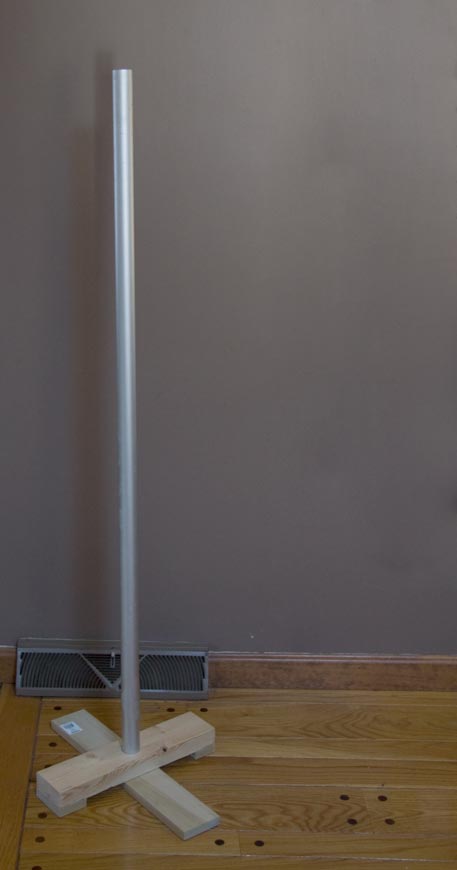
The festivus pole
The festivus pole

Festivus (/ˈfɛstɪvəs/) is a secular holiday celebrated on December 23 as an alternative to the pressures and commercialism of the Christmas season. Originally created by author Daniel O’Keefe, Festivus entered popular culture after it was made the focus of the 1997 Seinfeld episode “The Strike“, which O’Keefe’s son, Dan O’Keefe, co-wrote.

The non-commercial holiday’s celebration, as depicted on Seinfeld, occurs on December 23 and includes a Festivus dinner, an unadorned aluminum Festivus pole, practices such as the “airing of grievances” and “feats of strength”, and the labeling of easily explainable events as “Festivus miracles”. The episode refers to it as “a Festivus for the rest of us”. It has been described both as a parody holiday festival and as a form of playful consumer resistance. Journalist Allen Salkin describes it as “the perfect secular theme for an all-inclusive December gathering”.

Links:
Happy Festivus… for the Rest of Us!

Meteorenzwerm Ursiden in december 2025

Ursiden

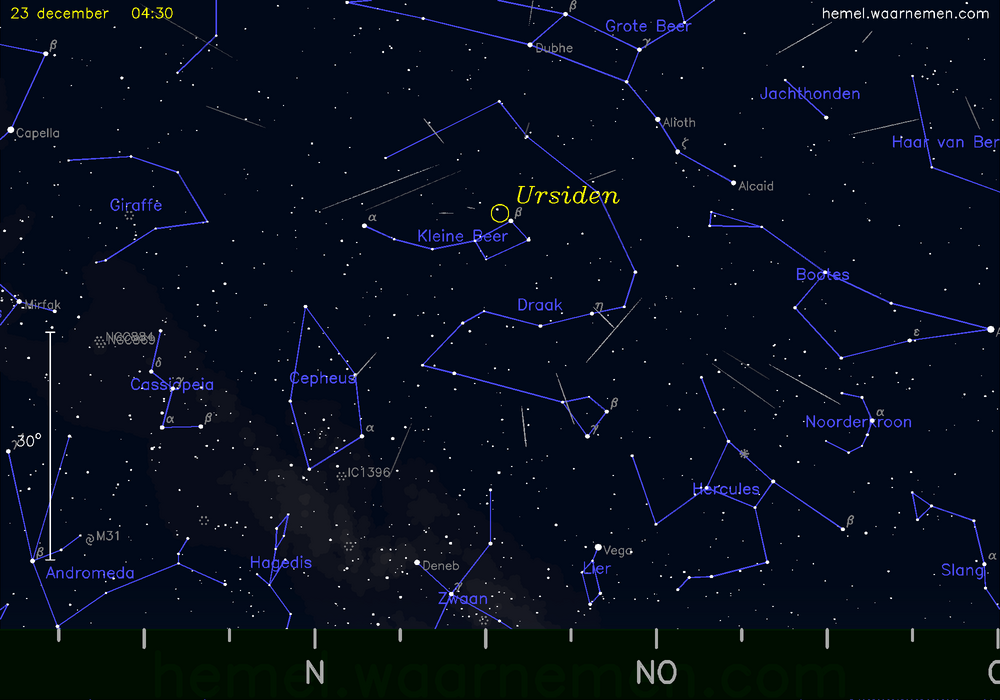
De meteorenzwerm Ursiden bereikt op dinsdag 23 december 2025, rond 00:00, zijn maximum. De meteoren van de Ursiden zijn niet erg opvallend, wanneer de radiant in het zenit zou staan, zouden er van deze zwerm naar verwachting gemiddeld zo’n 12 meteoren per uur vallen.

De radiant van de zwerm staat rond 09:00 in het hoogste punt aan de hemel, op 67° boven de horizon. Het beste moment om Ursiden waar te nemen is op 23 december rond 04:30. De radiant staat op dat moment zo’n 55° boven de horizon, in het noordnoordoosten. Door de matige omstandigheden zijn er in onze streken dan vermoedelijk maar circa 2–6 meteoren per uur van deze zwerm te zien. In totaal zijn er, door meteoren van andere zwermen en sporadische meteoren, bij donkere en heldere hemel circa 11–19 meteoren per uur zichtbaar. Op een donkere locatie zijn ongeveer vijf keer zoveel meteoren te zien als in dichtbevolkt gebied. De Maan stoort niet. Rond 08:00 gaat het schemeren en om 08:47 komt de Zon op. Over het algemeen zijn de de meteoren van een zwerm niet alleen op de dag van het maximum zichtbaar, maar de Ursiden zijn bijzonder scherp gepiekt, en de zwerm duurt niet veel langer dan 16 uur. Een dag voor of na het maximum is nog slechts 14% van het piekaantal meteoren per uur te zien. De snelheden van de meteoren van de Ursiden zijn gemiddeld: zo’n 35 km/s, dat is circa 126.000 km/uur.

Links:
Meteorenzwerm Ursiden in december

2025-12-21, Lief dagboek

Zondag; Wat eten we vandaag?; Gaza−Israël oorlog 2023 – … ; Dalek remembrance day; Vroege Vogels; Astronomische winter.

Deze afbeelding heeft een leeg alt-attribuut; de bestandsnaam is dagboek.png

Wat eten we vandaag?:

Klik op afbeelding voor origineel

Knipselkrant:


Agenda:

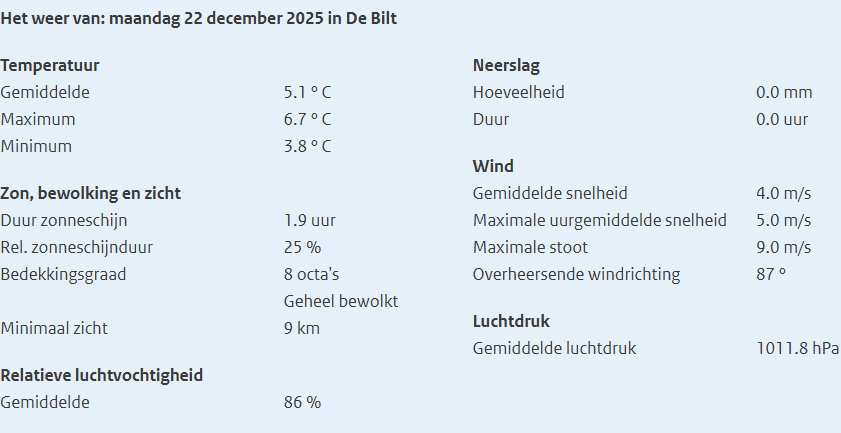
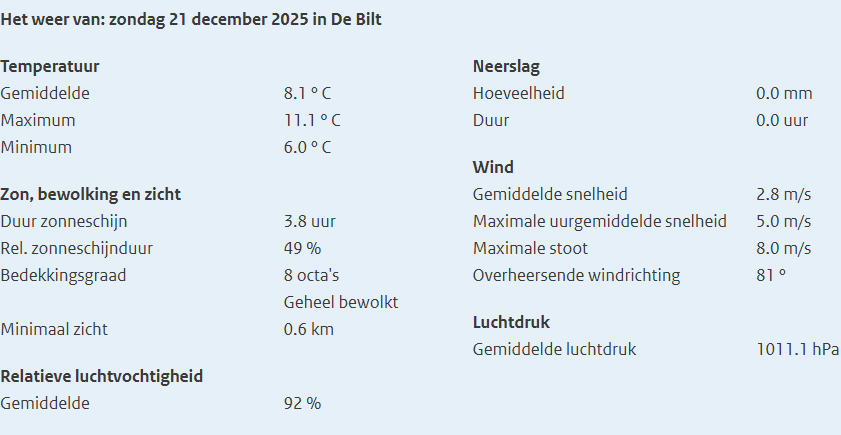
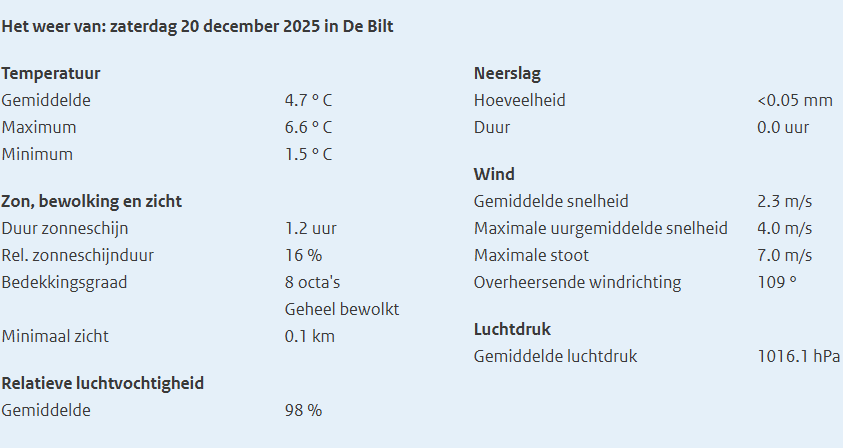
Weer:

Links:
In de geschiedenis

#InternationalDalekRemembranceDay Dalek remembrance day 2025

Dalek remembrance is on the 21 December every year, this date was chosen because on the 21 December 1963, the Daleks (/ˈdɑːlɪks/ (listenDAH-leks) first made their appearence on screen and into history.

The Daleks are a fictional extraterrestrial race of mutants principally portrayed in the British science fiction television programme Doctor Who. The Daleks were conceived by science-fiction writer Terry Nation and first appeared in the 1963 Doctor Who serial The Daleks, in shells designed by Raymond Cusick. Drawing inspiration from the Nazis, Nation portrayed the Daleks as violent, merciless and pitiless cyborg aliens, who demand total conformity to their will and are bent on the conquest of the universe and the extermination of what they see as inferior races. Collectively they are the greatest enemies of Doctor Who’s protagonist, the Time Lord known as “the Doctor.” During the second year of the original Doctor Who programme (1963-1989), the Daleks developed their own form of time travel. In the beginning of the second Doctor Who TV series that debuted in 2005, it was established that the Daleks had engaged in a Time War against the Time Lords that affected much of the universe and altered parts of history.

In the programme’s narrative, the planet Skaro suffered a thousand-year war between two societies: the Kaleds and the Thals. During this time-period, many natives of Skaro became badly mutated by fallout from nuclear weapons and chemical warfare. The Kaled government believed in genetic purity and swore to “exterminate the Thals” for being inferior. Believing his own society was becoming weak and that it was his duty to create a new master race from the ashes of his people, the Kaled scientist Davros genetically modified several Kaleds into squid-like life-forms he called Daleks, removing “weaknesses” such as mercy and sympathy while increasing aggression and survival-instinct. He then integrated them with tank-like robotic shells equipped with advanced technology based on the same life-support system he himself used since being burned and blinded by a nuclear attack. His creations became intent on dominating the universe by enslaving or purging all “inferior” non-Dalek life. The Daleks are the show’s most popular and famous villains and their returns to the series over the decades have often gained media attention. Their frequent declaration “Exterminate!” has become common usage. Contrary to popular belief, the Daleks are not contractually required to appear in every season, as former showrunner Steven Moffat stated in an interview.

Links:
Dalek remembrance day

Daleks

Dalek on Tardis at Fandom, an external wiki

A history of the dalek props 1963–1988

The making of the ‘Cover of the Century’

#InternationalDalekRemembranceDay – Facebook

World Human #SolidarityDay / Dag voor Menselijke Solidariteit 2025

The UN General Assembly, convinced that the promotion of the culture of solidarity and the spirit of sharing is important for combating poverty, proclaimed 20 of December as International Human Solidarity Day.

The Sustainable Development Agenda is centred on people & planet, underpinned by human rights and supported by a global partnership determined to lift people out of poverty, hunger and disease. It will, thus, be built on a foundation of global cooperation and solidarity. World Human Solidarity Day is:

  • a day to celebrate our unity in diversity;
  • a day to remind governments to respect their commitments to international agreements;
  • a day to raise public awareness of the importance of solidarity;
  • a day to encourage debate on the ways to promote solidarity for the achievement of the Sustainable Development Goals including poverty eradication;
  • a day of action to encourage new initiatives for poverty eradication.

Solidarity is identified in the Millennium Declaration as one of the fundamental values of international relations in the 21st Century, wherein those, who either suffer or benefit least deserve help from those who benefit most. Consequently, in the context of globalization and the challenge of growing inequality, strengthening of international solidarity is indispensable. Therefore, the UN General Assembly proclaimed 20 of December as International Human Solidarity Day. Through initiatives such as the establishment of the World Solidarity Fund to eradicate poverty and the proclamation of International Human Solidarity Day, the concept of solidarity was promoted as crucial in the fight against poverty and in the involvement of all relevant stakeholders. The concept of solidarity has defined the work of the United Nations since the birth of the Organization. The creation of the United Nations drew the peoples and nations of the world together to promote peace, human rights and social and economic development. The Organization was founded on the basic premise of unity and harmony among its members, expressed in the concept of collective security that relies on the solidarity of its members to unite “to maintain international peace and security.” It is in the spirit of solidarity that the Organization relies on “cooperation in solving international problems of an economic, social, cultural or humanitarian character” as well. The General Assembly, on 22 December 2005, by resolution 60/209 identified solidarity as one of the fundamental and universal values that should underlie relations between peoples in the twenty-first century, and in that regard decided to proclaim 20 December of each year International Human Solidarity Day. By resolution 57/265 the General Assembly, on 20 December 2002, established the World Solidarity Fund, which was set up in February 2003 as a trust fund of the United Nations Development Programme. Its objective is to eradicate poverty and promote human and social development in developing countries, in particular among the poorest segments of their populations.

Links:
Human Solidarity Day 20 December