World Lion Day supports and promotes charities and foundations that instill awareness of the great need for conservation efforts and sustainable solutions for addressing the global dwindling wild lion population in fulfilling our mission to protect and save the lions.
Woensdag; Wat eten we vandaag?; Juli 2023 warmste maand sinds begin metingen; Global sea surface temperature reaches a record high; Euclid space telescope / Euclides; Neutrino Summer Lecture series; Meteorenzwerm δ-Aquariden noord; Dag van de Inheemse Volken.
To achieve this, the Korsch-type telescope will measure the shapes of galaxies at varying distances from Earth and investigate the relationship between distance and redshift. Dark energy is generally accepted as contributing to the increased acceleration of the expanding universe, so understanding this relationship will help to refine how physicistsand astrophysicists understand it. Euclid’s mission advances and complements ESA’s Planck telescope (2009 to 2013). The mission is named after the ancient Greek mathematician Euclid. Euclid is a medium-class (“M-class”) mission and is part of the Cosmic Vision campaign of ESA’s Science Programme. This class of missions have an ESA budget cap at around €500 million. Euclid was chosen in October 2011 together with Solar Orbiter, out of several competing missions. Prior to the Russian invasion of Ukraine, the launch was scheduled on a Soyuz ST-B in 2023; following the invasion, Euclid will instead be launched on a Falcon 9 Block 5 on 1 July 2023.
De meteorenzwermδ-Aquariden noord bereikt op woensdag 9 augustus 2023, rond 06:00, zijn maximum.
Zelfs wanneer de radiant in het zenit zou staan, zouden er van deze zwerm naar verwachting gemiddeld slechts zo’n 4 meteoren per uur vallen. Rond 03:30 staat de radiant van de zwerm in het hoogste punt (op 40°) aan de hemel. Er is dan bij ons ieder uur slechts een enkele meteoor van deze zwerm zichtbaar. In totaal zijn er, door meteoren van andere zwermen en sporadische meteoren, bij donkere en heldere hemel circa 10–18 “vallende sterren” per uur te zien. Op een goed donkere plek zijn circa drie keer zoveel meteoren zichtbaar als in een grote stad. De Maan komt om 00:17 op, is voor ongeveer 35% verlicht en kan eventueel storen. Rond 05:30 gaat het schemeren en om 06:15 komt de Zon op.
This event also recognizes the achievements and contributions that indigenous people make to improve world issues such as environmental protection. It was first pronounced by the General Assembly of the United Nations in December 1994, marking the day of the first meeting of the UN Working Group on Indigenous Populations of the Subcommission on the Promotion and Protection of Human Rights, in 1982.
The Neutrino Physics Center Summer Lectures are informal presentations for students at all levels interested in finding out more about neutrino physics in general, with some emphasis on neutrino experiments being carried out at Fermilab.
The lectures are geared towards undergraduate and graduate students. Regularly scheduled Neutrino University lectures will be held on Wednesdays, with options for both in-person and Zoom attendance. Please subscribe to our mailing list to get lecture announcements and Zoom connection information here (the name of the mailing list is “NEUTRINO_UNIVERSITY”).
De invasie leidde tot de grootste vluchtelingencrisis in Europa sinds de Tweede Wereldoorlog. Meer dan 6,5 miljoen Oekraïners werden als vluchteling geregistreerd en ongeveer 3,7 miljoen mensen raakten binnen Oekraïne ontheemd. Volgens de Verenigde Naties zijn sinds het begin van de invasie tot oktober 2026 meer dan 17.605 burgers om het leven gekomen. De Russische president Poetin kondigde bij het begin van de invasie een ‘speciale militaire operatie’ aan, die volgens de Russische regering gericht was op het ‘demilitariseren‘ en ‘denazificeren‘ van Oekraïne. Oekraïne en westerse landen verwierpen deze rechtvaardiging en beschouwden de invasie als een schending van het internationaal recht. Russische troepen rukten aanvankelijk snel op richting meerdere grote steden, maar stuitten bij de hoofdstad Kiev op hevig verzet. Oekraïense troepen wisten de Russische opmars vervolgens gedeeltelijk terug te dringen. Vanaf medio 2023 werd de oorlog voornamelijk gekenmerkt door langdurige gevechten langs een relatief langzaam verschuivend front. In de daaropvolgende jaren gingen onbemande systemen een steeds grotere rol spelen. Beide partijen zetten op grote schaal drones in voor verkenning en aanvallen aan het front en voor aanvallen op militaire, logistieke en infrastructurele doelen ver achter de frontlinie. Rusland boekte in 2024 en 2025 verdere terreinwinst, maar in 2026 vertraagde de Russische opmars sterk. Rusland hield begin september 2026 ongeveer een vijfde van het Oekraïense grondgebied bezet. Tegelijkertijd nam de intensiteit van de luchtoorlog toe. Rusland voerde grootschalige drone- en raketaanvallen uit op Oekraïne, waarbij steeds meer burgers omkwamen of gewond raakten. Oekraïne voerde steeds meer droneaanvallen uit op doelen ver binnen Russisch grondgebied. De internationale gemeenschap veroordeelde de invasie breed en legde uitgebreide sancties op aan Rusland, wat onder meer leidde tot het vertrek van westerse bedrijven. Wereldwijd vonden protesten plaats tegen de oorlog, ook in Rusland zelf, waar demonstranten werden gearresteerd en onafhankelijke media verder onder druk kwamen te staan. Rusland probeerde de sancties gedeeltelijk te omzeilen via parallelle import en schakelde zijn economie steeds meer over op een oorlogseconomie. Oekraïne spande in februari 2022 een zaak aan tegen Rusland bij het Internationaal Gerechtshof, dat Rusland opdroeg de militaire operaties te staken. Rusland gaf hier geen gehoor aan.
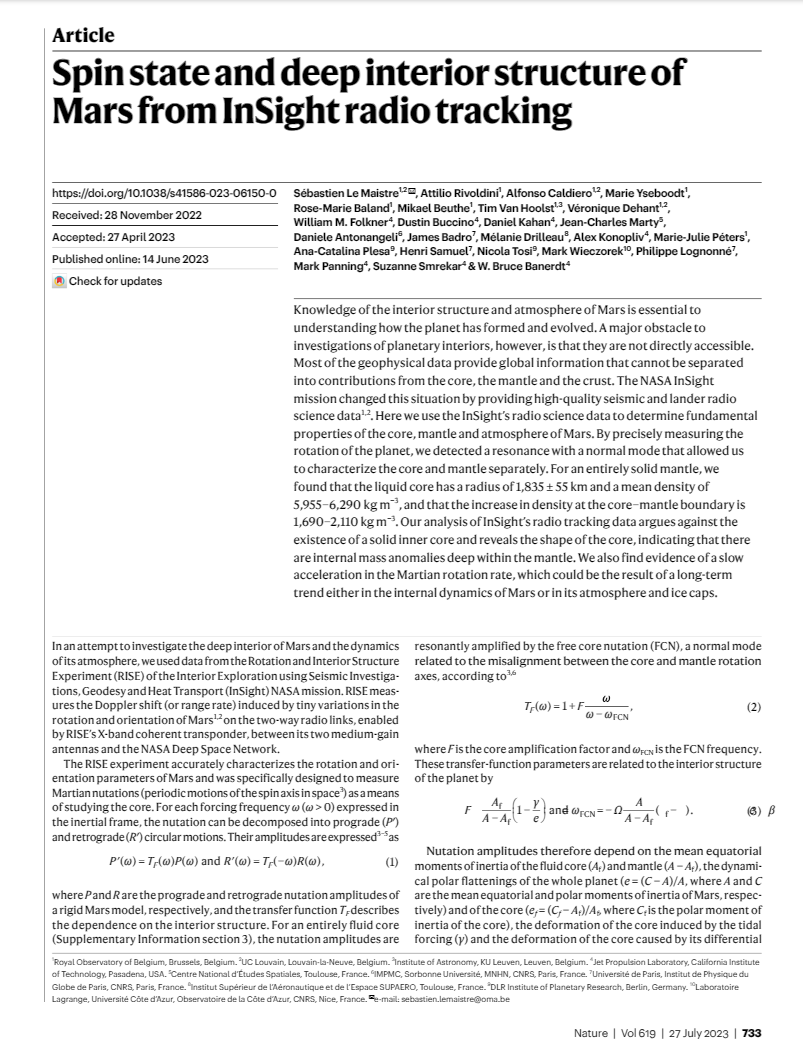
Scientists have made the most precise measurements ever of Mars’ rotation, for the first time detecting how the planet wobbles due to the “sloshing” of its molten metal core.
The findings, detailed in a Nature paper, rely on data from NASA’s InSight Mars lander, which operated for four years before running out of power during its extended mission in December 2022. To track the planet’s spin rate, the study’s authors relied on one of InSight’s instruments: a radio transponder and antennas collectively called the Rotation and Interior Structure Experiment, or RISE. They found the planet’s rotation is accelerating by about 4 milliarcseconds per year – corresponding to a shortening of the length of the Martian day by a fraction of a millisecond per year. It’s a subtle acceleration, and scientists aren’t entirely sure of the cause. But they have a few ideas, including ice accumulating on the polar caps or post-glacial rebound, where landmasses rise after being buried by ice. The shift in a planet’s mass can cause it to accelerate a bit like an ice skater spinning with their arms stretched out, then pulling their arms in.
…bij A3veen.nl, sinds 29-04-2003 de webplek van Aaldrik Adrie (A3) van der Veen, met een weBLOG vol weetjes die het delen waard zijn, onder het motto: “Zie de wereld door de ogen van A3…”