“Stop fossiele subsidies” – blokkade A12
Stop fossiele subsidies

Nederlandse medeplichtigheid aan genocide en ecocide moet stoppen, het is tijd voor dekoloniaal herstel en solidariteit.

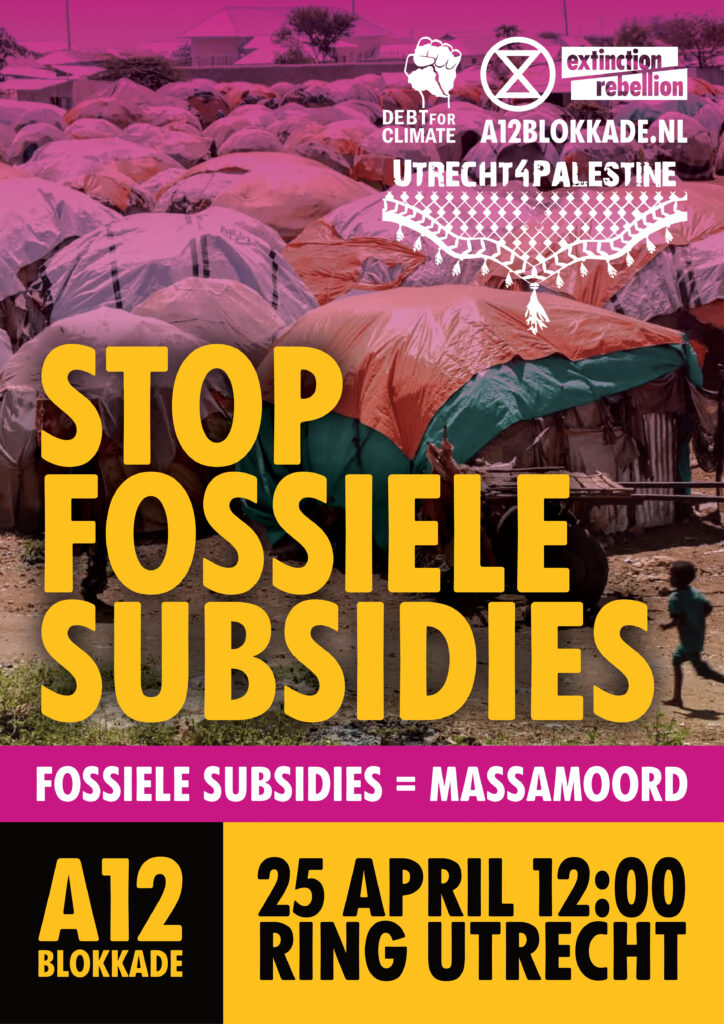
Op zaterdag 25 april 2026 om 12:00 uur leggen Extinction Rebellion (XR), Debt for Climate (D4C) en Utrecht for Palestine (U4P) de ring rond Utrecht plat. De blokkade vindt plaats na de reis van de Climate Justice Flotilla (CJF) en voorafgaand aan de conferentie over het uitfaseren van fossiele brandstoffen die Nederland en Colombia in Santa Marta organiseren. XR, D4C, U4P eisen een direct einde aan jaarlijks 39,7 tot 46,4 miljard euro fossiele subsidies. Deze subsidies jagen de klimaat- en ecologische crisis aan en gaan naar bedrijven die medeverantwoordelijk zijn voor de genocide van Israël op de Palestijnen. Het geld moet gebruikt worden voor betaalbare woningen en zorg, dekoloniaal herstel en schuldkwijtschelding.

Links:
Utrecht for Palestine sluit zich aan bij Extinction Rebellion en Debt for Climate: “Stop fossiele subsidies”

Escalatie A12-blokkade op ring Utrecht, regering moet in actie komen: “Stop fossiele subsidies”

A12 blokkade

2026-04-24, Lief dagboek

Vrijdag; Wat eten we vandaag?; Operatie (uitgesteld); Wereldproefdierendag; World Immunization Week.

Deze afbeelding heeft een leeg alt-attribuut; de bestandsnaam is dagboek.png

Wat eten we vandaag?:

Klik op afbeelding voor origineel

Operatie (uitgesteld):
A3 werd verwacht in het Tergooi ziekenhuis in Hilversum voor wederom een medische ingreep aan het rechteroor.

Klaar voor de ingreep, klik voor origineel

Na een lange tijd in de wachtkamer werd de patiënt voorbereid en aan het infuus gehangen. Toen kwam de behandelend arts meedelen dat de voorafgaande operaties deze dag waren uitgelopen en er rekening moest worden gehouden met uitstel. Later werd de vrees bewaarheid, er kon op deze dag niet meer geopereerd worden en kon A3 naar huis gaan.

Knipselkrant:

Agenda:

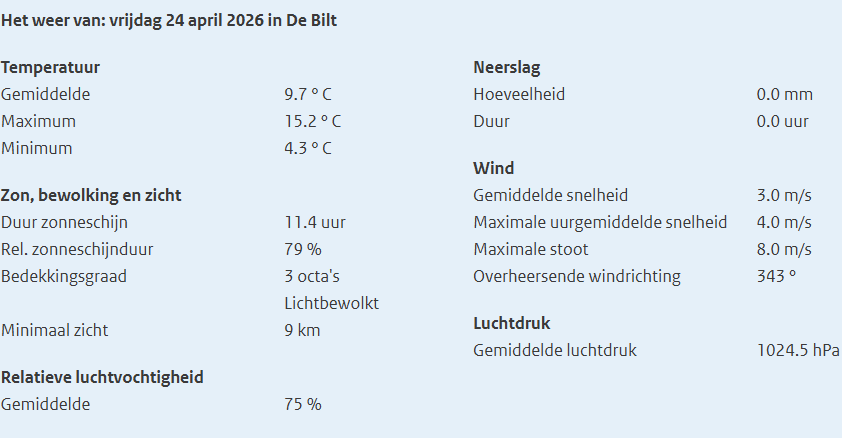
Weer:

Links:
In de geschiedenis

#LongLifeforAll World Immunization Week 2026


World Immunization Week

World Immunization Week is a global public health campaign to raise awareness and increase rates of immunization against vaccine-preventable diseases around the world, it takes place each year during the last week of April (24th – 30th).

Immunization can protect against 25 different infectious agents or diseases, from infancy to old age, including diphtheriameaslespertussispoliotetanus and COVID-19. The World Health Organization (WHO) estimates active immunization currently averts 2 to 3 million deaths every year. However, 22.6 million infants worldwide are still missing out on basic vaccines, mostly in developing countries. Inadequate immunization coverage rates often result from limited resources, competing health priorities, poor management of health systems and inadequate surveillance. The goal of World Immunization Week is to raise public awareness of how immunization saves lives, and support people everywhere to get the vaccinations needed against deadly diseases for themselves and their children. World Immunization Week sprung out of the efforts taking place across different countries and regions for a week-long immunization awareness commemoration. World Immunization Week is one of eleven official campaigns marked by the WHO, along with World Health DayWorld Blood Donor DayWorld No Tobacco DayWorld Tuberculosis DayWorld Malaria DayWorld Patient Safety DayWorld Hepatitis Day, World Antimicrobial Awareness Week, World Chagas Disease Day and World AIDS Day.

Links:
World Immunization Week 2026

Wereldproefdierendag / World Day for Laboratory Animals 2026

Jaarlijks wordt er op Wereldproefdierendag, 24 april, stil gestaan bij de vele dieren die in laboratoria zijn overleden.

En bij de vele proefdieren die werden gedood nog voordat ze aan proeven werden blootgesteld. Gewoon omdat ze overbodig waren. De dag wordt tevens gehouden als protest tegen het gebruik van proefdieren. De Verenigde Naties hebben 24 april erkend als dag om alle proefdieren te herdenken. Wereldproefdierendag werd in 1979 werd op initiatief van de Engelse organisatie ‘International Association Against Painful Experiments on Animals’ (deze organisatie bestaat sinds 1969) voor het eerst georganiseerd. De 24e april is de geboortedag van Lord Dowding (overleden in 1970), die in zijn leven fel van leer trok tegen het proefdiergebruik. Zijn vrouw, Lady Dowding (Muriel Albino Whiting), nam later een groot deel van zijn werk over. De naam Dowding is nog steeds verbonden aan een Engels fonds dat financiële middelen verstrekt om onderzoek te stimuleren zonder gebruik te maken van proefdieren.

Links:
World Day for Laboratory Animals

Be Cruelty-Free Campaign

#Dierendag / Eet Geen Dierendag / Dierendag tegen dierenmishandeling

Call for coordinated and concrete policies to advance non-animal science

Dierproeven zijn niet meer van deze tijd – petitie

Hoe nabij is proefdiervrij

First Conference on Transitioning Away from Fossil Fuels / Eerste Conferentie over de Afbouw van Fossiele Brandstoffen

First Conference on Transitioning Away from Fossil Fuels

Colombia and the Netherlands will host the First Conference on Transitioning Away from Fossil Fuels.

An International Conference on Transitioning Away from Fossil Fuels is one of a series of international conferences for planning a phase-out of fossil fuels (oilnatural gas, and coal) in an effort to reduce climate change, and to avoid the high prices, insecurity, volatility, conflict and instability associated with fossil fuels. These fossil fuel-related conferences complement the annual United Nations COP conferences that focus on climate change. The conferences were born of frustration with the yearly United Nations climate conferences (COP, Conference of the Parties) that began in 1995. At COP conferences, all countries must agree on the language of any agreement, so fossil fuel producing countries can oppose given language in the text and energy-rich nations can derail efforts to slow fossil fuel use. COP conferences traditionally focus on cutting greenhouse gas emissions, rather than directly addressing fossil fuel production. Greenhouse gas emissions from military operations, such as those in Ukraine (2022–) and Iran (2026), are not accurately accounted for under the 2015 Paris Agreement that was negotiated at COP 21. At COP28 (2023), countries agreed to transition away from fossil fuels, but did not agree on how. At COP 30 (2025), 80 countries supported phasing out fossil fuels but the conference ended without a plan. The conference’s organizer, Fossil Fuel Treaty Initiative, describes itself as “alliance of nation-states and civil society working to secure a global just transition from coal, oil and gas”. The conferences’ focus on fossil fuels complements, but does not replace, the work of COP climate change conferences.

The First International Conference on Transitioning Away from Fossil Fuels—also called The Santa Marta Conference—was held from 24–29 April 2026 in Santa Marta, Colombia. The conference was co-hosted by Colombia and the Netherlands, with 57 countries participating. Participating countries generate about one-third of global economic activity, with almost all participating nations being democracies. Representatives from indigenous groups, civil society, youth, and subnational authorities such as California also participated. The United States (the largest oil and gas producer and largest consumer of oil) and China (the largest consumer of coal) did not participate. Colombian environment minister Irene Vélez Torres said that, to avoid rehashing COP 30 debates, countries including China, Russia and the US were not invited. A “science pre-conference” attended by 400 global academics from 24–25 April conceived a scientific panel designed to quickly provide country-specific analyses to nations wanting to accelerate their transition. The scientific panel was seen as necessary to combat the climate and energy disinformation populating the media. The next day involved a meeting for subnational governments, parliamentarians and other stakeholders. Finally, a high-level segment for ministers and climate envoys was held on 28–29 April. The conference’s format was less formal than that of COP conferences. At the 2026 conferenceTuvalu and Ireland announced they would co-host the next conference on the Polynesian island of Tuvalu, which is facing rising sea levels.

Links:
First Conference on Transitioning Away from Fossil Fuels

Takeaways on the First Conference on Transitioning Away from Fossil Fuels

The Voyage Continues Tuvalu 2027

People in Santa Marta have spoken 📣

In Santa Marta willen zelfs olielanden met fossiel stoppen

Agenda – A Fair Fossil Fuel Phase-Out Is Feasible – publicatie

Renewables Trump card

Bijeenkomst over afbouw fossiele brandstoffen

EU-top – Informal meeting of heads of state or government of 23-24 April 2026

EU-top

EU leaders will meet in Lefkosia and Agia Napa (Cyprus) on 23-24 April for an informal meeting of heads of state and government.

The leaders will be joined by key regional partners in the Middle East for an informal working lunch on 24 April. The informal meeting will be chaired by the President of the European Council, António Costa, and hosted by the President of Cyprus, Nikos Christodoulides.

Links:
Informal meeting of heads of state or government of 23-24 April 2026

2026-04-23, Lief dagboek

Donderdag; Wat eten we vandaag?; Google geeft persoonsgegevens aan staat; Artemis; World Press Photo; Dierentransport; SLAPP rechtszaak Greenpeace; Wereldboekendag; AIVD Jaarverslag; Sit-in van Rijksambtenaren; Sit-ins op stations; War is the Health of the State; Russian Prison Art.

Deze afbeelding heeft een leeg alt-attribuut; de bestandsnaam is dagboek.png

Wat eten we vandaag?:

Klik op afbeelding voor origineel

Knipselkrant:


Greenpeace Nederland sleept pestkop oliegigant Energy Transfer voor de rechter www.greenpeace.org/nl/klimaat-c…

[image or embed]

— A3veen.nl (@a3veen.bsky.social) 23 april 2026 om 21:51

Agenda:

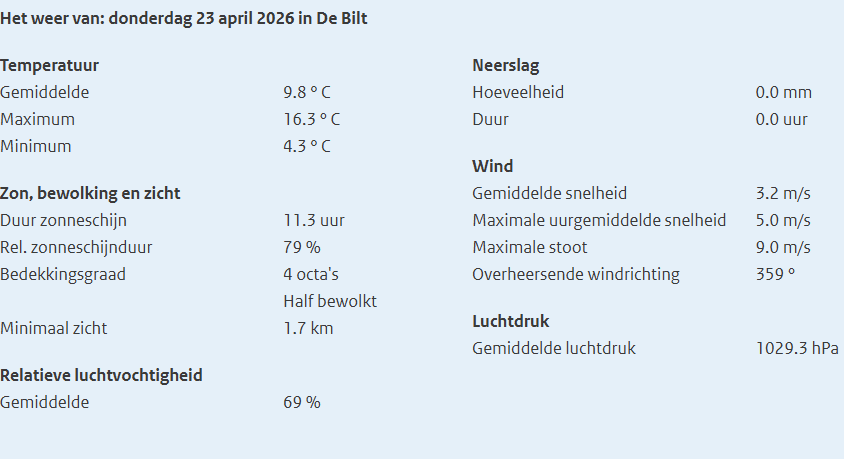
Weer:

Links:
In de geschiedenis