Bescherm Nederlandse burgers tegen online volgen en bespieden – petitie

Het volgen van ieders surf- en klikgedrag is in strijd met de AVG en heeft vele schadelijke gevolgen voor het functioneren van onze democratie, daarom moet de Nederlandse politiek zich inzetten voor een verbod op ‘online tracking’ in zowel Nederland als de EU.

Met online tracking wordt gedoeld op het online volgen van surfgedrag met behulp van cookies. Met de verzamelde informatie wordt van iedere internetgebruiker een persoonlijk profiel aangelegd dat een indringend beeld biedt van iemands interesses, voorkeuren en persoonlijke leven. Dit gebeurt zonder geldige toestemming en is daarmee in strijd met de AVG. Deze digitale profielen zijn niet zelden gebaseerd op zaken als etniciteit, gender en andere gevoelige kenmerken. Ondanks een EU-verbod op het gebruik van gevoelige gegevens vinden slimme algoritmes van techbedrijven vaak al snel alternatieve data die indirect hetzelfde onderscheid maken. Big tech verdient miljarden door massaal onze privacyrechten te schenden. De tracking technologie waarmee ze dat doen is voortdurend in ontwikkeling. Grote hoeveelheden persoonsgegevens van internetgebruikers worden daardoor nog sneller verzameld. De gebruikersprofielen worden vervolgens doorverkocht aan de hoogste bieder. Dit gebeurt allemaal achter onze rug om en vaak zonder geldige toestemming! Pasgeleden is de Europese Digital Services Act (DSA) in werking getreden. Dat is in het Nederlands: de digitale dienstenwet. Dit is al een stap in de goede richting om de schimmige aanpak van de techbedrijven aan banden te leggen. Maar de DSA gaat niet ver genoeg! Gebruik van gevoelige gegevens zoals ras, politieke overtuiging en gezondheid wordt verboden, maar de techbedrijven weten deze nieuwe regels nu al te omzeilen. The Privacy Collective is daarom met partners een petitie gestart. De lijst met organisaties die de petitie onderschrijven bestaat uit Bits of Freedom, Burgerrechtenvereniging Vrijbit, De Datavakbond, De Waag, Freedom Internet, Free Press Unlimited, Internet Society Nederland, Platform Burgerrechten en The Privacy Collective.

Links:
Bescherm Nederlandse burgers tegen online volgen en bespieden

#TheEarthshotPrize2023 / Earthshot Week 2023

The Earthshot Prize is awarded to five winners each year for their contributions to environmentalism, it was first awarded in 2021 and is planned to run annually until 2030.

Each winner receives a grant of £1 million to continue their environmental work. The five categories were inspired by the UN Sustainable Development Goals; they are ‘restoration and protection of nature’, ‘air cleanliness’, ‘ocean revival’, ‘waste-free living’, and ‘climate action’. The Earthshot Prize was launched in 2020 by Prince William and David Attenborough. The winners are selected by the Earthshot Prize Council, which includes Prince William and Attenborough. New for 2023, the awards ceremony was complemented by a series of events as part of ‘Earthshot Week’ taking place in the heart of Singapore. The week features thought-leadership forums, networking opportunities, community events and an exciting youth programme for exceptional young leaders from across Southeast Asia.

2023 Winners:

Links:
The Earthshot Prize 2023

2023-11-09, Lief dagboek

Donderdag; Wat eten we vandaag?; Mars voor klimaat en rechtvaardigheid; Urbanism Awards; Dag van de Uitvinders; Val Berlijnse Muur; Carl Sagan; Dag tegen Fascisme en Antisemitisme; Week of Science and Peace; The Earthshot Prize.

Wat eten we vandaag?:

Lunch, klik op afbeelding voor origineel

Knipselkrant:


Agenda:

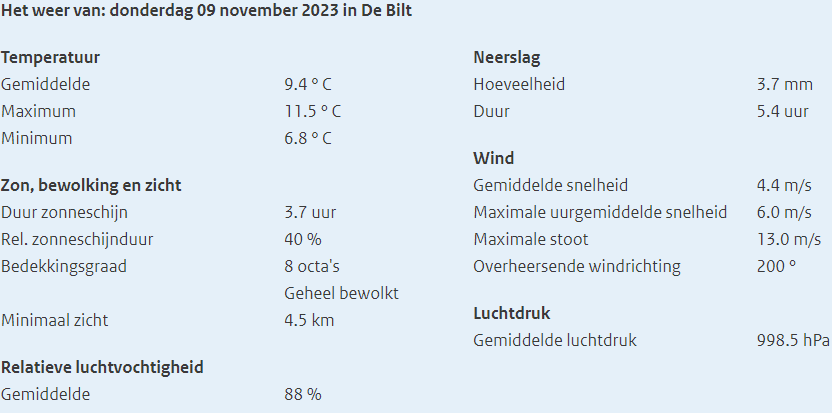
Weer:

Links:
In de geschiedenis

Week of Science and Peace 2023

The International Week of Science and Peace was first observed during 1986 as part of the observance of the International Year of Peace.

The organization of events and activities for the week was undertaken as a non-governmental initiative; the secretariat for the International Year of Peace was informed of the preparatory activities and the final summary of events that occurred during the week. The organizers sought to encourage the broadest possible international participation in the observance. Based on the success of the 1986 observance, the organizers continued their efforts in successive years. In recognition of the value of the annual observance, the General Assembly adopted resolution 43/61 in December 1988, which proclaims the “International Week of Science and Peace”, to take place each year during the week in which 11 November falls. The General Assembly urged Member States and intergovernmental and non-governmental organizations to encourage relevant institutions, associations and individuals to sponsor events and activities related to the study and dissemination of information on the links between progress in science and technology and maintenance of peace and security; urged Member States to promote international co-operation among scientists and required the Secretary-General to report to the General Assembly as its forty-fifth session on the activities and initiatives of Member States and interested organizations in connection with the week. The annual observance of the International Week of Science and Peace is making an important contribution to the promotion of peace. The Week encourages greater academic exchanges on a subject of universal importance while also generating greater awareness of the relationship of science and peace among the general public. Based on observances of Science and Peace Week to date, it may be expected that participation each year will increase, contributing to greater international understanding and opportunities for co-operation in the applications of science for the promotion of peace throughout the year.

Links:
Week of Science and Peace

Dag tegen Fascisme en Antisemitisme / #Kristallnacht herdenking 2023

De Kristallnacht was het resultaat van de al in 1933 begonnen nazi-propaganda en indoctrinatie van de Duitse en Oostenrijkse bevolking specifiek gericht tegen de Joden.

Het uiteindelijk resultaat was de Holocaust. De naam Kristallnacht verwijst naar het vele glaswerk (etalageramen) dat tijdens deze rellen werden vernield.

Links:
Night of the broken glass

Day Against Fascism and Antisemitism : Speak up now! Fighting fascism is not radical, it is necessary!

Herdenking Kristallnacht extra beladen door oorlog

Carl Sagan – birthday (1934) / Carl Sagan Prize for Science Popularization 2023

Carl Edward Sagan (/ˈseɪɡən/; November 9, 1934 – December 20, 1996) was an American astronomer, cosmologist, astrophysicist, astrobiologist, author, science popularizer, and science communicator in astronomy and other natural sciences.

He is best known for his work as a science popularizer and communicator. His best known scientific contribution is research on extraterrestrial life, including experimental demonstration of the production of amino acids from basic chemicals by radiation. Sagan assembled the first physical messages sent into space: the Pioneer plaque and the Voyager Golden Record, universal messages that could potentially be understood by any extraterrestrial intelligence that might find them. Sagan argued the now accepted hypothesis that the high surface temperatures of Venus can be attributed to and calculated using the greenhouse effect.

Sagan published more than 600 scientific papers and articles and was author, co-author or editor of more than 20 books. He wrote many popular science books, such as The Dragons of Eden, Broca’s Brain and Pale Blue Dot, and narrated and co-wrote the award-winning 1980 television series Cosmos: A Personal Voyage. The most widely watched series in the history of American public television, Cosmos has been seen by at least 500 million people across 60 different countries. The book Cosmos was published to accompany the series. He also wrote the science fiction novel Contact, the basis for a 1997 film of the same name. His papers, containing 595,000 items, are archived at The Library of Congress.

Sagan advocated scientific skeptical inquiry and the scientific method, pioneered exobiology and promoted the Search for Extra-Terrestrial Intelligence (SETI). He spent most of his career as a professor of astronomy at Cornell University, where he directed the Laboratory for Planetary Studies. Sagan and his works received numerous awards and honors, including the NASA Distinguished Public Service Medal, the National Academy of Sciences Public Welfare Medal, the Pulitzer Prize for General Non-Fiction for his book The Dragons of Eden, and, regarding Cosmos: A Personal Voyage, two Emmy Awards, the Peabody Award, and the Hugo Award. He married three times and had five children. After suffering from myelodysplasia, Sagan died of pneumonia at the age of 62, on December 20, 1996.

Links:
Carl Sagan Prize for Science Popularization

Val Berlijnse Muur (1989) 2023

Door Jess & Peter uit Geneva, Switzerland – Flickr, CC BY 2.0

De Berlijnse Muur viel op 9 november 1989.

Onder de Berlijnse Muur verstaat men een 100 m brede constructie van opeenvolgende obstakels die van 13 augustus 1961 tot 9 november 1989 West- en Oost-Berlijn van elkaar scheidde. De Berlijnse Muur was 45,3 km lang en een onderdeel van de Duits-Duitse grens. De Berlijnse Muur was het bekendste symbool van de Koude Oorlog en de deling van Duitsland.

Links:
Berlijnse Muur