
Je staat te koop : rechtszaak tegen Adobe om privacyschending
Softwaremaker Adobe, onder meer bekend van het pdf-programma, verzamelt op grote schaal privacygevoelige informatie van Nederlanders stelt Stichting Data Bescherming Nederland (SDBN) die een rechtszaak tegen de softwaremaker aanspant.

Iedereen die regelmatig het internet gebruikt via de Chrome-browser en regelmatig apps downloadt en gebruikt, is slachtoffer van Adobe en kan zich gratis voor deze rechtszaak aanmelden. Adobe verzamelt, zo stelt SDBN, in het geheim enorme hoeveelheden persoonsgegevens via onder meer de websites van KPN, ABP, Beter Horen en zelfs de Belastingdienst, en via mobiele apps van onder andere Marktplaats en Buienradar. Namens miljoenen Nederlanders eist SDBN dat Adobe stopt met het verzamelen van persoonsgegevens via tracking cookies en via software in mobiele apps. Contact met het bedrijf heeft de afgelopen maanden niets opgeleverd en daarom stapt SDBN naar de rechter. Iedereen die regelmatig het internet gebruikt via de Chrome-browser en regelmatig apps download en gebruikt, is slachtoffer van Adobe en kan zich gratis voor deze rechtszaak aanmeldenstaa via de website van Je staat te koop.

Links:
Je staat te koop

Massaclaim tegen Adobe: softwaregigant plaatst illegaal tracking cookies en deelt data miljoenen Nederlanders met bedrijven

A data dump of suffering: the EU’s long-distance trade in farm animals exposed – publication

The report A data dump of suffering: the EU’s long-distance trade in farm animals exposed, released by the animal protection NGOs Eurogroup for Animals and Compassion in World Farming, reveals analyses a cache of previously unpublished EU records relating to the long-distance transportation of 180,000 consignments of farmed animals within and from the EU during a 19-month period from October 2021 to April 2023.

It reveals disturbing details of the extent and nature of suffering endured by around 44 million farmed cattle, sheep, pigs and other animals transported annually. The report shows that the EU’s journey records were incomplete, often inaccurate and vastly underestimate the sheer extent of the length and duration of many journeys. Around 60% of journeys are shown as starting at assembly centres but animals may have been transported from the farm of origin for many hours prior to this without any requirement for this to be logged. Many transporters practise ‘assembly centre hopping’, avoiding the requirement for animals to be given 24 hours mid-journey rest before resuming their journey.

This release comes just days before the publication of the European Commission’s (EC) proposal on animal transport on 7 December. However, the EC has failed to publish the other proposals it committed to present as part of a more comprehensive revision of the animal welfare legislation, including the ban on caged animal farming, which was expected by September 2023. The two NGOs are calling on the EU to ban the export of live animals from the EU to non-EU countries, to switch to a trade in meat and carcasses only, and to introduce tougher rules to protect the welfare of animals on journeys within the EU. This call for greater protection for farmed animals’ welfare during transportation is supported by the majority of European citizens. The 2023 Special Eurobarometer found that eight out of ten Europeans think the travel time for the commercial transport of live animals within or from the EU should be limited1 and an overwhelming nine out of ten people believe it’s important to protect the welfare of farmed animals.

Links:
EU maakt geen einde aan dierenleed verre veetransporten

True horror of EU live animal transport masked in official records 

StopTransportSuffering – open letter

2023-12-13, Lief dagboek

Woensdag; Wat eten we vandaag?; Dierentransport; COP28 2023 United Nations Climate Change Conference; Gaza−Israël oorlog van 2023; Global Refugee Forum; Gezonde eiwittransitie.

Wat eten we vandaag?:

Rijst, klik op afbeelding voor origineel

Knipselkrant:


Agenda:

Weer:

Links:
In de geschiedenis

We’ve ‘lost’ 19 years in the battle against global warming since the Paris Agreement – publication

When the Paris Agreement was signed, in December 2015, the world was projected to reach the 1.5°Celsius (C) threshold by March 2045.

Today, on the 8th anniversary of its signature, we risk breaching that benchmark by February 2034, according to data extrapolation based on Copernicus Climate Change Service data. But many other indicators have turned red since the Paris Agreement. Time is shrinking if we want to keep the global temperatures below 1.5°C compared with the pre-industrial average. An application developed by C3S shows it very clearly. In 2015, when COP delegates signed the Paris accord, our data estimated that the global temperature was 0.98°C above the pre-industrial average and would have breached the 1.5°C threshold in 2045. Today, as delegates address the first global stocktake, a critical inventory of the Paris Agreement actions and commitments to assess the progress made, the same data estimates that we have reached a global average of 1.25°C and will be at 1.5°C over pre-industrial levels in 2034. And this extrapolation, doesn’t take into account the record temperatures of November 2023.

Links:
We’ve ‘lost’ 19 years in the battle against global warming since the Paris Agreement

Wereldlichtjesdag 2023

Wereldlichtjesdag, iedere tweede zondag van december, is de dag van het overleden kind, mensen branden om 19:00 wereldwijd kaarsjes om overleden kinderen te herdenken.

Door de verschillende tijdzones in de wereld ontstaat hierdoor een golf van licht, zodat de wereld een beetje lichter wordt voor de mensen die hun kind hebben verloren en daarbij mogen beseffen dat zij niet alleen zijn met hun verdriet.

Links:
Wereldlichtjesdag

Chapman-Silverman storm of 1872 / The Extreme Space Weather Event of 1872 February: Sunspots, Magnetic Disturbance, and Auroral Displays – publication

Two of the most massive magnetic solar storms known are the Carrington Event of 1859 and the New York Railroad Superstorm of 1921, the study ‘The Extreme Space Weather Event of 1872 February: Sunspots, Magnetic Disturbance, and Auroral Displays‘, however, also identified another storm named the Chapman-Silverman storm of 1872.
Links:
Historic magnetic storms help scientists learn what to expect when one hits

In 1872, a Solar Storm Hit the Earth Generating Auroras from the Tropics to the Poles

List of solar storms

Actueel dreigingsniveau 12 december 2023: Dreigingsniveau verhoogd naar 4 (substantieel)

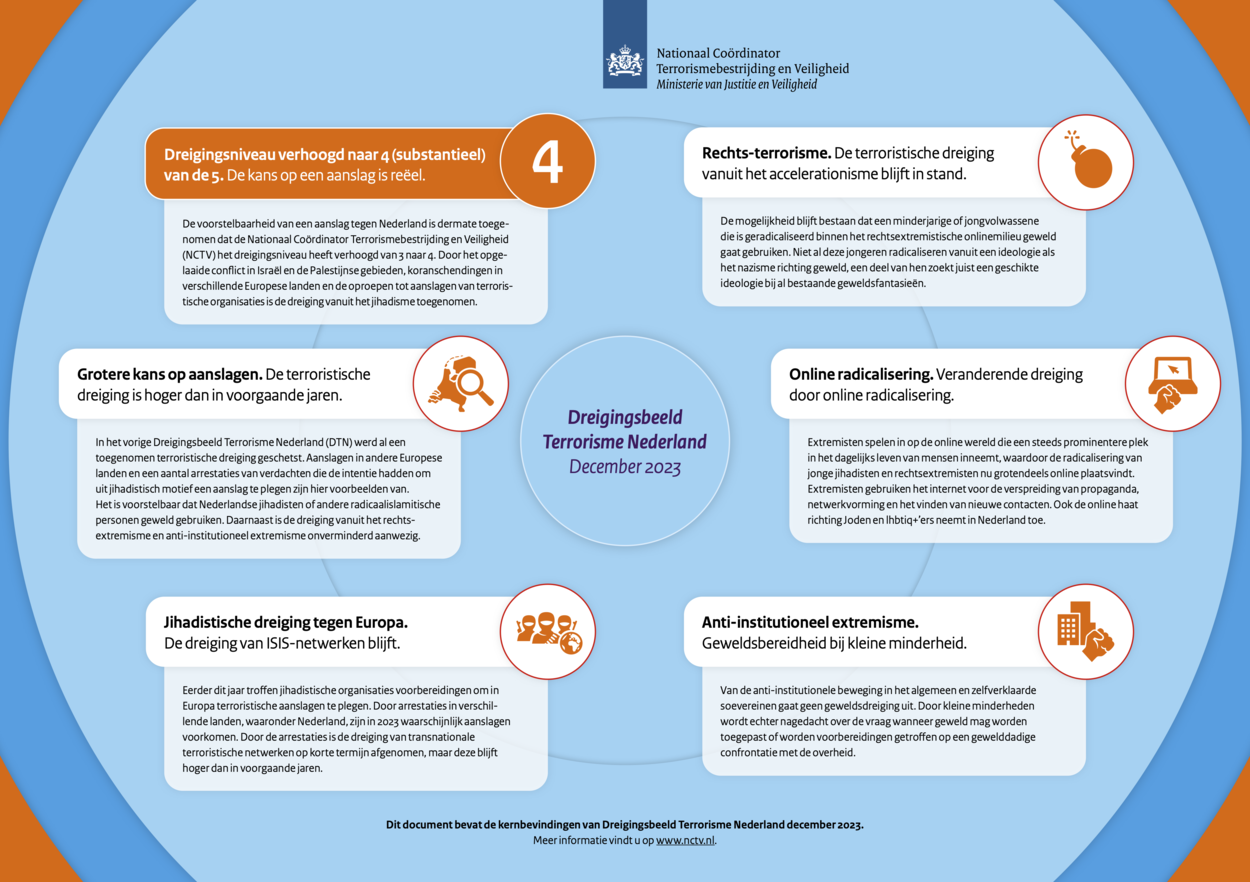
Op 12 december 2023 is het terreurdreigingsniveau in Nederland verhoogd naar 4 (substantieel) van in totaal 5 dreigingsniveaus, dat betekent dat de kans op een aanslag reëel is.

Dat blijkt uit het Dreigingsbeeld Terrorisme Nederland van december 2023 (DTN). Door het opgelaaide conflict in Israël en de Palestijnse gebieden, koranschendingen in verschillende Europese landen en de oproepen tot aanslagen van terroristische organisaties is de dreiging vanuit het jihadisme toegenomen. De voorstelbaarheid van een aanslag tegen Nederland is dermate toegenomen dat de Nationaal Coördinator Terrorismebestrijding en Veiligheid (NCTV) het dreigingsniveau heeft verhoogd van 3 (aanzienlijk) naar 4 (substantieel). Dat betekent dat er een reële kans is dat er een aanslag in Nederland plaatsvindt. Dat schrijft de NCTV in het Dreigingsbeeld Terrorisme Nederland december 2023. In het vorige Dreigingsbeeld Terrorisme Nederland werd al een toegenomen terroristische dreiging geschetst, omdat jihadistische organisaties voorbereidingen troffen om in Europa terroristische aanslagen te plegen.

Links:
NCTV verhoogt dreigingsniveau terrorisme van 3 naar 4

#YearOfCamelids

The United Nations declared 2024 the Year of Camelids (IYC 2024), the Year will highlight how camelids are key to the livelihoods of millions of households across over 90 countries.

From alpacas to Bactrian camels, dromedaries, guanacos, llamas, and vicuñas, camelids contribute to food security, nutrition and economic growth as well as holding a strong cultural significance for communities across the world. Camelids play an important role in advancing the Sustainable Development Goals(SDGs) related to the fight against hunger, the eradication of extreme poverty, the empowerment of women and the sustainable use of terrestrial ecosystems. From providing milk, meat and fibre for communities to transport for products and people, and organic fertilizer, camelids thrive where other livestock species cannot survive. Camelids play a key role in the culture, economy, food security and livelihoods of communities in Andean highlands and in the arid and semi-arid lands in Africa and Asia, including Indigenous Peoples. Even in extreme climatic conditions they continue to produce fibre and nutritious food. Indeed, the IYC 2024 presents a unique opportunity to raise awareness of the role of camelids in building resilience to climate change – particularly in mountains and arid and semi-arid lands. The IYC 2024 aims to build awareness of the untapped potential of camelids and to call for increased investment in the camelid sector, advocating for greater research, capacity development and the use of innovative practices and technologies.

Links:
Year of Camelids