#SharkAwarenessDay Haai Bewustwordingsdag 2024

Evenement om aandacht te vragen voor de bedreigingen waar haaien mee te maken hebben.

Feit is dat deze machtige roofdieren meer van ons te duchten hebben dan andersom. Meer dan 100 miljoen haaien leggen elk jaar het loodje en diverse soorten dreigen uit te sterven. De grootste bedreiging voor de haaien is zoals gewoonlijk de mens. Onze motorboten, visnetten en onze angst voor haaien vormen bedreigingen voor het bestaan van de haai. Maar net als andere toppredators op het land spelen haaien een essentiële rol bij het gezond en productief houden van de zeeën. De grootste bedreiging is geld. Simpelweg omdat dode haaien nu eenmaal veel geld opleveren. Alleen al in de haaienvinnensoep verdwijnen miljoenen haaien. Ze worden ook gedood voor hun tanden (souvenir), kraakbeen (medicijn) en lever (vitamine A). Sinds de film Jaws vinden veel mensen het stoer om een haai te vangen. Maar uiteindelijk verdwijnen de meeste haaien als “bijvangst” in de visnetten. En daar staan we bij stil op de Shark Awareness Day.

Links:
What is Shark Awareness Day- Why Should We Care?

#SharkAwarenessDay

Barbershop Music Appreciation Day 2024

Barbershop Music Appreciation Day takes place on July 13 every year.

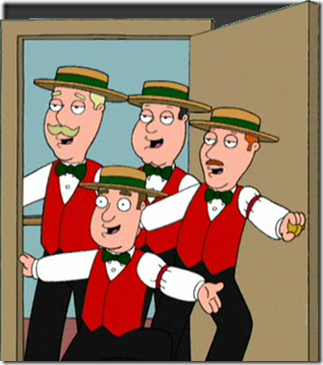
The best way to join in Barbershop Music Appreciation Day is to go straight into a barbershop and enjoy the music that you can hear inside. In 2005, “The Sweet Adelines International” have founded this cheery holiday on their 60th anniversary. Barbershop vocal harmony, as codified during the barbershop revival era (1930s–present), is a style of a cappella close harmony, or unaccompanied vocal music, characterized by consonant four-part chords for every melody note in a primarily homorhythmic texture. Each of the four parts has its own role: generally, the lead sings the melody, the tenor harmonizes above the melody, the bass sings the lowest harmonizing notes, and the baritone completes the chord, usually below the lead. The melody is not usually sung by the tenor or baritone, except for an infrequent note or two to avoid awkward voice leading, in tags or codas, or when some appropriate embellishment can be created. One characteristic feature of barbershop harmony is the use of what is known as “snakes” and “swipes”. This is when a chord is altered by a change in one or more non-melodic voices. Occasional passages may be sung by fewer than four voice parts.

Barbershop music is generally performed by either a barbershop quartet, a group of four singers with one on each vocal part, or a barbershop chorus, which closely resembles a choir with the notable exception of the genre of music. According to the Barbershop Harmony Society (BHS), “Barbershop music features songs with understandable lyrics and easily singable melodies, whose tones clearly define a tonal center and imply major and minor chords and barbershop (dominant and secondary dominant) seventh chords that resolve primarily around the circle of fifths, while making frequent use of other resolutions.” Slower barbershop songs, especially ballads, often eschew a continuous beat, and notes are often held (or sped up) ad libitum. Except for the bass, the voice parts in barbershop singing do not correspond closely to their classical music counterparts; the tenor range and tessitura are similar to those of the classical countertenor, the baritone resembles the Heldentenor or lyric baritone in range and a tenor in tessitura, and the lead generally corresponds to the tenor of classical repertoire, with some singers possessing a tessitura more similar to that of a high baritone. Barbershop singing is performed both by men’s and women’s groups; the elements of the barbershop style and the names of the voice parts are the same for both.

Links:
Listen to Barbershop music at the Internet Archive

The Origins of Barbershop Harmony

#EmbraceYourGeeknessDay 2024

Due to Embrace your Geekness Day on July 13 all geeks in the world are invited to feel proud about their peculiarities.

The word “geek” originally refers to someone who strikes out for his or her strange deeds. Today it’s rather a word for people who have a major interest in science or fictional topics. People who get very much into something and mostly if it’s from the IT sector are often called geeks. Above all Embrace your Geekness Day emphasizes the positive features of geeks. Very often they are keen specialists on a certain topic which is a natural consequence of their detailed involvement in mostly technical issues. This would be a good reason to embrace oneself and feel proud not only on Embrace your Geekness Day. The definition of the word geek is very close to that of the word nerd or hacker: also persons who like to deal with technology and have therefore only few practises in social interactions. The social behavior of geeks and the communication between two geeks is often incomprehensible for non-geeks. Geek is also a derogative name for people with a high level of intelligence combined with rare social skills.

Links:
It’s Embrace Your Geekness Day | July 13, 2024

Transmission Spectroscopy of the Habitable Zone Exoplanet LHS 1140 b with JWST/NIRISS – publication

Located 50 light-years from Earth, the beady-eyed exoplanet LHS 1140 b could be a perfect candidate for discovering liquid water outside the solar system, research ‘Transmission Spectroscopy of the Habitable Zone Exoplanet LHS 1140 b with JWST/NIRISS‘ suggests.

Links:
Habitable Zone Exoplanet LHS 1140b is Probably Snowball or Water World

‘Eyeball’ planet spied by James Webb telescope might be habitable

Kwaku Summer Festival 2024

Het Kwaku Summer Festival (voorheen het Kwakoe Zomerfestival) wordt sinds 1975 bijna elk jaar tijdens een aantal weekeinden in de zomer gehouden in het Nelson Mandelapark in Amsterdam-Zuidoost.

Het is van origine een Surinaams festival, maar het heeft zich ontwikkeld tot een multicultureel festival. Op woensdag 1 juli 1863 werd de slavernij in Suriname afgeschaft. Een naam die vanuit de slavernijtijd verbonden is aan woensdag is Kwaku. Zonen van de Akan in Ghana die op woensdag geboren werden kregen de naam Kwaku. Het festival is ontstaan in 1975 als voetbaltoernooi, georganiseerd door Stichting Jongeren Centrum Kwakoe. Het speelde zich aanvankelijk af op de sportvelden van SV Bijlmer, op de locatie van het huidige Bijlmerplein in Amsterdam Zuidoost. In 1983 verhuisde het festival naar de huidige locatie in het Nelson Mandelapark dat in die tijd Bijlmerpark heette. Eind jaren negentig dienden zowel het jongerencentrum Kwakoe als de organisatie van het festival een vergunningaanvraag in. De festivalorganisatie Stichting Kwakoe Events onder leiding van Winston Kout kreeg de vergunning toegewezen en heeft het festival sindsdien georganiseerd. Van een louter Surinaams feest, voor arme Surinamers uit de Bijlmerhoogbouw die geen geld hebben om op vakantie te gaan, ontwikkelde het festival zich sindsdien tot een multicultureel festival dat zich ook op Antillianen en Afrikanen richt. Op zondag 27 juli 2008 werd tijdens het Kwakoe Zomerfestival voor het eerst de Roze Zondag georganiseerd, een initiatief van de Surinaamse lhbt-activist Mikel Haman. Als eerbetoon wordt tijdens de Roze Zondag van 2018 voor het eerst de Mikel Haman Award uitgereikt aan een persoon die zich op bijzondere wijze voor de positie van lhbt’ers heeft ingezet.

Links:
Kwaku festival