


In de geschiedenis
Links:
Wikipedia
46th session of the World Heritage Committee 2024

The World Heritage Committee meets once a year for an ordinary session to discuss the management of existing World Heritage Sites, and accept nominations by countries.
Extraordinary meetings can be convened at the request of two-thirds of the state members. Meetings are held within the territory of state members of the World Heritage Committee at their invitation. Rotation between regions and cultures is a consideration for selection and the location for the next session is chosen by the committee at the end of each session.
The World Heritage Committee is a committee of the United Nations Educational, Scientific and Cultural Organization that selects the sites to be listed as UNESCO World Heritage Sites, including the World Heritage List and the List of World Heritage in Danger, defines the use of the World Heritage Fund and allocates financial assistance upon requests from States Parties. It comprises representatives from 21 state parties that are elected by the General Assembly of States Parties for a four-year term. These parties vote on decisions and proposals related to the World Heritage Convention and World Heritage List. According to the World Heritage Convention, a committee member’s term of office is six years. However many States Parties choose to voluntarily limit their term to four years, in order to give other States Parties an opportunity to serve. All members elected at the 15th General Assembly (2005) voluntarily chose to reduce their term of office from six to four years. Deliberations of the World Heritage Committee are aided by three advisory bodies, the IUCN, ICOMOS and ICCROM.
46th session of the World Heritage Committee
Vroege Vogels Radio | 21 juli 2024 (Radio 1 NPO)

Vroege Vogels is een live-radioprogr
In het radioprogramma wordt het gesproken woord omlijst door licht klassieke muziek en salonmuziek. He
Deze zomer krijgen onze verslaggevers de kans om de reportage van hun dromen te maken. Voor verslaggever Gert Elbertsen was die keuze snel gemaakt: zijn jeugdheld Midas Dekkers interviewen! Hoe verantwoord is de herintroductie van lammer- of baardgieren, als er nog steeds met medicijnen vergiftigd aas in de bergen ligt? En verder: op pad met Nederlands kampioen veldrijden én vogelaar Joris Nieuwenhuis, gaasvliegen, Madelief filmfestival en de column is deze week van Niki Dekker. Voor de start van de zomerserie heeft Midas Dekkers een extra column gemaakt.
Links:
Vroe
Mens steeds vaker in conflict met wilde dieren
Madelief festival, vogelende NK veldrijder en alle overige onderwerpen
2024-07-20, Lief dagboek
Zaterdag; Wat eten we vandaag?; Wereldwijde computerstoring; Wereld Schaakdag; Moon Day; KMI Code Geel.

Wat eten we vandaag?:

Knipselkrant:
Agenda:
Weer:

Links:
In de geschiedenis
Digital biomarkers for non-motor symptoms in Parkinson’s disease: the state of the art – publication

Smartwatch brengt onzichtbare symptomen van Parkinson in beeld, door slimme sensoren krijgen zorgverleners meer inzicht in het ziekteverloop.
Bij Parkinson denk je vooral aan traagheid en trillen, maar ook andere klachten komen vaak voor, echter is er voor deze symptomen nauwelijks aandacht in onderzoek naar Parkinson volgens onderzoekers van het Radboudumc. Denk aan slaapproblemen, depressieve klachten, een verminderd denkvermogen en plasproblemen. Onterecht, want ze hebben veel invloed op de kwaliteit van leven. De onderzoekers zochten daarom uit hoe ze deze klachten kunnen meten in de thuissituatie. Het onderzoeksteam spitte de wereldwijde wetenschappelijke literatuur door op zoek naar geschikte meetmethodes. Daarbij beperkten ze zich niet tot onderzoek bij mensen met Parkinson, maar keken ze ook naar andere aandoeningen. Vooral slimme sensoren die de slaapkwaliteit meten blijken veelbelovend. In vrijwel alle gevallen gaat het daarbij om metingen aan de pols, door bijvoorbeeld smartwatches. Die geven verrassend betrouwbare resultaten, vergeleken met een uitgebreid slaaponderzoek waarvoor je een nacht moet worden opgenomen in een ziekenhuis of gespecialiseerde kliniek. Mensen met Parkinson deden als “patiëntonderzoekers” mee aan het literatuuronderzoek. Onderzoeker Jules Janssen Daalen legt uit: ‘We betrokken hen al in een vroeg stadium en ze speelden een belangrijke rol. Zo beoordeelden ze welke sensoren echt toepasbaar zijn in het dagelijks leven, zeker als je ze jarenlang zou moeten gebruiken.’ Ook daar kwamen de smartwatches goed uit de bus. Andere innovatieve meetmethodes, zoals slimme toiletten die het plassen meten en sensoren in de woonkamer die je gedrag in de gaten houden vonden de patiëntonderzoekers minder wenselijk. Die hebben een veel grotere inbreuk op de privacy, en hun toegevoegde waarde bij de ziekte van Parkinson is nog niet bewezen.
Links:
Smartwatch brengt onzichtbare symptomen van Parkinson in beeld
World #ChessDay / Wereld Schaakdag 2024

On 12 December 2019, the General Assembly proclaimed 20 July as World Chess Day to mark the date of the establishment of the International Chess Federation (FIDE) in Paris in 1924.
Chess is a two player strategy board game where the aim is to move different types of playing piece, each with a prescribed set of possible moves, around a chequered square board trying to capture the opponents ‘king’ piece. Today there are over 2,000 identifiable variants of the game. One theory is that an early game similar to chess called Chaturanga originated in Northern Indian Subcontinent during the Gupta period (~ 319 – 543 CE) and spread along the Silk Roads west to Persia. Whilst modern Chess is believed to have been derived from Chaturanga means ‘four divisions’ referring either to the divisions of the playing pieces into infantry, cavalry, elephantry and chariotry (pieces which in the modern game became the pawn, knight, bishop and rook), or to the fact that the game was played by four players. Chatrang, and later Shatranj, was the name given to the game when it arrived in Sassanid Persia around 600 CE.
The earliest reference to the game comes from a Persian manuscript of around 600 CE, which describes an ambassador from the Indian Subcontinent visiting king Khosrow I (531 – 579 CE) and presenting him with the game as a gift. From there it spread along the Silk to other regions including the Arabian Peninsula and Byzantium. In 900 CE, Abbasid chess masters al-Suli and al-Lajlaj composed works on the techniques and strategy of the game, and by 1000 CE Chess was popular across Europe, and in Russia where it was introduced from the Eurasian Steppe. The Alfonso manuscripts, also known as the Libro de los Juegos (Book of Games), a medieval collection of texts on three different types of popular game from the 13th century CE describe the game of Chess as very similar to Persian Shatranj in rules and gameplay.
Under initiative of FIDE, July 20 has been observed as International Chess Day by chess players around the world since 1966. The designation of World Chess Day of the UN will not only recognize the important role of the FIDE in supporting international cooperation for chess activity and aiming to improve friendly harmony among all peoples of the world, but also to provide an important platform to foster, dialogue, solidarity and culture of peace.
The United Nations recognizes that sports, the arts and physical activity have the power to change perceptions, prejudices and behaviours, as well as to inspire people, break down racial and political barriers, combat discrimination and defuse conflict, and therefore contribute in promoting education, sustainable development, peace, cooperation, solidarity, social inclusion and health at the local, regional and international levels. Chess is one of the most ancient, intellectual and cultural games, with a combination of sport, scientific thinking and elements of art. As an affordable and inclusive activity, it can be exercised anywhere and played by all, across the barriers of language, age, gender, physical ability or social status.
Chess is a global game, which promotes fairness, inclusion and mutual respect, and noting in this regard that it can contribute to an atmosphere of tolerance and understanding among peoples and nations. Chess also offers important opportunities in the implementation of the 2030 Agenda for Sustainable Development and the Sustainable Development Goals, including strengthening education, realizing gender equality and the empowerment of women and girls and fostering inclusion, tolerance, mutual understanding and respect.
Links:
W
#KMI #CodeGeel : Onweer
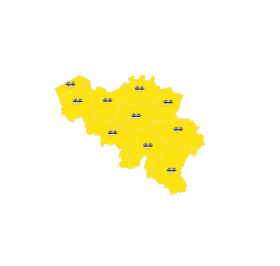
In de namiddag en aan het begin van de avond barsten er op sommige plaatsen enkele onweerachtige cellen los.
Ze zijn weinig mobiel, waardoor er veel neerslag op korte tijd kan vallen en ze gaan mogelijk gepaard met hagel. Later vanavond en vannacht bereikt een zone met meer gestructureerde onweerachtige buien ons land (aankomst verwacht iets voor of rond middernacht vanaf Frankrijk, einde voorzien tegen de ochtend via het noorden). Deze onweersbuien kunnen vergezeld zijn van zeer intense neerslag, krachtige rukwinden en hagel. Hoewel de waarschuwing een gele code hanteert (lokaal 20 tot 30 l/m² in 1h tijd en rukwinden van 70 tot 90 km/h), kan er zeer lokaal een oranje kleur voorkomen, vooral dan tijdens de nacht (40 l/m² of iets meer in weinig tijd en sterke windstoten).
Links:
Weerstation
Moon Day 2024

The General Assembly declared International Moon Day, a United Nations-designa
Internatio
Link
Moon Day
Apollo 11 Real-Time Mission Experience
Rare Views of the Moon, as Seen by Apollo Astronauts
Lette
In de geschiedenis
Links:
Wikipedia