Superlijst Gezondheid 2024 – publicatie

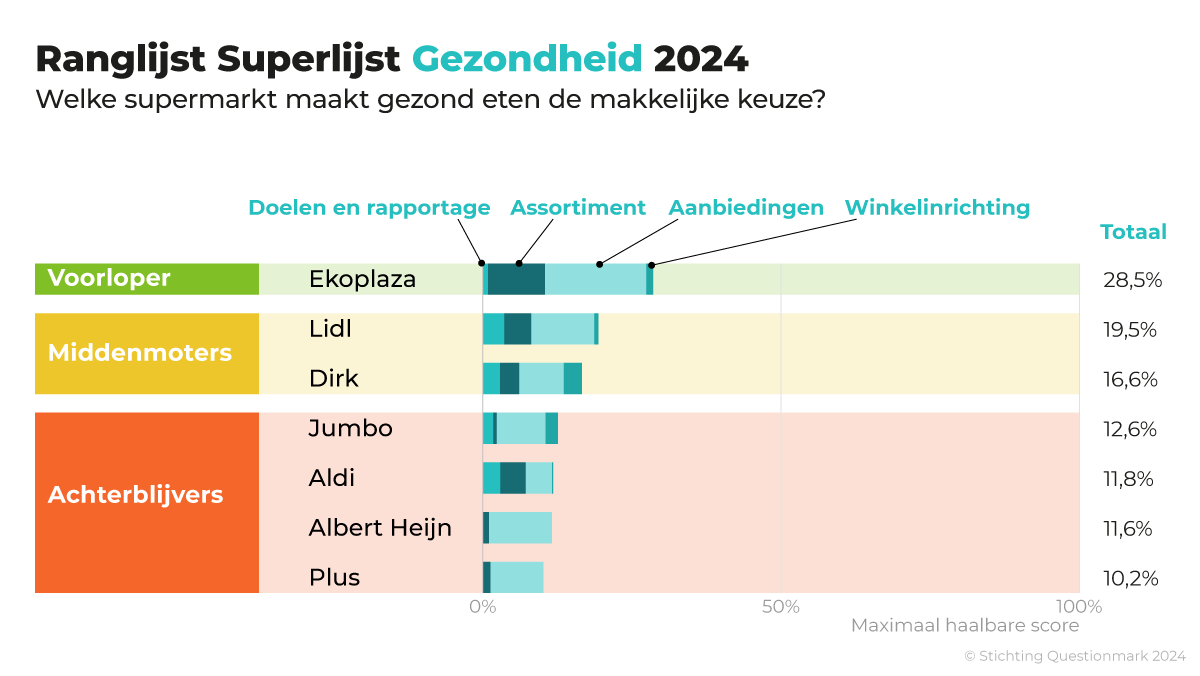
Stevige aanpak nodig voor gezondere supermarkten, marktleiders blijven achter bij budgetsupers.

Supermarkten zetten consumenten nog steeds aan tot ongezond eten, ondanks beloftes. Dit blijkt uit onderzoek van Superlijst Gezondheid, een initiatief van denktank Questionmark in samenwerking met de gezondheidsfondsen Diabetes Fonds, Hartstichting, Maag Lever Darm Stichting en Nierstichting. Gezamenlijk doen zij een uiterst dringende oproep voor wettelijke maatregelen die zorgen dat supermarkten de noodzakelijke stappen zetten. Het onderzoek wordt elke twee jaar uitgevoerd. Al jarenlang is meer dan 80 procent van de aanbiedingen ongezond. In 2024 gaat het om 83 procent. De directeur van Questionmark wijst op de “toenemende problematiek van het groeiend aantal mensen met overgewicht en ziektes die hierdoor veroorzaakt of verergerd worden”. Ze pleit voor gezamenlijke initiatieven van supermarkten of wetgeving. Uit onderzoek van het RIVM kwam gisteren naar voren dat het aantal mensen met overgewicht in Nederland in 2050 naar verwachting zal zijn opgelopen tot 64 procent. In 2022 was dat percentage 50.

Links:
Stevige aanpak nodig voor gezondere supermarkten

Onderzoek: gros van aanbiedingen supermarkten nog altijd ongezond

World Sustainable Transport Day 2024

Recognizing the important role of safe, affordable, accessible and sustainable transport systems for all in supporting sustainable economic growth, improving the social welfare of people and enhancing international cooperation and trade among countries, the General Assembly decided to declare 26 November as World Sustainable Transport Day.

It also noted the importance of cooperation in enhancing transport connectivity through an integrated intermodal transport system by developing quality, reliable, sustainable and resilient infrastructure, exchanging best practices to optimize the development of interconnected highways, roads, streets, railways, waterways, airways, areas of modal transfer and ports, and by encouraging transport infrastructure construction and operations to minimize consumption of energy, land and other resources; generate lower emissions of greenhouse gases, ozone-depleting substances and other pollutants and ensure a positive social impact. The Assembly invited stakeholders to mark World Sustainable Transport Day by means of education and the holding of events aimed at enhancing the knowledge of the public on sustainable transport issues, in particular enhancing intermodal transport connectivity, promoting environmentally friendly transportation, developing socially inclusive transport infrastructure and other aspects of transport sustainability. Transport is vital for promoting connectivity, trade, economic growth and employment. Yet it is also implicated as a significant source of green-house gas emissions. Resolving these trade-offs is essential to achieving sustainable transport and, through that, sustainable development.

In its 2016 report, the Secretary-General’s High-level Advisory Group defined sustainable transport as “the provision of services and infrastructure for the mobility of people and goods — advancing economic and social development to benefit today’s and future generations — in a manner that is safe, affordable, accessible, efficient, and resilient, while minimizing carbon and other emissions and environmental impacts.” Sustainable transport is therefore not an end in itself, but a means to achieve sustainable development. Sustainable transport — with its objectives of universal access, enhanced safety, reduced environmental and climate impact, improved resilience, and greater efficiency — is central to sustainable development. Apart from providing services and infrastructure for the mobility of people and goods, sustainable transport is a cross-cutting accelerator, that can fast-track progress towards other crucial goals, such as eradicating poverty in all its dimensions, reducing inequality, empowering women, and combatting climate change. Find out more about sustainable transport and sustainable development in this interagency report.

Links:
World Sustainable Transport Day

Plenair debat (wetgeving) : Vaststelling van de begrotingsstaten van het Ministerie van Onderwijs, Cultuur en Wetenschap (VIII) voor het jaar 2025 (36600-VIII)

Vaststelling van de begrotingsstaten van het Ministerie van Onderwijs, Cultuur en Wetenschap (VIII) voor het jaar 2025.

Links:
Vaststelling van de begrotingsstaten van het Ministerie van Onderwijs, Cultuur en Wetenschap (VIII) voor het jaar 2025 (36600-VIII) 1e TK

Vaststelling van de begrotingsstaten van het Ministerie van Onderwijs, Cultuur en Wetenschap (VIII) voor het jaar 2025 (36600-VIII) antwoord 1e termijn + rest

Onderwijsdebat gaat door, geen uitstel vanwege onderhandelingen

Coalitie op zoek naar oplossingen voor onderwijsbegroting

World Olive Tree Day 2024

World Olive Tree Day was proclaimed at the 40th session of the UNESCO General Conference in 2019 and takes place on 26 November every year.

The aim of World Olive Tree Day is to encourage the protection of the olive tree and the values it embodies, in order to appreciate its important social, cultural, economic and environmental significance to humanity. Conserving and cultivating the olive tree is a growing imperative as the world combats and adapts to climate change. The protection of cultural and natural heritage, including landscapes, is at the heart of UNESCO’s mission and marking World Olive Tree Day reinforces environmental sustainability efforts. The olive tree, specifically the olive branch, holds an important place in the minds of men and women. Since ancient times, it has symbolized peace, wisdom and harmony and as such is important not just to the countries where these noble trees grow, but to people and communities around the world. There is much to learn, share and celebrate on World Olive Tree Day, and UNESCO encourages everyone to join in through various activities such as debates, conferences, workshops, cultural events and presentations or exhibitions.

Links:
World Olive Tree Day

Palestine: Land of Olives and Vines – Cultural Landscape of Southern Jerusalem, Battir, inscribed on World Heritage List and on List of World Heritage in Danger

Phase separation of planetary ices explains nondipolar magnetic fields of Uranus and Neptune – publication

Models using Voyager 2 data from the 1980s show that separate layers in the mantles of the planets Uranus and Neptune could be creating disordered magnetic fields.

In 1986 and 1989, Voyager 2 made the final two stops on its grand tour of the outer solar system when it swept by Uranus and Neptune, respectively. Now, nearly 40 years later, the archive of data the craft collected is still returning unexpected results. In the paper ‘Phase separation of planetary ices explains nondipolar magnetic fields of Uranus and Neptune‘, astronomer Burkhard Militzer of the University of California, Berkeley wanted to explore why Voyager 2 data show something unexpected: The magnetic fields of both planets, which are not that far apart in mass, are not dipolar. Earth, Jupiter, and Saturn all have dipolar magnetic fields, meaning they have a north and south pole — the type of configuration we’re obviously used to. But Uranus and Neptune don’t. Instead, their magnetic fields are more of a jumbled maze than an ordered set of lines.

Links:
Uranus and Neptune have weird magnetic fields — this might be why

What lies beneath the bland surfaces of Uranus and Neptune?

Intergovernmental Negotiating Committee to develop an international legally binding instrument on plastic pollution, including in the marine environment – first part of the fifth session

The fifth session of the Intergovernmental Negotiating Committee (INC-5) to develop an international legally binding instrument on plastic pollution, including in the marine environment (INC-5), is scheduled to take place from 25 November to 1 December 2024 at the Busan Exhibition and Convention Center in Busan, Republic of Korea.

In March 2022, at the resumed fifth session of the UN Environment Assembly (UNEA-5.2), a historic resolution was adopted to develop an international legally binding instrument on plastic pollution, including in the marine environment. The UNEA resolution (5/14) requested the Executive Director of the UN Environment Programme (UNEP) to convene an Intergovernmental Negotiating Committee (INC) to develop “the instrument,” which is to be based on a comprehensive approach that addresses the full life cycle of plastic, including its production, design, and disposal. The INC began its work in the second half of 2022. It has since convened its first session (INC-1) in Punta del Este, Uruguay (November–December 2022); second session (INC-2) in Paris, France (May–June 2023); third session (INC-3) in Nairobi, Kenya (November 2023); and fourth session (INC-4) in Ottawa, Canada (April 2024). The fifth session has been held in parts: Busan, Republic of Korea (INC-5.1, November–December 2024) and Geneva, Switzerland (INC-5.2, August 2025). The third part (INC-5.3) is scheduled for 7 February 2026 at the Geneva International Conference Centre (CICG). Following the resignation of the former INC Chair, the Bureau of the INC at its meeting held on 30 October 2025 decided that INC-5.3 is a one-day resumed session for organizational and administrative purposes with the focus on election officers including for the position of Chair. Therefore, no so substantive negotiations will be held during this resumed session.

Links:
Intergovernmental Negotiating Committee on Plastic Pollution

Fifth Session (INC-5) – Webcast

Plastic in de ban – Plek voor plastic: kunnen we nog terug?

Agenda – Intergovernmental Negotiating Committee on Plastic Pollution – second part of the fifth session

High-Statistics Measurement of the Cosmic-Ray Electron Spectrum with H.E.S.S. – publication

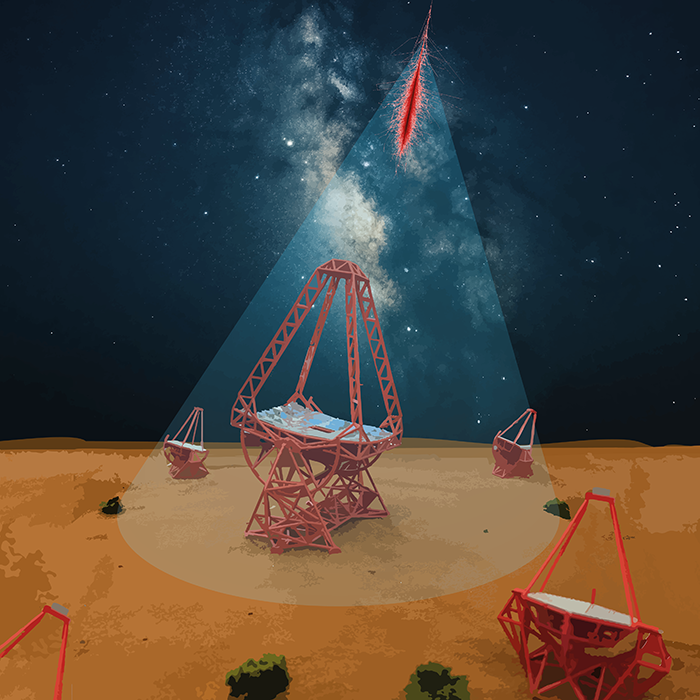
Scientists from the CNRS, a consortium of German universities, and the Max-Planck-Institut für Kernphysik working at the High Energy Stereoscopic System (H.E.S.S.) observatory have recently identified electrons and positrons with the highest energies ever recorded on Earth.

They provide evidence of cosmic processes emitting colossal amounts of energy, the origins of which are as yet unknown. These findings are published on 25 November 2024 in the journal Physical Review Letters.

Links:
H.E.S.S. collaboration detects the most energetic cosmic-ray electrons and positrons ever observed

Groninger Wetenschapspubquiz 2024

Tijdens de Groninger Wetenschapspubquiz worden vragenrondes afgewisseld met spannende opdrachten in hét wetenschapsmuseum van Groningen.

Waarom laat een kikker dode muggen links liggen? Hoe ontstaat het verschil tussen zoete en droge champagne? Waarom staat er een BMW in het Universiteitsmuseum en welke vreemde vogels loop je er tegen het lijf? En welke Groninger wetenschapper zou de Nobelprijs misschien wel hebben gewonnen, maar kwam vroegtijdig te overlijden? Wil je meedoen? Stel gauw een team samen van tenminste drie en maximaal vijf personen, bedenk een pakkende teamnaam en meld je aan via studium@rug.nl. Wie weet gaan jullie er met de winst vandoor!

Links:
Groninger Wetenschapspubquiz

Geweldstoepassingen van politie bij demonstraties van 6 tot en met 13 mei – publicatie

De politie zegt in het rapport ‘Geweldstoepassingen van politie bij demonstraties van 6 tot en met 13 mei‘ over haar eigen handelen tijdens de UvA-demonstraties tussen 6 en 13 mei 2024 lessen te leren van gemaakte fouten.

Op 7 oktober 2023 escaleert het geweld in Israël en de Gazastrook. De beelden van de oorlog gaan de wereld over. Dit leidt op veel plekken tot demonstraties. Zo ook in Amsterdam. Op 6 mei 2024 gaan studenten de straat op uit protest tegen samenwerkingsvormen die de Universiteit van Amsterdam (UvA) heeft met opleidingsinstanties in Israël. In navolging van de protesten in Amerika willen de studenten dat hun universiteit de banden met Israëlische instellingen bekendmaakt en verbreekt. Ook andere groepen sluiten zich bij de onaangekondigde acties aan. Het is een mix van
studenten, universiteitsdocenten en in pro-Palestijnse actievoerders van buiten de universiteit. Wat begint als vreedzame protesten, slaat om in grote verstoringen van de openbare orde met onveilige situaties, met strafbare gedragingen als gevolg.

Een groot deel van de acties in de week van 6 mei vindt plaats op het terrein en in de gebouwen, van de UvA. Daarbij worden forse vernielingen aangericht. Het is voor de driehoek noodzakelijk om hiertegen op te treden. De politie past daarbij geweld toe tegen de demonstranten. Het verloop van de demonstraties krijgt veel aandacht in de (sociale) media. Hieruit komt naar voren dat er verschil is in de beleving van demonstranten, driehoek, raadsleden en andere betrokkenen over het verloop van de demonstraties en het daarbij toegepaste geweld.

De gemeenteraad van Amsterdam vraagt na het ingrijpen door de driehoek om een ingelaste vergadering. Op 10 mei vindt er een debat plaats, waarin de gemeenteraad met de driehoek spreekt over de ingrijpende gebeurtenissen van de afgelopen dagen en de gemaakte keuzes door de driehoek. Er worden zorgen geuit en kritische opmerkingen gemaakt over het politieoptreden. De gemeenteraad wil ook weten hoe voorkomen kan worden dat Amsterdam de komende dagen en weken weer het toneel wordt van protesten zoals in de dagen daarvoor is gezien. De meerderheid van de raadsleden spreekt in het debat steun uit voor het optreden en de gemaakte keuzes van de driehoek.

De driehoek doet in het debat van 10 mei de toezegging te reflecteren op de opbouw van het politieoptreden en het door de politie toegepaste geweld tijdens de inzetten in de week van 6 mei. Aanvullend op de toezegging is door de politiechef besloten om ook de gebeurtenissen op maandag 13 mei op het Roeterseiland toe te voegen. Deze rapportage is geen uiteenzetting of evaluatie van de aanloop en verloop van alle gebeurtenissen tussen 6 en 13 mei, maar een reflectie op het eigen politieoptreden en het daarbij toegepaste geweld.

Links:
“Veel conflict en wrijving”: politie trekt lessen na klachten en aangiften rondom optreden UvA-demonstraties