
In de geschiedenis
Links:
Wikipedia

Links:
Wikipedia
Zaterdag; Wat eten we vandaag?; Trump; Pollutocrat Day; Code Geel.

Wat eten we vandaag?:

Knipselkrant:
Agenda:
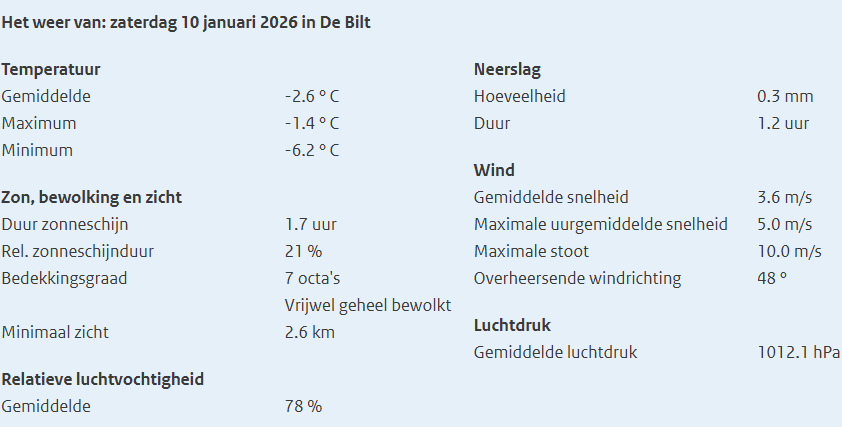
Weer:
Links:
In de geschiedenis

The richest 1% have exhausted their annual carbon budget – the amount of CO2 that can be emitted while staying within 1.5 degrees of warming – only ten days into the year, according to new analysis from Oxfam.
This day – named by Oxfam as ‘Pollutocrat Day’ – highlights how the super-rich are disproportionately responsible for driving the climate crisis. The richest 0.1% already used up their carbon limit on the 3rd January. The Oxfam report, “Climate Plunder: How a powerful few are locking the world into disaster“, presents new data which finds that a person from the richest 0.1% produces more carbon pollution in a day than the poorest 50% emit all year. If everyone emitted like the richest 0.1%, the carbon budget would be used up in less than 3 weeks. The emissions of the richest 1% generated in one year alone will cause an estimated 1.3 million heat-related deaths by the end of the century. Decades of over consumption of emissions by the world’s super rich are also causing significant economic damage to low and lower-middle income countries, which could add up to $44 trillion by 2050. To stay within the 1.5 degrees limit, the richest 1% would have to slash their emissions by 97% by 2030. Meanwhile, those who have done the least to cause the climate crisis – including communities in poorer and climate-vulnerable countries, Indigenous groups, women and girls – will be the worst impacted. On top of their lifestyle emissions, the super-rich are also investing in the most polluting industries. Oxfam’s research finds that each billionaire carries, on average, an investment portfolio in companies that will produce 1.9 million tonnes of CO2 a year, further locking the world into climate breakdown. The wealthiest individuals and corporations also hold disproportionate power and influence. The number of lobbyists from fossil fuel companies attending the recent COP summit in Brazil, for example, was more than any delegation apart from the host nation, with 1600 attendees. Oxfam calls on governments to slash the emissions of the super-rich and make rich polluters pay through:
Rijken hebben uitstootplafond CO2 voor 2026 nu -10 januari – al opgemaakt 😱 ⁉️
De rijkste 1% heeft in slechts 10 dagen hun aandeel CO2-uitstoot voor 2026 al opgebruikt
“Pollutocrat Day”: Rijkste 1 procent heeft CO2-budget nu al opgebruikt
Links:
Wikipedia
Vrijdag; Wat eten we vandaag?; EU-Mercosur Association Agreement; Code Geel.
Wat eten we vandaag?:

Knipselkrant:
Agenda:
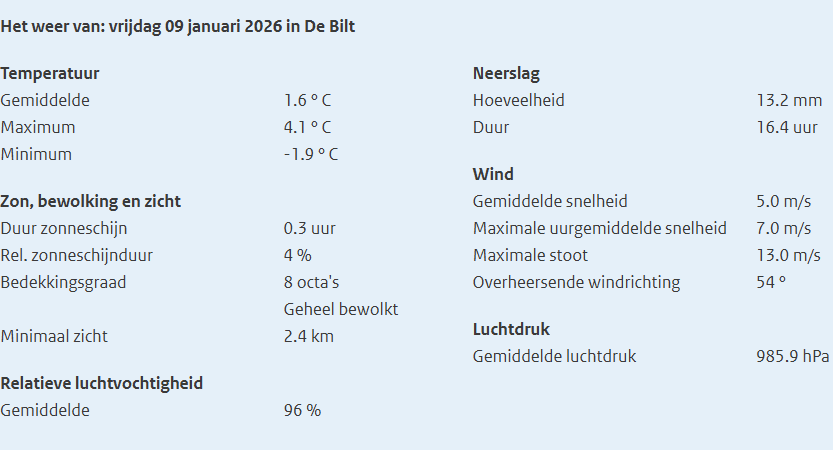
Weer:
Links:
In de geschiedenis

Vroege Vogels is een live-radioprogramma, tv-programma en online community van BNNVARA over natuur en milieu.
In het radioprogramma wordt het gesproken woord omlijst door licht klassieke muziek en salonmuziek. Het radioprogramma werd in 1978 voor het eerst uitgezonden door de VARA en is een van de langst lopende en best beluisterde radioprogramma’s van de publieke omroep. Het wordt elke zondagmorgen uitgezonden tussen 07:00 en 10:00 op NPO Radio 1. De beginmuziek is een bewerking van Vivaldi’s “Piccolo Concerto in C major” (RV 443).
De steenuil is de vogel van het jaar 2026 geworden. Met deze benoeming vragen de organisaties om extra aandacht voor het kleinste uiltje van ons land. In de Amsterdamse Waterleidingduinen probeert beheerder Waternet konijnen weer terug te krijgen. Ze doen dat door de konijnen te vangen en te verhuizen. En verder: antivries in insecten, snippen, sporen in de sneeuw, winter onder water en winterse weersverschijnselen. De column is deze week van Dichtwater. Vroege Vogels Radio wordt gepresenteerd door Menno Bentveld vanuit het Groene Huis te Amersfoort.
Links:
Vroege Vogels Radio
Links:
Wikipedia

Interdisciplinary understanding is vital for delivering sound climate policy advice.
However, navigating the ever-growing and increasingly diverse scholarly literature on climate change is challenging for any individual researcher. This annual synthesis highlights and explains recent advances across a variety of fields of climate change research. In 2026, the 10 insights focus on:
(1) the record-warmth of 2023/2024 and the elevated Earth energy imbalance;
(2) acceleration of ocean warming and intensifying marine heatwaves;
(3) northern land carbon sinks under strain;
(4) reinforcing feedback between biodiversity loss and climate change;
(5) accelerated depletion of groundwater;
(6) global dengue incidence;
(7) global income losses and labour productivity declines;
(8) strategic scaling of CDR;
(9) integrity challenges in carbon credit markets and emerging responses; and
(10) effective policy mixes for emissions reductions.
The insights have been written to be accessible to researchers from different fields, serving as entry-points to specific topics, as well as providing an overview of the evolving landscape of climate change research. In the final section, the insights are used to develop overarching policy-relevant messages. This paper provides the basis for a science-policy report that was shared with all Party delegations ahead of COP30 in Belém, Brazil.

De illegale aanval van Trump op Venezuela heeft voor wereldwijde opschudding gezorgd — en de reactie van onze leiders was traag en zwak.
Wie is de volgende? Nu bedreigt hij Colombia, Cuba en Mexico, en zet hij zijn plannen kracht bij om Groenland te annexeren. Het klinkt onvoorstelbaar. Maar de aanval op Venezuela klonk ook onvoorstelbaar — totdat het gebeurde. Als er één ding duidelijk is geworden in het afgelopen jaar, dan is het dat Trump bereid is het ondenkbare te doen — zeker als hij geen weerstand verwacht. We moeten hem stoppen voordat hij nog verder gaat. Zijn topadviseurs zeggen nu dat niemand de VS zal tegenhouden als Trump Groenland inlijft. Sluit je aan bij deze dringende oproep van Avaaz aan wereldleiders: sta niet toe dat Trump de wereld als speelbal gebruikt. Laat je stem horen en versterk deze oproep, dan overhandigt Avaaz onze stemmen aan regeringen over de hele wereld.
Links:
Sta op tegen Trump!
Annexatie Groenland zou einde betekenen van de NAVO (NOS)
‘Dit is óns halfrond’: VS claimt na actie in Venezuela dominantie in westen (RTL Nieuws)
Olie? Of toch drugs? Waarom de VS president Maduro gevangenneemt tijdens een verrassingsaanval (VRT NWS)
Who could Trump invade next? Fears over president’s plans for Greenland, Cuba and Colombia (Independent)
Rubio to meet Denmark leaders next week, signals no retreat on Trump’s Greenland goal (Reuters)
Trump says US oversight of Venezuela could last years (Reuters)
Is there any legal justification for the US attack on Venezuela? (The Guardian)
Donderdag; Wat eten we vandaag?; Iran; Aarde Rotatie Dag; Sit-in van Rijksambtenaren; Sit-ins op stations; Sta op tegen Trump!; Code geel; Storm Goretti.
Wat eten we vandaag?:
Knipselkrant:
Agenda:
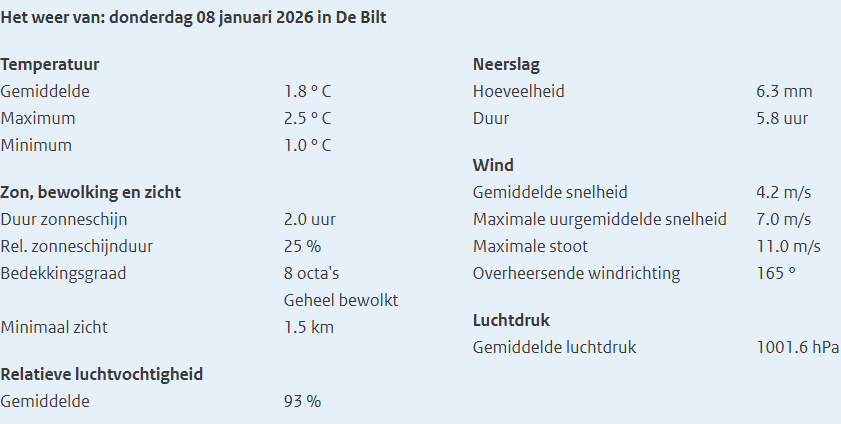
Weer:
Links:
In de geschiedenis