



- Dit evenement is voorbij.
Three-quarters of Earth’s land became permanently drier in last three decades: UN / The Global Threat of Drying Lands: Regional and global aridity trends and future projections – publication
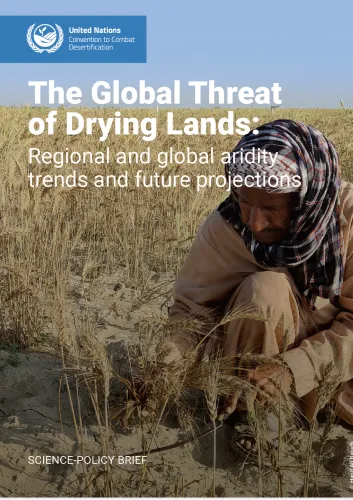
The report, ‘The Global Threat of Drying Lands: Regional and global aridity trends and future projections‘, was launched at the 16th conference of UNCCD’s nearly 200 Parties in Riyadh, Saudi Arabia (COP16), the largest UN land conference to date, and the first UNCCD COP to be held in the Middle East, a region profoundly affected by impacts from aridity.
For the first time, the aridity crisis has been documented with scientific clarity, revealing an existential threat affecting billions around the globe. The analysis points to human-caused climate change as the primary driver of this shift. Greenhouse gas emissions from electricity generation, transport, industry and land use changes warm the planet and other human activities warm the planet and affect rainfall, evaporation and plant life, creating the conditions that increase aridity. Even as dramatic water-related disasters such as floods and storms intensified in some parts of the world, more than three-quarters of Earth’s land became permanently drier in recent decades, UN scientists warned today in a stark new analysis. Some 77.6% of Earth’s land experienced drier conditions during the three decades leading up to 2020 compared to the previous 30-year period, according to the landmark report from the UN Convention to Combat Desertification (UNCCD). Over the same period, drylands expanded by about 4.3 million km2 – an area nearly a third larger than India, the world’s 7th largest country – and now cover 40.6% of all land on Earth (excluding Antarctica). In recent decades some 7.6% of global lands – an area larger than Canada – were pushed across aridity thresholds (i.e. from non-drylands to drylands, or from less arid dryland classes to more arid classes).
Most of these areas have transitioned from humid landscapes to drylands, with dire implications for agriculture, ecosystems, and the people living there. And the research warns that, if the world fails to curb greenhouse gas emissions, another 3% of the world’s humid areas will become drylands by the end of this century. In high greenhouse gas emissions scenarios, expanding drylands are forecast across the Midwestern United States, central Mexico, northern Venezuela, north-eastern Brazil, south-eastern Argentina, the entire Mediterranean Region, the Black Sea coast, large parts of southern Africa, and southern Australia. The report by UNCCD Science-Policy Interface (SPI) — the UN body for assessing the science of land degradation and drought — points to human-caused climate change as the primary driver of this shift. Greenhouse gas emissions from electricity generation, transport, industry and land use changes warm the planet and other human activities warm the planet and affect rainfall, evaporation and plant life, creating the conditions that increase aridity. Global aridity index (AI) data track these conditions and reveal widespread change over the decades.
Links:
Three-quarters of Earth’s land became permanently drier in last three decades: UN
VN: driekwart aardoppervlak is de afgelopen 30 jaar droger geworden