



- Dit evenement is voorbij.
‘On this journey, no one cares if you live or die’ Abuse, protection and justice along routes between East and West Africa and Africa’s Mediterranean Coast: A route-based perspective on key risks Volume 2 – publication
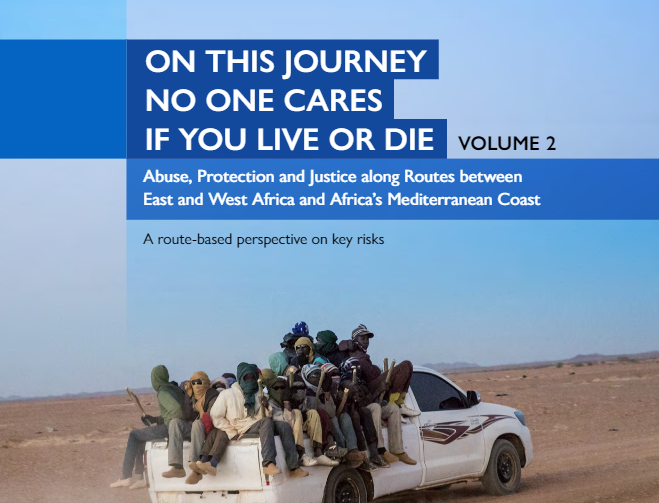
The mixed movement of refugees and migrants on the African continent is often reduced to its more
mediatized aspect – the perilous crossings of the Mediterranean Sea to Europe.
While some of the movements take root in North Africa, many include multiple legs through several countries in an attempt to reach safety and/or better opportunities. The protection risks and extreme forms of violence and exploitation refugees and migrants are confronted with on land are much less documented. The International Organization for Migration (IOM), the Mixed Migration Centre (MMC) and the Office of the United Nations High Commissioner for Refugees (UNHCR) decided to work together to map them out and have an updated and more precise understanding of where these risks and different forms of violence are perceived to be more acute and who are reported to be the perpetrators. To do so, many different sources of information were employed including 4Mi interviews with over 31,000 refugees and migrants between 2020 and 2023 by the MMC, the Missing Migrants Project and Counter Trafficking Data Collaborative of IOM, and UNHCR Protection Monitoring.
The first edition of this report issued in 2020 uncovered patterns of widespread human rights violations and abuses along the routes from East and Horn of Africa and West Africa to North Africa. It highlighted the gap between smugglers’ narratives and the dramatic realities people faced on these dangerous journeys, where human life is just the mere subject of a commercial transaction. It provided clear data for States and their partners to enable them to design routes-based solutions and move services and prevention/response mechanisms to where protection problems occurred. Unfortunately, three years later, the findings of the first report are reconfirmed and in some places surpassed. As the data suggest, the risks and the list of unimaginable horrors people face in some countries along the route have not disappeared, on the contrary. New conflicts erupted in the Sahel, bringing the displaced population to almost 5 million, double from the time of the previous report. In the East and Horn of Africa, droughts and floods generated by climate change are having a dramatic impact on new and protracted emergencies, while the number of displaced people due to the conflict in the Sudan reached 8.8 million as of May 2024.
The deteriorating situation in many countries of origin and host countries is leading an increased number of individuals to embark on dangerous onward journeys towards the southern shores of the Mediterranean Sea, with many of them ending up in extremely vulnerable situations. While there are no comprehensive statistics on land arrivals across the many countries of transit and initial destination, evidence points to an increased number of refugees and migrants moving to North Africa. In Tunisia for instance, UNHCR registered 209 per cent more refugees and asylum-seekers in 2023 than it did in 2020. During this post-COVID period, the presence of refugees and migrants in a number of countries was also politically instrumentalized, leading to more visible expressions of racism, generating protection incidents and fear among refugees and migrants and consequent onward dangerous movements, including across the Mediterranean Sea.
Despite some progress, this second report “On this journey, no one cares if you live or die’ Abuse, protection and justice along routes between East and West Africa and Africa’s Mediterranean Coast: A route-based perspective on key risks” suggests a degraded protection environment along the Central Mediterranean routes with insufficient protection-centred responses. Unfortunately, experience has taught us that increased risks will not prevent refugees and migrants from moving irregularly. The increased risks will continue to be downplayed by smugglers and traffickers, and people will resort to what they think might be the most effective individual risk mitigation strategy. As a young Somali refugee named Saeed said: “They [the smugglers] lie to the youth. They have workers everywhere and make tahriib [the journey to Europe] look easy […], but you will wake up when you face the dangers.”
Sadly, this second version of the report may not be the last documenting violations and abuses of human rights of refugees and migrants along these routes. Critical protection safety nets remain lacking in key areas as highlighted by the second iteration of a report mapping protection services along the routes that will be published in 2024. In addition, many interlocutors have become accustomed to the prevalence of protection risks, abuses and the inexorable erosion of hope, as if nothing can be attempted to address them. A dangerous sense of resignation has paralysed States-led response along these routes despite the commitment to save lives and address vulnerabilities they have assumed under international law and other instruments, such as the Global Compact on Refugees and the Global Compact for Safe, Orderly and Regular Migration.
As data depend on access to refugees and migrants, gaps exist for some locations, especially for the Sahara Desert, and may distort part of the analysis. However, many ultimately move out from these out-of-reach places and tell their story. They include the tens of thousands of refugees and migrants who told their stories upon which this report is based. Accordingly, we will no longer be able to say that we did not know about the extreme and unacceptable forms of violence they face. We hope, and expect, that this report will help to inform increased and concrete routes-based protection responses to reduce the suffering associated with the desperate journeys refugees and migrants undertake. We also hope it will generate a push to address the root causes of displacement and drivers of irregular migration through positive action on peace, climate change, governance, inequality and social cohesion, as well as the creation of safe migration pathways. We should never accept or get used to the horrors experienced by refugees and migrants nor leave unquestioned the significance of the grossly negative human rights indicators emerging from the countries where violations and abuses occur. These violations and abuses will continue to represent a stain on our collective conscience that we cannot afford to ignore.
Links:
De reis van migranten: woestijn twee keer dodelijker dan zee